

Workers' Compensation vs. Third-Party Injury Claim
If you are injured in a car accident or by any other third party while performing your job duties, you may actually have two separate claims.
First, you may have a South Carolina workers’ compensation claim through your employer’s workers’ compensation system. Second, you may have a separate third-party liability claim against the outside person or company that caused the accident.
These cases can become very complex from both a legal and medical standpoint. Understanding how workers’ compensation benefits interact with a third-party injury claim requires experience and careful analysis.
| Workers' Compensation | Third-Party Injury Claim |
|---|---|
| Through the workers' compensation system | Against a negligent person or company |
| No need to prove fault | Fault must generally be proven |
| Covers medical treatment | May include pain and suffering |
| Wage replacement benefits | May allow recovery of damages not available through workers' compensation |
| Governed by workers' compensation law | Governed by personal injury law |
| May exist alongside another claim | May exist alongside workers' compensation |
| Carrier may have reimbursement/lien rights if a third-party recovery is made | Settlement may need to account for workers' compensation reimbursement rights |
The important part is understanding that these are two different claims with different rules. They may arise from the same accident, but they can provide different benefits and damages, involve different insurance coverage, and affect one another as the cases move forward.
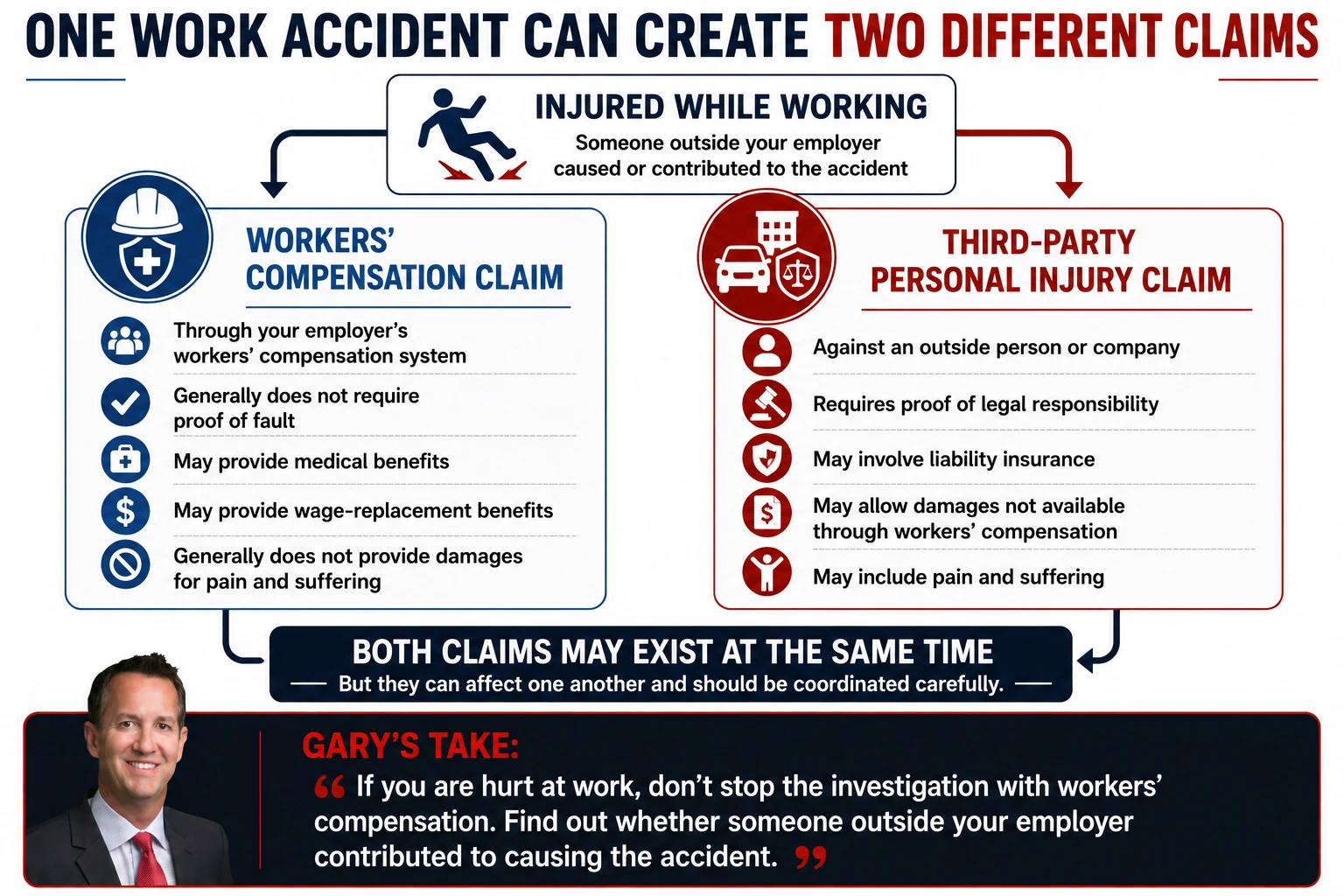
Both claims may exist at the same time, but they can affect one another and should be coordinated carefully.
Who Can Have Both a Workers' Compensation and Personal Injury Claim?
You may have both types of claims if you were injured while working and someone outside your employer contributed to causing the accident.
This could include delivery drivers, construction workers, utility workers, sales representatives traveling for work, healthcare workers making home visits, employees driving company vehicles, or workers injured by defective equipment, negligent contractors, or other outside companies.
In many of these situations, the injured worker may have both a workers’ compensation claim and a third-party liability claim. That distinction is critical because third-party claims often provide avenues of recovery that are not available through workers’ compensation alone.
I believe every serious workplace accident should be investigated to determine whether someone outside the employer contributed to causing the injury.
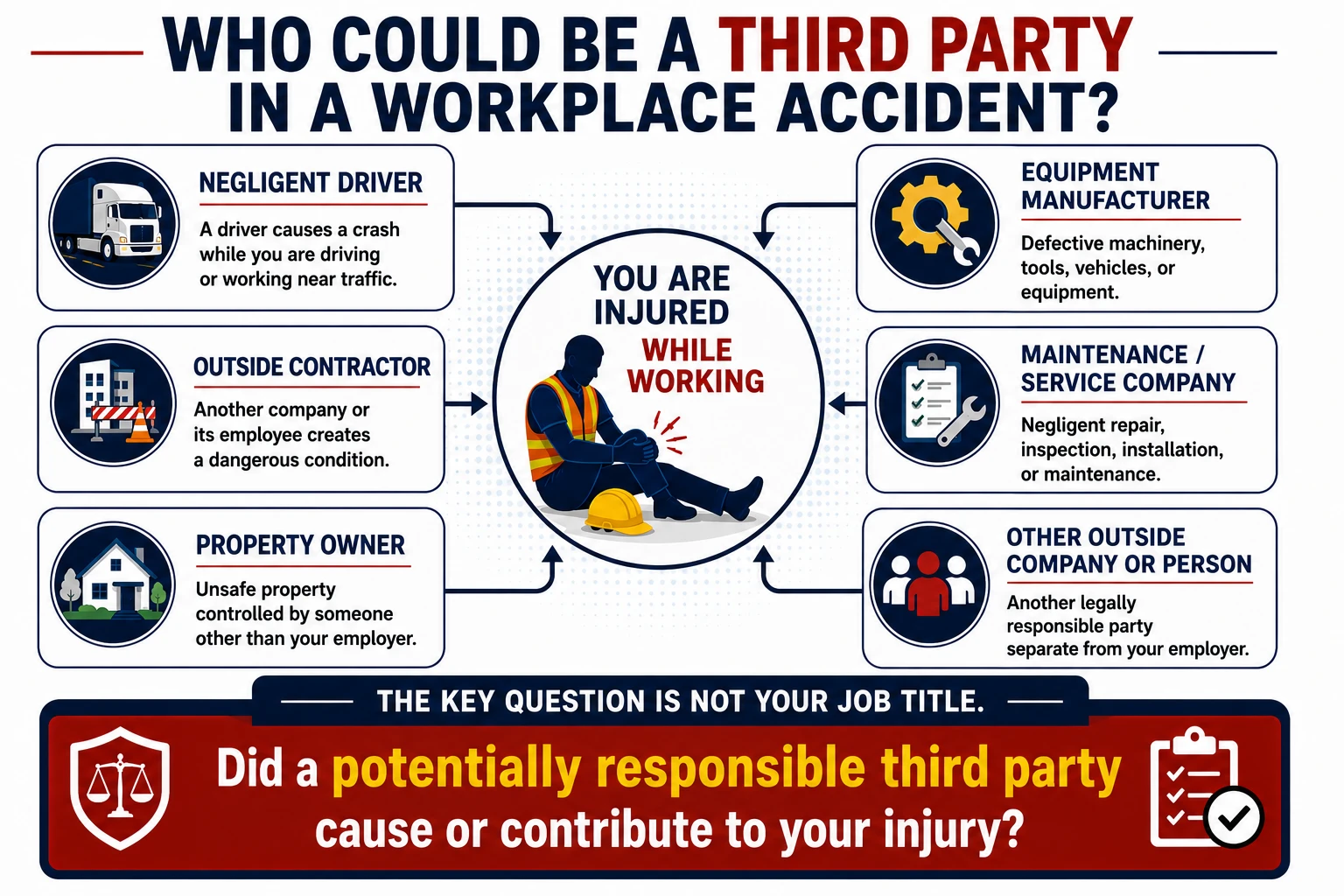
The key question is not your job title. Did a potentially responsible third party cause or contribute to your injury?
Can I File a Workers' Compensation Claim and a Lawsuit?
The biggest misconception is that workers believe they can only file a workers’ compensation claim.
Sometimes that misconception comes from statements made by the employer. Sometimes it comes from the workers’ compensation insurance company. Other times, people simply do not know that additional legal rights may exist.
Sometimes, yes. Workers’ compensation is generally the exclusive remedy against your employer for a covered work injury, but that does not necessarily prevent a separate claim against an outside person or company whose negligence caused the accident.
For example, if a negligent driver, outside contractor, property owner, equipment manufacturer, or other third party caused or contributed to the injury, a separate liability claim may exist in addition to workers’ compensation benefits.
What Mistakes Should I Avoid After Being Injured at Work?
One of the biggest mistakes injured workers make is assuming the workers’ compensation claim is the only claim that needs to be investigated.
If someone outside your employer caused or contributed to the accident, evidence of that third party’s responsibility may be critical. Photographs, witness information, contracts, jobsite records, vehicle evidence, surveillance footage, and other documents can disappear if they are not preserved early.
Another mistake is treating the workers’ compensation case and third-party case as completely separate. They can affect one another. The workers’ compensation carrier may have reimbursement or lien rights against a third-party recovery, and South Carolina law imposes procedural requirements when both claims are pursued.
The better approach is to identify all potentially responsible parties, all available insurance coverage, and the workers’ compensation issues from the beginning so the two claims can be coordinated rather than handled in isolation.
What Types of Workplace Accidents Create Two Claims?
Over the years, we have handled many cases involving both workers’ compensation claims and third-party liability claims.
We have represented workers who fell through roofs while performing repair work, employees injured in vehicle collisions while running errands for their employer, workers struck while driving company vehicles, and individuals injured by defective equipment or the negligence of outside contractors.
The specific facts vary, but the lesson is always the same. Anytime you are injured on the job, it is important to investigate every possible source of liability, every potentially responsible party, and every available insurance policy.
What Insurance Issues Came Up in Cases You've Handled Like This?
In one matter, the role of a third-party contractor became important after further investigation. The accident initially involved a workers’ compensation claim, but the investigation identified evidence that an outside contractor may also have contributed to the dangerous condition that caused the injury.
The workers’ compensation claim continued through the compensation system while a separate third-party claim was pursued against the outside contractor.
What lesson should readers learn?
The lesson is not to assume that workers’ compensation is the only potential claim simply because the accident happened at work. There may be outside companies, additional insurance coverage, or other sources of liability that are not obvious at the beginning.
Simply put, you do not know what you do not know. That is why I believe the accident itself should be fully investigated before anyone assumes there is only one potential claim.
Can I Receive Workers' Compensation Benefits and Still Sue Someone Else?
Yes, in many situations you can. One of the biggest misconceptions we see is that injured workers believe workers’ compensation is their only remedy. While workers’ compensation benefits are generally the exclusive remedy against your employer, that does not necessarily mean you are limited to a workers’ compensation claim if someone else contributed to causing your accident.
For example, if you were injured by a negligent driver, an outside contractor, a maintenance company, a property owner, or the manufacturer of defective equipment, you may have a separate third-party liability claim in addition to your workers’ compensation claim. These cases can be legally complex because the workers’ compensation carrier may have rights that need to be addressed as part of the third-party case.
If both claims are pursued, they must be coordinated carefully. South Carolina law gives the workers’ compensation carrier certain reimbursement and lien rights against a third-party recovery and imposes procedural requirements concerning the third-party action. That means the gross third-party settlement is not necessarily the same as the amount the injured worker ultimately receives.
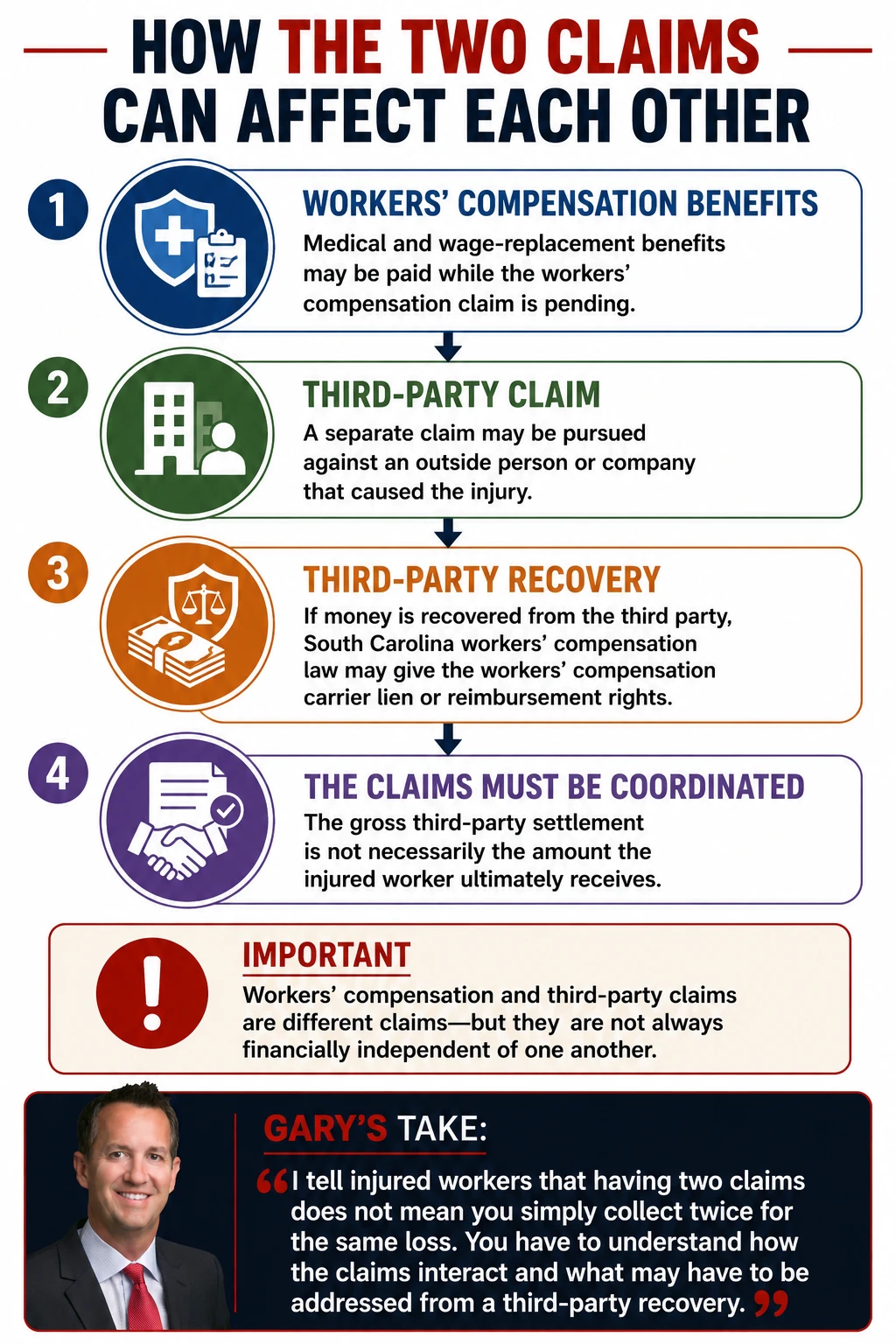
Workers’ compensation and third-party claims are different claims, but they are not always financially independent of one another.
When Do Workers' Compensation and Personal Injury Claims Overlap?
The most common situation involves a motor vehicle accident that occurs while the injured person is performing work-related duties.
For example, a delivery driver, sales representative, utility worker, or employee driving between job sites may be struck by another driver while working. In that situation, the worker may have both a workers’ compensation claim and a third-party liability claim against the at-fault driver.
However, vehicle accidents are only one example. We’ve seen many situations involving defective equipment, negligent contractors, unsafe job sites, and other third parties whose conduct contributed to a workplace injury.
Every case should be thoroughly investigated to determine whether additional claims exist.
Why Might a Third-Party Claim Be Missed After a Workplace Accident?
In some cases, the initial focus is only on the workers’ compensation claim, so the possibility of a separate third-party claim may not be identified right away. That can prevent injured workers from fully understanding their legal rights and the compensation potentially available to them.
That is why the accident itself should be investigated independently: who caused it, who controlled the property or equipment, what outside contractors were involved, and what insurance coverage may apply. Those questions can reveal potential claims that are not obvious when the case is viewed only as a workers’ compensation matter.
Our firm believes every case should be fully investigated to identify all responsible parties and all available insurance coverage. Going it alone is a mistake. These cases require a law firm that understands both workers’ compensation and third-party liability law.
What Should I Do in the First 24-72 Hours?
The advice is simple.
- Report the injury to your employer promptly
- Seek appropriate medical attention
- Tell your medical providers how the injury happened
- Photograph the scene, equipment, vehicles, or dangerous condition if possible
- Get witness names and contact information
- Identify outside contractors, property owners, manufacturers, drivers, or other companies involved
- Preserve surveillance video, dashcam footage, maintenance records, and other evidence if available
- Keep workers' compensation documents and third-party insurance information
- Avoid guessing or giving inconsistent accounts of the accident
- Get legal guidance if someone outside your employer may have contributed to the injury
Early investigation can make an important difference because evidence identifying a responsible third party may become harder to locate or preserve as time passes.
What Jobs Most Often Involve Both Types of Claims?
While delivery drivers, truck drivers, construction workers, utility workers, and traveling sales representatives frequently encounter these issues, the reality is that a third-party workplace injury can occur in almost any industry.
The key questions include whether the injury arose out of and in the course of employment and whether a potentially liable third party who is not protected by workers’ compensation exclusivity contributed to causing it.
Whether the employee was driving a tractor-trailer, operating a company vehicle, using equipment supplied by another company, or working alongside outside contractors, every possible source of liability should be examined.
Our philosophy is simple: do not stop with workers’ compensation. Investigate every potentially responsible party and every available insurance policy so the injured worker understands every potentially available claim and source of coverage.
The job title is not what determines whether two claims exist. The key question is whether the injury arose out of and in the course of employment and whether a legally responsible third party, separate from the employer, contributed to causing it.
Injured While Working Checklist
- Report the work injury promptly
- Seek appropriate medical treatment
- Document how the accident happened
- Preserve photographs, video, equipment, and physical evidence
- Get witness names and contact information
- Identify all outside companies or people involved
- Keep workers' compensation and liability-insurance documents
- Do not assume workers' compensation is the only possible claim
- Get legal guidance if a third party may have contributed to the injury
In Summary
If you are injured while working and someone outside your employer caused or contributed to the accident, you may have both a South Carolina workers’ compensation claim and a separate third-party personal injury claim.
Workers’ compensation may provide medical treatment and wage-replacement benefits without requiring you to prove that your employer was at fault. A third-party claim is different. It generally requires proof that an outside person or company was legally responsible for causing the accident, but it may allow recovery of damages that are not available through workers’ compensation, including pain and suffering.
Workers’ compensation is generally the exclusive remedy against your employer for a covered work injury, but that does not necessarily prevent a separate claim against a negligent driver, outside contractor, property owner, equipment manufacturer, maintenance company, or another legally responsible third party.
When both claims exist, they must be coordinated carefully. The workers’ compensation carrier may have lien or reimbursement rights against money recovered from the third party, and South Carolina law imposes procedural requirements when workers’ compensation benefits and a third-party action are pursued together.
The important point is not to assume that workers’ compensation is the only potential claim. A workplace accident should be investigated to determine who caused the injury, which companies or individuals may be legally responsible, what insurance coverage is available, and how the workers’ compensation and third-party claims may affect one another.