


Important South Carolina Injury Deadlines
South Carolina Code § 15-3-530 generally provides a three-year limitations period for personal injury actions. In a typical car accident case, that means the lawsuit generally must be filed within three years of the collision.
If you fail to file your lawsuit within the applicable statute of limitations, you may lose the right to pursue the claim in court. However, there are important exceptions. Claims involving a South Carolina governmental entity can be subject to different deadlines and procedures under the South Carolina Tort Claims Act.
| Situation | General Consideration |
|---|---|
| Typical South Carolina car accident injury claim | Generally three years |
| Government vehicle/entity involved | Different Tort Claims Act rules may apply |
| Injured person is under 18 | South Carolina's disability/tolling rules may affect the deadline |
| Wrongful death arising from a crash | Generally three years from the person's death |
| Settlement negotiations are ongoing | Do not assume negotiations stop the filing deadline |
| Unsure which rule applies | Have the deadline determined from the specific facts |
I tell people not to calculate these deadlines casually. Identify the applicable deadline early, write it down, and do not assume anything happening with the insurance company has stopped the clock.
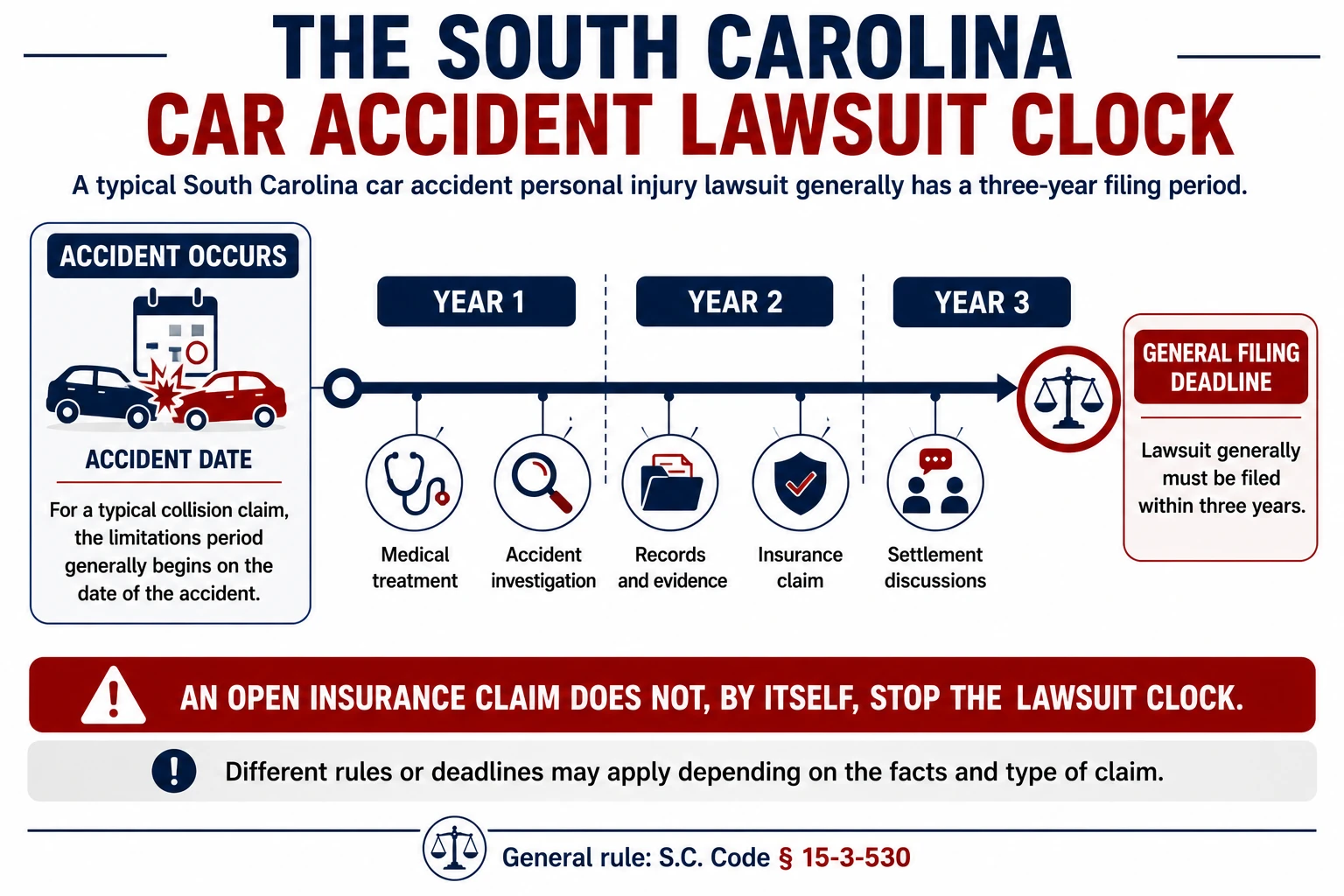
An open insurance claim does not, by itself, stop the lawsuit clock. General rule: S.C. Code § 15-3-530.
What Happens If I Wait Too Long to File My Lawsuit?
Unfortunately, we have spoken with many injured people over the years who waited too long to seek legal advice.
Some attempted to handle the case on their own. Others believed the insurance company was taking care of things. By the time they contacted our firm, important deadlines had passed, evidence had disappeared, or the statute of limitations had expired.
Simply put, they did not know what they did not know, and the consequences were significant. In some situations, the case was no longer legally viable. In others, the value of the claim was substantially diminished.
If the applicable statute of limitations expires, the legal right to pursue the lawsuit may be lost. Even before that deadline arrives, waiting can create other problems because witnesses become harder to locate, video can disappear, and physical evidence can be lost.
The three-year deadline can sound like a long time when you are standing at the beginning of a case. It does not feel nearly as long when medical treatment, investigation, insurance issues, and settlement discussions consume months or years.
Why Do People Miss the Statute of Limitations?
One reason people miss the deadline is that they confuse an open insurance claim with a filed lawsuit. Those are not the same thing.
You can be exchanging medical records, speaking with an adjuster, discussing the claim, or even negotiating settlement while the statute of limitations continues to run.
There are also other important deadlines that may apply depending on the type of case involved. Workers’ compensation claims, claims against government entities, and other injury cases can all involve unique timing requirements.
Our position is simple: injured people should not be responsible for trying to learn hundreds of legal rules while recovering from an accident. That is why we strongly encourage people to seek experienced legal counsel as soon as possible.
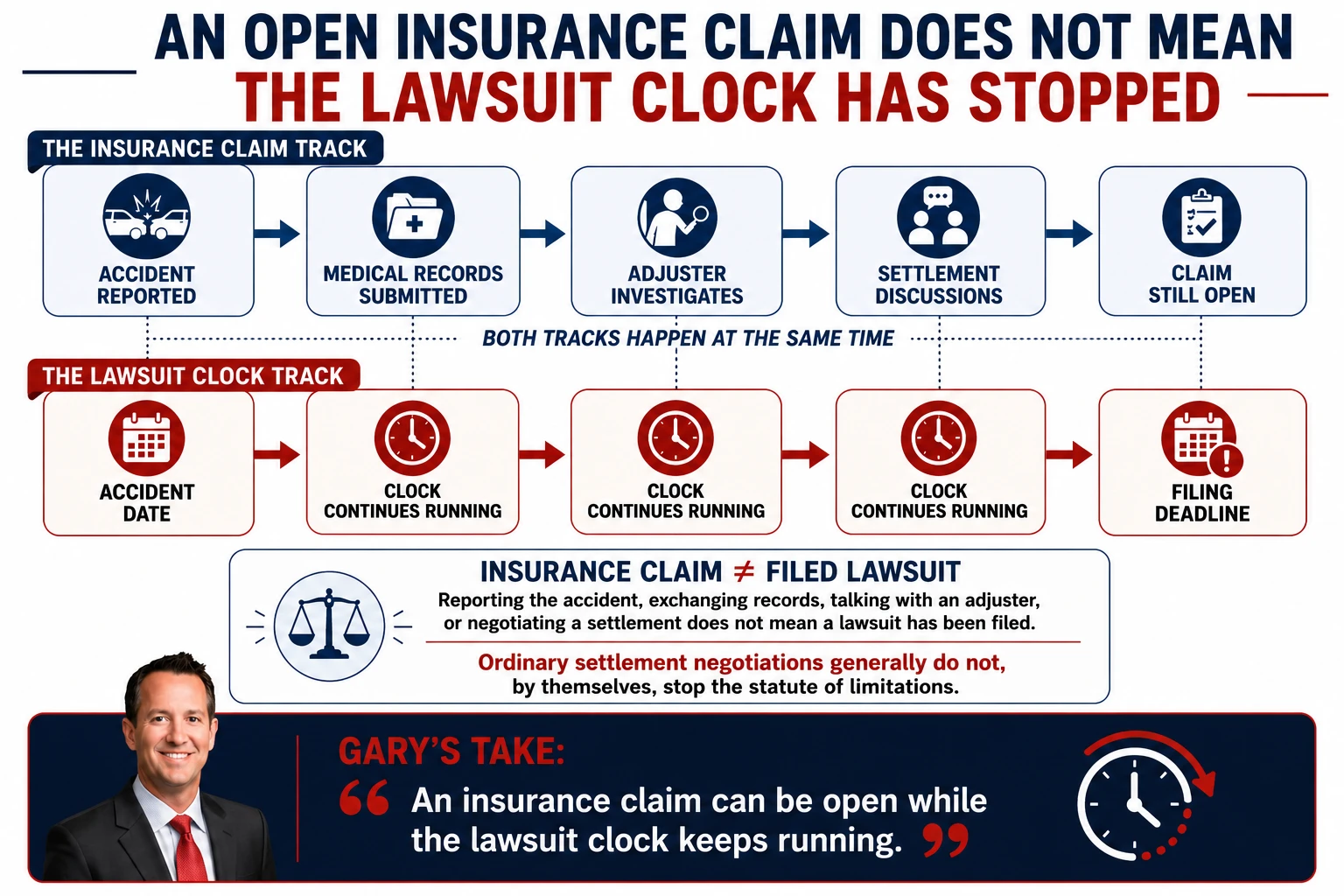
An insurance claim can be open while the lawsuit clock keeps running.
Are There Exceptions to the Three-Year Statute of Limitations?
Yes. South Carolina law recognizes circumstances that can affect how a filing deadline is calculated, but you should never assume an exception applies to your case.
For example, South Carolina has tolling rules that can apply when the person entitled to bring certain actions was under 18 or legally insane when the cause of action accrued. Different statutes and procedural rules can also apply to particular types of defendants or claims.
These rules are fact-specific. The safest approach is to determine the applicable deadline based on the particular accident rather than assuming additional time will be available.
What If a Government Vehicle Caused My Accident?
Different rules can apply if your accident involves a South Carolina state agency, county, city, school district, or another governmental entity or employee acting within the scope of official duties. These claims may fall under the South Carolina Tort Claims Act rather than the ordinary rules that apply to a claim against a private driver.
Because the applicable deadline and procedural requirements can depend on how the claim is pursued, do not assume the ordinary three-year car-accident rule automatically answers the question.
What Is the Difference Between a Legal Deadline and an Insurance Deadline?
There can be several different deadlines involved after a South Carolina car accident, and they do not all mean the same thing.
A statute of limitations is a deadline created by law for filing a lawsuit. In a typical South Carolina car accident injury case, the general statute of limitations is three years. If the applicable statute of limitations expires before the lawsuit is filed, you may lose the right to pursue the claim in court.
Your insurance policy may also contain separate requirements and deadlines. Depending on the policy and the type of claim involved, there may be requirements concerning notice of the accident, cooperation with the insurance company’s investigation, proof of loss, or other steps that must be taken. These policy requirements are not the same thing as the statute of limitations, but that does not mean they should be ignored.
Certain types of claims can also involve separate statutory or administrative requirements. For example, a claim involving a governmental entity may be governed by different rules than an ordinary claim against a private driver. Other types of claims may have their own notice, filing, or procedural requirements.
The important thing to understand is that meeting one deadline does not necessarily mean you have satisfied all of the others.
For example, reporting the accident to an insurance company does not mean you have filed a lawsuit. Likewise, having an open insurance claim does not, by itself, mean the statute of limitations has stopped running.
I tell clients to think of these as different clocks that may be running at the same time. You need to know which requirements apply to your particular case, what each one requires, and when each deadline expires.
The safest approach is to identify every applicable deadline early rather than assuming that taking one step, such as opening an insurance claim, has protected all of your legal rights.

Meeting one deadline does not necessarily mean you have met all of them. The rules that apply depend on the specific facts and type of claim.
Do Settlement Negotiations Stop the Statute of Limitations?
Generally, no. You should not assume that talking with an insurance adjuster or negotiating a settlement stops the statute of limitations from running.
South Carolina courts have recognized limited circumstances where a defendant may be prevented from relying on a statute-of-limitations defense because the defendant’s conduct induced the injured person to delay filing. But ordinary settlement negotiations, standing alone, generally do not stop the limitations period.
The practical rule is simple: never allow an approaching filing deadline to pass because you believe the insurance company is going to settle the claim.
What Mistakes Can Cause Me to Miss an Important Deadline?
One of the biggest mistakes people make with the statute of limitations is assuming that three years means they have three years to start thinking about the case. It does not.
Three years can pass much faster than people expect, especially when you are receiving medical treatment, dealing with insurance companies, gathering records, and trying to get your life back to normal. More importantly, not every claim necessarily follows the same deadline or procedural requirements.
Here are several mistakes I would want someone to avoid:
Assuming an open insurance claim protects the lawsuit deadline.
An insurance claim and a lawsuit are two different things. You can be communicating with an adjuster, submitting medical records, discussing your injuries, or negotiating a settlement while the statute of limitations continues to run. Opening an insurance claim does not, by itself, mean a lawsuit has been filed or that the filing deadline has stopped.
Assuming settlement negotiations stop the clock.
Do not allow an approaching filing deadline to pass simply because settlement discussions are ongoing or because you believe the insurance company is going to make an offer. Ordinary settlement negotiations generally do not, by themselves, stop the statute of limitations from running.
Failing to identify every potentially responsible party early.
Sometimes the identity of the proper defendant is obvious. Other times, additional investigation may reveal that another driver, vehicle owner, business, employer, contractor, or other person or entity may bear legal responsibility. Waiting until the deadline is approaching to determine who should be included in a lawsuit can create serious problems.
Failing to recognize that a governmental entity may be involved.
An accident involving a government-owned vehicle, government employee, public agency, municipality, county, or other governmental entity can involve different rules and procedures under South Carolina law. You should not assume that the ordinary deadline for a claim against a private driver automatically answers the question.
Assuming an exception automatically gives you more time.
South Carolina law recognizes circumstances that can affect how certain filing deadlines are calculated, but those rules are fact-specific. Do not assume that being a minor, discovering something later, or another unusual circumstance automatically extends the deadline in your particular case.
Confusing the statute of limitations with insurance-policy or other notice requirements.
A lawsuit deadline is not necessarily the only deadline that matters. An insurance policy may contain separate notice, cooperation, proof-of-loss, or other requirements. Certain claims may also involve statutory or administrative notice requirements. Satisfying one requirement does not necessarily satisfy the others.
Waiting until the last minute.
This is the mistake I would avoid above all else. Determining the correct defendants, investigating the accident, obtaining records, identifying insurance coverage, preserving evidence, and preparing a lawsuit can take time.
I tell clients that three years may sound like a long time at the beginning of a case, but you should never build a case around using every day the law might give you.
The better approach is to identify the applicable deadlines early, understand which requirements apply to your particular claim, and keep those dates in mind as the case moves forward.
A deadline is much easier to protect when you know about it well in advance than when you discover it is only days away.
Why Does Your Firm Take Such a Strong "Don't Wait" Position?
Because we have seen firsthand what happens when people wait.
Evidence disappears. Witness memories fade. Surveillance footage gets deleted. Physical evidence is lost. Opportunities to preserve critical information vanish with every passing day.
More importantly, injured people often make avoidable mistakes before they ever realize they need legal help. Those problems can make an otherwise valid claim harder to investigate and prove.
Our philosophy is simple: the sooner experienced trial counsel becomes involved, the sooner evidence can be preserved, mistakes can be avoided, and the case can be properly developed.
Why Are South Carolina Injury Cases More Complicated Than They Appear?
South Carolina accident cases involve far more than simply calculating a filing deadline. There are often complex medical issues, insurance coverage issues, evidentiary issues, procedural requirements, and strategic decisions that must be addressed throughout the life of a case.
Many injured people are trying to figure out how to obtain medical treatment, how to pay for treatment, how to deal with insurance companies, and how to protect their legal rights, all at the same time.
Our advice is simple: do not go it alone. These cases are often much more complicated than they appear.
What Should I Do After a Car Accident to Protect Important Deadlines?
Start by documenting the date of the accident and preserving every accident-related document you receive. Report the collision as required, seek appropriate medical care, preserve evidence, and identify every person or entity that may have contributed to causing the accident.
Then determine which legal deadlines actually apply. Do not assume an open insurance claim, ongoing medical treatment, or settlement discussions have stopped the statute of limitations.
I tell clients the deadline is not something you want to discover when it is almost here. Identify it early and build the case with that date in mind.
Protect Your Legal Rights Checklist
- Record the exact date of the accident
- Keep the collision report and insurance documents
- Identify every potentially responsible person or entity
- Determine whether a governmental entity is involved
- Know the statute of limitations that applies to your claim
- Identify any separate notice or insurance-policy requirements
- Do not confuse an open insurance claim with a filed lawsuit
- Do not assume settlement negotiations stop the clock
- Do not assume an exception gives you more time
- Have important deadlines identified well before they approach
In Summary
In South Carolina, you generally have three years to file a personal injury lawsuit arising from a car accident. For a typical collision claim, that period generally runs from the date of the accident. If the applicable statute of limitations expires before a lawsuit is filed, you may lose the right to pursue the claim in court.
However, the three-year rule is not the only deadline that may matter. Claims involving governmental entities can involve different rules and procedures, and South Carolina law recognizes certain circumstances that may affect how a filing deadline is calculated. Insurance policies may also contain separate notice, cooperation, proof-of-loss, or other requirements.
An important distinction is that an insurance claim is not the same thing as a lawsuit. Reporting the accident, submitting medical records, communicating with an adjuster, or negotiating a settlement does not mean a lawsuit has been filed. You should not assume that an open insurance claim or ordinary settlement negotiations have stopped the statute of limitations from running.
The practical lesson is simple: identify the deadlines that apply to your particular case as early as possible. Do not assume every South Carolina car accident follows exactly the same timeline, that an exception automatically gives you additional time, or that taking one step, such as opening an insurance claim, protects every legal deadline.
Three years can sound like a long time after an accident. But medical treatment, investigation, insurance issues, evidence collection, and settlement discussions can consume months or even years. A deadline is much easier to protect when you know about it well in advance than when you discover it is only days away.