

Factors That Can Affect Pain and Suffering Compensation in South Carolina
| Factor | Why It Matters |
|---|---|
| Injury Severity | More serious injuries generally have a greater impact on daily life. |
| Medical Evidence | Medical records and physician opinions help support the claim. |
| Permanent Impairment | Long-term limitations often increase damages. |
| Emotional Impact | Anxiety, depression, PTSD, and emotional suffering may be considered. |
| Credibility | Consistent treatment and truthful reporting strengthen a claim. |
| Daily Life Changes | Loss of hobbies, activities, and enjoyment of life may affect value. |
| Future Medical Care | Ongoing treatment needs may support higher damages. |
| Trial Readiness | Strong evidence and preparation can influence outcomes. |
If you have been injured in an accident in South Carolina, you may be entitled to compensation for pain and suffering, as well as for loss of enjoyment of life, the activities you can no longer do as a result of your accident. It can be important to create a pain diary or journal to track your pain and suffering as your case moves forward. This can help us quantify your damages in this category when we move to settle your case or try it before a jury.
Building a Strong Pain & Suffering Case
Pain and suffering claims are strongest when they are built step by step, starting the moment your accident happens through settlement or trial.
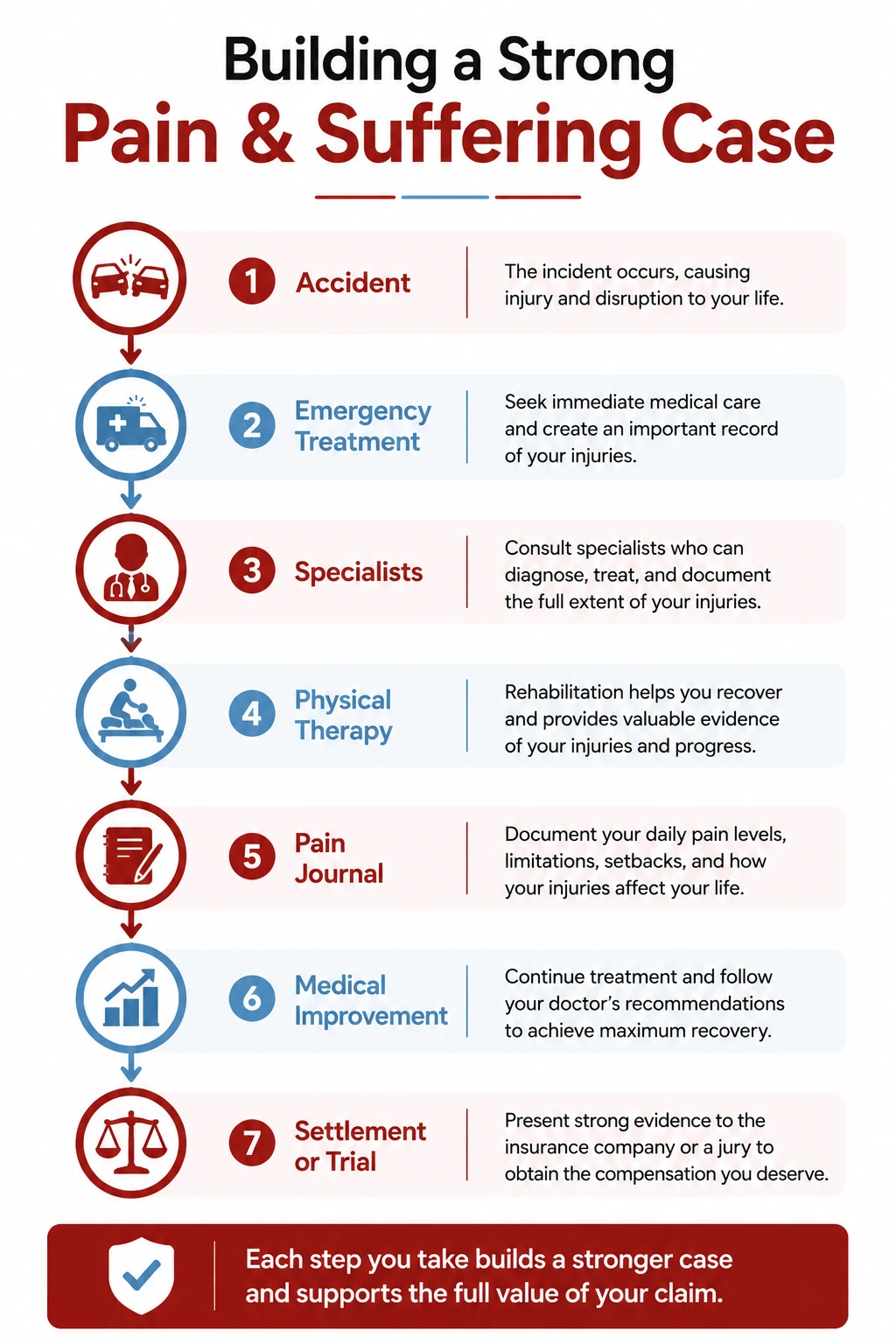
Each step you take, from emergency treatment to a documented treatment timeline, builds a stronger case and supports the full value of your claim.
What Is Gary Christmas's Honest Opinion About Pain and Suffering Damages in South Carolina?
Pain and suffering damages are very important in South Carolina. These are not always damages that a jury can easily wrap its head around. However, they are extremely important, and we want to help the jury fully understand and properly value this category of damages so that an injured person can be fairly compensated for the harm they have suffered.
Pain and suffering includes more than just physical injuries. It also includes mental pain and suffering, anxiety, depression, and other emotional or psychological conditions that result from an accident.
Our law firm views this category of damages the way we view other damages in a case. Each category of damages is like a different room in a house. Each room may be a different size and contain different things, but every room is part of the same house. Likewise, each category of damages represents a different loss suffered by the injured person, and each must be considered and fairly compensated as a result of the negligence that caused the accident.
Pain & Suffering May Include
- Physical pain
- Emotional distress
- PTSD
- Anxiety
- Depression
- Loss of enjoyment of life
- Permanent impairment
- Scarring
- Sleep disturbances
- Chronic pain
In our experience, one of the most important things people should understand is that pain and suffering is not limited to what can be seen on an X-ray, MRI, or medical bill. The human impact of an injury matters. The physical pain, emotional struggles, lifestyle changes, and limitations a person experiences after an accident are all important parts of the story that should be understood and evaluated.
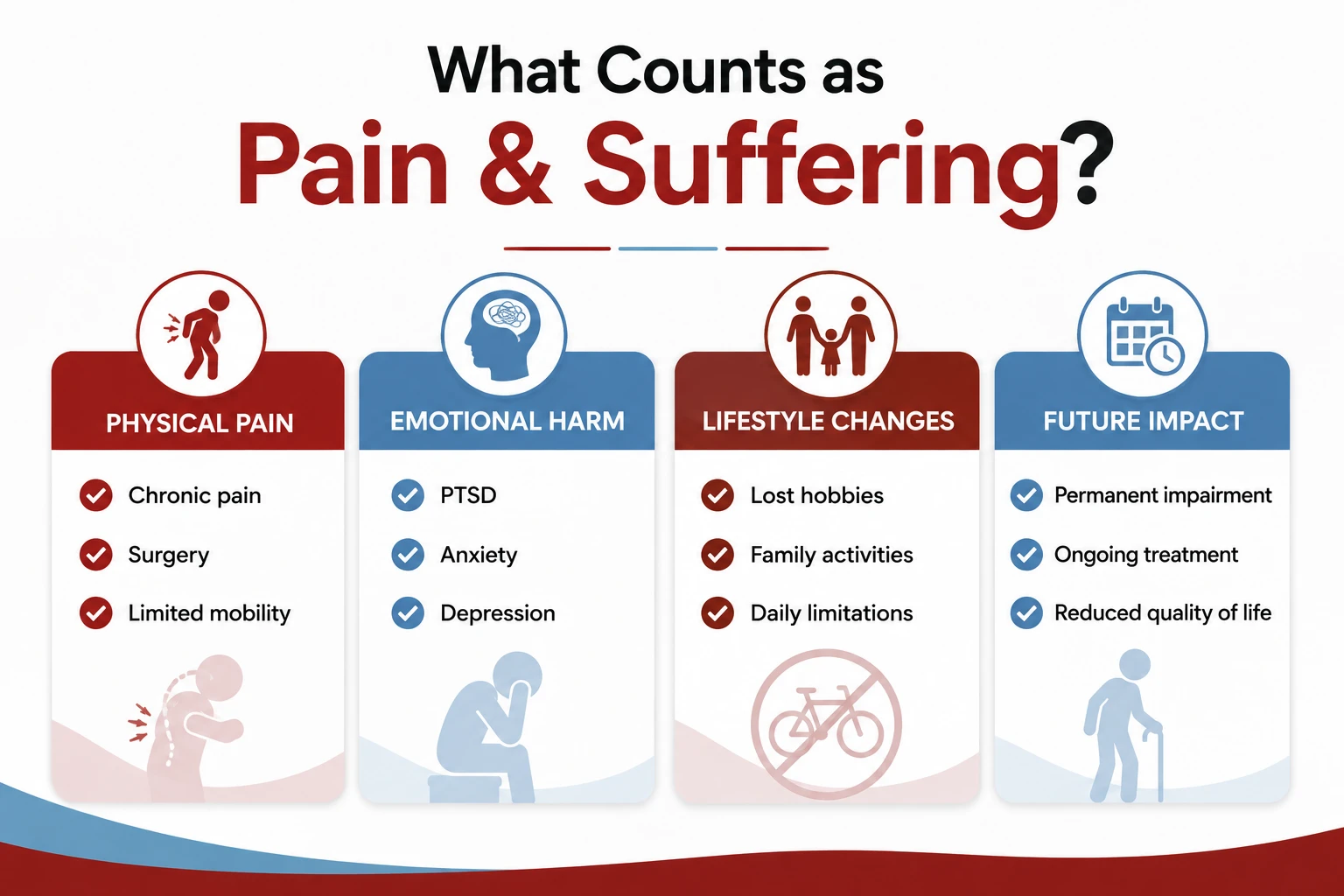
Pain and suffering covers far more than what shows up on a medical bill. The human impact of an injury matters.
What Are Non-Economic Damages After a South Carolina Car Accident?
It is very important for readers to understand that there are both economic and non-economic damages in a personal injury case.
Economic damages are those that can be easily calculated and displayed on a projector screen, such as past and future lost wages, past and future medical bills, and any other measurable financial losses an injured person has suffered as a result of the accident.
In addition to economic damages, there are also non-economic damages. These damages include, but are not limited to, pain and suffering, loss of enjoyment of life, permanent impairment, and loss of consortium, just to name a few. While these damages may be more difficult to measure, they are often some of the most significant losses a person experiences after a serious accident.
Can Someone Have Significant Pain and Suffering Even After a Low-Impact Accident?
Generally speaking, when someone suffers a serious physical injury from a low-impact accident, the insurance company will almost always question the severity of the injury. However, the truth is that serious injuries can occur from low-impact events. There can also be serious mental injuries, including post-traumatic stress disorder (PTSD), depression, and anxiety, resulting from any type of accident.
For whatever reason, insurance companies often target and deny mental injury claims, even though these injuries can have a significant impact on a person’s daily life. A jury may not immediately understand how a serious physical injury can result from a low-impact accident or how mental injuries can arise from any type of accident or injury.
That is why it is so important for our legal team to present these concepts in a clear and easy-to-understand way. When the evidence is properly explained, the jury can fully understand what the injured person has gone through and assess the appropriate amount of damages to award for each category of harm and loss.
What Kinds of Injuries Do Insurance Companies Most Commonly Undervalue?
In the 30 years that Gary Christmas has been practicing injury law in South Carolina, insurance companies commonly undervalue every type of injury case. It is not just low-impact or minor-impact injury cases that insurance companies try to minimize.
Insurance companies often attempt to minimize the number of body parts that were injured and, for each injured body part, the significance and degree of the impairment or injury that occurred. With regard to mental injuries, you can expect insurance companies to deny or strongly challenge claims involving mental pain and suffering, post-traumatic stress disorder (PTSD), anxiety, or depression.
It has been our experience that insurance companies routinely look for anything and everything they can use to deny or minimize both your physical and mental injuries, as well as the damages you have sustained as a result of your accident.
What Mistakes Do Injured People Commonly Make That Weaken Pain and Suffering Claims?
There are many ways that an injured person can unintentionally weaken their claim for damages. These mistakes include, but are not limited to, failing to attend scheduled medical appointments, not providing their doctors with a complete head-to-toe history of all body parts injured as a result of the accident, and downplaying their symptoms.
Many people put on what we call “rose-colored glasses” and tell themselves, or even tell their doctors, that things are not really that bad or that nothing is wrong when, in fact, the opposite is true. When injuries and symptoms are not fully reported, it can make it more difficult to demonstrate the true impact of the accident.
Social media can also play a significant role in minimizing damages in a case. People sometimes continue to post photos or videos, including older content taken before the accident, which can create the wrong impression. To others, including the insurance company, these posts may suggest that the person is living a much more active and unrestricted life than they actually are following their accident.
What Evidence Most Strongly Proves Pain and Suffering Damages?
In our view, the best and strongest evidence to prove pain and suffering damages in an accident case often comes from the doctor, specialist, or specialists who are treating you for your injuries.
For example, if an orthopedic specialist treats you for a back or neck injury and recommends and performs fusion surgery, that can be very strong and compelling evidence of your damages. The doctor’s opinions should address important issues such as causation, permanent work restrictions, permanent impairment, future medical care and treatment, and the reason for any treatment performed during your recovery.
Of course, these medical opinions should not exist in a vacuum. They should always be supported by the medical records in your case.
Testimony from the injured person, as well as testimony from family and friends, can also be very important. This testimony can help establish that the injured person was in good health before the accident and explain the permanent differences in their condition after the accident.
It is also our view that keeping a pain journal or diary is very important and helpful in developing evidence of damages in your case.
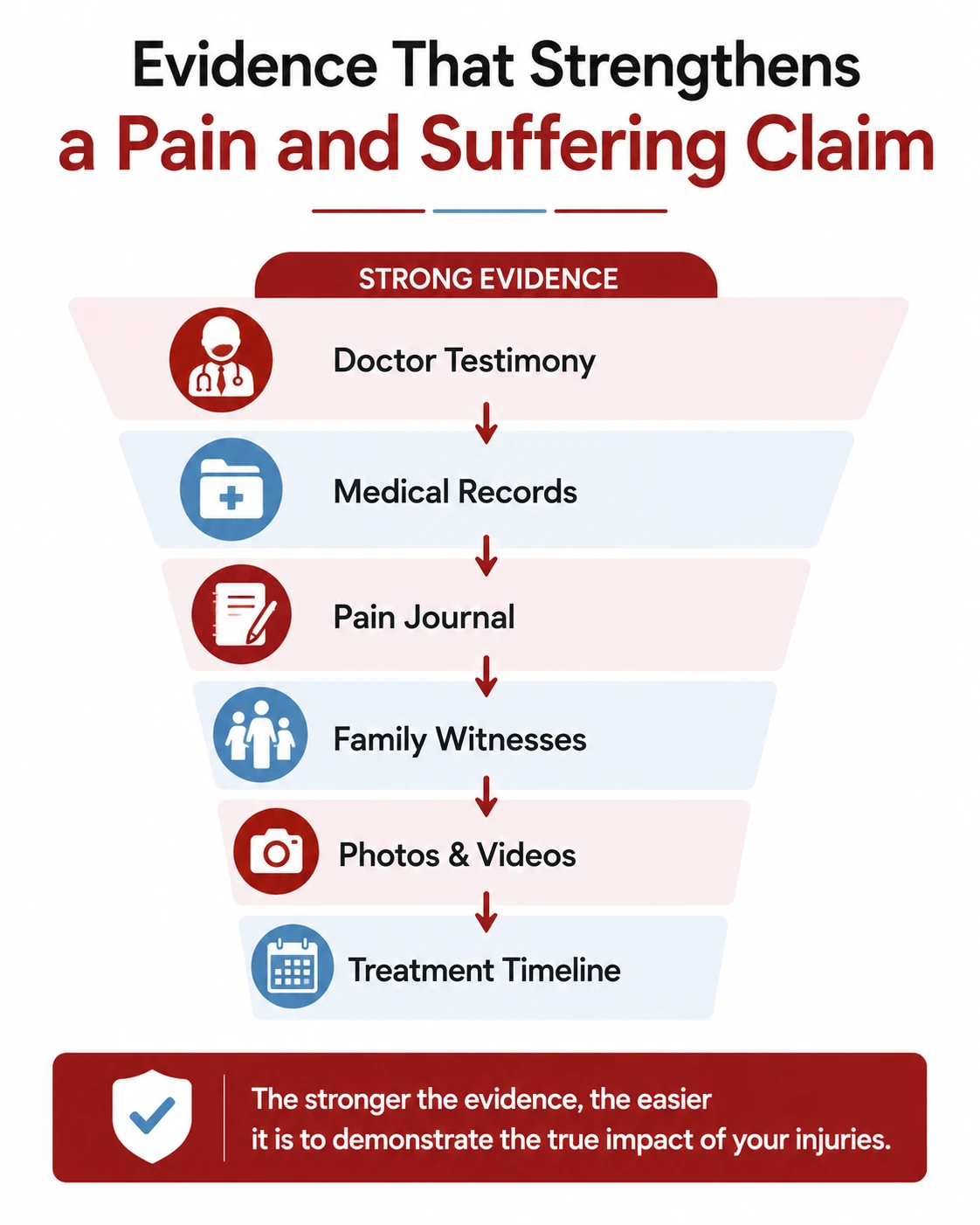
Doctor testimony, medical records, a pain journal, family witnesses, photos, and a treatment timeline all help prove the true impact of your injuries.
How Does the Firm Approach Insurers Who Delay, Deny, and Minimize Suffering?
Our approach begins with helping people understand that they should not expect the insurance company to treat them fairly. Insurance companies have adjusters, managers, nurse case managers, supervisors, private investigators, and attorneys, really an entire team whose goal is to minimize the amount they pay on an accident claim. This includes minimizing payments for medical treatment, lost wages, pain and suffering, and loss of enjoyment of life.
No one is trying to build up a case to recover more than what is deserved from the insurance company. Our goal is to pursue full and fair compensation for all injuries and losses you have suffered as a result of your accident.
On the other hand, insurance companies are well known for denying, delaying, and minimizing claims in an effort to save themselves money. Our job is to level the playing field, protect your rights, and present the evidence necessary to ensure that the full extent of your injuries and damages is understood and fairly evaluated.
What Trial Experience and Philosophy Does Christmas Injury Lawyers Bring to a Case?
Our firm has firmly planted its flag as a litigation and trial law firm. While many people assume that all lawyers regularly go to court, that is simply not the case. Many lawyers who practice in this area of law have never tried a case before a jury, judge, or commissioner.
Our law firm has tried more than 500 cases. That is not to say we have only handled 500 cases. In fact, we have handled thousands of cases over the years. Rather, it means that in more than 500 cases, we have presented evidence and testimony before a jury, judge, or commissioner and received a verdict or decision on behalf of our clients.
Our philosophy is simple. We prepare every case as though it may ultimately be decided in a courtroom. By being prepared to present the facts, evidence, and testimony necessary to prove our clients’ claims, we work to ensure that our clients have the strongest possible opportunity to recover for the injuries and losses they suffered as a result of their accidents.
What Is the #1 Takeaway for a Seriously Injured Reader?
Do not trust the insurance company to treat you fairly, because they will not. Think seriously about which law firm you hire, and make sure they have a proven track record of litigation and trying cases before juries, judges, and commissioners.
Look for a law firm that has proven it will go the distance and walk with its clients every step of the way, whether the case settles, goes to trial, or continues on appeal.
In our view, the best way to work toward the highest settlement value in a case is to prepare every case as though it is going to be tried. If the insurance company pays fair value, then the case does not have to be tried. If they do not, we are prepared either way so we can pursue the best result possible at trial.