

What Evidence Should You Collect at a Car Accident Scene?
| Evidence | Why It Matters |
|---|---|
| Vehicle photographs | Show damage and impact points |
| License plates and vehicle information | Helps identify the vehicles involved |
| Insurance information | Document coverage |
| Witness contact information | Preserve testimony |
| Road conditions | Show hazards |
| Skid marks and debris | Help reconstruct the accident |
| Traffic signals and signs | Establish right of way |
| Nearby cameras | May capture the collision |
| Driver, passenger, and witness information | Helps identify people who may have relevant information |
| Vehicle positions | May help show how the collision occurred |
Photograph the vehicles, their positions, visible damage, license plates, and the surrounding accident scene when it is safe to do so. Preserve the names and contact information of the drivers, passengers, and witnesses when available.
At our law firm, we strongly believe that evidence should be gathered as quickly as possible. We also believe that injured people should contact an experienced trial lawyer immediately so that experts can be retained, evidence can be preserved, and the case can be properly prepared for trial if necessary.
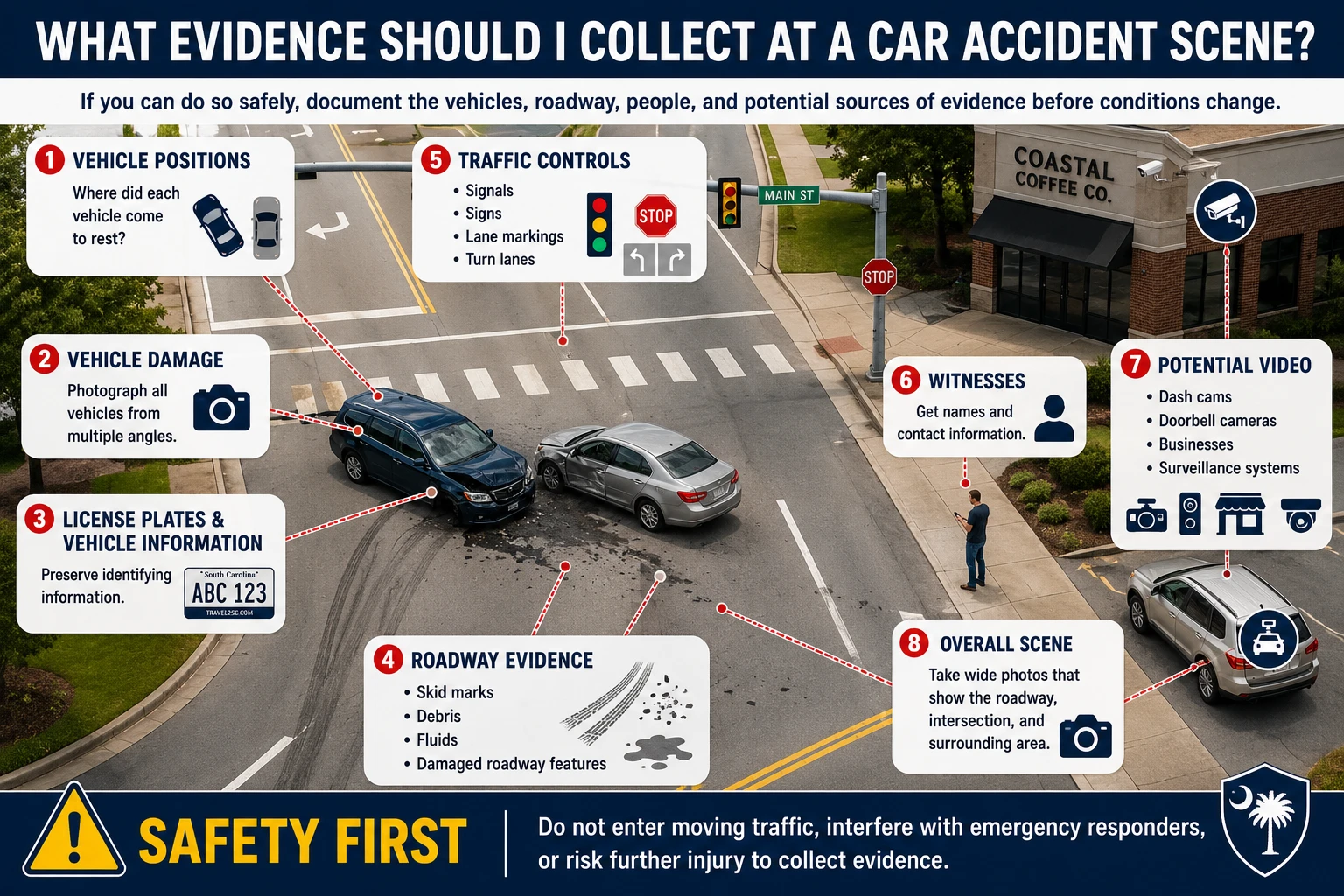
Safety first. Do not enter moving traffic, interfere with emergency responders, or risk further injury to collect evidence.
What Mistakes Should I Avoid While Collecting Evidence at the Accident Scene?
The moments after a car accident can be confusing, and it is easy to overlook evidence that may become important later. Your safety and medical needs should always come first. If you are physically able to document the scene safely, try to avoid these common mistakes:
- Putting yourself in danger to take photographs. Do not step into moving traffic, interfere with emergency responders, or risk further injury just to collect evidence.
- Waiting until after the vehicles have been moved. When it is safe and practical, photograph where the vehicles came to rest and their positions relative to lanes, intersections, traffic signals, signs, and other roadway features.
- Photographing only your vehicle. Take photographs of all vehicles involved, including multiple angles of the damage and the overall accident scene.
- Failing to identify witnesses. If someone saw the collision, try to obtain their name and contact information before they leave.
- Overlooking nearby cameras. Look for businesses, homes, doorbell cameras, parking facilities, dash cams, commercial vehicles, or other cameras that may have captured the collision.
- Allowing dash cam footage to be overwritten. If your vehicle recorded the accident, preserve the original footage as soon as reasonably possible.
- Guessing about what happened. Avoid estimating speed, distance, timing, or other facts if you do not actually know the answer.
- Making unnecessary admissions or apologies. An immediate reaction at a stressful accident scene may not reflect all of the facts that are later discovered.
- Editing the original evidence. Do not crop, filter, annotate, trim, or otherwise alter your only copy of an original photograph or video. Preserve the original and make backup copies.
- Leaving without preserving important identifying information. When possible, make sure the required driver and vehicle information has been exchanged and preserved before leaving the scene.
Exchange the information required after the collision and cooperate with the investigating officer. When describing what happened, stick to the facts you actually know. Avoid guessing about speed, distance, or fault simply because someone asks for an immediate answer.
The goal is not to conduct a perfect accident investigation yourself. It is to safely preserve the information and evidence available at the scene before vehicles move, witnesses leave, roadway evidence disappears, or video is overwritten.
What Information Does South Carolina Law Require Drivers to Exchange After an Accident?
South Carolina law requires a driver involved in an accident resulting in injury, death, or damage to an attended vehicle to provide certain identifying information. That includes the driver’s name, address, and vehicle registration number. Upon request and if available, the driver must also show a driver’s license.
That is separate from the additional evidence you may choose to preserve for an insurance or injury claim, such as photographs, witness information, video, and roadway evidence.
Should I Call the Police After a South Carolina Car Accident?
If the accident results in injury or death, South Carolina law requires the driver to report the accident promptly to the appropriate law-enforcement authority. A police investigation can also create an important contemporaneous record of the collision, identify drivers and witnesses, and document information that may become relevant later.
If you are injured or the scene is unsafe, your immediate focus should be on getting emergency assistance rather than trying to collect evidence yourself.
What If Law Enforcement Does Not Investigate the Accident?
If a South Carolina accident involving injury, death, or apparent total property damage of $1,000 or more is not investigated by law enforcement, state law generally requires the operator or owner to submit the prescribed written accident report and proof of liability insurance to the South Carolina Department of Motor Vehicles within 15 days of the accident.
This is separate from documenting the scene for an insurance or injury claim, so it is important not to assume that exchanging information with the other driver satisfies every reporting requirement.
Can Photos or Videos Really Make a Difference in an Injury Case?
Yes. We handled a tractor-trailer case near the Port of Charleston where a commercial truck failed to stop and yield the right-of-way before entering an intersection.
The defense claimed the truck driver had come to a complete stop and carefully entered the intersection. However, photographs taken by port police showed the tractor-trailer positioned in a lane where it should never have been if the driver had actually stopped and entered the intersection properly.
Those photographs became important because they showed the tractor-trailer’s position at the scene and provided evidence that could be compared with the driver’s description of how the collision occurred.
That case reinforced something I have seen many times over the years: a photograph taken in the first few minutes after a collision can preserve a fact that becomes impossible to recreate later.
What Evidence Can Disappear After a Car Accident?
Some of the most useful evidence after a car accident may also be temporary. Once vehicles are moved, the roadway is cleared, witnesses leave, or digital recordings are overwritten, it may be difficult, or impossible, to recreate exactly what existed immediately after the collision.
Evidence that can change or disappear includes:
- Skid or tire marks. Rain, traffic, and normal roadway use can cause marks to fade or disappear.
- Debris and fluids. Broken vehicle parts, glass, cargo, and fluids may be cleaned from the roadway soon after the accident.
- Vehicle positions. Once vehicles are moved, photographs taken later cannot show exactly where they came to rest after impact.
- Temporary road conditions. Construction zones, lane closures, temporary signs, roadway hazards, or other conditions may change quickly.
- Weather conditions. Rain, fog, standing water, ice, lighting, and visibility may be different by the time someone investigates the scene later.
- Witness information and memory. Witnesses can leave before their identities are recorded, and memories of specific details may become less clear over time.
- Surveillance footage. Businesses, homes, parking facilities, and other camera systems may automatically overwrite older recordings.
- Dash cam footage. Some dash cams continuously record over existing footage unless the relevant file is saved or protected.
- Damaged vehicle components. Vehicles may be repaired, totaled, sold, or disposed of before particular damage or components can be examined.
- Electronic vehicle data. Depending on the vehicle and circumstances, relevant electronic data may exist, but preserving and obtaining that information can require timely action.
This is why early documentation can matter. You cannot always recreate an accident scene weeks or months later. When it is safe to do so, preserving photographs, video, witness information, and other available evidence can create a record of conditions as they actually existed close to the time of the collision.
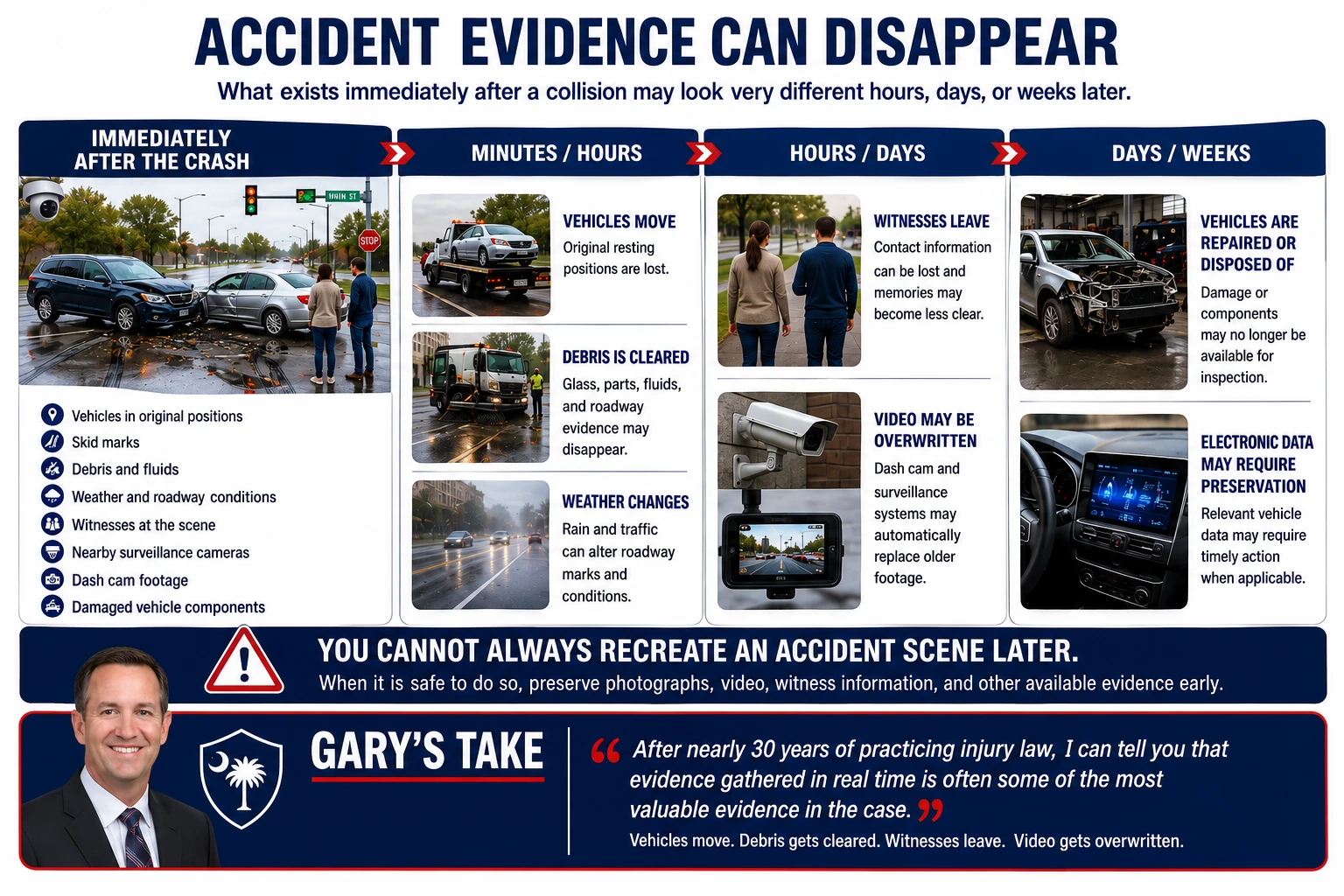
You cannot always recreate an accident scene later. When it is safe to do so, preserve photographs, video, witness information, and other available evidence early.
What Should I Do Immediately After a Crash?
My advice is simple: document, document, document.
If it is safe and lawful to do so before vehicles are moved, photograph where the vehicles came to rest and their positions relative to lanes, intersections, signs, traffic signals, and other roadway features.
Look around to see whether there are nearby businesses, homes, or traffic cameras that may have captured the accident. If there are witnesses, obtain their names, phone numbers, email addresses, and any other contact information available.
Modern evidence may also come from dashcams, Tesla vehicle cameras, business surveillance systems, home security cameras, and traffic cameras.
After nearly 30 years of practicing injury law, I can tell you that evidence gathered in real time is often some of the most valuable evidence in the case. Rain washes away skid marks. Witnesses move. Video footage gets deleted. Evidence disappears.
Time is always of the essence.
Are There South Carolina-Specific Evidence Issues I Should Know About?
Yes. In addition to preserving photographs, video, witness information, and other accident-scene evidence, South Carolina law contains requirements that can become important depending on how the collision occurred.
Three issues are particularly worth knowing:
- Required accident information. After a qualifying collision, South Carolina law requires drivers to provide certain identifying information, including their name, address, and vehicle registration number. Upon request and if available, a driver must also show their driver's license.
- Accident reporting requirements. Accidents involving injury or death must be promptly reported to the appropriate law-enforcement authority. In addition, certain accidents involving injury, death, or apparent total property damage of at least $1,000 that are not investigated by law enforcement can trigger a separate written reporting requirement to the South Carolina DMV.
- Unknown-driver and hit-and-run claims. Evidence preservation can become especially important when the responsible driver cannot be identified. In certain South Carolina uninsured-motorist claims involving an unknown driver, a recording showing that the unknown vehicle caused the injury or damage can be one way of satisfying part of the statutory requirements, even when there was no physical contact between the vehicles. Other legal requirements still apply.
The important point is that evidence after a South Carolina accident does more than help explain how the crash happened. In some situations, the evidence you preserve may also become important to satisfying specific legal or insurance requirements that apply to the claim.
What Photos and Videos Should I Try to Preserve?
Photos and videos can preserve details that may change or disappear shortly after a car accident. If you are physically able to do so safely, try to document both the vehicles and the larger accident scene rather than focusing only on the damage to your own vehicle.
Useful photographs and videos may include:
- The overall accident scene. Take wide photographs showing the roadway, intersection, lanes, shoulders, and surrounding area. These images can provide context for where and how the collision occurred.
- Vehicle positions. If it is safe to do so before the vehicles are moved, photograph where each vehicle came to rest and its position relative to lanes, intersections, signs, signals, and other roadway features.
- All vehicles involved. Photograph each vehicle from multiple angles, including visible impact areas and damage, not just your own vehicle.
- License plates and vehicle information. Clear photographs can help preserve identifying information about the vehicles involved.
- Roadway evidence. Photograph skid or tire marks, debris, broken vehicle parts, fluids, damaged barriers, or other physical evidence associated with the collision.
- Traffic controls and roadway features. Preserve photographs of traffic lights, stop or yield signs, lane markings, turn lanes, construction signs, sight obstructions, and other features that may help explain how the accident happened.
- Relevant interior damage. When applicable, photograph deployed airbags, damaged seats or seat belts, broken glass, or other visible damage inside the vehicle.
- Dash cam footage. If your vehicle or another involved vehicle has a dash cam, preserve the relevant original footage before it can be overwritten.
- Nearby surveillance video. Look beyond the vehicles involved. Businesses, homes, doorbell cameras, apartment complexes, parking garages, gas stations, commercial vehicles, and other nearby sources may have recorded the collision or the moments leading up to it.
When taking photographs, think in terms of both detail and context. A close-up may show the damage, while a wider photograph may show where that damage occurred in relation to the rest of the accident scene.
Do not alter your only copy of a photograph or video. Preserve the original files and make backup copies. A photograph or recording can be much more useful when the original file, source, and surrounding context have been preserved.
How Should I Preserve Photos and Videos After the Accident?
Taking photographs and videos is only the first step. How you preserve that evidence afterward can also matter. The goal is to keep the original files intact and preserve enough information to understand where the evidence came from and what it shows.
A few practical steps can help:
- Preserve the original files. Keep the original photographs and videos from your phone, dash cam, camera, or other device whenever possible.
- Do not alter your only copy. Avoid cropping, trimming, filtering, annotating, enhancing, or otherwise editing the original file. If you want to create an edited version for another purpose, first preserve an untouched copy.
- Create backup copies. Store important evidence in more than one secure location so it is not lost if a phone, camera, computer, or storage device is damaged or replaced.
- Preserve the surrounding context. Do not save only a few seconds of video or a single photograph if additional footage or images help show what happened before, during, or after the collision.
- Note where the evidence came from. When possible, preserve information about the source of the photograph or video, along with the date, time, location, and who provided it.
- Do not rely only on compressed copies. Photos and videos sent through text messages, social media, or some messaging platforms may be compressed or stripped of useful information. Keep the original file whenever it is available.
The safest approach is simple: preserve the original, keep the context, and make backups. You can always create copies later, but once the original evidence has been altered, overwritten, or lost, it may be impossible to recreate.
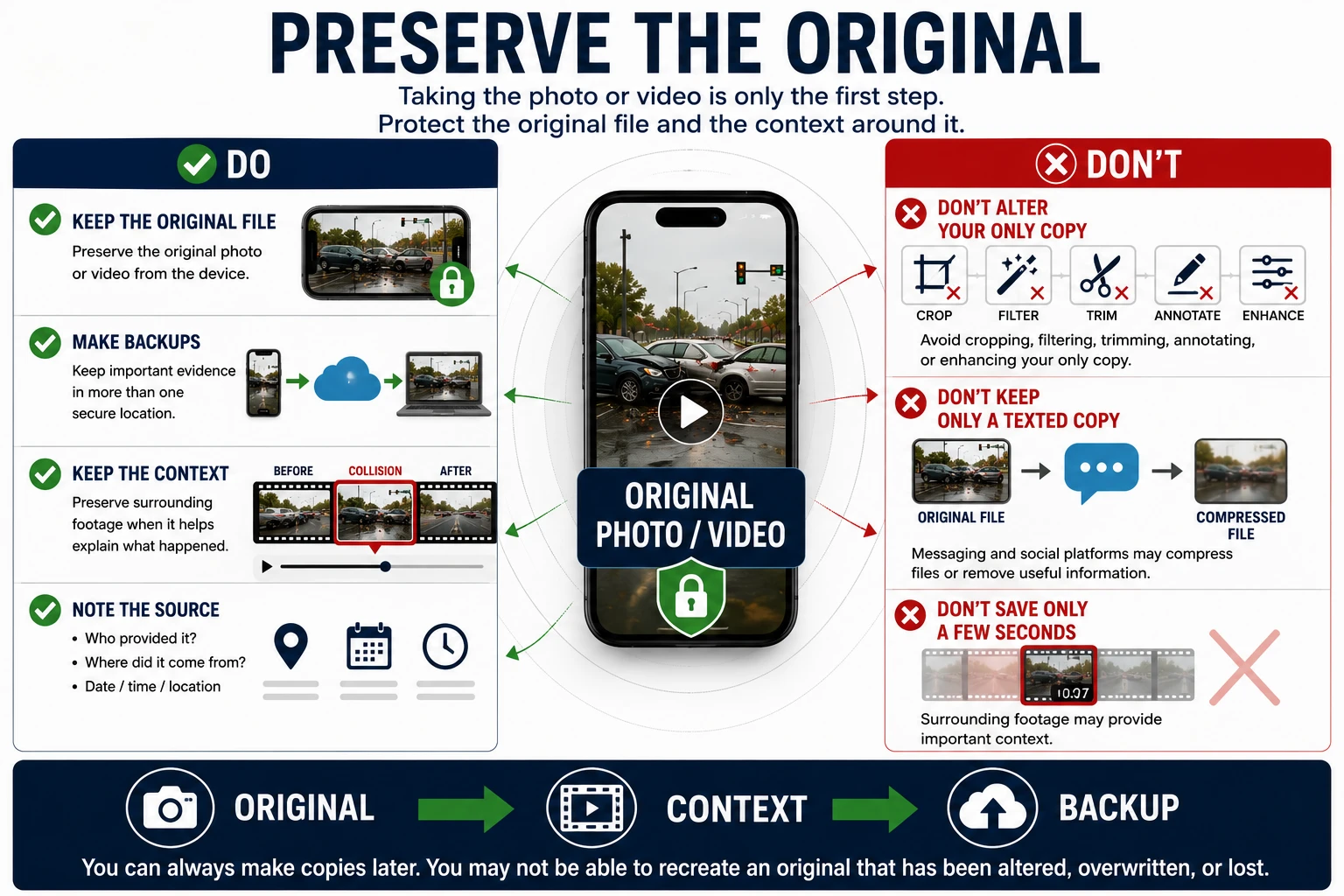
You can always make copies later. You may not be able to recreate an original that has been altered, overwritten, or lost.
What Should I Remember If I'm Scared or in Shock After an Accident?
Immediately after an accident, most people are dealing with adrenaline, shock, confusion, and uncertainty.
You are not thinking as clearly as you normally would. You may be injured, scared, worried about your family, concerned about your vehicle, and unsure of what to do next. That is completely normal.
If you are overwhelmed, focus first on safety, emergency medical needs, and getting appropriate help. You do not need to create the perfect accident investigation while you are injured or in shock.
If you can safely take photographs or obtain witness information, that can be useful. If you cannot, do not risk your health trying to do it. Other evidence may still be available through law enforcement, witnesses, nearby cameras, vehicle records, and later investigation.
Car Accident Evidence Checklist
- Put safety and medical needs first
- Report an injury accident to law enforcement
- Photograph all vehicles and visible damage
- Photograph vehicle positions when safely possible
- Photograph license plates and preserve exchanged vehicle/insurance information
- Photograph the overall roadway and intersection
- Photograph traffic signs, signals, and lane markings
- Photograph skid marks, debris, fluids, or damaged roadway features
- Get names and contact information for witnesses
- Look for dash cams, doorbell cameras, businesses, and other potential video sources
- Preserve your own dash cam footage before it is overwritten
- Save original photographs and videos without altering them
- Create secure backup copies
- Record the date, time, location, and source of important evidence
- Do not guess or speculate about facts you do not know
In Summary
If you are physically able to do so safely, preserving evidence at a South Carolina car accident scene can make a meaningful difference later. Photograph all vehicles, their positions, damage, license plates, roadway conditions, skid marks, debris, and traffic controls, and get names and contact information for witnesses. Look for nearby dash cams, doorbell cameras, and business surveillance that may have captured the collision.
South Carolina law also requires drivers to exchange certain identifying information after a qualifying accident, promptly report accidents involving injury or death to law enforcement, and, in certain circumstances, submit a written report and proof of insurance to the DMV within 15 days when law enforcement does not investigate.
Much of the most useful evidence is temporary. Skid marks fade, debris gets cleared, witnesses leave, and video gets overwritten within minutes, hours, or days. Preserve the original files of any photographs or videos, avoid altering them, make secure backups, and keep track of where the evidence came from.
Above all, your safety and medical needs come first. If you are seriously injured or the scene is unsafe, focus on getting help. Other evidence may still be available afterward through law enforcement, witnesses, nearby cameras, and further investigation.