

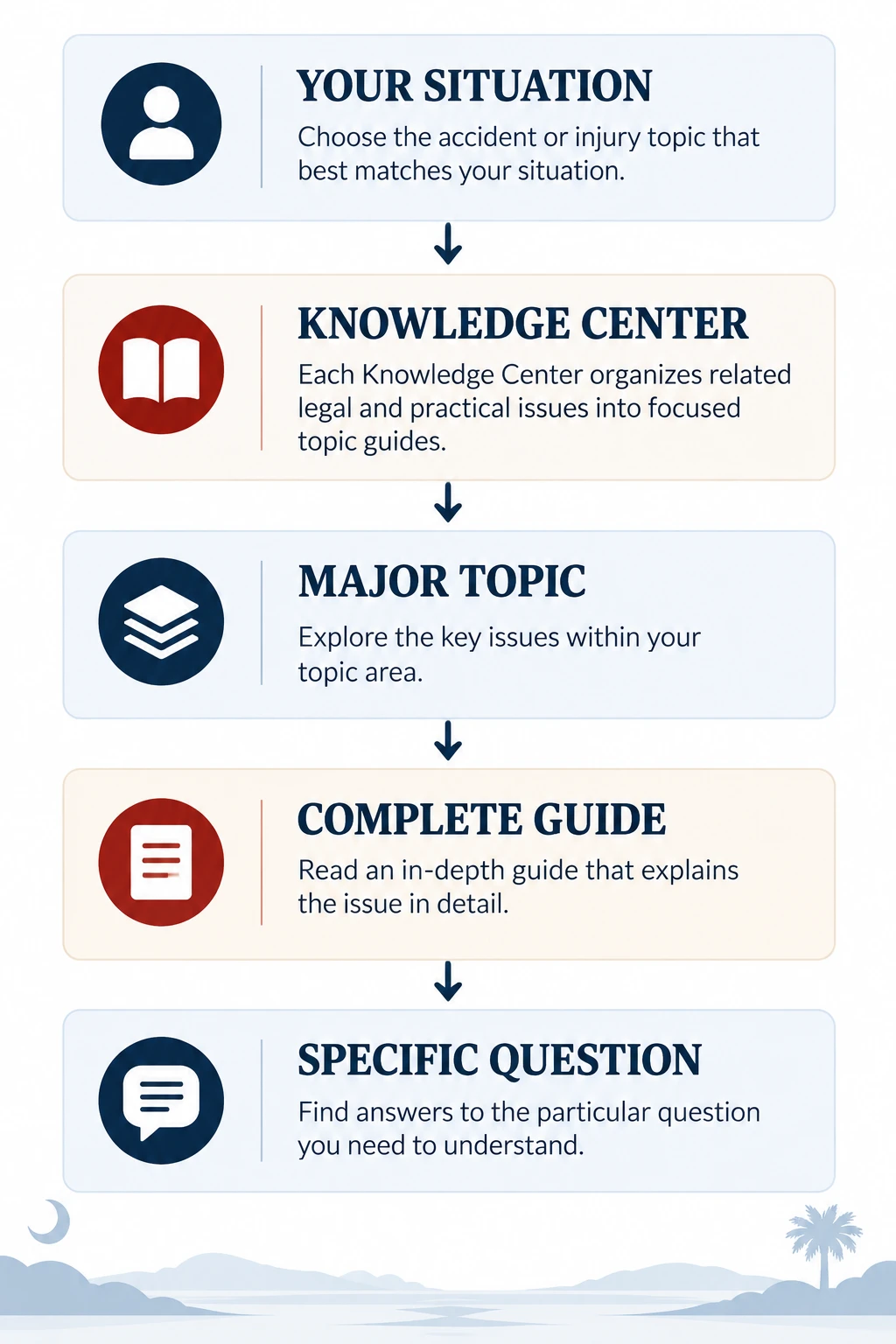
What Evidence or Liability Issue Are You Dealing With?
You do not need to become an expert on evidence law before figuring out where to start. Identify the problem you are facing and use the corresponding resource to learn more.
The other driver says I caused the accident
When drivers disagree about what happened, photographs, witness information, video, vehicle damage, statements, traffic rules, and other evidence may become important to evaluating responsibility.
I don’t know what evidence matters
Different evidence can answer different questions. Some evidence helps establish how the collision happened. Other evidence may be more relevant to injuries, causation, or financial losses.
I may be partly at fault
South Carolina follows a modified comparative negligence system. Shared responsibility can affect whether and how much an injured person may recover, so the evidence concerning each party’s conduct matters.
Important evidence may be disappearing
Some evidence does not remain available indefinitely. Surveillance footage may be overwritten, vehicles may be repaired, physical conditions may change, and witnesses can become more difficult to locate.
I don’t know whether I have a strong case
Case strength cannot usually be determined from one fact alone. The important question is how well the available evidence supports the issues that are actually disputed.
How Is a Car Accident Claim Evaluated From an Evidence and Liability Standpoint?
Evaluating a car accident claim involves more than asking which driver received a ticket or who says the other person was at fault.
The process often requires separating several different questions.
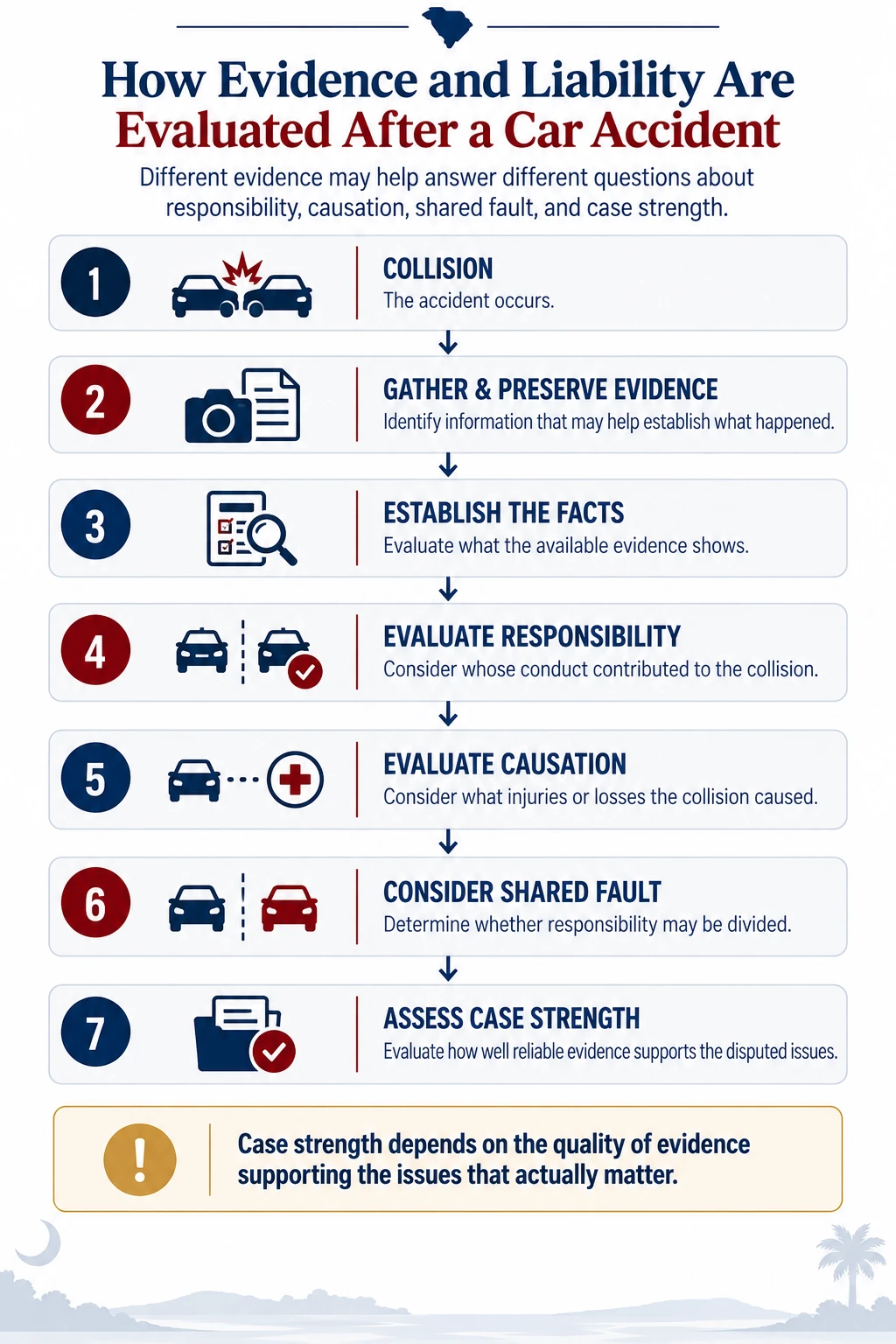
Different evidence may help answer different questions about responsibility, causation, shared fault, and case strength.
1. Identify What Happened
Start with the collision itself.
Where did it occur? Which vehicles were involved? How were the vehicles traveling? What happened immediately before impact? What were the traffic controls, roadway conditions, and positions of the vehicles?
Those facts create the foundation for evaluating responsibility.
2. Gather and Preserve Evidence
The next question is what information exists to support or challenge the competing versions of events.
Potential evidence may include photographs, video, witness information, police documentation, vehicle damage, electronic data, statements, medical information, and other records.
Some evidence can change or disappear, making early preservation particularly important in certain cases.
3. Evaluate Responsibility
The available facts can then be considered alongside driver conduct, traffic rules, and the circumstances surrounding the collision.
A driver may be alleged to have followed too closely, failed to yield, made an unsafe lane change, ignored a traffic signal, driven too fast for conditions, or engaged in some other conduct relevant to the collision.
The specific facts determine which issues matter.
For a deeper discussion, see Proving Fault After a South Carolina Car Accident →
4. Evaluate Causation
Establishing responsibility for the collision does not necessarily resolve every issue in an injury claim.
There may be a separate dispute over whether the crash caused a particular injury, aggravated an existing condition, or produced a claimed loss.
That distinction becomes especially important when there are delayed symptoms, prior medical conditions, subsequent events, or disagreements about the medical evidence.
5. Evaluate Shared Fault
Sometimes more than one person’s conduct contributed to a collision. South Carolina’s modified comparative negligence rules can make the allocation of fault important because a claimant’s share of responsibility may affect recovery.
When several parties are involved, the analysis can become more complex, which is another reason the underlying evidence matters.
Read: What Happens If I’m Partially at Fault for the Accident? →
6. Assess Overall Case Strength
The final question is not simply how much evidence exists.
A claim may become stronger or weaker based on the reliability, consistency, relevance, and completeness of the evidence supporting the disputed issues.
That means ten pieces of weak or irrelevant evidence are not necessarily more useful than one reliable piece of evidence that directly addresses the issue in dispute.
Four Questions That Can Affect Case Strength
A useful way to evaluate the evidence in a car accident claim is to separate four questions.
They are connected, but they are not the same.
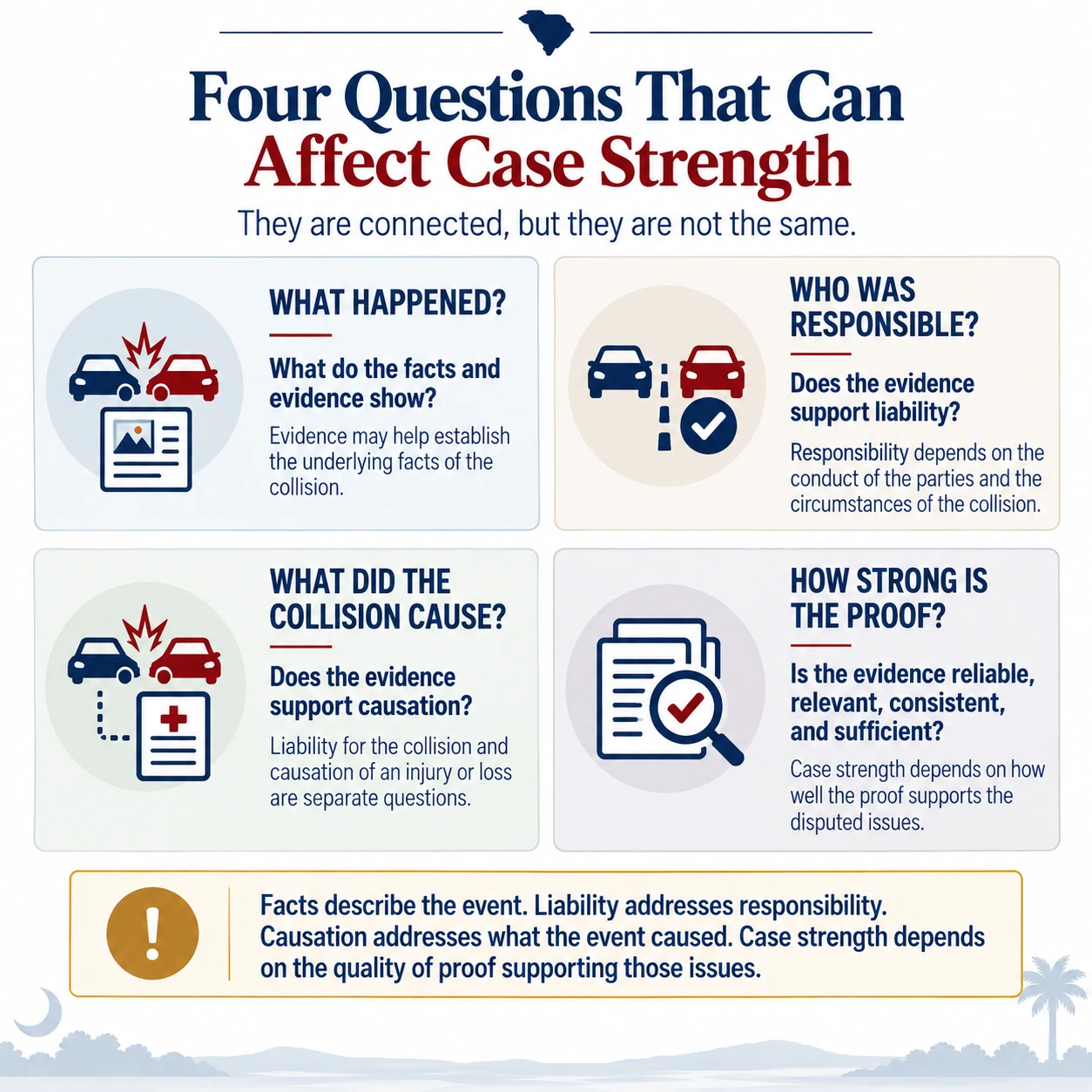
They are connected, but they are not the same.
What Happened?
What does the available evidence show about the collision?
Photographs, video, vehicle positions, damage patterns, witness information, statements, roadway evidence, and other records may help establish the underlying facts.
Who Was Responsible?
Does the evidence support liability against one or more parties?
Liability concerns legal responsibility. It involves considering what the drivers or other responsible parties did and whether their conduct contributed to causing the collision.
What Did the Collision Cause?
Does the evidence support a connection between the accident and the claimed injuries or losses?
This is causation.
A person may establish that another driver caused a collision and still face a separate disagreement about whether the crash caused a particular medical condition or financial loss.
How Strong Is the Proof?
Is the evidence reliable, consistent, relevant, and sufficient to support the disputed issues?
Not every piece of evidence carries the same significance. The strength of the proof depends partly on what must actually be established and what the other side disputes.
Facts describe the event. Liability addresses responsibility. Causation addresses what the event caused. Case strength depends on the quality of proof supporting those issues.
Start With Our Complete Evidence and Liability Guides
If you want to understand the larger evidence and liability picture before focusing on one specific problem, start with these two guides.
Proving Fault After a South Carolina Car Accident
This guide explains how responsibility may be evaluated after a collision.
It covers driver conduct, traffic rules, police documentation, witness evidence, photographs and video, vehicle damage, disputed versions of events, and comparative negligence.
Evidence That Can Strengthen a South Carolina Car Accident Claim
This guide focuses on the information that may help document what happened, what injuries were caused, and what losses resulted.
It explains different categories of evidence, preservation issues, documentation, evidentiary gaps, and why the usefulness of evidence depends on the question it is being used to answer.
Common Evidence and Liability Problems After a Car Accident
Some evidence questions require a more focused answer. These resources address common problems that can arise while responsibility and case strength are being evaluated.
Fault & Responsibility
Can I Recover If I Was Partly at Fault for a South Carolina Car Accident?
An insurer may argue that your own conduct contributed to the collision. Learn how South Carolina’s comparative negligence rules can make allocation of fault important and why the evidence supporting each party’s conduct matters.
What Happens If I Get A Ticket At The Scene?
Receiving a traffic ticket at the scene does not necessarily determine who is legally responsible for a car accident or whether you can pursue an injury claim. Learn how a citation may relate to fault, what other evidence can matter, and why the circumstances of the collision still need to be evaluated.
How Do I Report a Car Accident In South Carolina?
Reporting a car accident can involve notifying law enforcement, documenting the collision, and completing additional reporting requirements depending on what happened. Learn when a South Carolina car accident should be reported, what information may be required, and what steps to take after the crash.
Evidence Preservation
How Do I Preserve Evidence After a South Carolina Car Accident?
Potential evidence can sometimes be lost through ordinary events rather than intentional conduct. A damaged vehicle may be repaired or disposed of. Video may be overwritten. Road conditions can change. Witnesses can become difficult to locate. This resource explains why identifying potentially relevant evidence early can matter.
Important Evidence and Liability Distinctions
Several concepts in an injury claim are closely related but should not be treated as interchangeable.
Evidence ≠ Liability
Evidence is the information or proof used to establish facts. Liability concerns legal responsibility for the collision.
Liability ≠ Causation
A driver may be responsible for causing the collision while a separate dispute remains over whether the collision caused a particular injury or loss.
Police Report ≠ Final Determination of Fault
A police report can contain useful observations and information, but it should not automatically be treated as the final legal determination of liability.
No Witnesses ≠ No Case
An independent witness can be useful, but other evidence may still help establish what happened.
Comparative Fault ≠ Automatic Bar to Recovery
Being partly responsible does not necessarily mean an injured person cannot recover under South Carolina law. The percentage and allocation of fault matter.
More Evidence ≠ Stronger Evidence
Quantity alone does not determine case strength. Relevant, reliable, consistent evidence addressing an important disputed issue may be more useful than a large amount of marginal information.
Inconsistency ≠ Automatic Fraud
People do not always describe an event in exactly the same words every time, and records can contain differences or mistakes. An inconsistency may require explanation, but its significance depends on what differs, why it differs, and how it relates to the disputed issue.
What Types of Evidence Can Matter After a Car Accident?
Different types of evidence can help answer different questions about a car accident claim. The important issue is not simply how much evidence exists, but what a particular piece of evidence can help establish.
Scene Evidence
Photos and other scene evidence may help show where and how the collision occurred, including vehicle positions, roadway conditions, traffic controls, debris, or other physical details.
Witness & Statement Evidence
Witness accounts and statements from drivers or passengers may help explain what happened before, during, or immediately after the collision. Their usefulness can depend on what the person actually observed and how the information compares with other evidence.
Vehicle & Digital Evidence
Vehicle damage, dashcam footage, surveillance video, photographs, and available electronic data may help clarify how an impact occurred or resolve conflicting accounts of the collision.
Medical Evidence
Medical records may help document injuries, symptoms, diagnoses, treatment, recovery, and medical causation. This evidence addresses different questions from evidence showing who caused the collision.
Financial & Loss Evidence. Employment records, repair documents, receipts, invoices, and similar records may help support specific financial losses associated with the accident.
The type of evidence that matters most depends on what issue is actually disputed. For a broader explanation of evidence categories, preservation, and how different forms of proof may support a claim, see Evidence That Can Strengthen a South Carolina Car Accident Claim →
Why Does Preserving Evidence Early Matter?
Some evidence is durable. Other evidence can change or disappear surprisingly quickly.
A damaged vehicle may be repaired or sold. Surveillance systems may overwrite old footage. Skid marks, debris, construction conditions, or other physical features can change. Witnesses may move or become harder to locate. Electronic information may not remain available indefinitely.
That does not mean every accident requires an extensive investigation. It means potentially important evidence should be considered in light of the actual issues in the case.
Preserving evidence is most useful when the evidence relates to something that may later be disputed.
What If You May Be Partly at Fault?
Believing you made a mistake does not automatically mean you have no claim. A collision can involve conduct by more than one person, and the allocation of responsibility may itself be disputed.
South Carolina’s comparative negligence rules can make the percentage of fault important, which means the evidence concerning each person’s conduct matters.
Partial fault and no claim are not synonymous.
Read: Can I Recover If I Was Partly at Fault for a South Carolina Car Accident? →
Proving Fault and Proving an Injury Are Different Questions
Suppose the evidence clearly establishes that another driver caused a rear-end collision.
That may resolve much of the liability dispute, but it does not necessarily resolve the medical causation question.
An insurer could still dispute whether a particular condition resulted from that collision, whether the crash affected a preexisting condition, whether later symptoms are related, or whether another event contributed to the medical problem.
Those questions may involve the medical chronology, prior health history, timing and development of symptoms, examination and diagnostic findings, treatment, and healthcare-provider opinions.
This is why liability and injury causation should be analyzed separately.
What Can Make a Car Accident Claim Stronger or Weaker?
There is no universal checklist that can determine the strength of every car accident claim.
Different cases have different disputed issues. Still, four concepts can be useful when evaluating the quality of the available proof.
Consistency
Do the important pieces of evidence generally fit together?
For example, statements, photographs, physical evidence, medical history, and the overall chronology may support one another, or may raise questions that need to be understood.
Consistency does not require every record or recollection to use identical language.
Corroboration
Can an important fact be supported by more than one source?
A driver’s account may be supported by a witness, video, photographs, vehicle damage, or other evidence. Medical complaints may be documented across records and examinations.
Corroboration can be particularly useful when a material fact is disputed.
Documentation
Can the relevant facts, injuries, and losses be supported by appropriate records or other evidence?
Documentation may help establish what happened and provide a reliable chronology. What documentation matters depends on the particular issue being evaluated.
Disputed Issues
Perhaps the most important question is: what does the other side actually dispute?
If liability is accepted, spending most of the analysis proving fault may miss the real problem. The dispute may instead involve medical causation, comparative fault, the extent of an injury, financial losses, or credibility.
A strong case is not simply a case with a large amount of evidence. It is a case where reliable evidence supports the issues that actually matter.
Gary's Take: Identify What Actually Needs to Be Proven
“When I look at a car accident case, I don’t start by asking whether we have a big stack of evidence. I start by asking what is actually disputed.”
“Is the disagreement about who caused the wreck? Is the insurance company arguing that our client shares responsibility? Is it questioning whether the collision caused the injury? Is the disagreement about the extent of the damages? Or is there a credibility issue we need to understand?”
“Once you identify the real dispute, you can ask a much better question: what evidence do we have that addresses that issue? That’s usually far more useful than simply collecting documents without understanding what they prove,” says Gary Christmas.
Related South Carolina Car Accident Topics
Evidence and liability connect with several other parts of a car accident claim. If the question you are dealing with belongs primarily to another area, continue with the corresponding Knowledge Center section.
| If You're Trying to Understand… | Start Here |
|---|---|
| The insurance claim, adjuster, or coverage | Insurance & Claims → |
| Your injuries, symptoms, or medical treatment | Medical Treatment, Injuries & Recovery → |
| Who was at fault or what evidence matters | Evidence, Liability & Case Strength → |
| What losses may be recoverable or how settlement works | Settlement Value & Financial Recovery → |
| What happens if the dispute goes to court | Lawsuits & Litigation → |
| Whether, when, or how to hire an attorney | Hiring a Lawyer & Legal Strategy → |
Questions About Evidence or Liability After a South Carolina Car Accident?
Some collisions have relatively clear facts. Others involve conflicting accounts, incomplete records, multiple drivers, disputed injuries, or evidence that may not remain available for long.
Legal guidance may be useful when:
- The other driver or insurer disputes fault.
- Several drivers or potentially responsible parties are involved.
- The police report appears incomplete or inaccurate.
- Photographs, video, vehicle data, or other evidence may disappear.
- The insurer argues that you share responsibility.
- There are materially conflicting witness accounts.
- The insurer disputes whether the collision caused your injuries.
- You are unsure whether the available evidence supports the issues necessary for your claim.
Christmas Injury Lawyers represents injured people throughout South Carolina. The firm’s approach emphasizes careful preparation, clear communication, and helping clients understand the issues that may affect their claims.
If you have questions about disputed fault, disappearing evidence, shared responsibility, or whether the available proof supports your claim, you can contact Christmas Injury Lawyers to discuss your situation.