

How a Contingency Fee Works
This arrangement allows injured people to hire experienced legal representation without paying money out of pocket as the case progresses.
Our view is simple: we do not earn an attorney fee unless we recover money for you. Case costs and expenses are addressed separately in the written fee agreement.
| Question | Typical Answer |
|---|---|
| Upfront payment required? | Usually no |
| Hourly billing? | Usually no |
| Contingency fee? | Commonly yes |
| Attorney fee if there is no recovery? | Depends on the agreement; contingency arrangements generally provide that no attorney fee is earned without a recovery |
| Can the percentage change if a lawsuit is filed? | It may, depending on the written fee agreement |
| Case costs and expenses? | Separate from attorney fees and governed by the written fee agreement |
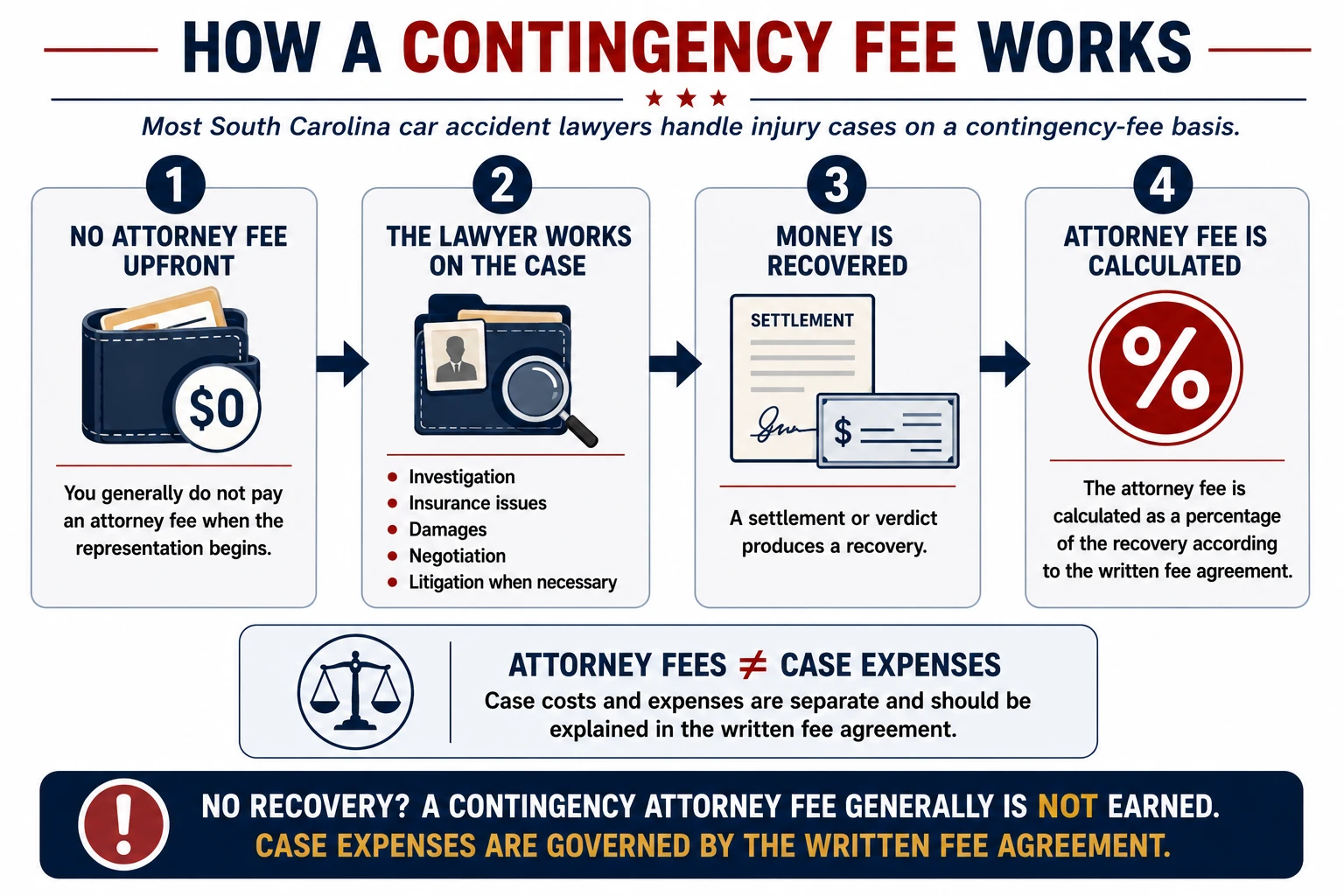
No recovery, no contingency attorney fee. Case expenses are separate and governed by the written fee agreement.
What Percentage Does a Car Accident Lawyer Take?
Contingency-fee percentages vary by law firm and by the written fee agreement. At Christmas Injury Lawyers, our written agreement explains the percentage that applies and whether that percentage changes if litigation becomes necessary.
South Carolina’s rules require a contingency-fee agreement to be in writing and signed by the client. The agreement must explain how the fee is calculated, including the percentage or percentages that apply in the event of settlement, trial, or appeal, as well as how litigation and other expenses are handled.
Under our firm’s current written fee agreement, the contingency-fee percentage may increase to 40% if the case enters formal litigation. The applicable percentage and when it changes are explained in the written agreement before representation begins.
Every law firm is different, and clients should always carefully review and understand their fee agreement. At our firm, we believe in being transparent about how fees work and making sure clients understand exactly how we earn our fee before they hire us.
What Should My Contingency-Fee Agreement Explain?
A South Carolina contingency-fee agreement should be in writing and signed by the client. It should explain how the attorney fee is calculated, which percentage or percentages may apply at different stages of the case, what litigation or other case expenses may be charged, and whether those expenses are deducted before or after the attorney fee is calculated.
I tell clients not to be embarrassed to ask questions about any part of the agreement they do not understand. Before you hire a lawyer, you should know how the attorney is paid, how expenses are handled, and how money will be distributed if the case produces a recovery.
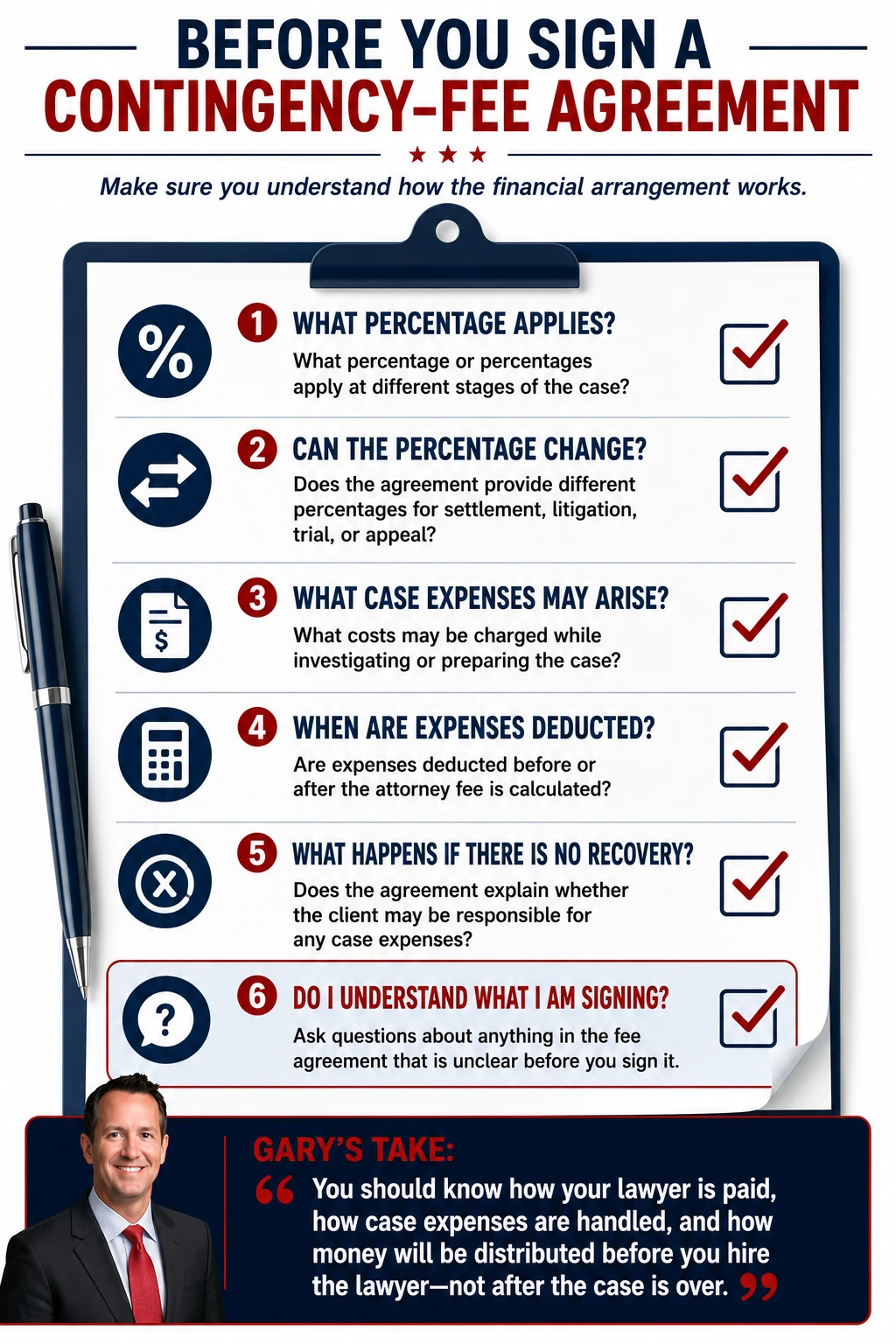
You should know how your lawyer is paid, how case expenses are handled, and how money will be distributed before you hire the lawyer, not after the case is over.
Do Car Accident Lawyers Charge Hourly Fees?
One of the biggest misconceptions is that hiring a lawyer means a large hourly bill starts running the moment the representation begins.
Most personal injury cases are handled differently.
Most South Carolina injury lawyers work on a contingency fee basis, which means there is no hourly billing and no monthly invoice arriving in your mailbox. The lawyer only earns a fee if money is recovered on your behalf.
Many people are surprised to learn that they can obtain experienced legal representation without paying money upfront.
Can Hiring a Lawyer Affect How My Claim Is Evaluated?
It can, depending on the case. A lawyer may identify evidence, damages, insurance coverage, legal issues, or responsible parties that were not fully developed before representation began. Filing a lawsuit can also change the posture of a claim because it begins formal discovery and moves the case toward potential trial.
Over the years, we have seen insurance companies reevaluate claims after additional evidence was developed or litigation began. But every case is different, and hiring a lawyer does not guarantee that the value of a claim will increase or that a particular result will occur.
Our focus is not on promising a number. It is on understanding the facts, documenting the damages, preparing the case thoroughly, and making sure the claim is evaluated on the evidence that actually exists.
What Costs Besides Attorney Fees May Be Involved?
Common case expenses may include charges for obtaining medical records, deposition transcripts, expert witness fees, court filing fees, accident reconstruction experts, medical illustrations, and other litigation-related costs.
At our firm, we work hard to gather every piece of evidence necessary to fully develop the case. That often requires obtaining records, reports, testimony, and other materials from third parties.
Those third parties frequently charge fees for producing those materials, and those expenses become part of the overall cost of preparing the case. Those expenses can be necessary to investigate, document, and prepare a case properly.
Attorney fees and case expenses are not the same thing. The written fee agreement should explain which expenses may be charged to the client, how those expenses are advanced or paid during the case, and how they are handled when the case concludes.
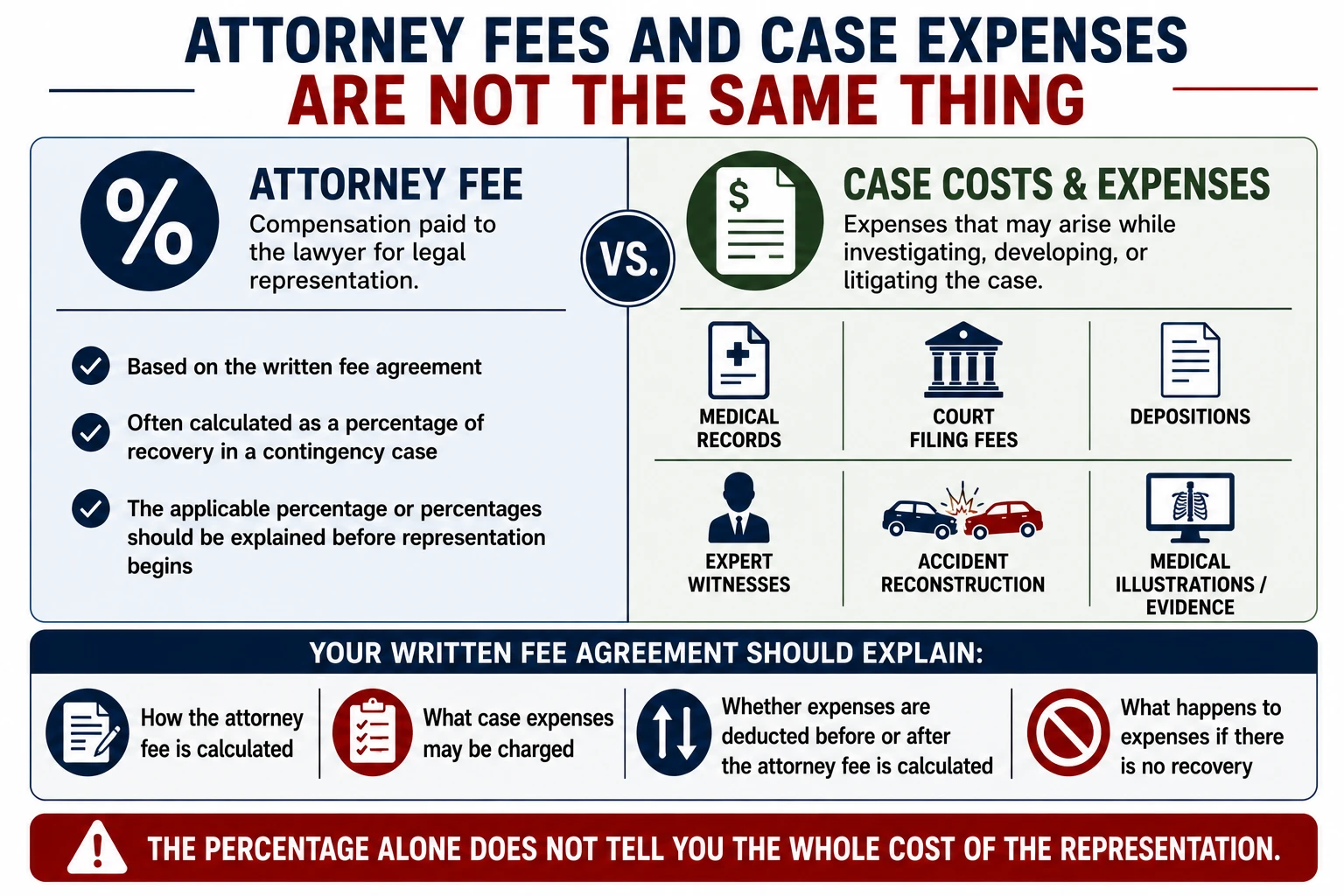
The percentage alone does not tell you the whole cost of the representation.
Do I Always Need a Car Accident Lawyer?
In our experience, the clearest example is a property-damage-only claim where no one was injured.
Property damage claims are often relatively straightforward. The vehicle is repaired, or if it is declared a total loss, the insurance company generally pays the fair market value based on recognized valuation sources.
Many straightforward property-damage-only claims can be handled without legal representation, although disputes can arise. Once bodily injuries become involved, however, the medical issues, legal issues, and insurance issues become significantly more complicated, and that is where experienced legal representation becomes much more important.
Why Does Trial Preparation Matter?
This really is a case of philosophy and mindset.
We strongly believe in preparing every case from day one as though it is going to trial. That does not mean every case goes to trial. In fact, most cases resolve before reaching a courtroom.
However, we believe preparing a case for trial can put the client in a stronger position by forcing us to gather the evidence, investigate the claim, identify the damages, and understand the strengths and weaknesses of the case.
In our experience, preparation matters, and that philosophy has guided our practice for decades.
Can Waiting Too Long to Get Legal Advice Create Problems for My Claim?
Yes, it can. Evidence may disappear, witnesses can become harder to locate, and decisions made early in the claim may become important later. Statements about how the accident happened or how you were injured can also create issues if they are incomplete or inconsistent with later evidence.
That does not mean every person who waits has damaged their case. It means some problems are easier to prevent early than to correct later.
If you are represented, your lawyer can handle many insurance communications while you focus on treatment and recovery.
Why Are People So Worried About Legal Fees?
When someone asks me what a lawyer costs, I know they are often asking a bigger question: “Can I afford to hire a lawyer when I am already worried about medical bills, missing work, and taking care of my family?”
There is often a tremendous fear of the unknown. Clients want to understand what their case may be worth and whether there will be enough compensation available to help them move forward.
The answer is always case-specific because every accident, every injury, and every set of damages is different.
That is exactly why the contingency-fee structure matters. It allows an injured person to hire legal representation without receiving hourly legal bills while the case is pending.
If I Lose My Case, Do I Still Owe Attorney Fees?
If your case is handled on a contingency-fee basis and there is no recovery, the lawyer generally does not earn a contingency attorney fee. Case costs and expenses are separate, and whether you are responsible for any of those expenses depends on the written fee agreement.
That said, every law firm is different, and every fee agreement is different. We strongly encourage clients to carefully read and fully understand the fee agreement before hiring any lawyer. At our firm, we believe in complete transparency. We take the time to explain how attorney’s fees and case costs work so our clients understand exactly how we earn our fee and what to expect as the case moves forward.
Why Does Your Firm Believe in Fee Transparency?
We believe in complete transparency.
At the beginning of every case, we take the time to explain how attorney’s fees work, what case costs may arise, and how compensation is distributed at the conclusion of a case.
Most importantly, we want clients to understand that we do not earn a contingency attorney fee unless we recover money for them.
That contingency fee structure allows injured people to obtain experienced legal representation without worrying about hourly bills accumulating while they focus on healing and rebuilding their lives.
Is Hiring a Car Accident Lawyer Financially Worth It?
Whether hiring a lawyer is financially worthwhile depends on the particular case. The question is not simply what percentage the lawyer charges. You should also consider what the lawyer will do to investigate liability, identify insurance coverage, document damages, address medical liens or reimbursement claims, negotiate the claim, and prepare for litigation if necessary.
The number that ultimately matters to the client is not just the gross settlement or verdict. It is what remains after attorney fees, case expenses, valid liens or reimbursement obligations, and other amounts that must be addressed.
That is why I believe fee transparency matters. You should understand both what the representation costs and what work the lawyer is agreeing to perform before you decide whether the arrangement makes sense for you.
Questions to Ask Before Hiring a Lawyer
- How are attorney fees calculated?
- Are there upfront costs?
- What case expenses may arise?
- What happens if there is no recovery?
- Has the lawyer tried cases?
- Who will handle my file?
- How will communication work?
- Do I understand the fee agreement?
- Are case expenses deducted before or after the attorney fee is calculated?
- Could I owe case expenses if there is no recovery?
In Summary
Most South Carolina car accident lawyers handle injury cases on a contingency-fee basis. That generally means you do not pay an attorney fee upfront, and the lawyer earns a fee only if money is recovered for you. The attorney fee is calculated as a percentage of the recovery according to the written fee agreement.
Attorney fees and case costs or expenses are not the same thing. Expenses may include items such as medical records, court filing fees, deposition transcripts, expert fees, accident reconstruction, medical illustrations, and other costs needed to investigate and prepare the case. The fee agreement should explain how those expenses are handled and whether they are deducted before or after the attorney fee is calculated.
Contingency-fee percentages can vary by law firm and by the stage of the case. The written agreement should explain the percentage or percentages that may apply if the case settles, proceeds into litigation, goes to trial, or is appealed. It should also explain what happens to attorney fees and case expenses if there is no recovery.
The important point is not simply to ask, “What percentage does the lawyer charge?” You should understand the entire financial arrangement: how the attorney fee is calculated, what expenses may arise, how those expenses are handled, what work the lawyer is agreeing to perform, and how the final recovery will be distributed.
For many injured people, the real concern is whether they can afford legal representation while already dealing with medical bills, lost income, and financial uncertainty. A contingency-fee arrangement can make legal representation available without hourly billing while the case is pending, but the terms should always be clearly explained and understood before the representation begins.