

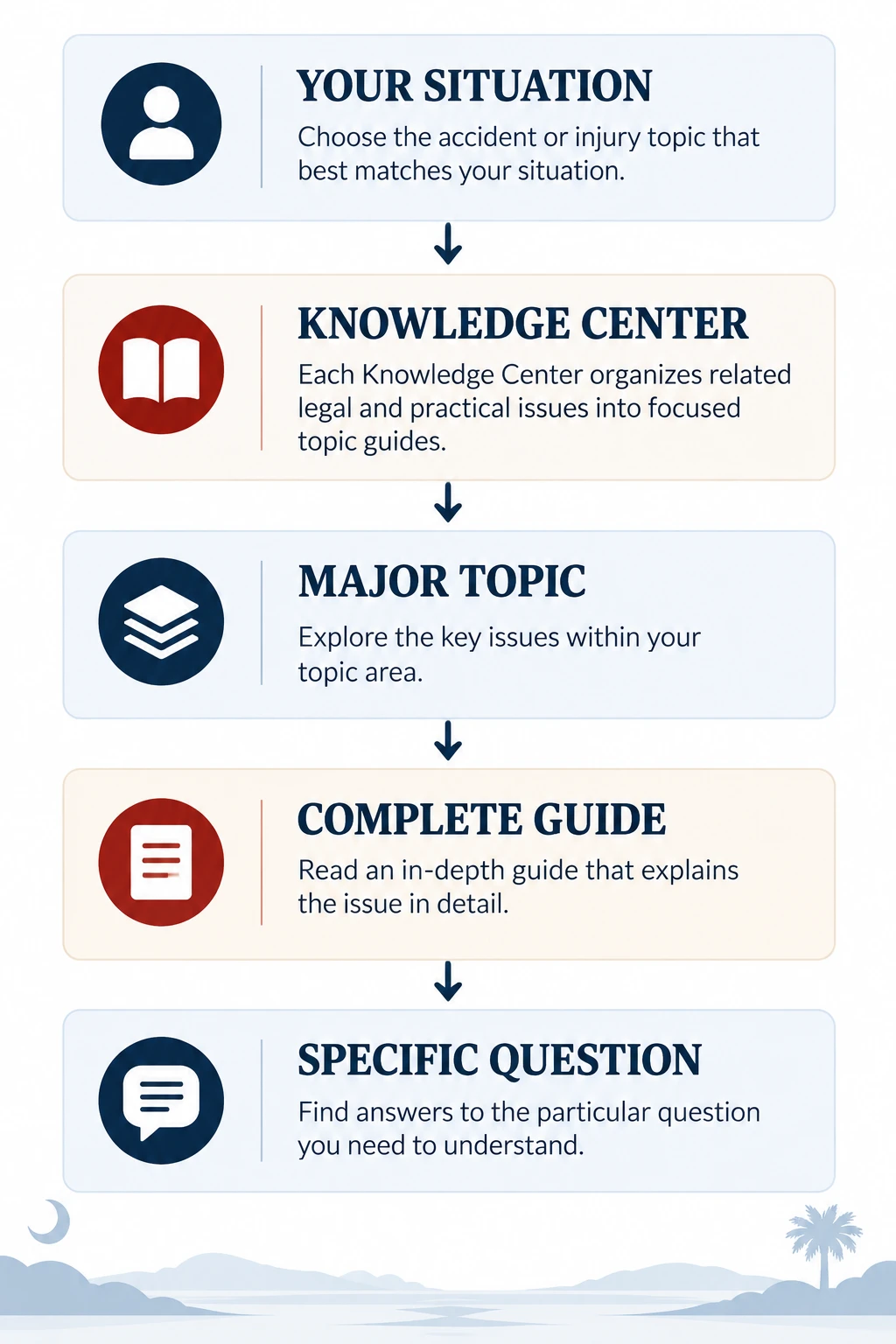
What Legal Help or Representation Question Are You Dealing With?
You do not have to understand every part of the legal process before deciding what information you need. Start with the question that most closely matches your situation.
I don't know whether I need a lawyer
Some relatively straightforward claims may be manageable without an attorney. More serious injuries, disputed issues, complicated insurance questions, substantial losses, or potential litigation can make legal representation more important.
I want to know what a car accident lawyer actually does
A lawyer’s role can extend well beyond communicating with an insurance adjuster. Depending on the claim, representation may involve investigating the collision, preserving evidence, identifying coverage, documenting damages, evaluating disputed issues, negotiating, and preparing for litigation.
I'm wondering when I should hire a lawyer
Timing can matter when evidence needs to be preserved, important decisions are approaching, an insurer is requesting information, or the claim is becoming more complicated.
I need to choose between lawyers
The right questions can help you understand who will handle your case, how communication will work, what experience may be relevant, how the lawyer approaches litigation, and what the representation will cost.
I want to understand attorney fees and costs
Attorney fees and case expenses are separate concepts. The written fee agreement should explain the financial terms of the representation.
My accident happened a while ago and I haven't hired anyone
Waiting to hire a lawyer does not necessarily mean representation is impossible, but delay can create problems involving evidence, claim development, and legal deadlines.
I don't have health insurance and need medical treatment
A lack of health insurance can create difficult questions about treatment access and medical bills after an accident. A lawyer may be able to help you understand potential options depending on the circumstances, but representation does not guarantee access to treatment or eliminate medical obligations.
My claim may require a lawsuit
If negotiations fail or major issues remain disputed, the next question may be what happens when a claim moves into formal litigation.
How Should You Think About Hiring a Car Accident Lawyer?
Instead of starting with the assumption that every accident requires an attorney, it can be more useful to identify the problems in the claim and determine what help those problems may require.
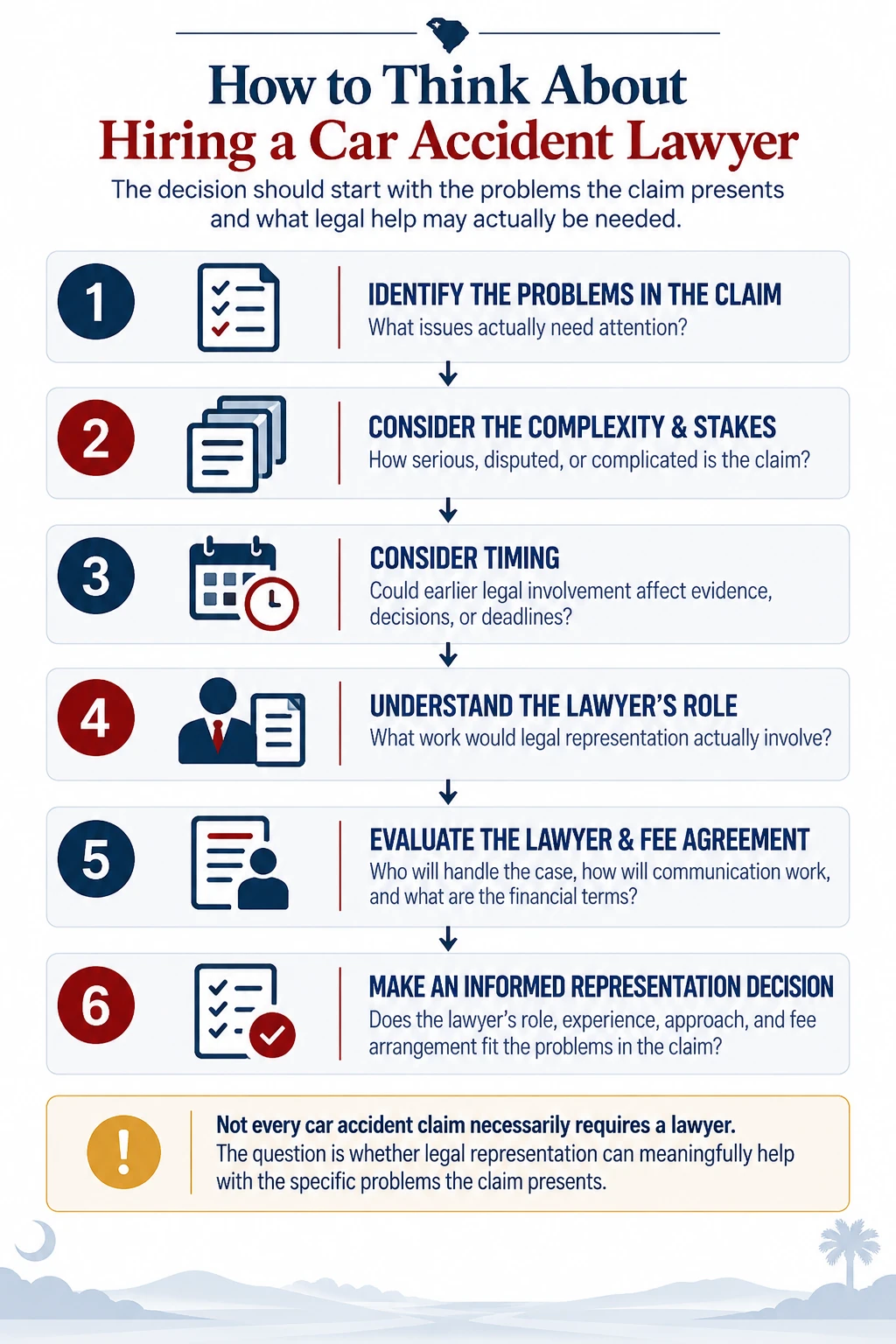
The decision should start with the problems the claim presents and what legal help may actually be needed.
1. Identify the Problems in the Claim
Start with what is actually making the claim difficult.
The issue might involve injuries, fault, medical causation, evidence, insurance coverage, settlement value, medical liens, deadlines, or potential litigation.
Identifying the problem helps clarify what legal representation would need to accomplish.
2. Consider the Complexity and Stakes
A minor property-damage matter can present very different concerns from a claim involving significant injuries, future medical care, disputed responsibility, substantial income loss, or multiple insurance policies.
As the consequences and disputed issues become more significant, the decisions involved in the claim may become more important as well.
3. Consider Timing
Timing can matter because evidence may change or disappear, memories can fade, insurers may request information, and legal deadlines may apply.
The question is not only whether a lawyer could eventually help. It is also whether earlier involvement could affect how evidence is preserved, the claim is developed, or important decisions are handled.
4. Understand What the Lawyer Would Do
Representation should have a practical purpose.
Depending on the claim, a lawyer may help investigate the collision, preserve evidence, address insurance issues, document damages, evaluate disputed issues, negotiate, or handle litigation.
5. Evaluate the Lawyer and Fee Agreement
Before hiring an attorney, understand who will actually handle the case and how the representation will work.
Communication practices, relevant experience, approach to preparation, litigation capability, attorney fees, case expenses, and the written fee agreement can all be important considerations.
6. Make an Informed Representation Decision
The final question is whether the attorney’s role, experience, approach, communication, and fee arrangement fit the problems presented by your claim.
That decision may look different for a relatively straightforward claim than for one involving serious injuries, disputed evidence, complicated coverage, or possible litigation.
Four Questions to Ask Before Hiring a Car Accident Lawyer
The decision to hire an attorney becomes easier to evaluate when you separate four different questions.
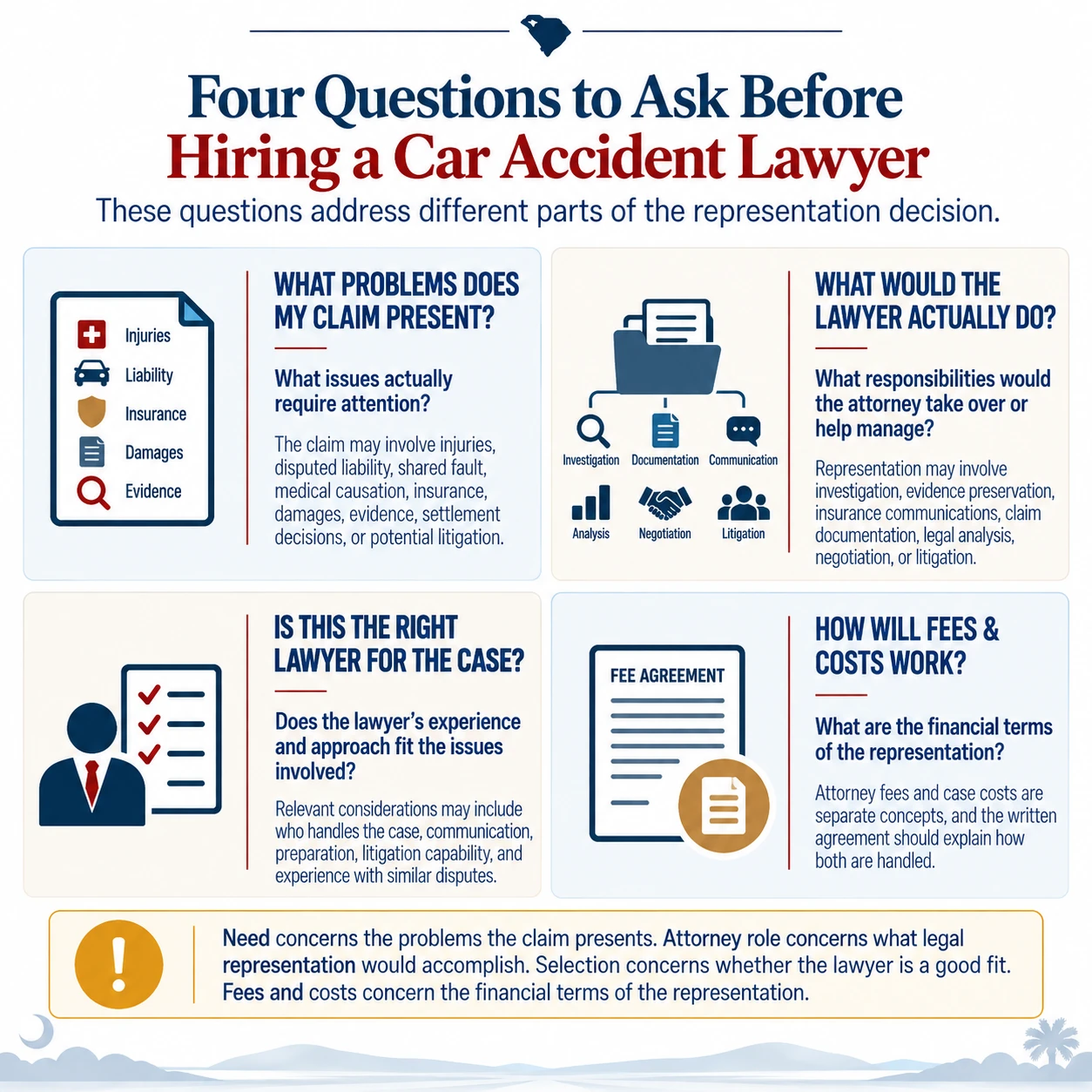
These questions address different parts of the representation decision.
What Problems Does My Claim Present?
What issues actually require attention?
Consider whether the claim involves significant injuries, disputed liability, shared fault, medical causation, insurance coverage, damages, evidence, settlement decisions, or potential litigation.
The problems in the claim help define the type of legal help that may be useful.
What Would the Lawyer Actually Do?
What responsibilities would the attorney take over or help manage?
Depending on the circumstances, that could involve investigation, evidence preservation, insurer communications, claim documentation, legal analysis, negotiation, or litigation.
Understanding the lawyer’s actual role gives you a better basis for evaluating the value of representation.
Is This the Right Lawyer for the Case?
Who will handle the matter, and does the lawyer’s approach fit the issues involved?
Relevant questions can involve experience with similar disputes, communication, case preparation, litigation capability, who will be responsible for day-to-day work, and how decisions will be made with you.
How Will Fees and Costs Work?
What are the financial terms of the representation?
The attorney fee and expenses associated with developing or litigating the case are separate concepts. The written agreement should explain how the attorney is paid and how expenses will be handled.
Need concerns the problems the claim presents. Attorney role concerns what legal representation would accomplish. Selection concerns whether the lawyer is a good fit for those problems. Fees and costs concern the financial terms of the representation.
Start With Our Complete Car Accident Lawyer Guides
These two guides answer the broadest questions about representation. Start with the one that most closely matches the decision you are trying to make.
Do I Need a Lawyer After a South Carolina Car Accident?
This guide explains circumstances that may make legal representation more important, including significant injuries, disputed fault or causation, complex insurance issues, disappearing evidence, substantial financial losses, settlement decisions, and potential litigation.
What Does a South Carolina Car Accident Lawyer Do?
This guide explains the attorney’s role in investigating a collision, preserving evidence, dealing with insurers, evaluating liability and damages, documenting the claim, negotiating resolution, managing legal issues, and preparing for litigation when necessary.
Common Questions About Hiring a Car Accident Lawyer
If you already know which part of the representation decision concerns you, these resources address more specific questions.
Choosing and Hiring a Lawyer
When Should I Hire a Car Accident Lawyer in South Carolina?
The question is not necessarily how quickly everyone should hire an attorney. It is whether circumstances in your particular claim make legal involvement more useful at a certain point. Learn how injuries, evidence, insurer communications, settlement decisions, disputed issues, and potential litigation can affect timing.
What Questions Should I Ask a South Carolina Car Accident Lawyer?
An initial conversation with a lawyer can help you evaluate more than credentials. Learn what to ask about who will handle the case, communication, relevant experience, litigation preparation, fees and costs, and what the attorney expects from you during the representation.
How Does Workers’ Compensation Work if I’m Hit by Someone Else While Working?
If you are injured in a car accident while working, you may have questions about both workers’ compensation benefits and a potential claim against the driver who caused the crash. Learn how these two types of claims can differ, how they may interact, and what issues may need to be considered when someone other than your employer or coworker caused the accident.
Fees and Costs
How Much Does a Car Accident Lawyer Cost in South Carolina?
Personal injury representation is commonly offered through contingency-fee arrangements, but the actual financial terms depend on the agreement. Learn how attorney fees and case costs differ, what a written fee agreement should address, and what financial questions to ask before hiring a lawyer.
Delayed Hiring
Is It Ever Too Late to Hire a Lawyer for an Old Accident?
The passage of time can affect evidence, witnesses, insurance issues, and legal deadlines. Learn why an open insurance claim does not necessarily preserve every legal right and why the circumstances and applicable deadlines need to be evaluated when an accident happened months or years ago.
Access to Medical Treatment
Can a Lawyer Help If I Don’t Have Health Insurance?
Lacking health insurance can make treatment and medical-billing decisions more difficult after an accident. Learn about the issues that may need to be considered when an injured person does not have health coverage and what role an attorney may be able to play.
Important Lawyer and Legal Strategy Distinctions
Several ideas about hiring a lawyer are commonly treated as interchangeable when they actually answer different questions.
Needing Legal Information ≠ Necessarily Needing Representation
Someone can need reliable legal information without necessarily needing to hire an attorney for every claim. The seriousness and complexity of the particular situation matter.
Hiring a Lawyer ≠ Filing a Lawsuit
Hiring an attorney does not mean a lawsuit must immediately be filed. A lawyer may assist with investigation, evidence, insurance, claim development, negotiation, and other matters before litigation becomes necessary.
Lawyer Selection ≠ Choosing the Biggest Advertisement
Advertising visibility does not tell you who will actually handle your case, how communication will work, what experience is relevant to your issues, or how the case will be prepared. Those questions should be evaluated directly.
Attorney Fees ≠ Case Costs
Attorney fees pay for legal representation. Case costs are expenses associated with investigating, developing, or litigating the matter. How both are handled should be addressed in the written fee agreement.
Consultation ≠ Obligation to Hire
Speaking with a lawyer about a potential claim does not itself establish the terms of representation. If you decide to hire an attorney, the engagement and financial terms should be addressed through the appropriate written agreement.
Settlement Experience ≠ Trial Experience
Negotiating injury claims and preparing and presenting cases for trial involve overlapping but distinct skills. When litigation is a realistic possibility, it can be useful to understand the lawyer’s experience with both.
Early Legal Help ≠ Automatic Lawsuit
Early involvement may focus on preserving evidence, identifying insurance, handling insurer communications, documenting the claim, or evaluating legal issues. A lawsuit is a separate strategic and procedural decision.
When Can Legal Representation Become More Important?
Not every car accident necessarily requires an attorney. Certain circumstances, however, can make a claim more complicated or make the decisions involved more significant.
Significant or Ongoing Injuries
Substantial treatment, future medical needs, lasting symptoms, or long-term limitations can create more complex medical and damages issues.
Disputed Liability or Shared Fault
When responsibility is contested, evidence and South Carolina’s comparative-fault rules may become more important.
Disputed Medical Causation
An insurer may accept that a collision occurred while disputing whether it caused particular injuries, treatment, or limitations.
Complex Insurance Issues
Multiple vehicles or policies, UM/UIM coverage, commercial insurance, or potentially inadequate liability limits can complicate the insurance analysis.
Significant Financial Losses
Lost income, future earning effects, continuing medical expenses, liens, or other substantial losses can require more detailed documentation and evaluation.
Potential Litigation
When negotiations fail or significant issues remain disputed, formal litigation may become necessary.
What Can a Car Accident Lawyer Help With?
A lawyer’s role depends on the problems presented by the particular claim. These categories provide a high-level overview of what representation may involve.
Investigation & Evidence
A lawyer may investigate the collision and identify, gather, or preserve evidence relevant to disputed issues.
Insurance & Communications
A lawyer may identify potentially applicable insurance and handle claim-related communications with insurers and other parties.
Medical & Damages Documentation
A lawyer may help develop documentation concerning medical treatment, injuries, income loss, future needs, and other claimed damages.
Claim Evaluation & Negotiation
A lawyer may evaluate liability, causation, damages, available recovery sources, and settlement proposals and negotiate on the client’s behalf.
Litigation & Trial Preparation
If the claim cannot be resolved, a lawyer may handle litigation and prepare the case for trial when necessary.
What Should You Evaluate Before Hiring a Car Accident Lawyer?
Choosing a lawyer should involve more than determining whether the attorney handles car accident cases.
Useful questions include:
- Who will actually handle my case?
- How will communication work?
- What experience is relevant to the issues in my claim?
- Is the lawyer prepared to litigate the case when necessary?
- How are attorney fees and case costs handled?
- What will the lawyer expect from me during the representation?
The goal is not simply to find a lawyer who handles car accidents. It is to understand who will handle the case, how the representation will work, and whether the lawyer’s experience and approach fit the issues involved.
Read: What Questions Should I Ask a South Carolina Car Accident Lawyer? →
How Do Car Accident Lawyer Fees Work?
Personal injury lawyers commonly use contingency-fee arrangements, with the attorney fee tied to a recovery under the terms of the written agreement.
Attorney fees and case costs are separate concepts. The agreement should explain how each will be handled.
Read: How Much Does a Car Accident Lawyer Cost in South Carolina? →
Does It Matter When You Hire a Lawyer?
Timing can matter because evidence may disappear, memories may fade, insurers may request statements or documents, settlement decisions may arise, and legal deadlines can affect the ability to pursue a claim.
Hiring a lawyer early does not mean a lawsuit must be filed immediately. Early representation may instead involve preserving evidence, identifying insurance, developing the claim, evaluating disputed issues, or handling communications and decisions as they arise.
If considerable time has already passed, the relevant question becomes different: what rights, evidence, insurance issues, and deadlines remain now?
Read: When Should I Hire a Car Accident Lawyer in South Carolina? →
Read: Is It Ever Too Late to Hire a Lawyer for an Old Accident? →
What Can Affect Legal Strategy After a Car Accident?
There is no single legal strategy that fits every injury claim. The appropriate approach depends on the problems that need to be addressed and can change as the case develops.
The Disputed Issues
Is the central problem liability, comparative fault, medical causation, damages, insurance coverage, credibility, or another issue?
Strategy should begin with understanding what actually needs to be established or challenged.
The Available Evidence
What evidence already exists? What information may disappear? What additional documents, testimony, medical evidence, or other proof may need to be developed?
The evidentiary picture can influence both claim strategy and litigation decisions.
The Stakes and Recovery Sources
How serious are the injuries and losses, and what insurance or other potential recovery sources may be available?
The practical stakes of a claim can affect which issues require the greatest attention.
The Stage of the Claim
A strategy appropriate during early investigation may differ from one used during negotiation, mediation, litigation, or trial preparation.
New evidence, medical developments, coverage information, and legal rulings can also change how a claim should be evaluated.
Legal strategy should respond to the actual problems in the claim. The appropriate approach may change as evidence develops, medical information becomes clearer, insurance issues are identified, or the dispute moves toward litigation.
Gary's Take: Start With the Problem, Not the Lawyer
“I don’t start with the idea that every car accident automatically requires a lawyer. I start by asking what problems the injured person is facing.”
“What needs to be protected? What needs to be proven? Is there a dispute about fault, medical causation, insurance coverage, or the extent of the losses? Is important evidence at risk? Is the insurance company asking the person to make a decision they don’t fully understand?”
“Once we know the problems, we can identify the work that needs to be done and the experience that work requires. That gives someone a much better way to decide whether legal representation can actually help.”
“The question isn’t simply, ‘Do I need a lawyer?’ It’s, ‘What does my situation require, and who is equipped to handle it?'” says Gary Christmas.
Related South Carolina Car Accident Topics
Hiring a lawyer is connected to the underlying insurance, medical, evidence, financial, and litigation issues in the claim. Use these sections to continue with the subject most relevant to your situation.
| If You're Trying to Understand… | Start Here |
|---|---|
| The insurance claim, adjuster, or coverage | Insurance & Claims → |
| Your injuries, symptoms, or medical treatment | Medical Treatment, Injuries & Recovery → |
| Who was at fault or what evidence matters | Evidence, Liability & Case Strength → |
| What losses may be recoverable or how settlement works | Settlement Value & Financial Recovery → |
| What happens if the dispute goes to court | Lawsuits & Litigation → |
| Whether, when, or how to hire an attorney | Hiring a Lawyer & Legal Strategy → |
Questions About Hiring a South Carolina Car Accident Lawyer?
You may not know whether your situation requires representation, and you do not need to make that decision based solely on an advertisement or a general rule about accident claims.
Legal guidance may be worth considering when:
- Your injuries are significant or continuing.
- Fault or medical causation is disputed.
- Multiple insurance policies may apply.
- Important evidence may disappear.
- An insurer wants a statement or release you do not understand.
- You have received a settlement offer that needs to be evaluated.
- Medical bills or lost income are substantial.
- You have questions about attorney fees or case costs.
- Considerable time has passed since the accident.
- Litigation may become necessary.
If you are unsure whether legal representation makes sense for your situation, Christmas Injury Lawyers can review the circumstances of the accident and discuss the legal and insurance issues that may affect your claim.