

Why Is Dash Cam Footage Important?
| Benefit | Why It Matters |
|---|---|
| Shows how the crash occurred | Helps establish liability |
| Captures driver behavior | May disprove false claims |
| Documents road conditions | Adds context |
| Can support or contradict witness accounts | Helps evaluate disputed facts |
| Preserves an independent recording | May help clarify factual disputes |
| Provides evidence for claim evaluation or litigation | Helps clarify disputed issues |
| May reveal unexpected facts | Benefits either side |
Can Dash Cam Footage Change the Outcome of a Case?
In cases we have handled, dash cam and other video footage has sometimes changed our understanding of how the collision occurred. Video from vehicles, homes, businesses, traffic cameras, or security systems can reveal facts that were not clear from the accident report or the drivers’ accounts.
When two drivers give different versions of what happened, video may provide independent evidence that helps determine which account is supported by the sequence of events.
Depending on what the camera captures, footage may help establish fault, test competing accounts, or reveal facts that were not apparent from the collision report or witness statements. It can be powerful evidence, but it should never be assumed to tell the entire story.
In many cases, dash cam footage has helped establish fault, disprove false claims, and provide a much clearer understanding of how the accident happened. It can be some of the most powerful evidence available in an accident case.
What Mistakes Should I Avoid When Preserving Dash Cam Video?
One of the biggest mistakes you can make with dash cam footage is assuming that because the video exists today, it will still be there when you need it.
Many dash cams record continuously and automatically overwrite older footage as the storage card fills up. Other video systems may retain recordings for only a limited period of time. If you believe a camera captured your accident, preserving that footage should be a priority.
Here are some of the mistakes I would avoid:
1. Allowing the recording to be overwritten.
Do not continue using a dash cam without first making sure the accident footage has been saved or locked. Depending on the device and its settings, continued recording could eventually overwrite the very evidence you are trying to preserve.
2. Editing or altering the original video.
Do not trim the footage, add captions, apply filters, change the playback speed, annotate the recording, or otherwise modify your only copy. There may be reasons later to create shorter clips or working copies, but the original recording should be preserved exactly as it was captured whenever possible.
3. Keeping only a text-message or social-media copy.
Sending a video through a text message, messaging application, or social-media platform can create a compressed or altered copy of the recording. That copy may not contain the same video quality or information as the original file. Do not treat a version saved from social media or a message thread as a substitute for preserving the original.
4. Failing to preserve the original file.
Keep the original recording in its original format whenever possible. The original file may become important when questions arise about where the video came from, whether it is complete, or whether it has been altered.
5. Keeping the footage in only one place.
Phones get lost. Memory cards fail. Computers break. Files can accidentally be deleted. Once you have preserved the original footage, create backup copies and store them in more than one secure location.
6. Failing to document where the video came from.
If possible, make a note of which camera recorded the footage, the vehicle or location associated with the camera, who possessed the recording, and when and how you obtained the copy. If the footage came from a business, homeowner, witness, or another driver, preserve that information as well.
7. Saving only the few seconds immediately surrounding the collision.
Do not assume the moment of impact is the only part that matters. Footage from before the crash may show traffic signals, lane positions, vehicle movements, road conditions, braking, or other driver behavior. Footage afterward may also capture vehicle positions, statements, people at the scene, or other relevant information. Preserve more footage than you think you will need.
8. Posting the video publicly before you understand everything it shows.
A recording can contain details you did not notice the first time you watched it. Once you post footage online, it can be copied, shared, edited, commented on, and viewed without the context of the other evidence in the case. Preserve the recording first and understand everything it shows before deciding how it should be used.
I tell people to treat accident video like any other important piece of evidence: preserve the original, do not alter it, make secure backup copies, and keep enough information to establish where it came from.
The goal is not to create the version of the video that looks best for your claim. The goal is to preserve what the camera actually recorded.
Why Is It Important to Preserve Video Evidence Quickly?
Video evidence can disappear quickly. If dash cam or other footage exists and you have the ability to preserve it, act as soon as reasonably possible.
Whether the recording comes from your own vehicle, another vehicle, a nearby business, or a residential security system, the sooner the source is identified and the footage is preserved, the less likely it is to be overwritten or deleted.
Can Dash Cam Footage Hurt My Case?
Video evidence is often excellent evidence because cameras generally capture events as they happen. For that reason, dash cam footage can help either side depending on what it shows.
Sometimes the footage strongly supports our client’s version of events. Other times, it may support the insurance company’s position regarding liability or fault.
The important point is that video evidence can cut both ways. Review everything the footage shows, including what happens before and after the collision, before making assumptions about how it affects liability.
What Types of Car Accidents Benefit Most From Dash Cam Evidence?
Dash cam footage can potentially be useful in many different types of accidents.
People often think of trucking accidents, road rage incidents, or high-speed collisions, but dash cam footage can be valuable in ordinary rear-end collisions, intersection accidents, lane-change accidents, parking lot incidents, and countless other situations.
The reason is simple: liability is one of the most important issues in every accident case. In a liability claim against another driver, proving how the collision happened and who was legally responsible can be critical.
Dash cam footage can often help tell the story of how the accident occurred and who was responsible.
How Should I Preserve Dash Cam Footage After an Accident?
- Stop the footage from being overwritten. Lock or save the relevant recording as soon as you safely can.
- Preserve the original file. Keep the original recording in its native format whenever possible. Do not edit, crop, filter, annotate, or change it.
- Create backup copies. Save copies in more than one secure location, such as a computer and cloud storage.
- Preserve enough footage before and after the collision. Footage from before and after the impact may show traffic signals, lane position, vehicle movement, braking, driver behavior, vehicle positions after impact, or other facts that later become important.
- Record where the footage came from. Note the device, vehicle, camera owner, date, time, and location associated with the recording when that information is available.
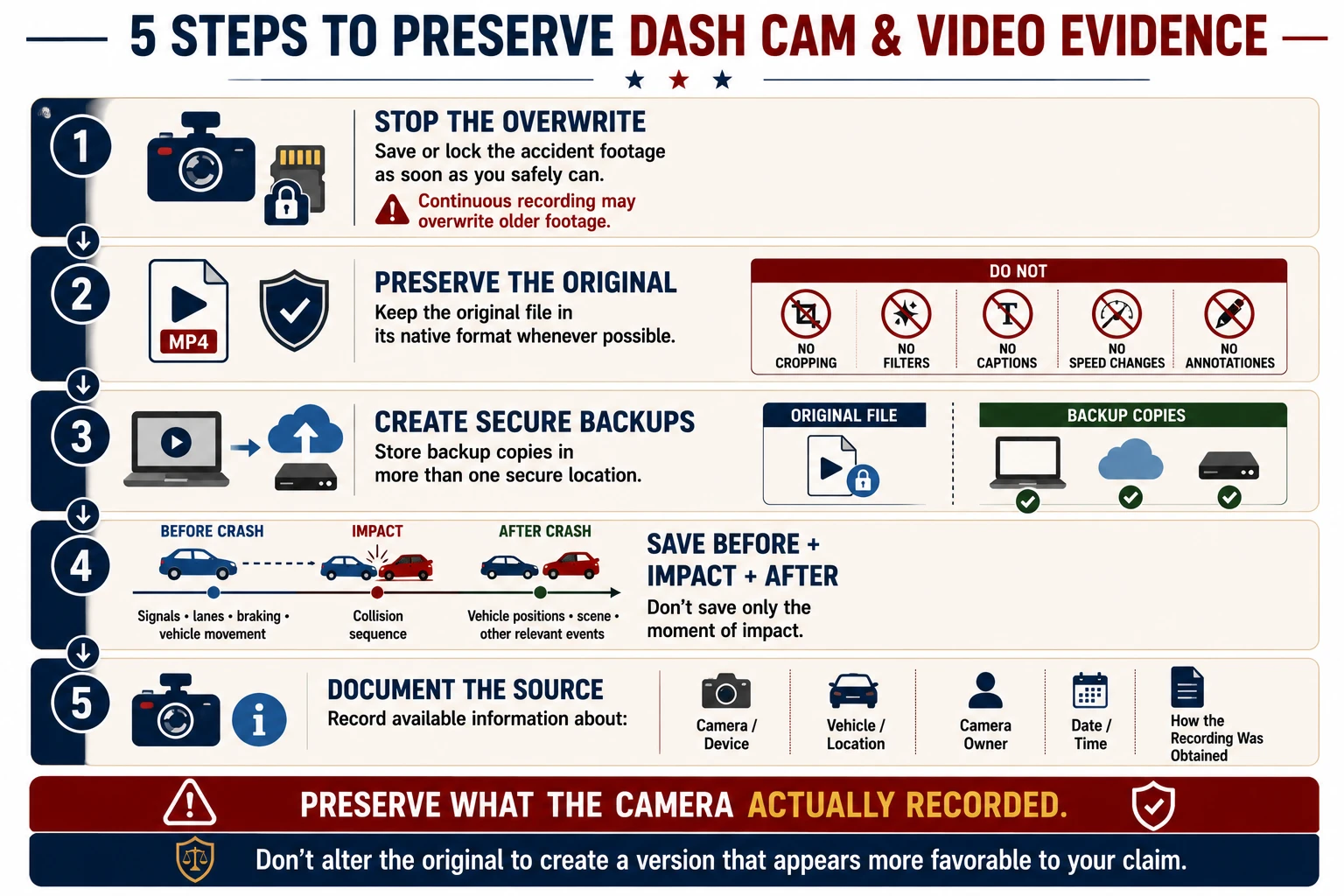
Preserve what the camera actually recorded. Don’t alter the original to create a version that appears more favorable to your claim.
What If Someone Else Has the Video of My Accident?
If another person, business, or organization may have recorded the accident, identify that source as quickly as possible. Ask where the camera was located, who controls the recording system, and how long recordings are normally retained.
Some systems automatically overwrite footage after a relatively short period of time. Depending on who controls the recording and the circumstances of the case, a preservation request, formal discovery, subpoena, public-records procedure, or other legal process may be necessary to obtain it.
The important point is to identify potential video sources early. Once footage has been overwritten or deleted in the ordinary course of a recording system, it may be impossible to recreate.
Where Else Should I Look for Video After a Car Accident?
Dash cam footage is only one possible source of video evidence after a car accident. Depending on where the collision happened, cameras on nearby homes, businesses, buildings, and other vehicles may have captured the accident itself or important events immediately before or after it. The key is to identify those potential sources quickly. Many recording systems automatically overwrite older footage, so video that exists shortly after an accident may no longer be available weeks or months later.
- Nearby businesses
- Homes and doorbell cameras
- Apartment complexes
- Parking garages
- Gas stations
- Commercial vehicles
- Buses
- Rideshare vehicles
- Law-enforcement recordings where applicable
- Traffic or roadway camera systems where footage exists
I tell people not to look only at the vehicles involved in the crash. Look around the entire scene and ask what cameras could have been pointed toward the roadway.
Sometimes the most useful recording is not from a vehicle involved in the collision at all. It may come from a camera across the street, a business parking lot, a nearby home, or another vehicle that happened to be in the right place at the right time.
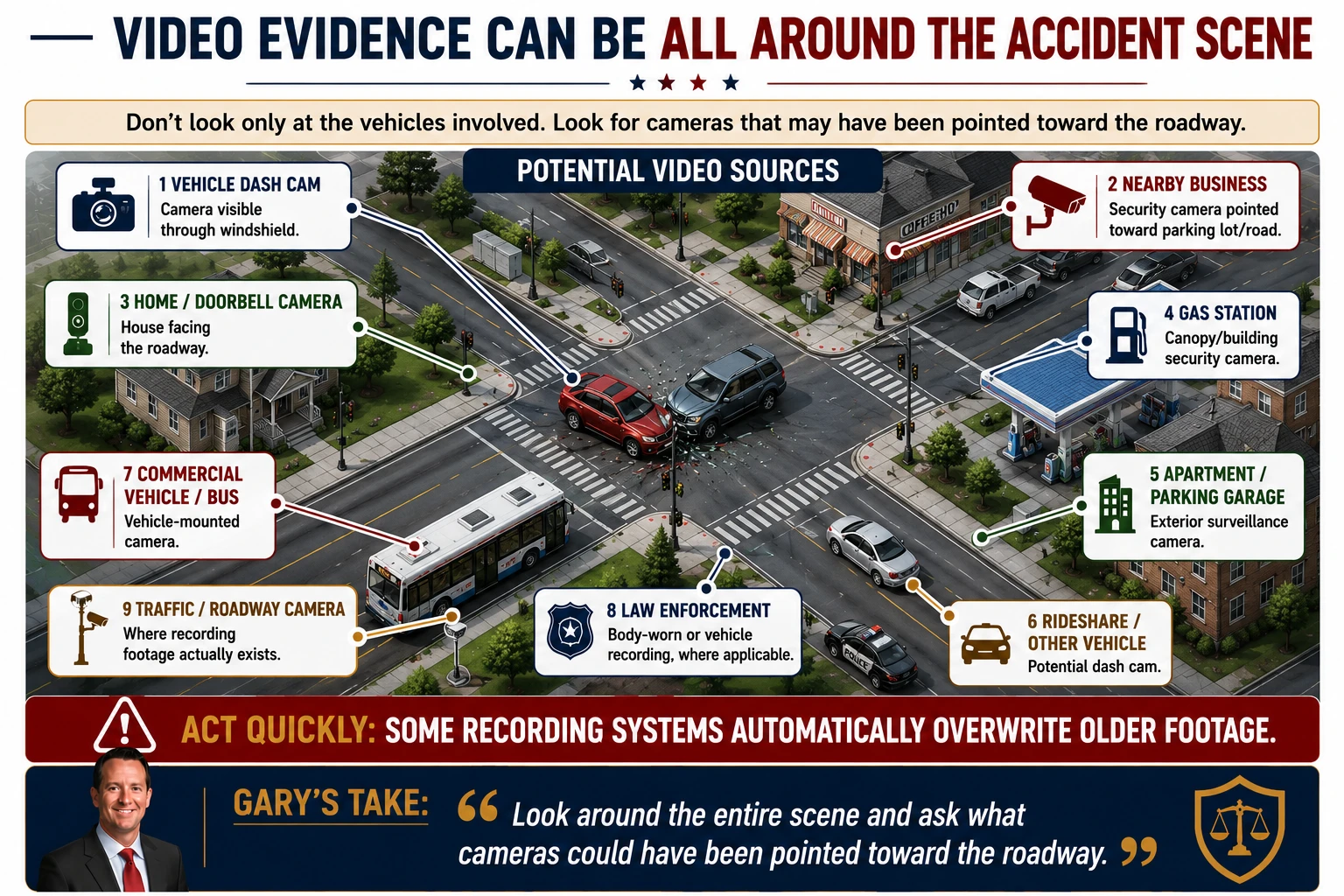
Act quickly. Some recording systems automatically overwrite older footage. Look around the entire scene and ask what cameras could have been pointed toward the roadway.
Can Dash Cam Video Be Used as Evidence in a South Carolina Car Accident Case?
Potentially, yes. Like other recordings and electronic evidence, dash cam footage must satisfy the applicable South Carolina Rules of Evidence to be admitted at trial.
One important issue is authentication, showing that the recording is what it is claimed to be. That is another reason to preserve the original file, avoid editing it, and keep information about where the footage came from.
Admissibility ultimately depends on the particular recording and the issues in the case. Preserving the footage properly gives you a much better starting point than trying to reconstruct or authenticate an altered copy later.
Can Dash Cam Video Be Especially Important in a South Carolina Hit-and-Run Case?
Yes. Video can be particularly important when the other driver leaves the scene or cannot be identified.
South Carolina law contains specific requirements for certain uninsured-motorist claims involving an unknown driver. In a no-contact accident, an electronic or other recording showing that the unknown vehicle caused the injury or damage can be one way of satisfying part of the statutory framework.
That makes preserving dash cam, surveillance, doorbell, or other video especially important when an unidentified vehicle causes a crash without actually striking your vehicle.
What Other Evidence Should I Collect Along With Dash Cam Footage?
Preserve as much relevant accident evidence as you reasonably can. Video can be important, but it is only one piece of the larger evidentiary picture.
Take photographs of the vehicles, accident scene, road conditions, skid marks, debris, traffic signs, and visible injuries when appropriate. Get names and contact information for witnesses. Preserve the collision report and insurance information, and photograph vehicle license plates when useful.
I tell clients that you never know which piece of evidence will ultimately become important. The goal is to preserve the evidence that exists before it changes or disappears.
Should I Post My Dash Cam Video on Social Media?
I generally would not post accident video publicly while an injury claim is pending. Once a recording is posted online, it can be copied, shared, edited, commented on, and viewed without the context of the other evidence in the case.
Preserve the original recording instead. Before deciding how the video should be used, understand everything it shows, including what happens before and after the collision.
Does Dash Cam Footage Automatically Win the Case?
One of the biggest misconceptions is that dash cam footage automatically wins the case.
While video evidence can be incredibly powerful in proving liability, liability is only one part of an accident claim. There are still medical issues, damages issues, insurance issues, causation issues, and many other factors that affect the outcome of a case.
We have seen people believe that because they had dash cam footage proving fault, they could handle the claim themselves. Unfortunately, they later discovered that proving fault was only one piece of a much larger puzzle.
Simply put, you do not know what you do not know. I tell clients that good liability evidence may answer one important question, but it does not answer every question in the case. You still may need to establish medical causation, the nature and extent of your injuries, damages, available insurance coverage, and other issues that affect the claim.
Dash cam footage can be powerful evidence. It is not an automatic win.
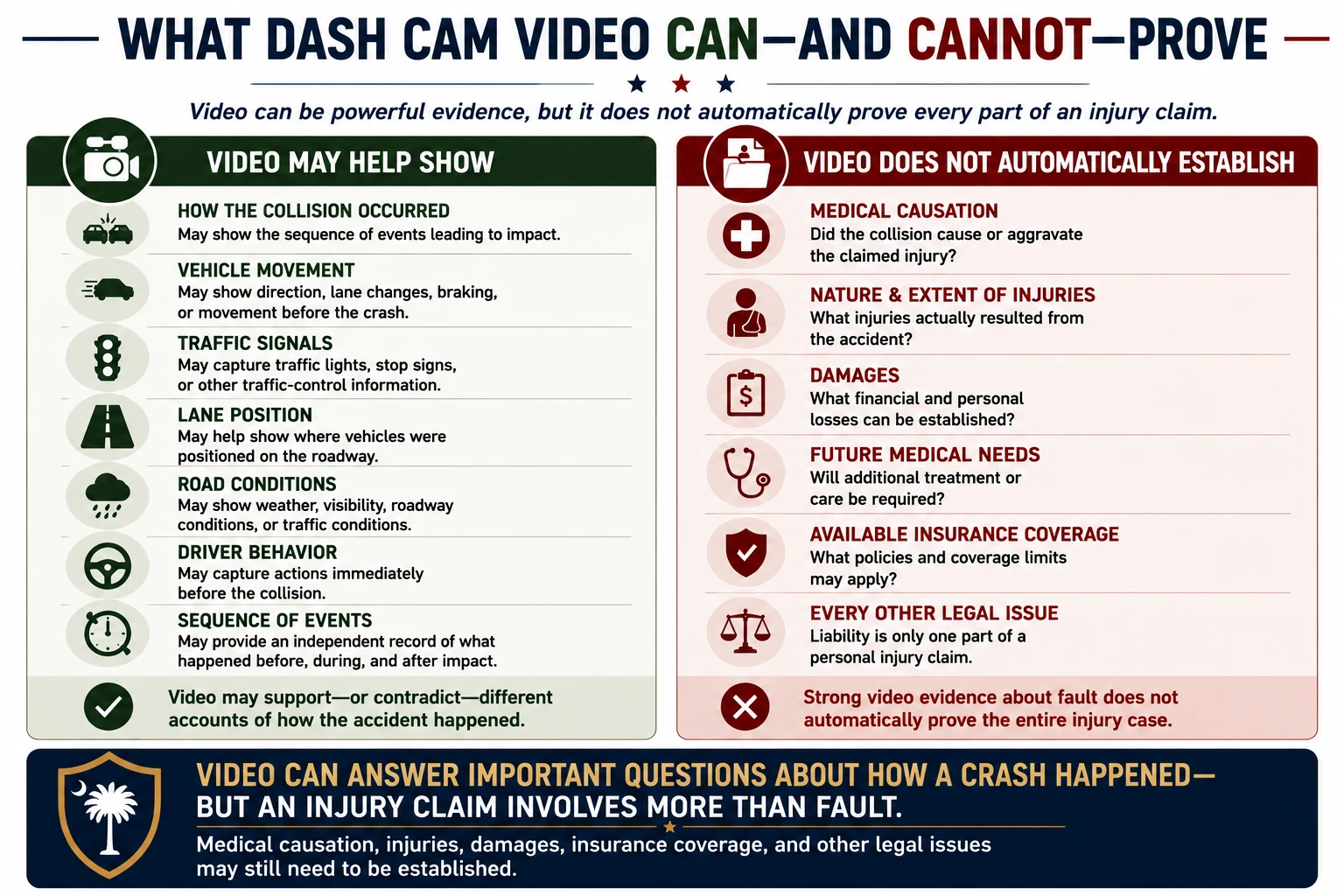
Video can answer important questions about how a crash happened, but an injury claim involves more than fault. Medical causation, injuries, damages, insurance coverage, and other legal issues may still need to be established.
How to Protect Dash Cam Evidence
- Save the footage before it can be overwritten
- Preserve the original, unedited file
- Create multiple secure backup copies
- Preserve footage from before and after the collision
- Do not crop, filter, annotate, or alter the original
- Record where the footage came from
- Identify nearby cameras that may also have captured the crash
- Act quickly if another person or business controls the footage
- Do not post the recording publicly while the claim is pending
- Preserve photographs, witness information, and other accident evidence
In Summary
Dash cam and other video footage can be important evidence after a South Carolina car accident, but the first priority is to identify and preserve the recording before it disappears. Dash cams, surveillance systems, doorbell cameras, and other recording systems may automatically overwrite older footage, so potential video sources should be identified as quickly as reasonably possible.
If you already have the footage, preserve the original, unedited file and create secure backup copies. Do not crop, filter, annotate, change the playback speed, or otherwise alter your only copy of the recording. Preserve enough footage from before and after the collision to provide context, and keep information about where the recording came from.
Do not limit your search to the vehicles involved in the accident. Nearby businesses, homes, doorbell cameras, apartment complexes, parking garages, gas stations, commercial vehicles, buses, rideshare vehicles, law-enforcement recordings where applicable, and traffic or roadway camera systems may also contain useful evidence. If someone else controls the footage, acting quickly can be important because the recording may eventually be overwritten or deleted.
Dash cam footage can help establish how a collision occurred, but video can help either side depending on what it actually shows. A recording may support one driver’s account, contradict it, reveal facts no one initially noticed, or provide only part of the story. That is why you should understand the entire recording, including what happened before and after impact, before making assumptions about what it proves.
Video evidence may also have particular importance in some South Carolina hit-and-run cases. In certain unknown-driver accidents involving no physical contact, an electronic or other recording showing that the unknown vehicle caused the injury or damage can be one way of satisfying part of South Carolina’s statutory framework.
If a case proceeds to court, video evidence must satisfy the applicable South Carolina Rules of Evidence. Authentication, showing that the recording is what it is claimed to be, can become important. Preserving the original recording, avoiding unnecessary alterations, and documenting where the footage came from can help protect the integrity of that evidence.
Most importantly, dash cam footage is one piece of an injury claim, not an automatic win. Even strong video evidence concerning fault does not necessarily establish medical causation, the nature and extent of the injuries, damages, available insurance coverage, or every other issue that may affect the claim.