

Does the Insurance Company's First Offer Tell Me What My Case Is Worth?
No. An insurance company’s offer is a settlement position, not an objective determination of what your case is worth.
Case value depends on the evidence and legal issues, including liability, causation, injuries, medical treatment, prognosis, lost income, future losses, comparative fault, available coverage, and litigation risk.
An offer can be evaluated against those factors, but the fact that an insurance company offered a particular number does not make that number the value of the case.
What Should Be Evaluated Before You Accept a Settlement Offer?
| Issue | Why It Matters |
|---|---|
| Liability | Disputed fault can affect the strength and value of the claim |
| Medical diagnosis and prognosis | The full nature and long-term effects of the injuries may not yet be clear |
| Future medical needs | Additional treatment or care may affect damages |
| Lost income and earning capacity | Current and future work losses may need to be evaluated |
| Permanent limitations | Long-term effects on work and daily life may matter |
| Insurance coverage | All potentially applicable coverage should be identified |
| Medical bills and reimbursement claims | Liens or reimbursement rights may affect what you ultimately receive |
| Release terms | The agreement may resolve some or all legal claims arising from the accident |
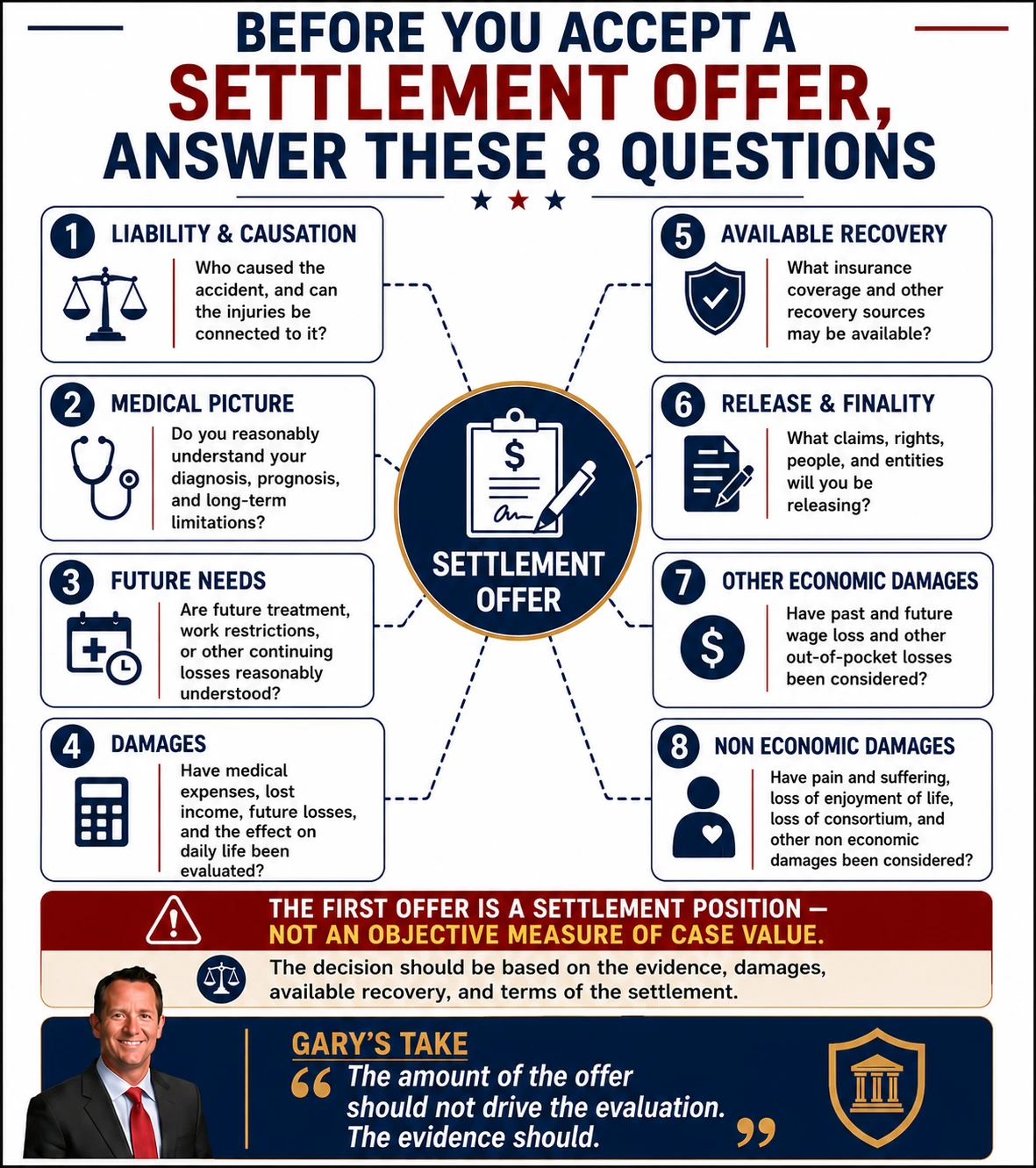
The first offer is a settlement position, not an objective measure of case value. The decision should be based on the evidence, damages, available recovery, and terms of the settlement.
Should I Accept the Insurance Company's First Settlement Offer?
My answer is almost always the same: do not accept the first offer simply because it puts money on the table. First, make sure you understand the injuries, damages, available coverage, and exactly what rights you will be giving up.
The reason is simple. It can take weeks, months, or even longer to fully understand the damages in a case. Doctors may still be evaluating injuries. Treatment may still be ongoing. Future medical needs may not yet be known. Permanent impairment may not yet have been determined.
Until the medical picture and other important damages are sufficiently understood, it may be difficult to reasonably evaluate whether an offer fairly resolves the claim.
What Happens If I Accept a Settlement Too Early?
Over the years, we have met with many people who accepted a quick settlement before speaking with a lawyer.
When you settle an injury claim, the insurance company will typically require a release describing the claims and rights being resolved. A valid release can prevent you from later pursuing additional damages covered by that agreement, even if your medical condition later becomes worse than you expected.
That is why the language of the release matters. Before signing, you should understand which claims and parties are being released and whether the injuries and damages being resolved can be reasonably evaluated.
If significant future medical needs, permanent limitations, lost earning capacity, or other damages are still uncertain, accepting a final settlement may carry substantial risk.
What Should Make Me Slow Down Before Accepting an Early Settlement Offer?
An early offer deserves careful review when important information is still unknown.
You may want to slow down when:
- Your diagnosis is still developing
- Treatment or additional evaluation is ongoing
- Future medical needs are unknown
- You are still missing work
- Long-term restrictions or limitations are unclear
- Liability is disputed
- All available insurance coverage has not been identified
- Medical liens or reimbursement claims have not been evaluated
- You do not understand the release
- You are being asked to make a decision before you have the information needed to evaluate the claim
The concern is not simply that the offer came early. The concern is whether you know enough to make an informed decision.
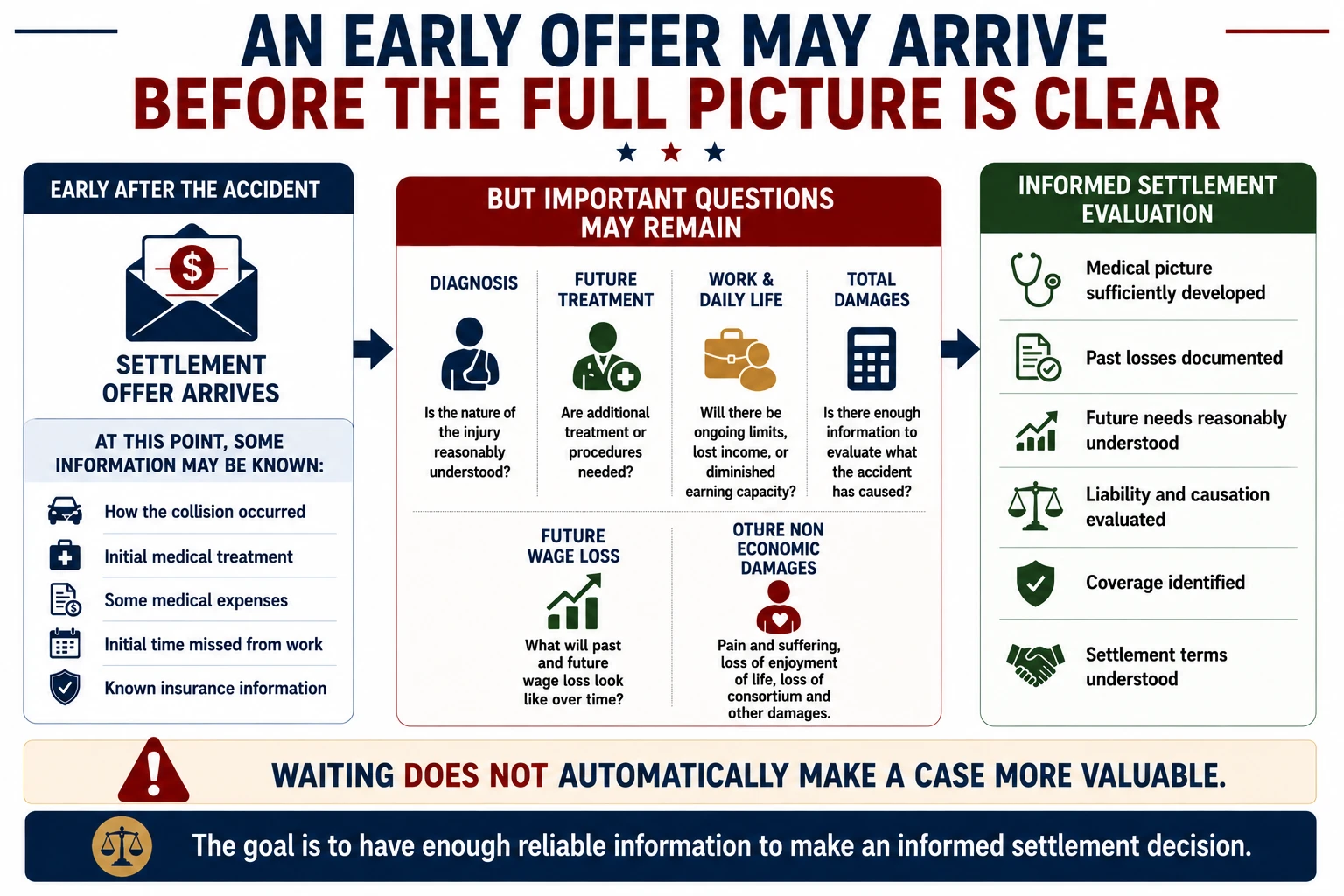
Waiting does not automatically make a case more valuable. The goal is to have enough reliable information to make an informed settlement decision.
What Issues May an Insurance Adjuster Raise During Settlement Negotiations?
An adjuster may evaluate the claim differently than you do.
Settlement discussions may involve disputes about who caused the accident, whether the crash caused all of the injuries being claimed, whether medical treatment was reasonable and related, whether treatment gaps matter, the effect of preexisting conditions, lost income, future medical needs, and the amount of non-economic damages.
An adjuster may also point to vehicle damage, medical records, prior statements, photographs, social-media content, or other evidence when explaining the company’s position.
The important thing is to understand why the offer is being made and which facts or legal issues are affecting the insurance company’s evaluation.
Why Can Some Injuries Be Difficult to Evaluate Early?
Some injuries are difficult to evaluate shortly after an accident because the diagnosis, response to treatment, prognosis, or long-term limitations may not yet be clear.
For example, symptoms initially treated as a strain may later lead to additional testing and a different diagnosis. A shoulder injury may require further evaluation before the extent of the condition and any future treatment needs are understood.
That does not mean every injury becomes more serious over time. It means a settlement decision should be based on the medical information actually available, rather than assumptions about what the future will bring.
When Is a Car Accident Claim Ready for Serious Settlement Evaluation?
There is no single point in every case when settlement discussions should begin. The important question is whether enough reliable information exists to reasonably evaluate the claim.
That may include understanding the diagnosis, treatment to date, prognosis, future medical needs, permanent limitations, lost income, future earning effects, liability issues, available insurance coverage, and other damages.
In some cases, a doctor may determine that the patient has reached maximum medical improvement, meaning the condition has stabilized to a point where further substantial improvement may not be expected. That information can be useful when evaluating long-term damages, but MMI is not a universal prerequisite to settlement in every personal injury case.
The goal is not to wait for a particular label. The goal is to understand enough about the case to make an informed settlement decision.
How Do Experienced Trial Lawyers Negotiate With Insurance Companies?
The best negotiation strategy begins with preparation.
We strongly believe that every case should be prepared as though it is going to trial. That means gathering evidence, understanding the medical evidence, documenting damages, and fully understanding both the strengths and weaknesses of the case.
We also believe serious settlement evaluation is most effective when the medical picture and other important damages are sufficiently developed to allow the claim to be reasonably evaluated.
Simply put, lowball offers should not drive the process. The evidence should.
What Should I Know Before Talking to the Insurance Company About Settlement?
I wish everyone understood one simple truth: you do not know what you do not know.
Accident cases involve complicated medical issues, legal issues, insurance issues, and damages issues. Most injured people are trying to navigate all of those things while also dealing with pain, medical treatment, missed work, and the stress of everyday life.
The insurance company has trained professionals evaluating liability, causation, injuries, damages, coverage, and settlement value from the company’s perspective. Their job is not to determine what legal decision is best for you.
How Can Trial Preparation Affect Settlement Negotiations?
Our negotiation strategy begins on day one.
The reason is simple: we prepare every case as though it is going to trial. We believe one of the best ways to approach settlement negotiations is to build the case so it is prepared to be presented to a jury if necessary.
If settlement discussions fail, we want to be ready. We want the evidence gathered, the witnesses identified, the medical evidence understood, and the case positioned for trial.
Trial preparation can also affect settlement negotiations because the other side can evaluate the evidence, witnesses, medical proof, damages, and litigation risks in a case that has been prepared for court.
If the case cannot be resolved on acceptable terms, preparation also means the client is not starting from scratch if litigation becomes necessary.
Can I Ask for More Money After Accepting a Settlement?
In many cases, a valid settlement and release will prevent you from seeking additional damages covered by that agreement.
The exact effect depends on the settlement terms and the rights and parties being released. That is why you should understand the document before signing it.
If your condition later becomes worse, you generally should not assume that you can simply reopen a claim that was fully and finally resolved. Settlement is intended to bring finality, which is why unresolved medical and damages issues matter before you agree to settle.
What Does Signing a Settlement Release Mean?
A settlement release is a legal agreement identifying the claims, parties, and rights being resolved in exchange for the settlement.
Depending on its language, signing a release can prevent you from pursuing additional damages covered by the agreement later. That is why the amount of the settlement is only part of the decision. You also need to understand what you are giving up in exchange for it.
Before signing, review which claims are being released, which people or entities are included, and whether there are any other provisions that affect your rights.
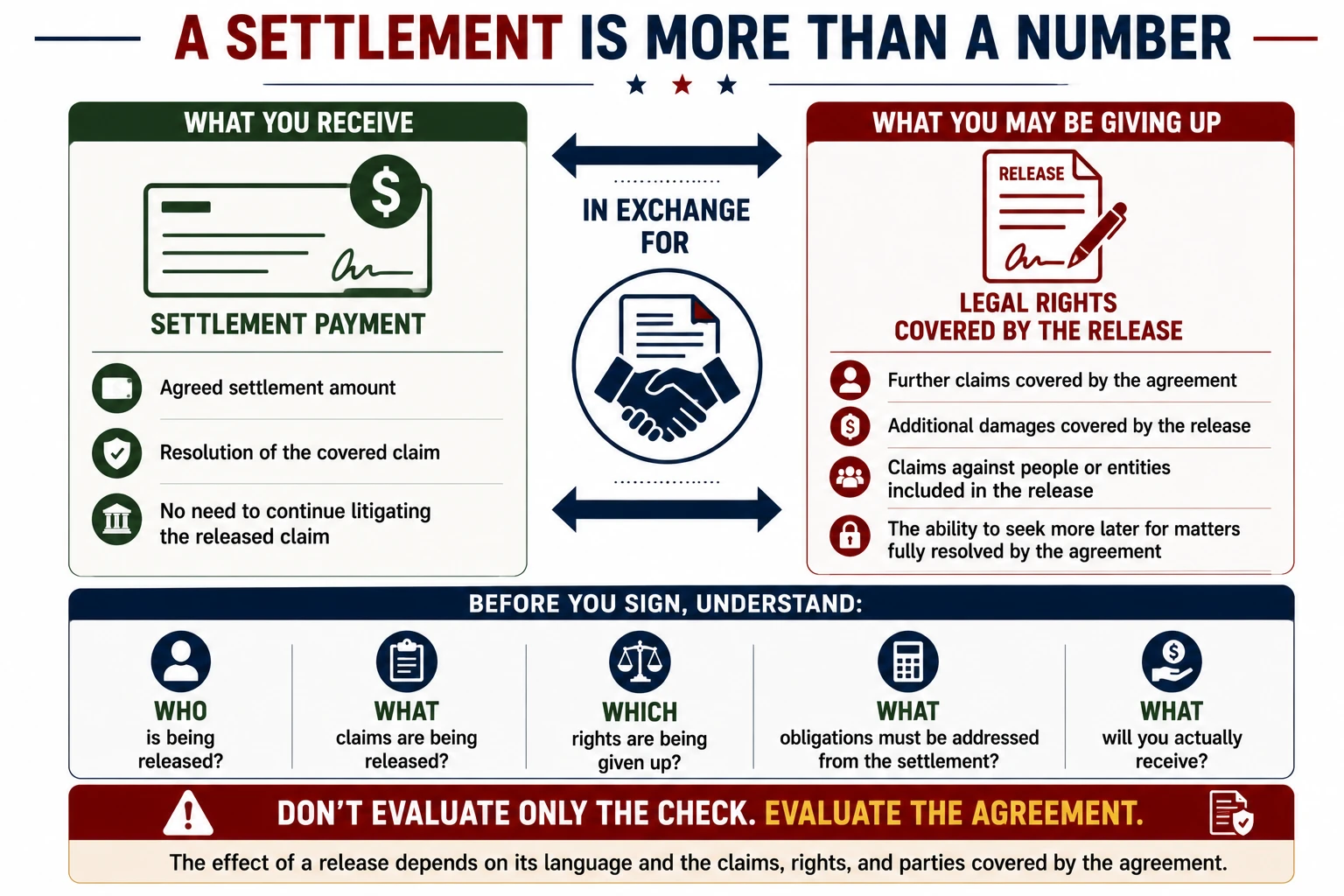
Don’t evaluate only the check. Evaluate the agreement. The effect of a release depends on its language and the claims, rights, and parties covered by the agreement.
Is the Settlement Offer the Amount I Will Actually Receive?
Not necessarily. The gross settlement amount and the amount you ultimately receive can be different.
Depending on the case, medical bills, valid liens, Medicare or Medicaid recovery rights, health-plan reimbursement claims, case expenses, and other obligations may need to be addressed from the settlement.
Before accepting an offer, understand both sides of the equation: the gross settlement amount and the valid bills, liens, reimbursement claims, expenses, or other obligations that may need to be addressed from it.
The number offered by the insurance company is not necessarily the amount that ultimately reaches you.
Before You Accept Any Settlement Offer
- Understand exactly what claims the offer is intended to resolve
- Make sure the medical picture is sufficiently developed
- Understand your diagnosis and prognosis
- Identify reasonably anticipated future medical needs
- Document past and potential future income losses
- Consider permanent limitations and effects on daily life
- Evaluate liability and any comparative-fault issues
- Identify potentially available insurance coverage
- Understand outstanding medical bills and valid reimbursement claims
- Review the terms and scope of the settlement release
- Understand what you are expected to receive after applicable obligations are addressed
- Do not make the decision simply because the offer is the first money placed on the table
In Summary
You should not accept an insurance company’s first settlement offer simply because money has been offered or because you want to put the accident behind you. A first offer is not automatically unreasonable, but before accepting it, you should have enough reliable information to evaluate the claim. That means understanding liability, causation, your diagnosis and prognosis, future medical needs, lost income and other damages, available insurance coverage, outstanding medical bills or reimbursement claims, and any other factors that may affect what the claim is reasonably worth.
You also need to understand exactly what you are agreeing to give up. A valid settlement release can prevent you from later pursuing additional damages covered by the agreement, even if your condition turns out to be worse than expected. The important question is not whether the offer is the insurance company’s first offer. The question is whether you understand the injuries, damages, evidence, available recovery, terms of the release, and what you may actually receive well enough to make an informed decision.