

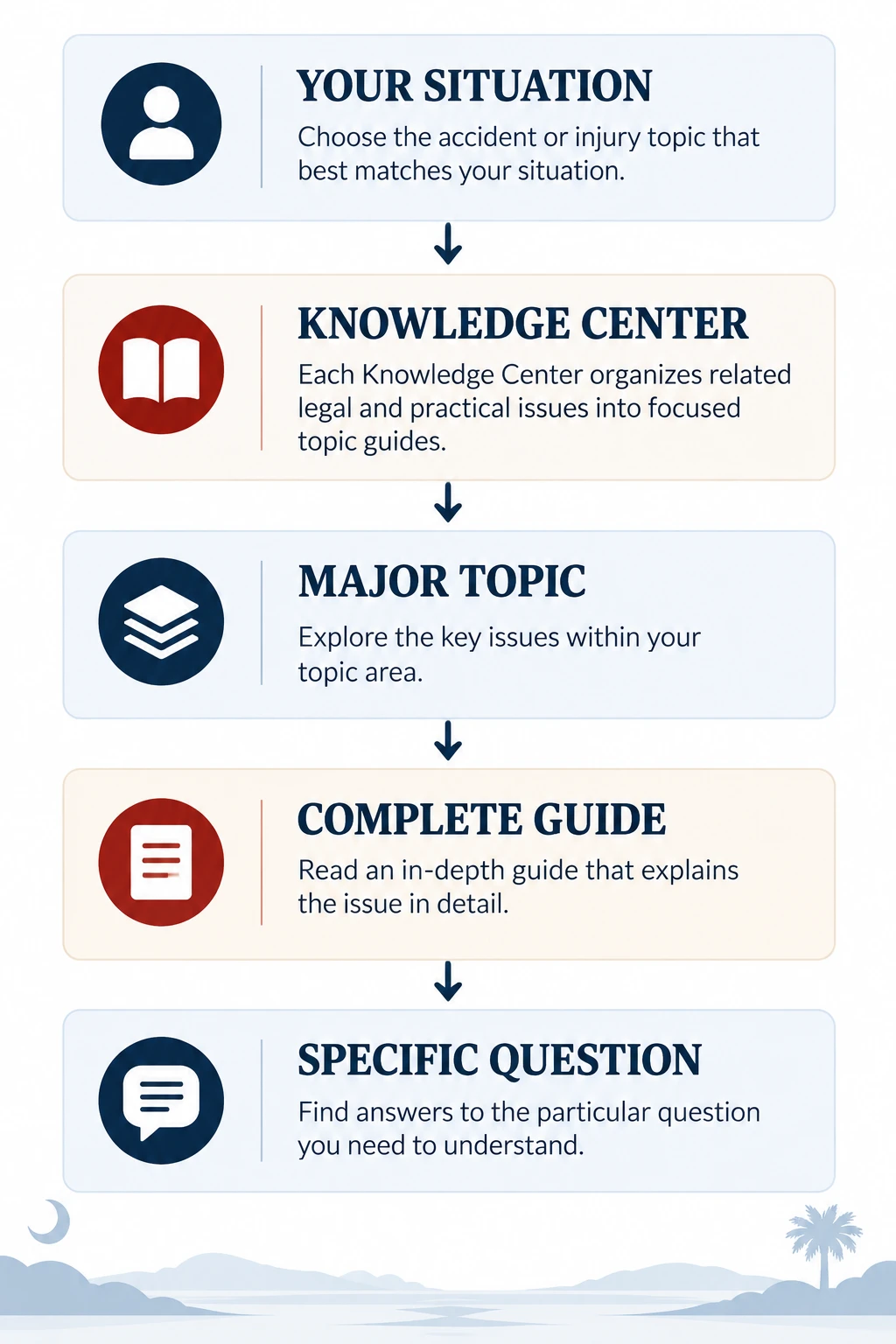
What Insurance Issue Are You Dealing With?
You do not need to understand every part of South Carolina insurance law to start finding answers. Start with the problem you are dealing with right now.
How Do I File a Claim Against Someone Else's Insurance?
Learn how to begin a claim with another driver’s insurance company, what information may be requested, and how liability, coverage, evidence, and documentation can affect the claims process.
The insurance adjuster wants to talk to me
Before discussing an injury claim, understand who the adjuster represents, what information is being requested, and why. The other driver’s insurance adjuster does not represent you. Your relationship with your own insurance company can be different because your policy may contain contractual cooperation requirements.
The insurance company isn't responding
A lack of communication does not necessarily tell you why the claim has stalled. The insurer may be waiting for information, investigating coverage or liability, reviewing documentation, or there may be another issue affecting the claim.
The other driver doesn't have insurance
The absence of liability insurance does not necessarily mean there is no potential source of insurance recovery. Depending on the circumstances, uninsured motorist coverage and other potentially applicable policies may need to be investigated.
My car was totaled
A total-loss claim can raise questions about the vehicle’s value, loan payoff, gap coverage, towing, storage, transportation, and what happens to the vehicle.
I have vehicle damage and injuries
The property-damage and bodily-injury portions of a claim arise from the same collision, but they involve different losses and may resolve at different times.
I received a settlement offer
A settlement offer is a proposed resolution of some or all of a claim. Before accepting an offer or signing a release, understand what is being resolved and what rights or claims the agreement requires you to release.
What Happens If I'm Partially at Fault?
Learn how being partially at fault may affect a South Carolina car accident claim, including how shared responsibility can influence whether you can recover and the amount of damages you may be able to receive.
How Does a South Carolina Car Accident Insurance Claim Work?
A car accident insurance claim is not one single decision made by an insurance company. It is a process, and different parts of that process may develop at the same time.
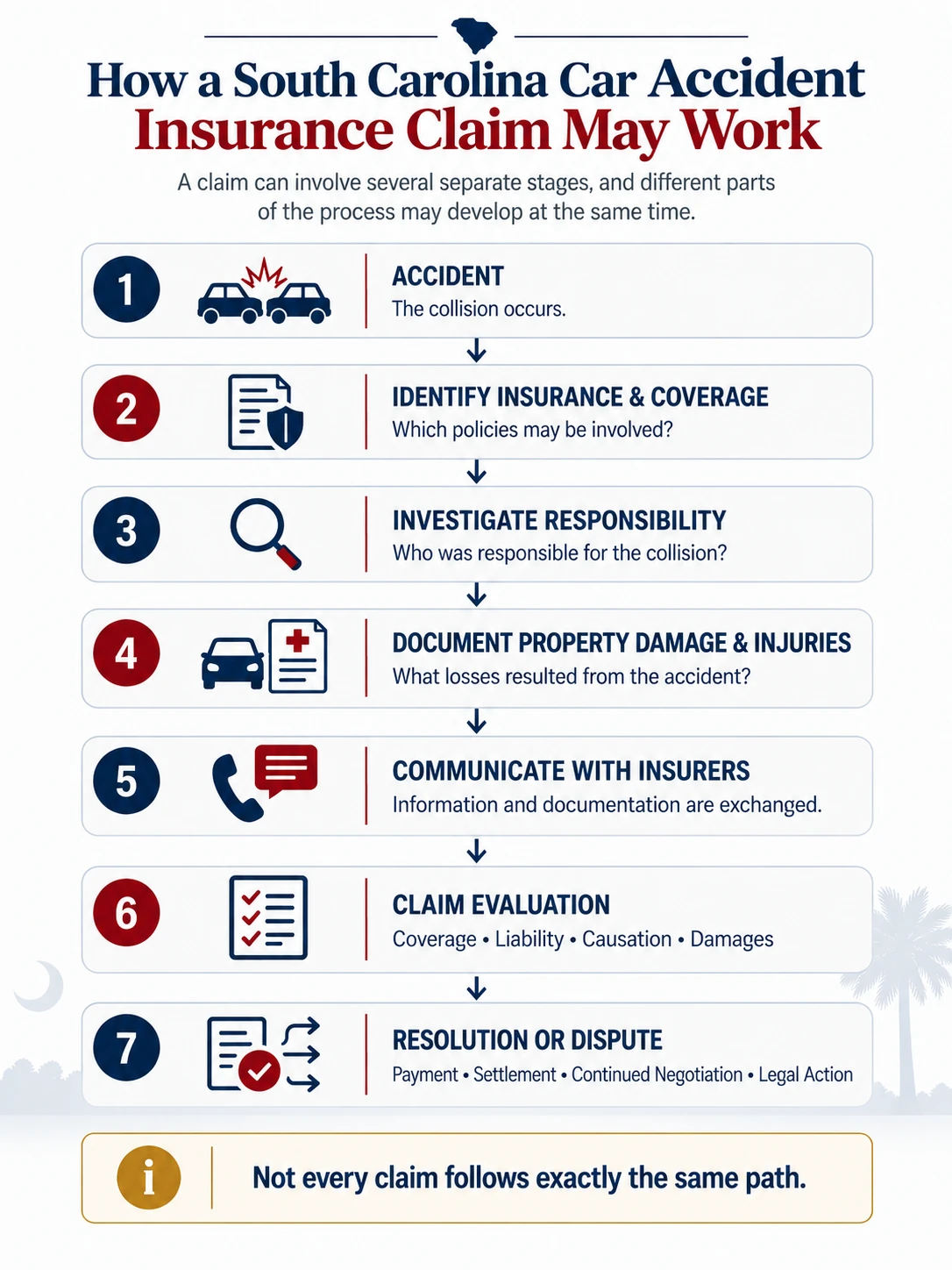
Not every claim follows exactly the same path. The important point is to understand which part of the process you are dealing with and what question needs to be answered next.
1. Identify the Insurance That May Be Involved
After a collision, one of the first questions is which insurers and policies may potentially be relevant. Depending on the circumstances, that may involve insurance associated with the drivers, vehicles, household policies, employers, commercial vehicles, rideshare companies, or other potentially responsible parties.
Identifying an insurer is only the starting point. The next question is whether a particular policy and coverage actually apply to the accident.
Read the Complete Guide: Understanding Car Accident Insurance Coverage in South Carolina →
2. Determine What Insurance May Apply
A collision may involve more than one policy or type of coverage. Depending on the facts and policy terms, potentially relevant coverage can include liability insurance, collision coverage, uninsured or underinsured motorist coverage, medical payments coverage, and insurance associated with commercial vehicles, employers, rideshare companies, or other circumstances.
Finding one policy does not necessarily mean every potentially applicable source of insurance has been identified. Identifying coverage is also different from proving who was responsible for the accident or what damages are supported.
3. Investigate Who Was Responsible
Insurance coverage and responsibility for the collision are separate questions. An insurer may review driver statements, collision reports, photographs, video, witnesses, vehicle damage, and other available evidence when evaluating how the accident occurred.
If fault is disputed, preserving and evaluating that evidence can become especially important.
4. Document the Property Damage and Injuries
One accident can create different categories of loss. A property-damage claim generally concerns what happened to the vehicle or other property. A bodily-injury claim concerns the injuries caused by the accident and the losses associated with those injuries.
Because the two claims involve different losses, they may require different documentation and may develop on different timelines.
Read: What’s the Difference Between a Property Damage and Injury Claim? →
5. The Insurance Company Evaluates the Claim
An insurer may evaluate several parts of the claim before deciding whether to make a payment, request additional information, dispute an issue, or make a settlement offer.
The important question is not simply whether the claim is “accepted” or “denied.” It is often more useful to determine what the insurer has accepted and what remains disputed.
Coverage, liability, causation, and damages are related issues, but they are not the same issue.
Read: How Do Insurance Companies Determine Who’s at Fault in a South Carolina Car Accident? →
6. The Claim Resolves, or the Dispute Continues
An insurance claim may result in payment, settlement, continued negotiation, or an unresolved dispute.
If a settlement is proposed, understand what the agreement resolves and which claims or rights may be released before signing it.
If important issues cannot be resolved through the insurance-claim process, further legal action may need to be evaluated.
For information about lawsuits, discovery, mediation, and trial, continue to Lawsuits & Litigation →
Four Questions That Can Affect an Insurance Claim
Insurance claims often become easier to understand when you separate the different questions the insurer may be evaluating.
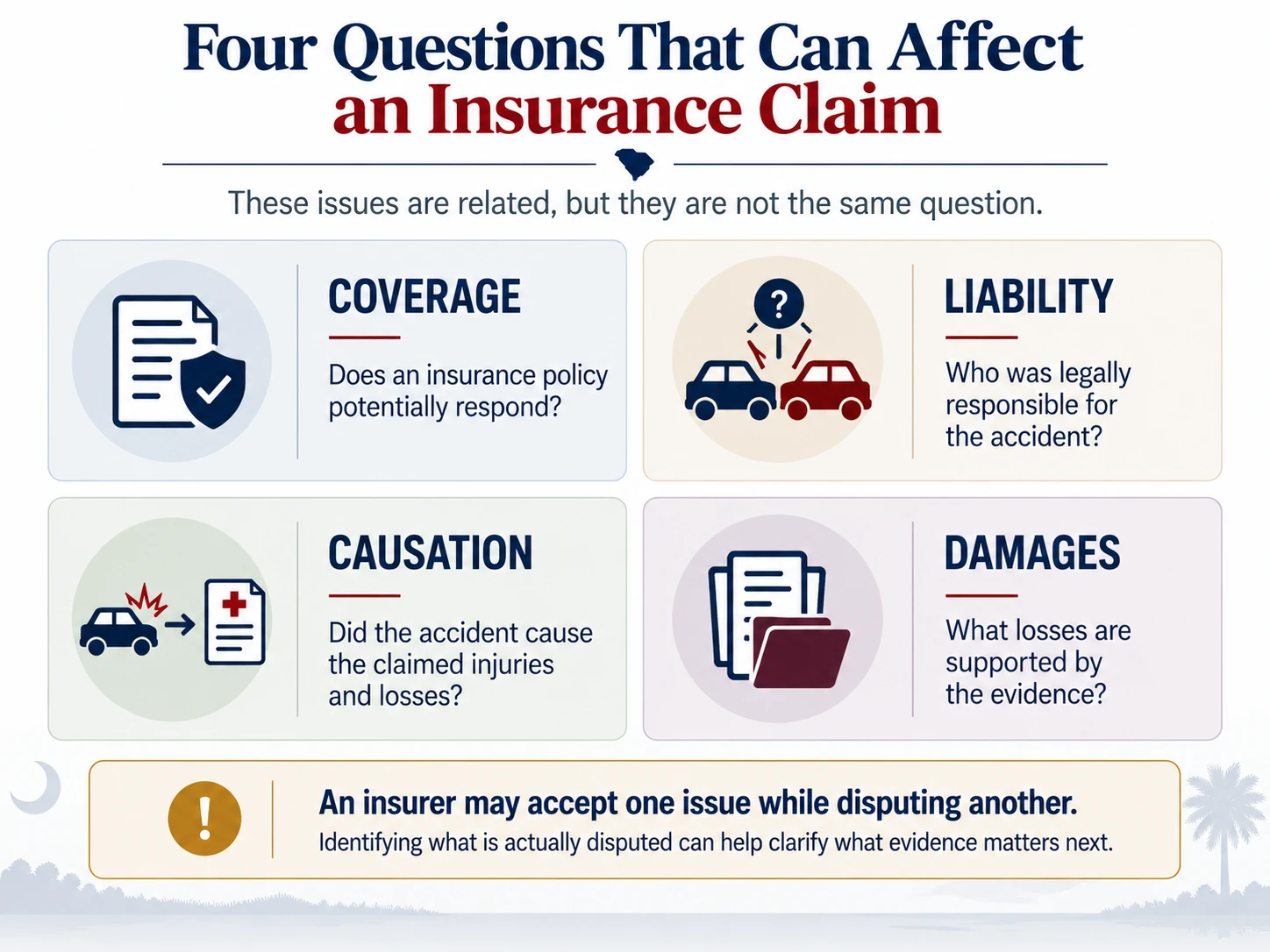
These issues are related, but they are not the same question.
- Coverage. Does an insurance policy potentially respond to the particular accident, person, vehicle, or loss?
- Liability. Who was legally responsible for causing the accident?
- Causation. Did the accident cause the injuries and losses being claimed?
- Damages. What losses are supported by the available evidence?
An insurer may accept one issue while disputing another. For example, it may accept that its insured caused the collision while disputing whether the accident caused a particular medical condition.
A claim is not necessarily an all-or-nothing question. Identifying what is accepted and what is actually disputed can help clarify what information or evidence matters next.
Start With Our Complete Insurance Guides
Understanding the South Carolina Car Accident Claims Process
A South Carolina car accident claim can involve several moving parts at the same time. The insurance company may assign an adjuster, investigate responsibility, evaluate vehicle damage, request information, review medical documentation, and assess the losses being claimed while treatment and evidence are still developing.
Our complete guide explains how the claims process can move from the initial report through investigation, documentation, evaluation, negotiation, and potential resolution.
Understanding Car Accident Insurance Coverage in South Carolina
Knowing that automobile insurance exists does not necessarily answer which policy applies, what type of coverage may respond, or whether additional insurance should be investigated.
Depending on the circumstances, a collision may involve liability coverage, collision coverage, UM or UIM coverage, medical payments coverage, multiple automobile policies, or insurance associated with a business, employer, commercial vehicle, rideshare company, or another potentially responsible party.
Our complete coverage guide explains how these different coverage questions fit together and why identifying a policy is only the beginning of the analysis.
Common Insurance Problems After a Car Accident
Insurance questions often become easier to understand when you identify the specific problem you are trying to solve.
Adjusters and Insurance Communications
What Should I Avoid Saying to Insurance Adjusters After a South Carolina Car Accident?
A conversation that feels informal can still be part of the insurer’s claim investigation. Learn what to consider before discussing fault, injuries, medical history, treatment, work losses, recorded statements, medical authorizations, or settlement documents with an adjuster.
Should I Talk to the Other Driver’s Insurance Company?
Learn what to consider before speaking with the other driver’s insurance company, including what information an adjuster may request, whose interests the insurer represents, and why your statements can matter to the claim.
What If the Insurance Company Won’t Return My Calls?
When communication stops, the important question is why. Learn how to document your attempts to communicate, determine what the claim may be waiting on, and continue protecting the underlying claim while seeking answers.
Insurance Coverage Problems
What If the Other Driver Doesn’t Have Insurance?
An uninsured at-fault driver can change the insurance analysis, but it does not automatically mean there is no potential claim. UM coverage and other potentially applicable insurance may need to be identified and evaluated.
Should I Accept the Insurance Company’s First Offer?
Learn what to consider before accepting an insurance company’s first settlement offer, including the extent of your injuries, medical treatment, documented losses, available coverage, and whether the offer accounts for the full impact of the accident.
Vehicle and Property-Damage Problems
What’s the Difference Between a Property Damage and Injury Claim?
The vehicle and bodily-injury portions of a claim involve different categories of loss and may move on different timelines. Learn why resolving the vehicle portion does not necessarily mean the injury claim has also been resolved.
What If My Car Is Totaled in the Accident?
A total-loss claim can involve more than receiving a valuation for the vehicle. Learn about valuation, loan payoff, gap coverage, towing and storage, transportation issues, and the distinction between resolving the vehicle loss and resolving an injury claim.
Settlement and Resolution Questions
Can I Still Sue If I Signed a Settlement With Insurance?
The amount of an offer is only one part of a settlement decision. Liability, causation, medical evidence, documented losses, available coverage, future needs, and the terms of any release may also matter.
Continue to Can I Still Sue If I Signed a Settlement With Insurance? →
Important Insurance Claim Distinctions
Insurance terminology can make the process sound more complicated than it needs to be. These distinctions can help you understand which question is actually being addressed.
Insurance Policy ≠ Applicable Coverage
Finding an insurance policy does not necessarily establish that the policy covers the particular accident, person, vehicle, or loss. Policy terms and the circumstances matter.
Coverage ≠ Liability
Insurance can exist while responsibility for the collision remains disputed. Coverage asks whether a policy may respond. Liability asks who was legally responsible.
Liability ≠ Causation or Damages
Accepting fault for a collision does not necessarily mean every claimed injury or loss will be accepted. The insurer may separately evaluate whether the collision caused the claimed injuries and what losses are supported.
Property Damage ≠ Bodily Injury
The vehicle claim and injury claim are separate parts of the accident. They involve different losses and may resolve at different times.
UM ≠ UIM
Uninsured motorist and underinsured motorist coverage address different insurance situations. Do not assume that one term can be substituted for the other.
Settlement Offer ≠ Claim Value
An insurance company’s settlement offer is a proposed resolution. It is not an objective declaration of what an injury claim is worth. Evaluating an offer requires looking at the evidence, supported losses, available recovery, and settlement terms.
Open Insurance Claim ≠ Unlimited Time
Continuing to communicate or negotiate with an insurance company does not necessarily extend an applicable legal deadline. If a deadline may be approaching, it should be identified independently of the status of insurance negotiations.
Your Insurance Company vs. the Other Driver's Insurance Company
One of the most important questions when an adjuster contacts you is: whose insurance company is calling
Your relationship with your own insurer is not necessarily the same as your relationship with another driver’s liability insurer.
| Your Insurance Company | Other Driver’s Insurance Company |
|---|---|
| Your relationship is governed in part by your insurance policy. | The insurer has a contractual relationship with its insured. |
| Your policy may contain cooperation requirements. | The adjuster does not represent you. |
| It may evaluate applicable first-party coverage under your policy. | It may investigate the liability claim against its insured. |
| Your policy terms can affect your rights and obligations. | Liability, causation, injuries, and damages may be investigated. |
This distinction is particularly important when someone requests a recorded statement, medical authorization, documents, or other information.
The other driver’s adjuster is not your attorney and does not have the role of advising you how to protect your injury claim. At the same time, your own insurance policy may require cooperation under certain circumstances.
Before responding to a significant insurance request, identify who is asking, why the information is being requested, and what obligations may apply.
One Accident Can Create Different Insurance Claims
A single collision can create both property-damage and bodily-injury issues.
Property damage generally concerns the vehicle and other property-related losses.
Bodily injury concerns the physical injuries caused by the accident and the financial and personal losses associated with those injuries.
The two claims may involve some of the same accident evidence, but they are evaluated differently and may develop on different timelines.
Resolving the vehicle claim does not necessarily mean the bodily-injury claim has also been resolved. The language of any settlement or release should be understood before signing.
Read: What’s the Difference Between a Property Damage and Injury Claim? →
What Does an Insurance Adjuster Do?
An insurance adjuster may investigate and evaluate different parts of a car accident claim, including:
Coverage → Liability → Property Damage → Injuries → Documentation → Claimed Losses → Settlement
The adjuster may request information or documentation while the insurance company evaluates the claim.
An adjuster may be professional and courteous, but there is an important distinction:
The adjuster investigates and evaluates the claim for the insurance company. The adjuster does not act as the injured person’s lawyer.
If an adjuster contacts you, first understand who they represent, what claim they are contacting you about, and what information or documents they are requesting.
Read: What Should I Avoid Saying to Insurance Adjusters After a South Carolina Car Accident? →
What Information Can Affect an Insurance Claim?
The evidence that matters depends on the issue being evaluated.
Accident Evidence
Photographs, video, witness information, collision reports, vehicle damage, and other physical or electronic evidence may help establish how the accident occurred.
Medical Evidence
Medical records, diagnostic testing, treatment documentation, restrictions, and medically supported future-care recommendations may help establish injuries and their effects.
Financial Evidence
Medical bills, wage records, receipts, and other documentation may help support claimed financial losses.
Insurance Evidence
Policy documents, declarations pages, coverage correspondence, claim communications, and written insurance decisions may help establish coverage and claim issues.
Evidence does not exist in isolation. Its importance depends on the issue it helps establish.
If your primary concern is proving fault, preserving evidence, or understanding the strength of the liability case:
Continue to Evidence, Liability & Case Strength →
If your primary concern is medical treatment, injuries, symptoms, or recovery:
Gary's Take: Identify the Question the Insurance Company Is Actually Disputing
“Insurance claims often involve several separate questions at once: who was responsible, what coverage applies, what injuries or property losses were caused by the accident, and what evidence supports those losses. Understanding which question is actually disputed can make the claim much easier to evaluate,” says Gary Christmas.
An insurance company saying “we’re investigating the claim” does not necessarily tell you what remains unresolved.
Is the dispute about coverage? Fault? Whether the collision caused a particular injury? The extent of the injuries? The amount of a financial loss? The terms of a proposed settlement?
Once you identify the actual issue, you can better understand what information or evidence may matter next.
Related South Carolina Car Accident Topics
Insurance is only one part of a car accident case. If the question you are trying to answer primarily concerns another issue, use the Knowledge Center to move directly to that topic.
| If You're Trying to Understand… | Start Here |
|---|---|
| The insurance claim, adjuster, or coverage | Insurance & Claims → |
| Your injuries, symptoms, or medical treatment | Medical Treatment, Injuries & Recovery → |
| Who was at fault or what evidence matters | Evidence, Liability & Case Strength → |
| What losses may be recoverable or how settlement works | Settlement Value & Financial Recovery → |
| What happens if the dispute goes to court | Lawsuits & Litigation → |
| Whether, when, or how to hire an attorney | Hiring a Lawyer & Legal Strategy → |
The goal of the Knowledge Center is not to make you learn legal terminology before you can find an answer. Start with the problem you are facing, then follow that issue to the information you need.
Questions About a South Carolina Car Accident Insurance Claim?
Insurance claims can become more complicated when injuries are significant or ongoing, responsibility is disputed, coverage is unclear, multiple insurance companies may be involved, important evidence needs to be preserved, or an insurer presents a settlement or release you do not understand.
Legal guidance may be particularly useful when:
- You suffered significant or ongoing injuries.
- Fault is disputed or you are accused of sharing responsibility.
- You do not know which insurance coverage may apply.
- An insurer asks you for a recorded statement, broad authorization, or release you do not understand.
- You receive a settlement offer while important medical issues remain unresolved.
- Evidence may disappear or a legal deadline may be approaching.
Christmas Injury Lawyers has spent nearly 30 years representing injured people and families throughout South Carolina. The firm’s approach is to guide injured clients through insurance and legal issues while they focus on their medical care and recovery.
If you were injured in a South Carolina car accident and have questions about the insurance process, contact Christmas Injury Lawyers to discuss your situation and whether legal representation makes sense for your case.