


When Does South Carolina Law Require Me to Report a Car Accident?
South Carolina has specific accident-reporting requirements.
If a motor vehicle accident results in injury or death, the driver must immediately notify the appropriate law enforcement agency. If the accident occurs within a municipality, that generally means the local police department. Outside a municipality, the law directs the report to the county sheriff or nearest South Carolina Highway Patrol office.
There is also a separate written-report requirement when law enforcement does not investigate the accident. If the crash results in injury, death, or apparent total property damage of $1,000 or more and was not investigated by law enforcement, the operator or owner generally must submit the required written accident report and verification of liability insurance coverage to the South Carolina Department of Motor Vehicles within 15 days.
Those are legal reporting requirements. Our practical advice goes further: whenever possible, call law enforcement after an accident and have the scene properly documented.
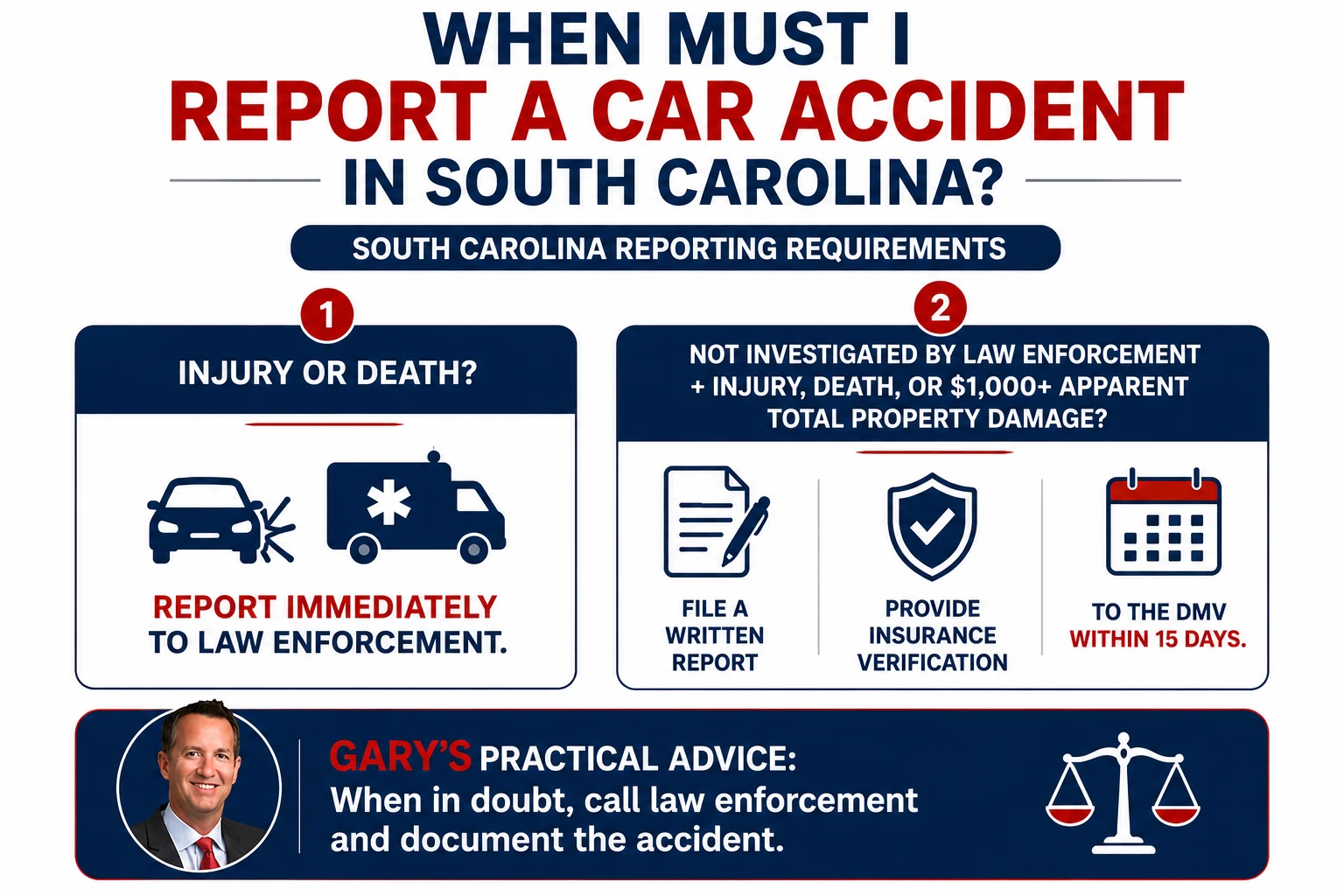
Gary’s practical advice: when in doubt, call law enforcement and document the accident.
What Should I Do After a Car Accident in South Carolina?
| Step | Why It Matters |
|---|---|
| Call 911 or law enforcement | Creates an official record |
| Check for injuries | Protects health and safety |
| Photograph the scene | Evidence disappears quickly |
| Exchange information | Identifies all parties |
| Obtain witness details | Witnesses may later disappear |
| Look for dashcams or surveillance | Video can change a case |
| Cooperate with police | Helps create accurate documentation |
| Continue preserving evidence | Helps document what happened and your losses |
Should I Call the Police Even If the Accident Seems Minor?
Even if an accident appears minor, our advice is to call the police and report it.
The responding officer can assess the accident scene, document the damage to the vehicles, speak with the drivers and witnesses, and prepare an accident report. This information can become very important later, even when the accident initially appears to involve only minor injuries or property damage.
In our view, involving law enforcement is a best practice in virtually every accident case.
What Happens If I Don't Report the Accident?
We have handled many cases where an accident was not properly documented at the time it occurred.
Often, the injured person simply trusted the other driver when they promised to take responsibility or assured them that their insurance company would cover everything. Unfortunately, that does not always happen.
Without an accident report or proper documentation, the case can quickly become a “he said, she said” dispute if the at-fault driver later changes their story. That is why our firm strongly encourages everyone involved in an accident to contact the police and create a record of what happened as soon as possible.
Can a Police Report Help My Injury Claim?
A South Carolina accident report generally cannot be used at trial as evidence that either driver was negligent or exercised due care, but the report can still be a useful tool during the investigation and insurance-claims process.
The report may contain information about contributing factors, citations, driver and witness statements, vehicle positions, and the officer’s observations. Insurance companies may consider that information when evaluating liability, but the report does not legally determine who was at fault.
For that reason, we strongly encourage clients to report accidents immediately and allow law enforcement to document the accident scene, vehicle damage, injuries, and other important details before preparing an accident report.
Does a Police Report Decide Who Was at Fault?
The biggest misconception is that the police report is the final word on who caused the accident. It isn’t.
The responding officer usually did not witness the collision. The officer generally arrives afterward and prepares the report based on observations at the scene, physical evidence, and information provided by the drivers and witnesses.
Ultimately, fault is determined by the facts and evidence, not simply by what appears on the accident report.
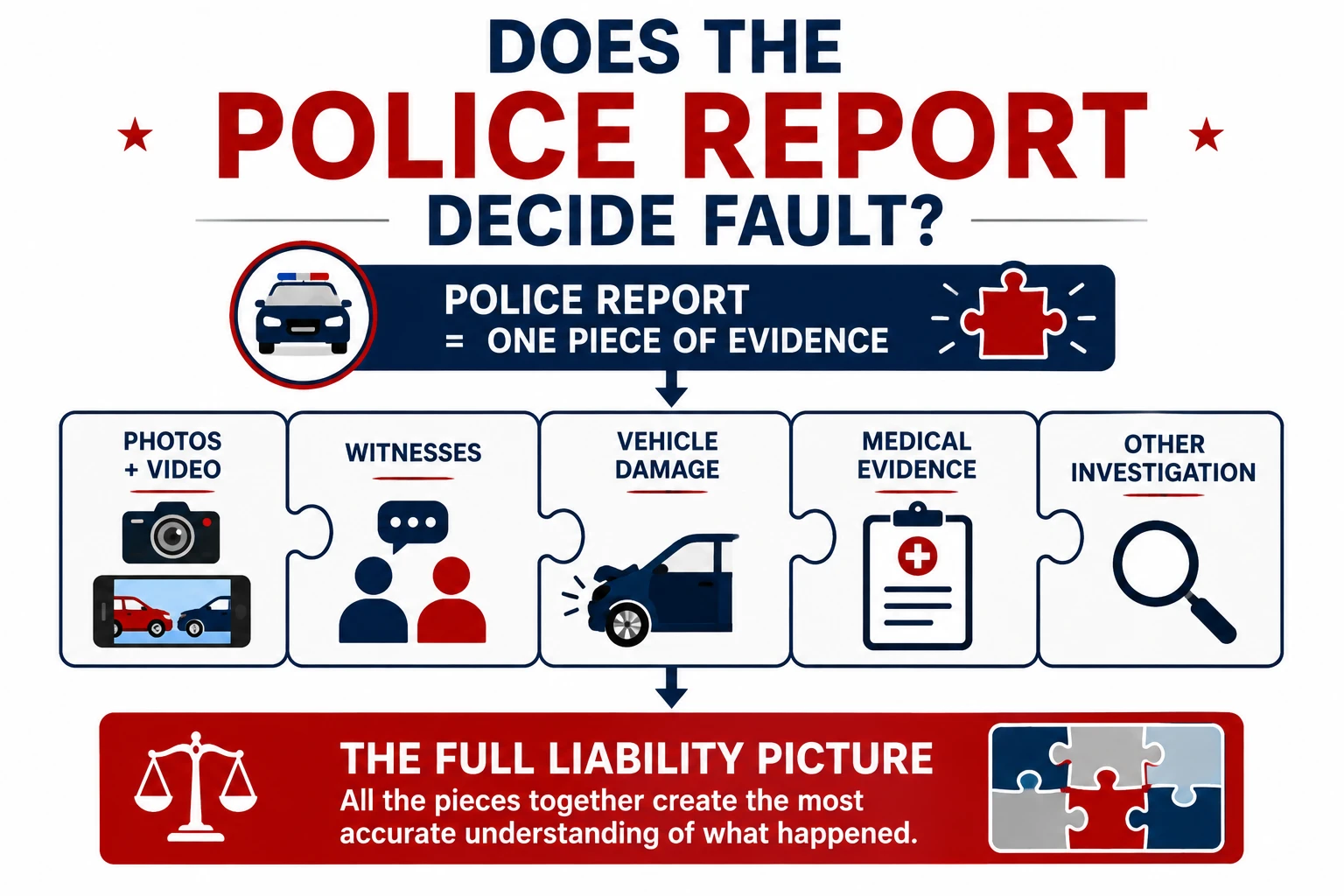
All the pieces together create the most accurate understanding of what happened.
What Should I Say to the Police After an Accident?
We advise our clients to cooperate fully with law enforcement.
At the same time, we encourage people to answer the questions they are asked without volunteering unnecessary information. Sometimes people try to explain too much, speculate about what happened, or make statements that can later be misunderstood or taken out of context.
Our advice is simple: be polite, be cooperative, and stick to the facts. If you do not know the answer to a question, say that you do not know rather than guessing.
What Parts of the Police Report Matter Most?
Several parts of a collision report can be useful when investigating what happened. These may include the officer’s observations, information about contributing factors or citations, statements from drivers and witnesses, and the accident diagram.
The accident diagram can also be extremely valuable. A drawing showing vehicle positions, points of impact, traffic flow, and roadway conditions may later help explain how the collision occurred.
At our law firm, we believe it is imperative to call the police after an accident so there is documentation of the vehicle damage, the accident scene, and the officer’s observations while the evidence is still fresh.
Do I Need to Report Every Car Accident in South Carolina?
Not every minor accident necessarily triggers the same statutory reporting requirements. South Carolina law specifically requires immediate reporting when an accident results in injury or death, and separate written-report requirements can apply when an accident involving injury, death, or at least $1,000 in apparent property damage is not investigated by law enforcement.
From a practical standpoint, however, our advice is to involve law enforcement whenever possible. What looks like a minor accident at the scene may become more complicated later.
The key takeaway is simple: whenever possible, call the police and have the accident properly documented.
What Should I Do Before the Police Arrive?
First, call the police and do not assume someone else has already done so.
Your safety comes first. If you are injured or it is not safe to move around the accident scene, do not put yourself at additional risk trying to gather evidence.
Next, begin gathering evidence if you are physically able. Take photographs of all vehicles involved, vehicle damage, license plates, insurance cards, driver’s licenses, road conditions, skid marks, traffic signs, and anything else that may help tell the story of how the accident occurred.
If there are witnesses, obtain their names and contact information. If any vehicle has a dashcam, determine whether footage may exist. Evidence gathered in the moments immediately following an accident is often some of the most important evidence in the entire case.
At our law firm, we believe you should begin building your case as though it may one day be presented to a jury.
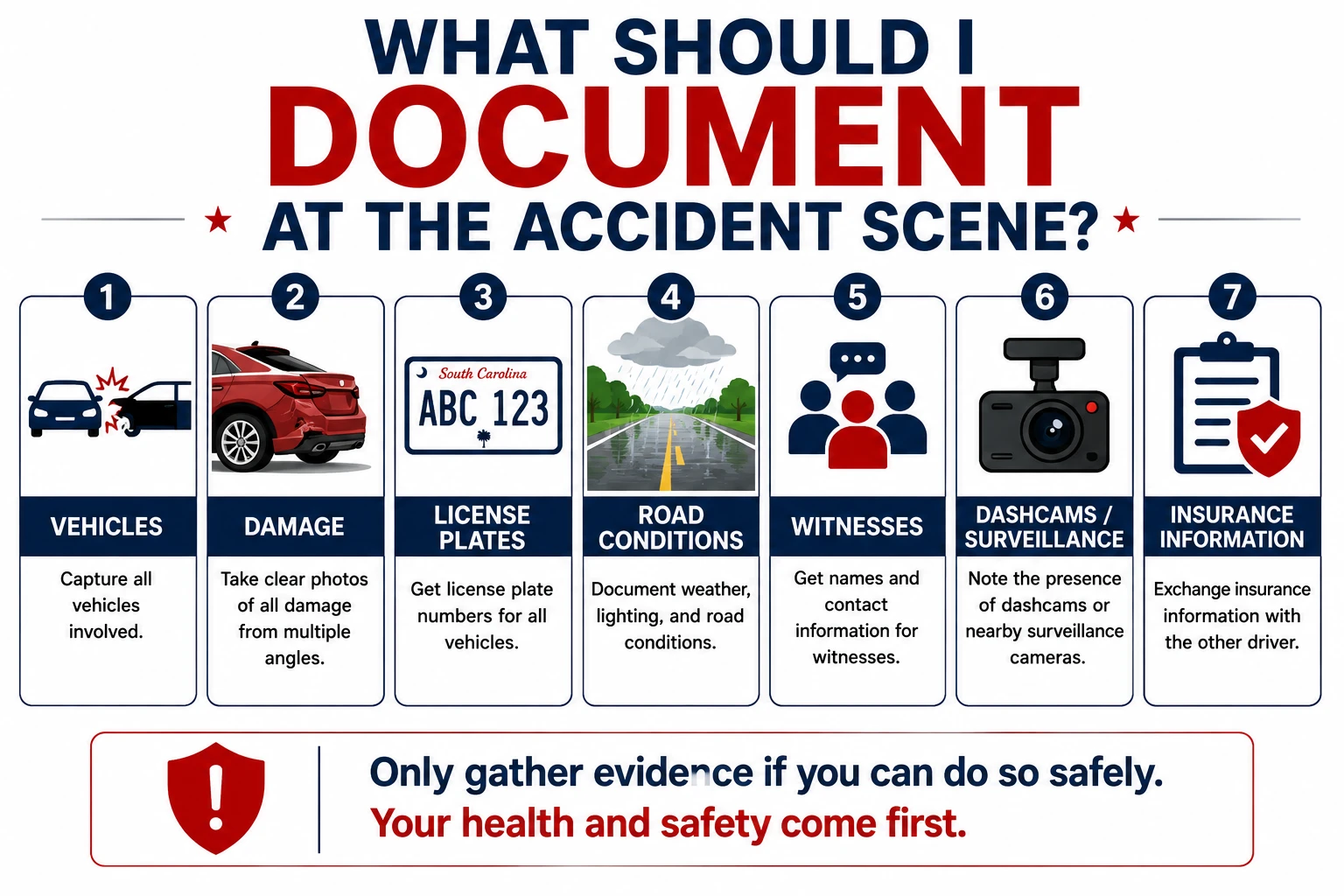
Only gather evidence if you can do so safely. Your health and safety come first.
What If the Other Driver Asks Me Not to Call the Police?
Our advice is simple: call the police anyway. We have handled many cases over the years where the other driver promised they would “take care of everything” or pay for the damages out of pocket, only to later change their story or deny responsibility altogether. Once everyone leaves the accident scene, those promises can quickly disappear.
At our law firm, we believe it is always a best practice to have law enforcement respond to the scene and document what happened. An accident report creates an independent record of the vehicles involved, the parties involved, the damage that occurred, and the officer’s observations. Simply put, you should not rely on promises from the other driver when a simple phone call can help protect your rights and preserve important evidence.
Can the Insurance Company Use a Missing Police Report Against Me?
A missing police report can make a claim more difficult in some circumstances, but it does not automatically mean you do not have a case.
Without an independent report, an insurance company may question how the accident happened, the extent of the vehicle damage, whether injuries were reported at the scene, or who was involved. That can become particularly important if the drivers later disagree about what happened.
If you did not call the police, preserve whatever other evidence exists, including photographs, videos, witness information, text messages, insurance communications, medical records, and anything else that may help establish what happened.
An insurance company may point to a missing or incomplete accident report when disputing how the accident happened, the extent of the damage, or who was responsible. Missing accident reports, incomplete reports, or reports that fail to document important facts often create opportunities for the insurance company to argue that you were partially, or even entirely, responsible for the accident.
South Carolina follows a modified comparative-negligence rule. If you are found partly responsible for an accident, your recovery may be reduced by your percentage of fault. If your negligence is greater than the defendant’s, you generally cannot recover damages from that defendant.
For that reason, we believe it is a best practice to involve law enforcement immediately and make every effort to ensure the accident is fully and accurately documented from the beginning.
What If I Already Left the Scene Without Calling the Police?
Do not assume that your injury claim is over simply because the police were not called at the scene.
Preserve whatever evidence you still have. Save photographs and videos, obtain witness information, keep communications with the other driver, preserve insurance information, and write down what happened while the details are still fresh in your mind.
You should also determine whether South Carolina’s written accident-reporting requirements apply. If the accident involved injury, death, or apparent total property damage of $1,000 or more and was not investigated by law enforcement, a written report and verification of liability insurance coverage generally must be submitted to the DMV within 15 days.
If you are injured, get the medical care you need. Then get legal advice if you are unsure what reporting requirements apply or how the lack of a police report may affect your claim.
South Carolina Accident Reporting Checklist
- Call the police
- Get medical help if you are injured
- Do not assume someone else reported the crash
- Photograph the vehicles and scene
- Collect witness information
- Look for dashcams or surveillance cameras
- Exchange insurance information
- Cooperate with law enforcement; if you do not know an answer, say that you do not know rather than guessing
- If law enforcement does not investigate, determine whether a written DMV report is required
- Keep records of your injuries, treatment, expenses, and other accident-related losses
In Summary
South Carolina law requires drivers to report certain car accidents, including crashes involving injury or death. If an accident involving injury, death, or apparent total property damage of $1,000 or more is not investigated by law enforcement, a separate written report and verification of liability insurance coverage may also need to be submitted to the South Carolina Department of Motor Vehicles within 15 days.
From a practical standpoint, our advice is simple: when in doubt, call law enforcement and have the accident documented. A responding officer can identify the parties involved, record vehicle damage, gather witness information, document conditions at the scene, and create an independent record of what happened.
A police report can be useful during the claims process, but it does not decide who was legally at fault. Liability ultimately depends on the full evidence, including photographs, video, witness statements, vehicle damage, medical records, and other information developed during the investigation.
If you left the scene without calling the police, do not assume your claim is over. Preserve whatever evidence you still have, get the medical care you need, and determine whether South Carolina’s written accident-reporting requirements apply.