


How Insurance Companies Determine Fault
Insurance companies conduct their own investigation after an accident occurs.
A police officer’s collision report may contain the officer’s assessment of what happened, while the South Carolina FR-10 serves a different purpose related to insurance information and verification. Neither document should be treated as the final word on legal fault.
The investigating officer’s assessment can be useful, but it does not necessarily determine legal fault. The officer usually did not witness the collision firsthand, and additional evidence may later provide a more complete picture of what happened. In some cases, an officer with specialized accident-reconstruction training may also analyze physical evidence to help determine how a collision occurred.
At the end of the day, I tell clients to focus on the evidence. A box checked on a report can be helpful, but photographs, video, witnesses, vehicle data, and physical evidence may tell a much more complete story.
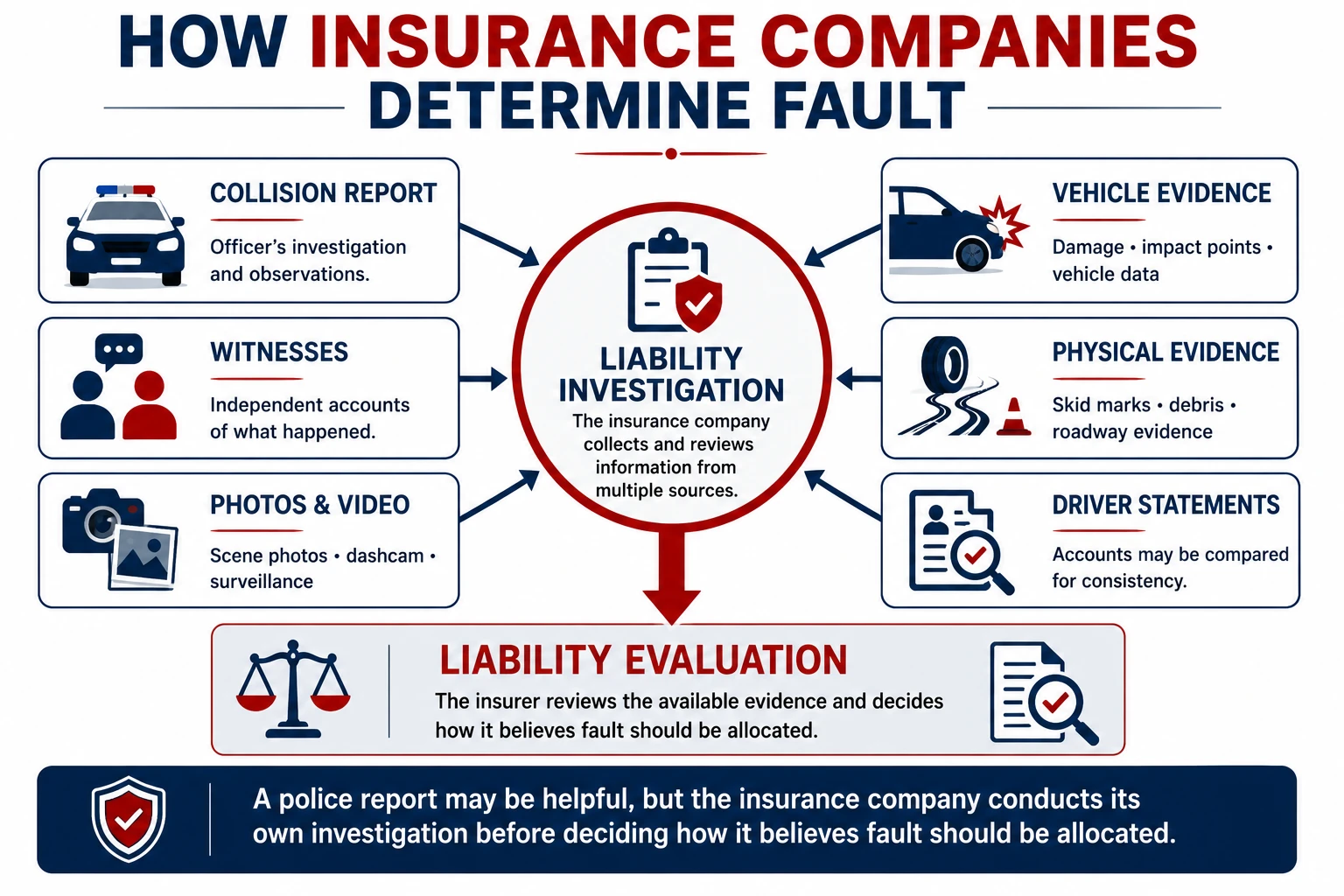
A police report may be helpful, but the insurance company conducts its own investigation before deciding how it believes fault should be allocated.
Can New Evidence Change Who Is Considered At Fault?
We have handled many cases over the years where fault was heavily disputed.
Often, our client was seriously injured, unconscious, or transported to the hospital before law enforcement completed its investigation. In those situations, the officer may have received only one side of the story, which can sometimes lead to an inaccurate conclusion in the accident report.
In those cases, we conduct a thorough investigation by locating witnesses, obtaining dashcam footage, gathering surveillance video from nearby homes and businesses, and collecting any other evidence that may help establish what actually happened.
I tell clients all the time that early investigation can matter because evidence does not wait for us. Witnesses can become difficult to locate, video may be erased, and physical evidence at the scene can disappear. When fault is disputed, we want to identify and preserve as much evidence as possible before it is lost.
Does the Police Report Decide Who Was At Fault?
One of the biggest misconceptions is that if the police officer circles the other driver as being at fault, the analysis is over.
Not necessarily. A collision report can be important evidence in the investigation, but it does not necessarily determine who is legally responsible for the crash.
Most officers did not witness the accident and are simply making an assessment based on what they learned at the scene. While that assessment may be helpful, it is only one piece of the puzzle.
Insurance companies look at the totality of the evidence, including witness statements, photographs, videos, vehicle data, and other information gathered during the investigation. Determining fault is rarely as simple as what appears on an accident report.
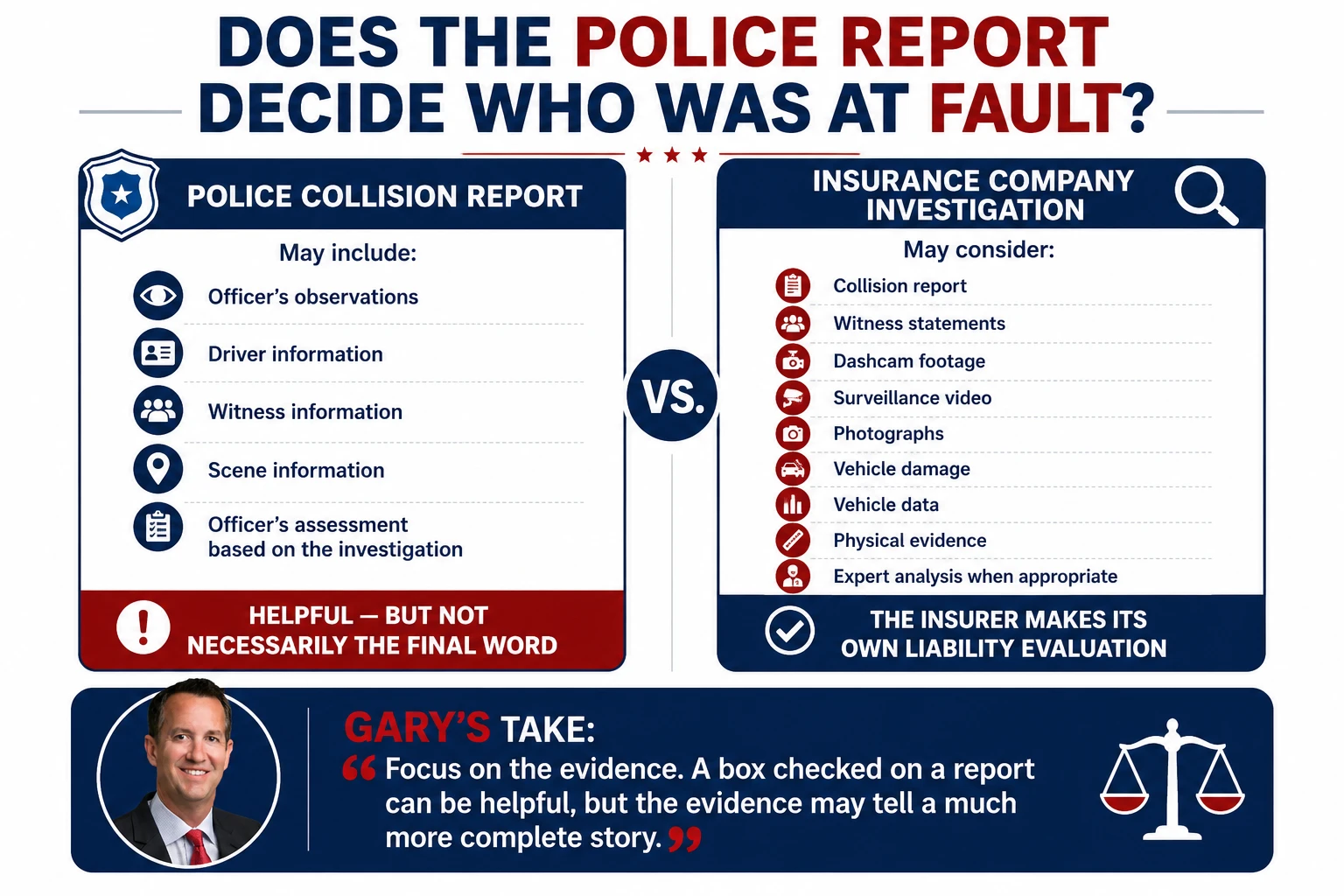
Focus on the evidence. A box checked on a report can be helpful, but the evidence may tell a much more complete story.
What Evidence Carries the Most Weight With Insurance Companies?
In our experience, evidence that directly shows how an accident occurred can be especially important when fault is disputed.
Video footage can be incredibly powerful. Dashcam recordings, surveillance footage from nearby businesses or homes, black box data, photographs, eyewitness testimony, and physical evidence from the scene can all play a major role in determining fault.
While accident reports can be helpful, they are generally prepared by officers who did not witness the collision. For that reason, objective evidence can be especially important when liability is disputed.
What Mistakes Make Fault Harder to Prove?
One of the biggest mistakes people make is discussing fault with the other driver.
There is nothing wrong with exchanging insurance information, driver’s license information, and vehicle information. However, there is usually no reason to discuss who caused the accident or whether you think you may have contributed to it.
Another problem can arise when materially different accounts of the accident appear in statements, records, or later testimony. Those inconsistencies may create credibility issues even when there is an innocent explanation.
The best approach is simple: stick to what you actually know, do not guess, and be truthful.
Credibility matters. Material inconsistencies can create problems later, even when there is an innocent explanation.
Do Insurance Companies Try to Blame the Injured Driver?
Yes, an insurance company may argue that the injured driver shares some responsibility for the collision. An adjuster may examine speed, following distance, lane position, distracted driving, right-of-way issues, or other facts that could affect how fault is allocated.
That matters in South Carolina because an injured person’s percentage of fault can affect whether they recover damages and how much they can recover.
The insurance company’s financial interests are not the same as yours. That is why evidence supporting your version of how the collision occurred can be so important when fault is disputed.
How Does Comparative Negligence Affect My Case?
South Carolina follows a modified comparative negligence rule. That means more than one person can share responsibility for causing a car accident.
If you are partly at fault, you may still be able to recover damages as long as your share of the fault is not greater than the other side’s. Your recovery is then reduced according to your percentage of fault.
For example, if your damages are $100,000 and you are found 20% at fault, your recovery would generally be reduced by 20%, or $20,000.
If you are found more than 50% at fault, South Carolina’s comparative negligence rule generally prevents you from recovering damages from the other party.
This is one reason fault disputes matter so much. A disagreement over whether you were 10%, 40%, or more than 50% responsible can have a major effect on the claim.
Should I Give a Recorded Statement to the At-Fault Driver's Insurance Company?
Generally, I would not recommend giving the at-fault driver’s insurance company a recorded statement before you understand your rights and why the statement is being requested.
Your obligations to your own insurance company may be different because your policy may require cooperation. That is why it matters which insurance company is asking for the statement.
Anything you say can potentially be used against you later. A recorded statement can later become important if there are questions about how the accident happened, what you experienced, or whether your account has remained consistent.
If you are represented, your lawyer can handle communications with the at-fault driver’s insurer while you focus on your medical treatment and recovery. If you are not represented, be careful about giving a recorded statement or signing authorizations before you understand what is being requested and why.
Can Witnesses or Video Change How Fault Is Evaluated?
Over the years, we have handled many cases where the insurance company initially denied liability or attempted to shift fault onto our client.
The reality is that you never know what piece of evidence may ultimately change the course of a case. Sometimes it is a witness. Sometimes it is a surveillance video. Sometimes it is dashcam footage, black box data, photographs, or physical evidence from the roadway.
Evidence can disappear. Witness memories fade. Video footage can be erased. Rain and weather can wash away skid marks and other physical evidence. That is why identifying and preserving available evidence early can matter so much when fault is disputed.
Our approach is simple: identify the evidence, preserve it, evaluate what it shows, and use it to build the clearest and strongest fact-based presentation of our client’s case.
Can the Insurance Company Change Its Mind About Fault?
Yes. An insurance company’s initial fault determination can change when additional evidence becomes available.
For example, a witness may come forward, surveillance footage may be located, dashcam video may surface, or an accident reconstruction expert may analyze the physical evidence and provide additional insight into how the collision occurred. Evidence has a way of changing the conversation. The sooner relevant evidence is identified and preserved, the better positioned you are to understand and address a disputed fault determination.
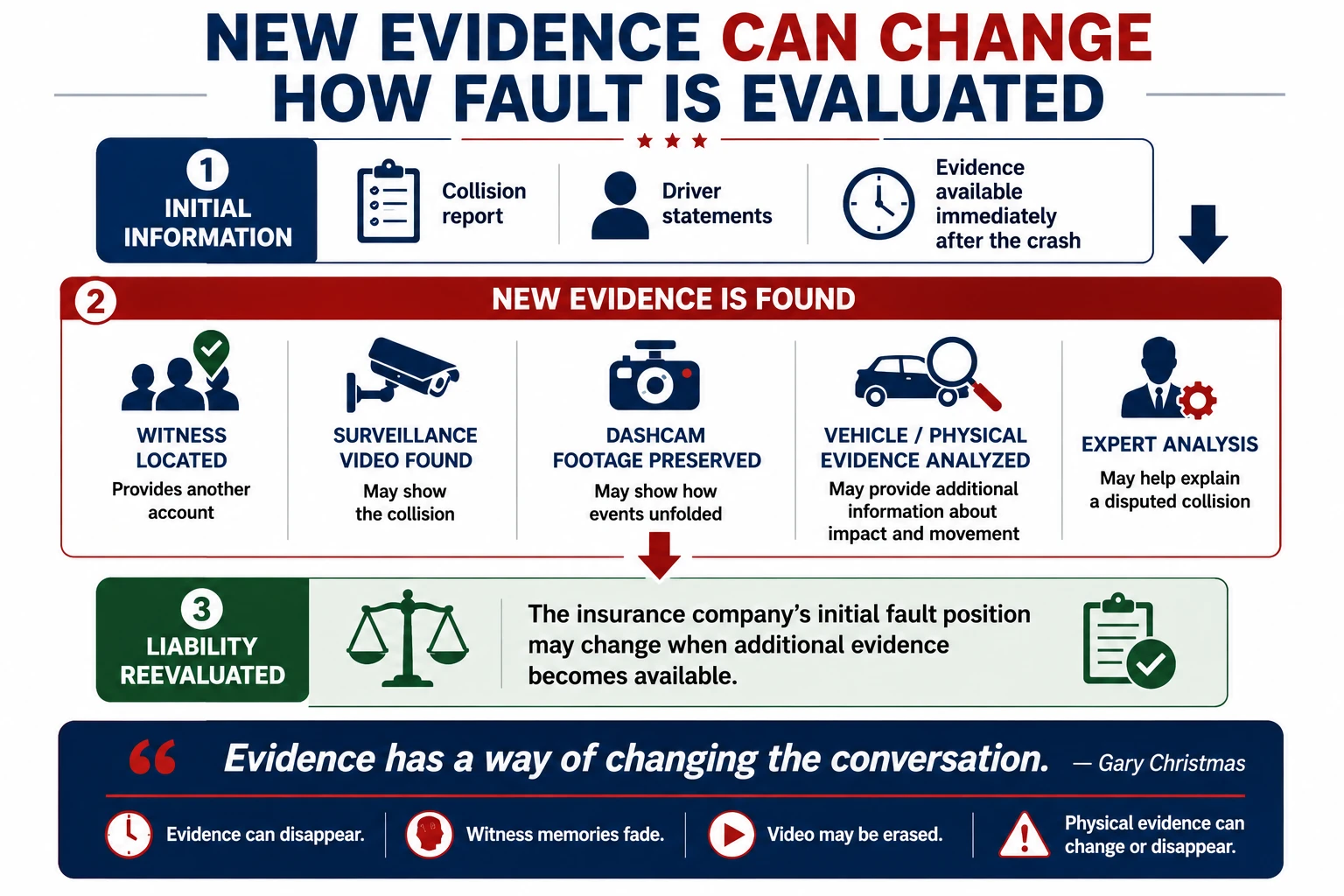
The insurance company’s initial fault position may change when additional evidence becomes available. Evidence has a way of changing the conversation.
What Should I Do If Fault Is Being Disputed?
If the insurance company is disputing fault, preserve as much evidence as you can. Keep photographs and video, save the collision report and FR-10, identify witnesses, preserve dashcam footage, and determine whether nearby homes or businesses may have surveillance video.
Do not assume the insurance company’s first liability decision is the final word. Additional evidence may change how responsibility is evaluated.
Fault disputes can involve legal, insurance, and evidentiary issues that are difficult to evaluate on your own. Getting legal guidance early can help identify what evidence matters and what needs to be preserved before it disappears.
Fault Investigation Checklist
- Photograph the scene
- Obtain witness information
- Look for dashcams
- Preserve surveillance footage
- Save the collision report and FR-10
- Do not discuss fault with the other driver
- Be cautious about giving the at-fault driver's insurer a recorded statement
- Get legal guidance if fault is disputed
In Summary
Insurance companies determine fault in South Carolina car accident claims by reviewing the available evidence and conducting their own liability investigation. A police collision report may be helpful, but it does not necessarily decide who is legally responsible. Witness statements, photographs, dashcam or surveillance video, vehicle damage, physical evidence, vehicle data, and other information can all affect how fault is evaluated.
South Carolina also allows fault to be shared. Under the state’s modified comparative negligence rule, your percentage of responsibility can affect both whether you can recover damages and the amount you may recover.
An insurance company’s initial fault determination can change when additional evidence becomes available. That is why identifying and preserving evidence as early as possible can be so important when liability is disputed.