


What Makes a Hit-and-Run Accident Different?
Hit-and-run accidents are not the same as other automobile accident cases.
While all accident cases involve complicated medical issues, legal issues, and insurance coverage issues, hit-and-run accidents add another layer of complexity. In South Carolina, there are specific legal requirements that must be satisfied when pursuing an uninsured motorist claim arising from a hit-and-run collision.
| Issue | Why It Matters |
|---|---|
| Driver leaves the scene | The driver's identity and insurance may remain unknown |
| UM coverage may apply | Your own uninsured motorist coverage may become important |
| South Carolina legal requirements | Unknown-driver claims must satisfy specific statutory conditions |
| Evidence can disappear | Video, witnesses, debris, and physical evidence should be identified early |
| No-contact accidents | Independent witness or recording evidence may become especially important |
| Insurance coverage investigation | The insurer may evaluate whether the statutory and policy requirements are satisfied |
The problem is that insurance companies know these cases are complex. Simply put, you do not know what you do not know. That is why our firm strongly believes that anyone injured in a hit-and-run accident should contact an experienced South Carolina trial lawyer immediately after the accident occurs.
What Should I Do in the First 24 Hours After a Hit-and-Run Accident?
The first hours after a hit-and-run accident can be especially important because evidence identifying the vehicle or proving that an unknown vehicle caused the crash may disappear quickly. If you are able:
- Call the police and report the hit-and-run
- Seek appropriate medical attention if you are injured
- Photograph the scene, your vehicle, debris, skid marks, and visible injuries
- Write down anything you remember about the fleeing vehicle
- Get names and contact information for witnesses
- Look for nearby businesses, homes, traffic cameras, doorbell cameras, or dashcams
- Preserve any video or photographs you already have
- Keep the collision report, FR-10, insurance information, and related documents
- Be careful about giving recorded statements until you understand what is being requested and what your policy requires
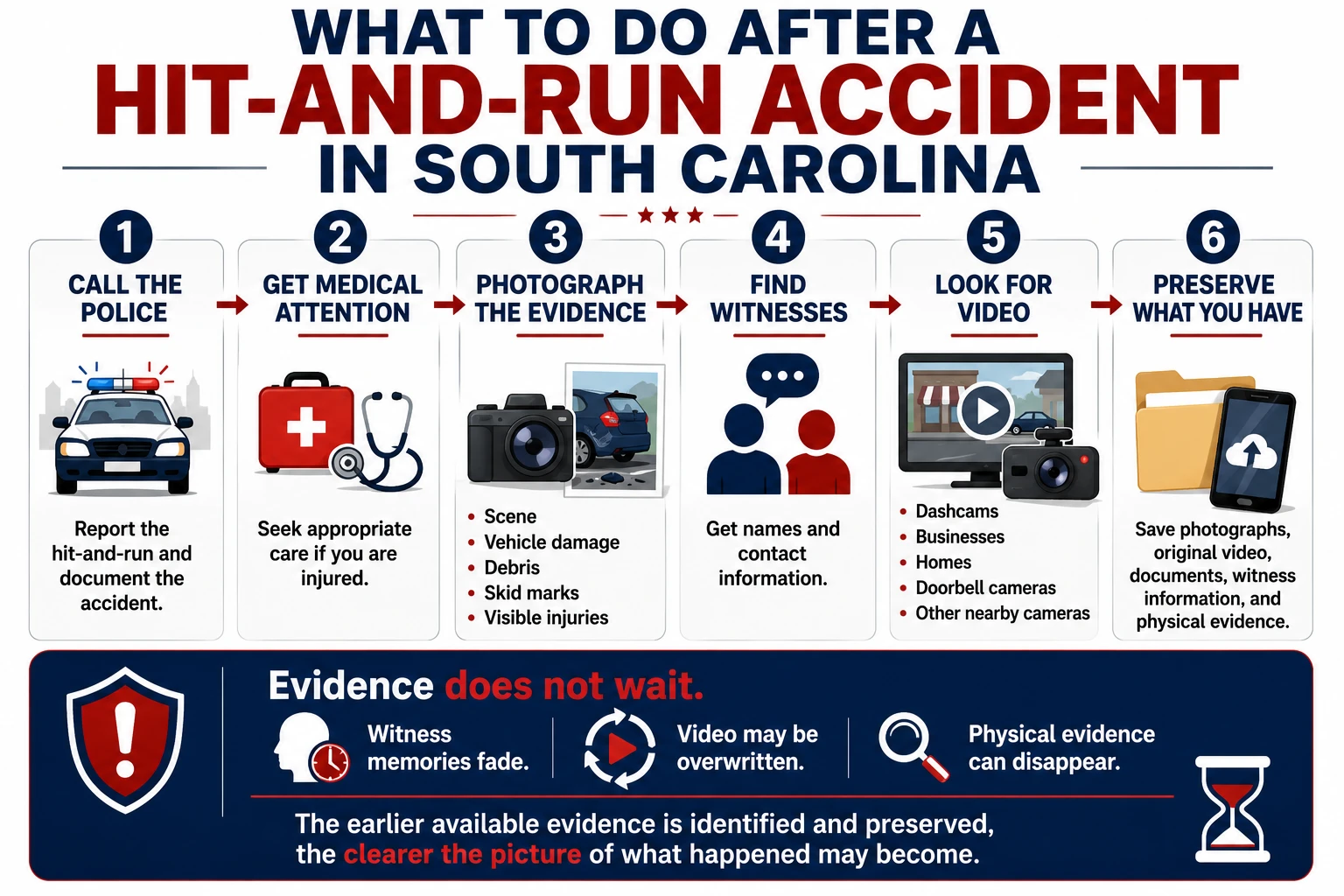
The earlier available evidence is identified and preserved, the clearer the picture of what happened may become.
Why Are Hit-and-Run Accident Cases More Complicated?
Every hit-and-run case stands out because each one presents unique challenges.
Unlike a traditional accident where everyone knows who caused the crash, hit-and-run cases often involve technical legal requirements regarding property damage, bodily injury, uninsured motorist coverage, and proof of what actually happened.
What stands out most is how frequently insurance companies attempt to use these technical requirements as a basis for denying coverage or reducing the value of a claim. In many cases, the battle is not only about proving injuries and damages but also about proving that the legal requirements for a hit-and-run claim have been satisfied.
That is one reason we strongly believe these cases should be handled by an experienced trial lawyer who understands the complexities involved.
What Does South Carolina Require When the Hit-and-Run Driver Is Unknown?
South Carolina law has specific requirements for uninsured motorist claims when the vehicle or driver that caused the accident is unknown.
First, the accident must be reported to an appropriate police authority within a reasonable time under the circumstances.
The claim must also satisfy one of three conditions concerning proof of the unknown vehicle’s involvement:
- Physical contact: The injury or damage was caused by physical contact with the unknown vehicle.
- Qualifying witness evidence: Someone other than the owner or operator of the insured vehicle witnessed the accident. Additional statutory requirements apply to that witness evidence.
- Recording: A recording of the accident shows that the unknown vehicle caused the injury or damage.
South Carolina law also requires that the insured was not negligent in failing to determine the identity of the other vehicle and its driver at the time of the accident.
These requirements are one reason evidence preservation matters so much in a hit-and-run case.
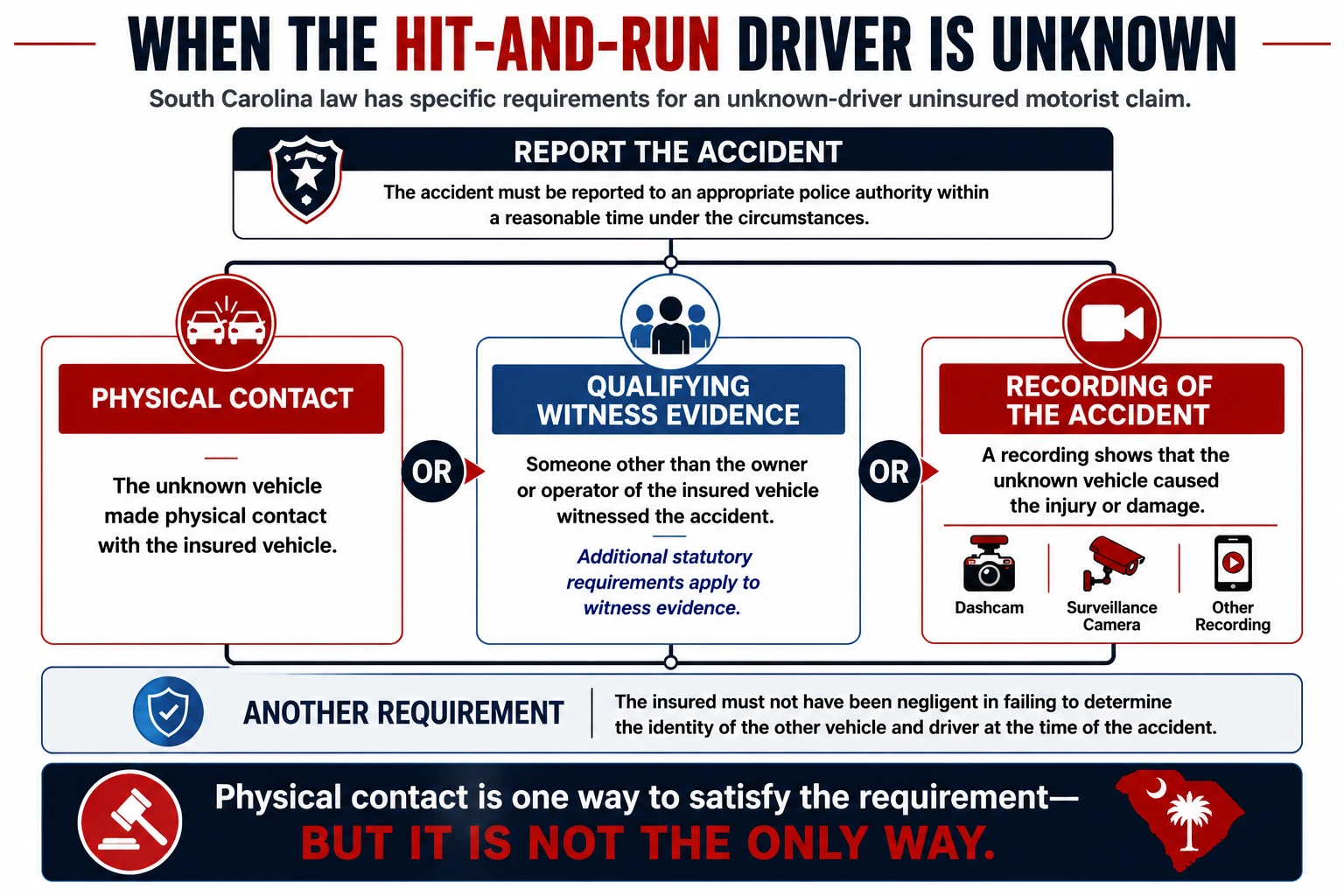
Physical contact is one way to satisfy the requirement, but it is not the only way.
What Happens If the Hit-and-Run Driver Is Never Found?
The fact that the police never identify the hit-and-run driver does not necessarily mean your case is over.
South Carolina law treats a vehicle as uninsured when its owner or operator is unknown, subject to the requirements that apply to uninsured motorist claims. That means your own uninsured motorist coverage may provide a source of recovery when an unidentified driver causes a qualifying accident.
However, you still have to establish the facts of the accident, your injuries and damages, and satisfy the legal requirements that apply when the other driver is unknown.
This is why I tell people not to assume they have no case simply because the other driver got away.
In a hit-and-run case, the focus often shifts from “Who is the driver?” to “Can we prove that an unknown driver caused this accident and satisfy the requirements for uninsured motorist coverage?”
That is where evidence becomes extremely important. Witnesses, dashcam footage, surveillance or doorbell video, photographs, vehicle damage, debris from the fleeing vehicle, roadway evidence, and other information may help establish what happened even when the driver is never identified.
What If the Hit-and-Run Driver Never Hit My Vehicle?
You may still have a potential uninsured motorist claim in South Carolina even if the hit-and-run vehicle never physically touched your vehicle.
This is an important point because many people assume there has to be an actual collision with the fleeing vehicle. Under current South Carolina law, physical contact is one way to satisfy the statutory requirement, but it is not the only way.
Imagine another driver suddenly crosses into your lane. You swerve to avoid being hit, leave the roadway, and crash. The other driver never touches your vehicle and keeps going.
The absence of physical contact does not automatically end the analysis.
South Carolina law provides two other potential ways to establish the unknown vehicle’s involvement in a no-contact accident.
One involves a person other than the owner or operator of the insured vehicle witnessing the accident. Additional statutory requirements apply to that witness evidence, including an affidavit requirement or, when the affidavit cannot be obtained, a potential presuit-deposition procedure.
The other involves a recording of the accident, obtained electronically or otherwise, showing that the unknown vehicle caused the injury or damage. This recording alternative was added to South Carolina law in 2024.
That makes evidence such as dashcam footage potentially very important in a no-contact hit-and-run accident.
It also makes early investigation critical. If a witness saw what happened, get that person’s contact information. If your dashcam recorded the accident, preserve the original recording. If a nearby business, home, or other camera may have captured the collision, try to identify that footage before it is overwritten or deleted.
I tell clients that physical contact is not the only question. The real question is whether we can prove that the unknown vehicle caused the accident and satisfy South Carolina’s legal requirements for the claim.
That distinction can make all the difference in a no-contact hit-and-run case.
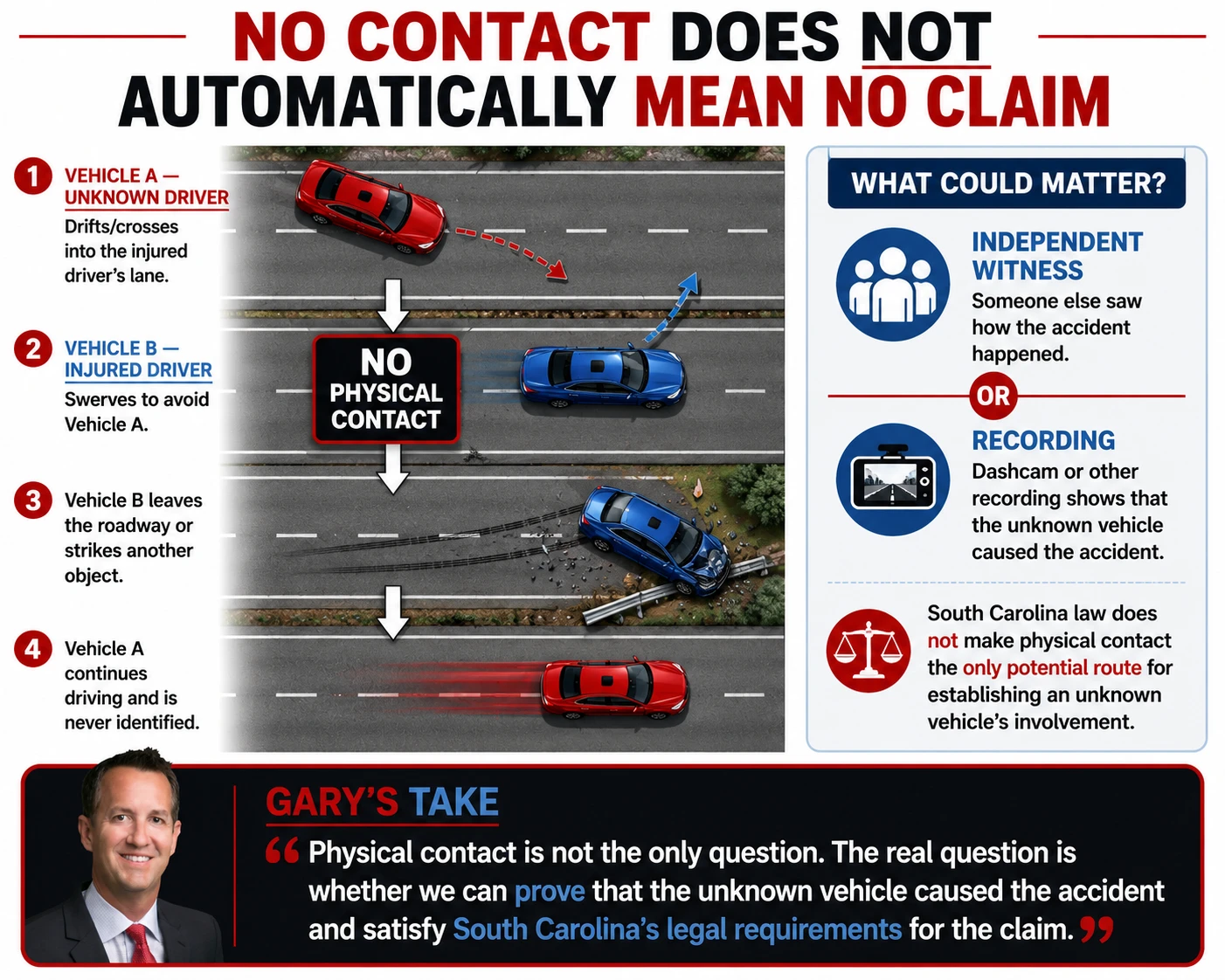
Physical contact is not the only question. The real question is whether we can prove that the unknown vehicle caused the accident and satisfy South Carolina’s legal requirements for the claim.
What Mistakes Should I Avoid After a Hit-and-Run Accident?
One of the biggest mistakes you can make after a hit-and-run accident is assuming there is nothing you can do because the other driver left the scene. In these cases, what you do immediately after the accident can become especially important.
First, report the accident to the police. South Carolina has specific legal requirements for claims involving an unknown driver, including reporting the accident to an appropriate police authority within a reasonable time. Make sure the hit-and-run is reported and keep copies of the collision report, FR-10, and other accident-related documents.
Second, look for witnesses and video immediately. A witness may have seen the vehicle, gotten part of a license plate number, or seen how the accident happened. Nearby businesses, homes, traffic cameras, doorbell cameras, and dashcams may also have captured important evidence. The problem is that video can be overwritten and witnesses can become harder to locate as time passes.
Third, preserve physical evidence. Photograph the scene, your vehicle, vehicle debris, skid marks, gouge marks, and anything else that may help establish how the collision occurred. If pieces of the other vehicle were left behind, they may potentially provide information about the vehicle that fled.
Do not assume you have no claim simply because the other vehicle never made physical contact with yours. South Carolina law provides other potential ways to establish an unknown driver’s involvement in certain circumstances, including qualifying independent witness evidence or a recording of the accident. Whether those requirements are satisfied depends on the specific facts of the case.
Another mistake is giving unnecessary statements about the accident before you understand what is being requested and why. If your own insurance company is involved, your policy may require you to cooperate with its investigation. That does not mean you should guess, speculate, or provide information you do not know. Stick to the facts and make sure you understand your obligations under the policy.
Finally, do not wait too long to investigate whether the fleeing driver can be identified. I tell clients that evidence does not wait for us. Witness memories fade, surveillance footage can disappear, physical evidence can be lost, and opportunities to identify the vehicle may disappear with them.
The goal in the early stages of a hit-and-run case is simple: report the accident, protect your health, preserve the evidence, and find out what actually happened before important information disappears.
Can I Still Recover Compensation After a Hit-and-Run Accident?
Potentially, yes. If the hit-and-run driver is never identified, uninsured motorist coverage may provide a source of recovery when the requirements of South Carolina law and the applicable policy are satisfied.
Whether you can recover will depend on the facts of the accident, the available evidence, your injuries and damages, the applicable insurance coverage, and whether the requirements for an unknown-driver claim have been satisfied.
The important point is that the other driver getting away does not automatically mean there is no potential claim. In a qualifying case, uninsured motorist coverage may provide a source of recovery even when the driver is never identified.
How Do Insurance Companies Handle Hit-and-Run Claims?
When a hit-and-run driver cannot be identified, the claim may involve your own uninsured motorist coverage. That can feel confusing because you may have paid premiums to the same insurance company for years and now find yourself making a claim under your own policy.
In a hit-and-run uninsured motorist claim, the insurance company may investigate several different issues. It may evaluate how the accident happened, whether the unknown driver was responsible, whether your injuries were caused by the accident, the extent of your damages, the available coverage, and whether South Carolina’s legal requirements for an unknown-driver claim have been satisfied.
That means you and your insurance company can have different interests on important issues in the claim. You are seeking the benefits you believe are available under the policy, while the insurance company is determining what it believes it is legally and contractually required to pay.
That does not mean you should assume your insurance company will deny the claim. It does mean you should understand that a hit-and-run claim can involve more than simply proving that you were injured. Coverage, evidence, and compliance with South Carolina’s unknown-driver requirements can all become important parts of the insurance company’s investigation.
Can an Insurance Company Deny a Hit-and-Run Claim?
Yes. A hit-and-run uninsured motorist claim may be disputed or denied if the insurance company believes the facts, policy terms, or South Carolina legal requirements necessary for coverage have not been satisfied.
For example, questions may arise about whether the accident was reported to an appropriate police authority within a reasonable time, whether there is sufficient evidence that an unknown vehicle caused the accident, or whether the other requirements for an unknown-driver claim have been met.
The insurance company may also investigate issues that arise in many other injury claims, including liability, causation, medical treatment, damages, and the consistency of the available evidence.
This is why I tell people to be careful about giving recorded statements or discussing details they are uncertain about. Your own policy may require cooperation with your insurance company, so the answer is not simply to refuse to communicate. The important thing is to understand what is being requested, why it is being requested, and what your policy requires before making decisions that could affect the claim.
In a hit-and-run case, the strongest approach is not to assume the insurance company is either “on your side” or “against you.” The better approach is to understand the coverage, preserve the evidence, satisfy the applicable legal requirements, and be prepared to address any legitimate dispute that arises.
Can Video or Witnesses Help Solve a Hit-and-Run Case?
Absolutely.
Over the years, we have seen many cases where a single piece of evidence dramatically changed the outcome.
Dashcam footage, surveillance video from nearby businesses, residential security cameras, eyewitness testimony, vehicle debris, gouge marks in the roadway, and other physical evidence have all played important roles in proving liability in hit-and-run cases.
The lesson is simple: identify and preserve available evidence as early as possible. A camera recording that exists today may be overwritten tomorrow, and a witness who remembers the vehicle clearly today may remember less as time passes.
What Makes Hit-and-Run Injury Claims Emotionally Different From Regular Car Accident Cases?
What makes these cases different is the additional sense of injustice many injured people feel. In a traditional accident, the other driver generally remains at the scene. In a hit-and-run accident, the person who caused the collision leaves, sometimes without knowing how badly someone else may have been hurt.
For many clients, that can add another emotional burden to the physical injuries, medical bills, lost income, and uncertainty they are already facing. We understand why people in this situation can feel frustrated, angry, or abandoned. Part of our job is to help bring some clarity and direction to a situation that can initially feel completely out of your control.
How Does Uninsured Motorist Coverage Work in a Hit-and-Run Case?
Uninsured motorist coverage often plays a critical role in hit-and-run cases.
When an unknown driver causes a qualifying hit-and-run accident, uninsured motorist coverage may provide a source of recovery for covered bodily injury and property damage, subject to South Carolina law and the terms and limits of the applicable policy.
However, every case is different. There is never a one-size-fits-all answer when it comes to insurance coverage issues. Because coverage and unknown-driver requirements can become important very quickly, it can be helpful to have the policy, available evidence, and circumstances of the accident reviewed early.
How Does Christmas Injury Lawyers Approach Hit-and-Run Accident Claims?
Our law firm has been representing injured people in South Carolina for more than 30 years and has tried hundreds of cases before judges, juries, and commissioners.
Simply put, we have handled virtually every type of accident scenario you can imagine, including complex hit-and-run claims involving disputed liability, coverage issues, and significant injuries.
Hit-and-run cases can require fast, detailed investigation. We use investigators, available technology, video and digital evidence, vehicle information, expert analysis when appropriate, and our trial experience to identify and preserve evidence and prepare the case.
Our approach is to identify the issues early, preserve the available evidence, understand the coverage, and prepare the case for the possibility that disputed issues may ultimately have to be litigated. Hit-and-run cases can turn on details that are easy to overlook in the beginning, and those details are exactly what we want to identify before they disappear.
Hit-and-Run Accident Checklist
- Call the police and report the hit-and-run
- Seek appropriate medical attention
- Photograph the scene and vehicle damage
- Preserve vehicle debris and physical evidence
- Get witness names and contact information
- Look immediately for surveillance, doorbell, traffic, or dashcam video
- Write down anything you remember about the fleeing vehicle
- Keep the collision report and FR-10
- Be cautious about giving recorded statements before understanding what is being requested
- Get legal guidance if the driver cannot be identified or coverage is disputed
In Summary
A South Carolina hit-and-run accident can present unique legal and insurance issues, particularly when the driver who caused the crash cannot be identified. In a qualifying case, uninsured motorist coverage may provide a source of recovery even if the hit-and-run driver is never found.
South Carolina law has specific requirements for claims involving an unknown driver. The accident must be reported to an appropriate police authority within a reasonable time, and the unknown vehicle’s involvement must be supported through physical contact, qualifying independent witness evidence, or a recording showing that the unknown vehicle caused the injury or damage. This means physical contact with the hit-and-run vehicle is not always required.
Evidence can be especially important in these cases. Witness information, dashcam footage, surveillance or doorbell video, photographs, vehicle damage, debris, and other physical evidence may help establish what happened or even identify the fleeing vehicle. Because that evidence can disappear quickly, early investigation and preservation can make an important difference.
Every hit-and-run accident is different. Whether uninsured motorist coverage applies and what may be recovered will depend on the specific facts, available evidence, applicable insurance coverage, and whether South Carolina’s legal requirements are satisfied.