

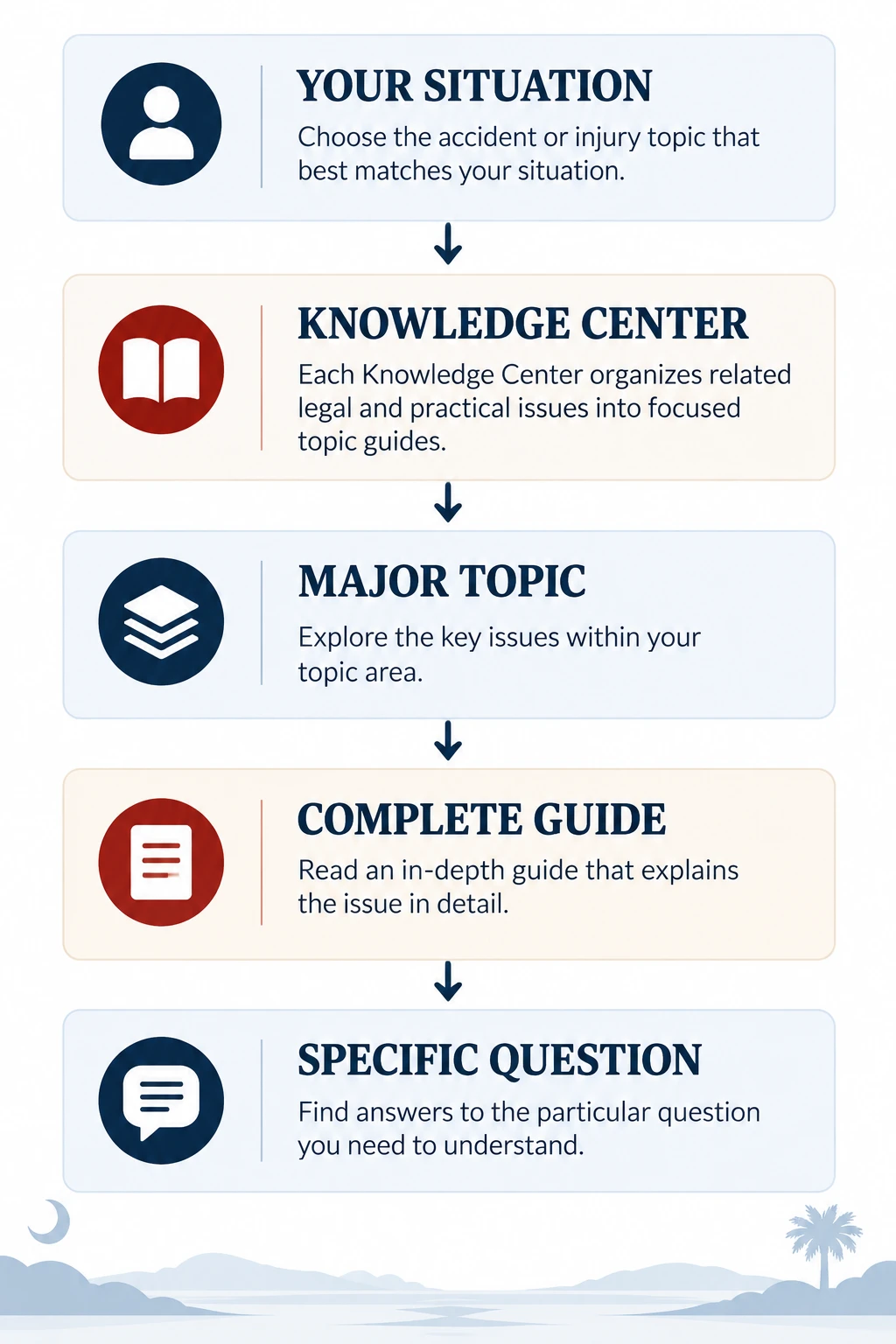
What Should I Be Careful Saying to an Insurance Adjuster?
| Statement or Topic | Why You Should Be Careful |
|---|---|
| "I'm fine." | A casual response may not accurately describe symptoms you are still experiencing |
| "I don't think I'm hurt." | Some injuries or symptoms may not be fully understood immediately after a crash |
| "I wasn't paying attention." | The insurer may evaluate whether your actions contributed to the collision |
| "It may have been partly my fault." | Speculation about responsibility may affect the insurer's liability evaluation |
| "I don't remember, but I think..." | Guessing can create an inaccurate statement that may later conflict with other evidence |
| "My old injury was completely healed." | Medical history should be described accurately rather than from assumption or incomplete memory |
| "I probably won't need more treatment." | You may not yet know what future care your medical providers will recommend |
| "I'm back to normal." | A broad statement may not accurately reflect continuing symptoms or limitations |
| Agreeing to a recorded statement | Your answers create a record that may later be compared with other evidence |
| Signing documents you do not understand | A release or authorization may affect information, claims, or rights beyond what you expect |
The goal is not to memorize “safe” answers. It is to avoid guessing, speculating, minimizing, exaggerating, or agreeing to something you do not understand.
Should I Talk to the Other Driver's Insurance Adjuster About My Injury Claim?
As a general rule, we advise our clients not to discuss their bodily injury claims directly with the other driver’s insurance adjuster.
That does not mean every communication with an insurance company should be avoided. Property-damage issues can be different. In some situations, it may be practical to communicate about vehicle inspections, repairs, towing, storage, or rental transportation without giving a detailed statement about your injuries or how the collision occurred.
For bodily injury claims, however, we generally prefer to handle those communications for our clients. Statements about fault, symptoms, prior medical history, treatment, work limitations, or recovery may later be compared with medical records and other evidence.
Having an attorney handle appropriate bodily injury communications can reduce the risk of misunderstandings while allowing you to focus on your medical care and recovery.
What Can I Safely Say If an Insurance Adjuster Calls?
You do not need to be rude, argumentative, or evasive when an insurance adjuster contacts you.
If the other driver’s insurer calls about a bodily injury claim and you are not prepared to discuss the accident, you can politely obtain basic information without giving a detailed statement.
For example, you can ask for:
- The adjuster's name
- The insurance company
- The insured driver's name
- The claim number
- The adjuster's telephone number and email address
- The reason for the call
If you do not want to discuss the accident before obtaining legal advice, you can simply say:
“Thank you for calling. I’m not prepared to discuss the accident or my injuries right now. Please give me your contact information and claim number.”
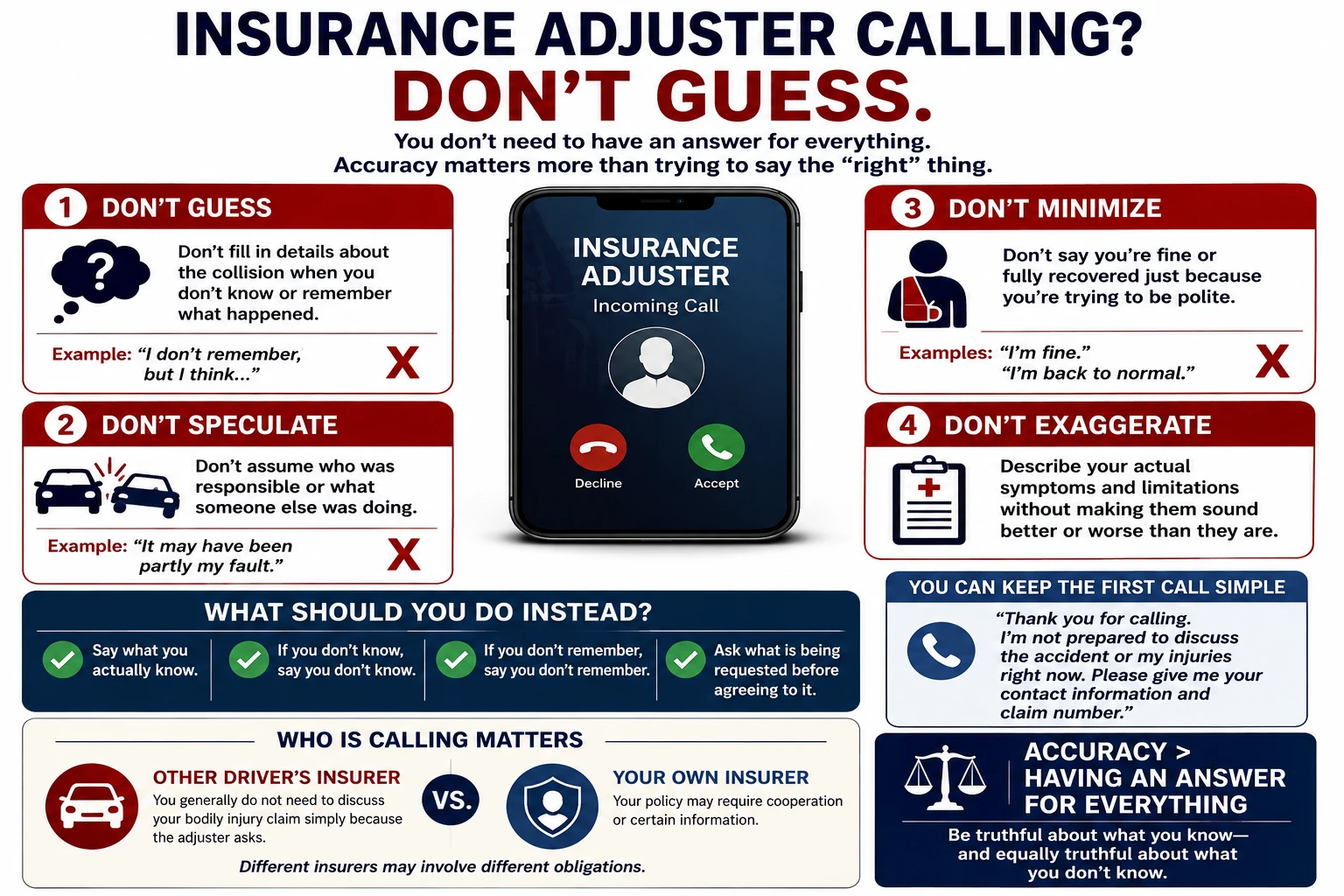
You don’t need to have an answer for everything. Accuracy matters more than trying to say the “right” thing.
If you have already hired a lawyer, provide your lawyer’s contact information and let the adjuster know that future communications about the bodily injury claim should be directed to your attorney.
You do not have to turn the conversation into a confrontation. Be polite, obtain the information you need, and avoid discussing subjects you are not prepared to address.
What Mistakes Can Hurt an Injury Claim When Talking to an Insurance Adjuster?
Some problems arise not because a person intends to say something harmful, but because they guess, minimize, speculate, or answer questions before they have enough information.
Common mistakes include:
- Guessing about how the accident happened when you did not see everything
- Speculating about who was at fault
- Saying "I'm fine" out of politeness when you are still experiencing symptoms
- Saying you are fully recovered before you know whether symptoms or treatment will continue
- Guessing about future medical treatment
- Giving inaccurate information about prior injuries or medical history
- Exaggerating symptoms or limitations
- Minimizing real symptoms because you do not want to sound like you are complaining
- Agreeing to a recorded statement without understanding why it is being requested
- Signing a medical authorization without understanding its scope
- Signing a release before understanding which claims or parties it affects
- Assuming a friendly conversation is "off the record"
- Assuming your own insurer and the other driver's insurer have the same relationship with you
The safest approach is accuracy. If you do not know something, do not guess. If you do not remember, say you do not remember. If you do not understand what is being requested, ask before agreeing to it.
Can a Recorded Statement Affect My Car Accident Claim?
Yes. A recorded statement creates a record of what you said at a particular point in time.
The insurer may later compare your statement with:
- The police report
- Witness statements
- Photographs or video
- Vehicle damage
- Medical records
- Deposition testimony
- Discovery responses
- Other evidence concerning the accident or your injuries
That does not mean every inconsistency is dishonest. Memory can be incomplete, symptoms can change, and additional facts may become known as the claim develops.
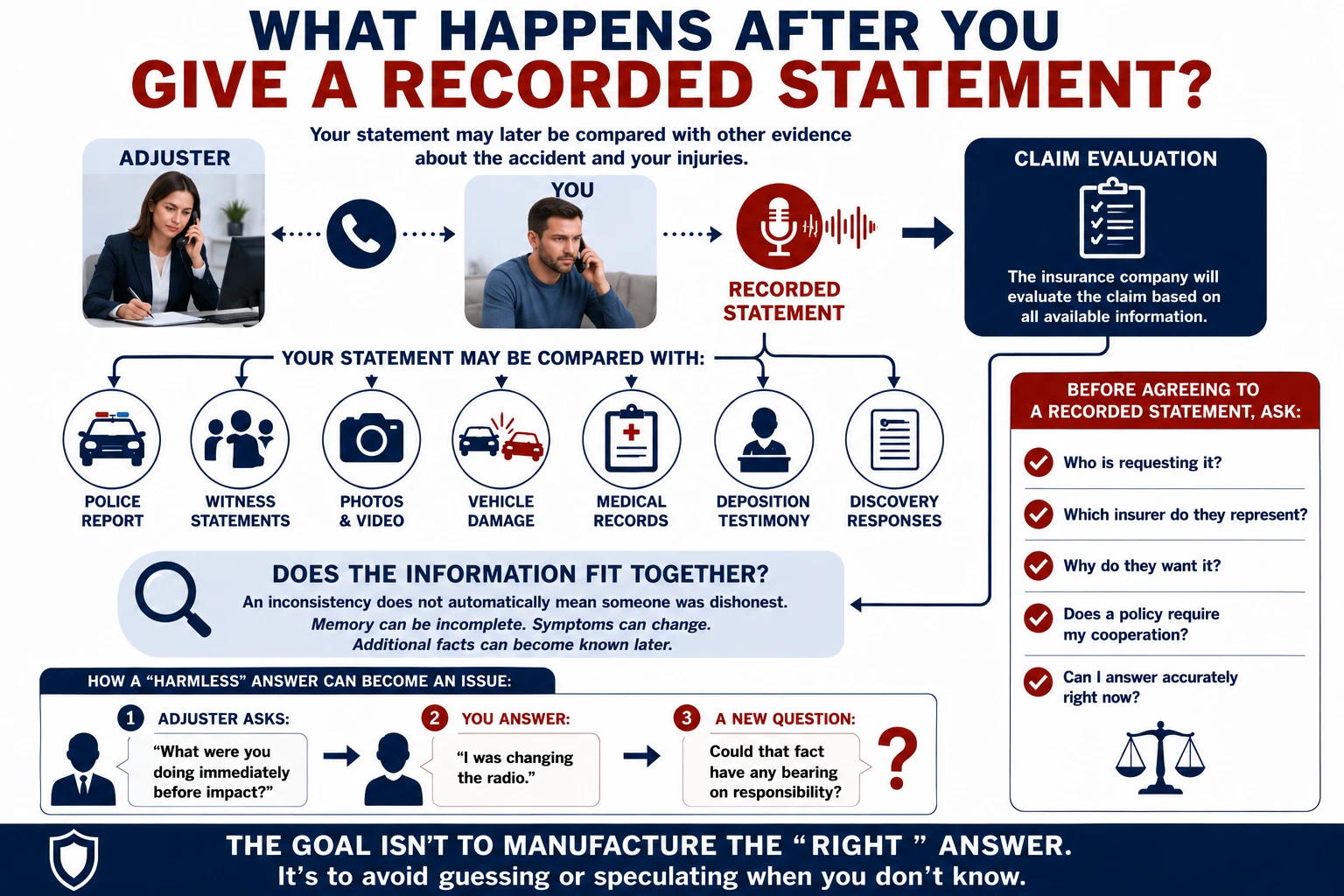
Your statement may later be compared with other evidence about the accident and your injuries.
But an inaccurate guess or casual statement can create questions that otherwise may not have existed.
For example, an adjuster investigating a rear-end collision may ask what you were doing immediately before impact. If you casually mention changing the radio, the insurer may evaluate whether that fact has any bearing on responsibility for the collision.
The important point is not to manufacture the “right” answer. It is to avoid guessing or speculating when you do not know.
Do I Have to Give the Other Driver's Insurance Company a Recorded Statement?
In many situations, you are not required to voluntarily provide a recorded statement to the other driver’s liability insurer simply because the adjuster requests one.
That is different from dealing with your own insurance company. Your policy may contain cooperation requirements that require you to provide information or participate in parts of the claim process.
Before agreeing to a recorded statement, determine:
- Who is requesting it?
- Which insurance company do they represent?
- Why are they requesting it?
- Does an insurance policy require your cooperation?
- Are you comfortable answering the questions accurately at this stage?
If you are represented, discuss the request with your lawyer before giving the statement.
Do not assume every request for a recorded statement creates the same obligation.
What Types of Questions Should I Be Careful Answering?
Insurance adjusters may ask about both how the accident occurred and how the accident affected you.
Questions about the collision may include:
- Where you were looking
- Your speed
- Whether you were using your phone
- What you were doing immediately before impact
- When you first saw the other vehicle
- Whether you could have avoided the collision
- Whether you believe you contributed to what happened
Questions about your injuries may include:
- Whether you were hurt
- When symptoms began
- Which body parts hurt
- Whether you have improved
- Whether you have returned to work
- Whether you have resumed normal activities
- Whether you had similar symptoms before the accident
- What future treatment you expect
There is nothing inherently improper about an insurer wanting information relevant to a claim.
The risk arises when you guess, speculate, minimize, exaggerate, or answer a question you do not fully understand.
If you do not know, say you do not know. If you do not remember, say you do not remember. Do not fill in missing details simply because you feel pressured to answer.
What If I Already Talked to the Insurance Adjuster?
Do not assume that your claim is ruined simply because you already spoke with an insurance adjuster.
What matters depends on what was discussed, whether the conversation was recorded, what you said, and how those statements compare with the other evidence.
If you already spoke with the insurer:
- Write down when the conversation occurred
- Identify who you spoke with
- Note whether you agreed to a recorded statement
- Preserve emails, texts, letters, or other communications
- Do not attempt to "correct" the situation by making additional speculative statements
- Tell your lawyer as accurately as possible what was discussed
If you later realize that something you said was incomplete or inaccurate, do not invent an explanation or pretend the conversation never occurred.
Tell your lawyer what happened so the statement can be evaluated in context.
One conversation does not automatically decide an injury claim. The important thing is to understand what was said and proceed carefully from that point forward.
What If the Insurance Adjuster Asks How I Am Feeling?
Questions about your injuries can be difficult to answer early in a claim because your medical condition may still be developing.
Avoid minimizing your condition simply because you are trying to be polite. At the same time, do not exaggerate symptoms or make medical conclusions that your healthcare providers have not made.
If you are still treating, you may not yet know:
- Your final diagnosis
- How long symptoms will last
- Whether additional testing will be needed
- Whether a specialist will recommend further treatment
- Whether you will have permanent limitations
- When you will fully recover
That is why statements such as “I’m fine,” “I’m completely healed,” or “I won’t need any more treatment” can be premature.
You do not need to predict your medical future. Accurately describe what you know, and let qualified medical providers determine diagnoses, treatment, prognosis, and future medical needs.
What If the Insurance Adjuster Asks About Prior Injuries or Medical Conditions?
Prior injuries and medical conditions can become relevant when they involve similar symptoms, the same body part, or another issue connected to the current claim.
Do not hide a relevant prior injury. But do not guess about dates, diagnoses, treatment, or how long ago something occurred if you genuinely do not remember.
For example, if you previously treated for lower-back pain and the new accident also injured your lower back, the insurer may compare your medical condition before and after the collision.
The important question may become:
What changed because of the new accident?
Medical records and qualified healthcare providers may help answer that question.
A prior injury does not automatically mean the new accident caused no additional harm. Accuracy about your medical history is more important than trying to make the prior condition disappear.
Should I Discuss My Activities or Social Media With an Insurance Adjuster?
Be careful about making broad statements concerning what you can or cannot do after an accident.
An adjuster may ask whether you have returned to work, exercised, traveled, performed household activities, attended events, or resumed hobbies. Those answers may later be compared with medical records, photographs, video, social-media posts, or other evidence.
That does not mean you should claim that you cannot do something when you actually can.
Be accurate about both your abilities and your limitations. There can be an important difference between being physically capable of doing an activity once and being able to perform it comfortably, repeatedly, or at the same level as before the accident.
You should also assume that publicly available social-media content may be reviewed during an injury claim.
Do not exaggerate your limitations, but do not minimize them either. Accuracy and context matter.
What Documents Should I Be Careful Signing for an Insurance Company?
An insurance company may ask you to sign documents during the claim process. Before signing anything, understand what the document authorizes and what rights it may affect.
Depending on the claim, documents may include:
- Medical authorizations
- Employment or wage authorizations
- Property-damage paperwork
- Settlement agreements
- Releases
- Other claim-related forms
A medical authorization, for example, may allow an insurer to obtain medical information. Before signing, understand which providers, records, and time periods the authorization covers.
A release can be especially important because signing one may resolve particular claims or affect your ability to pursue them later.
Do not sign simply because an adjuster tells you a form is “standard.” Read it, understand what it does, and obtain legal guidance if you have questions about how it could affect your claim.
Can I Talk to the Insurance Adjuster About My Vehicle Damage?
Property-damage issues can be different from bodily injury issues.
You may need to communicate with an insurer about practical matters such as:
- Vehicle inspection
- Repair estimates
- Towing
- Storage
- Rental transportation
- Whether a vehicle is repairable
- Property-damage payments
Those conversations do not necessarily require a detailed discussion of your physical injuries or an extensive statement about how the accident occurred.
If an adjuster begins asking questions that move from “Where is the vehicle?” to “Tell me exactly how the collision happened and describe every injury you have,” understand that the conversation has moved beyond basic vehicle logistics.
If you are represented, ask your lawyer how the firm wants property-damage communications handled.
The fact that you need to resolve your vehicle damage does not necessarily mean you need to provide a detailed bodily injury statement at the same time.
Why Does the Insurance Adjuster Ask So Many Questions?
Insurance adjusters gather information so the insurance company can evaluate the claim.
Depending on the circumstances, they may investigate:
- How the collision occurred
- Whether responsibility is disputed
- Whether more than one person may share fault
- When injuries were first reported
- Prior injuries or medical conditions
- Medical treatment
- Work loss
- Activity limitations
- Insurance coverage
- The amount being claimed
An adjuster may be friendly, courteous, and professional while asking these questions.
But remember: the adjuster is not your lawyer and does not represent your interests. The adjuster’s role is to investigate and evaluate the claim on behalf of the insurance company.
That is why you should approach the conversation as a claim-related communication, not as an informal conversation with someone who is advising you about your legal rights.
Does the Insurance Adjuster Represent Me?
No. The other driver’s insurance adjuster represents the interests of the insurance company and handles the claim involving its insured. The adjuster is not your attorney and does not have the role of giving you legal advice about how to protect your injury claim.
That does not mean the adjuster must be rude or dishonest. Many adjusters are professional and courteous.
The difficulty is that you may be speaking with a trained claims professional at a time when you are injured, stressed, arranging medical care, dealing with vehicle damage, missing work, and trying to understand a process you may never have encountered before.
That imbalance is one reason people can make incomplete or inaccurate statements without intending to.
You can be polite and cooperative where appropriate without assuming that the adjuster is acting as your advocate.
What Should I Do If an Insurance Adjuster Calls Me?
If the other driver’s insurance adjuster contacts you after an accident, you do not need to panic or feel pressured to resolve anything during the call.
A simple approach is:
- Identify the caller. Get the adjuster's name, insurance company, insured driver's name, claim number, and contact information.
- Determine why they are calling. Find out whether the call concerns property damage, bodily injury, a recorded statement, documents, or another issue.
- Do not guess or speculate. If you do not know or remember something, do not fill in the gaps.
- Do not agree to a recorded statement or sign documents you do not understand. First determine what is being requested and whether you are required to provide it.
- If you are represented, direct bodily injury communications to your lawyer.
- If you are not represented and have questions about your rights, consider obtaining legal advice before discussing the bodily injury claim in detail.
Most importantly, do not let the fact that the adjuster called create a false sense of urgency. You can obtain the caller’s information and decide how to respond after you understand what is being requested.
How Does Christmas Injury Lawyers Handle Insurance Company Communications?
Once Christmas Injury Lawyers represents you, one of our roles is to help manage communications concerning your injury claim so you do not have to navigate every insurance-company request on your own.
Depending on the case, our team may:
- Notify insurers that we represent you
- Direct appropriate bodily injury communications through the firm
- Evaluate requests for recorded statements
- Review medical authorizations and releases
- Provide claim-related information when appropriate
- Gather and organize evidence
- Identify insurance coverage
- Develop medical and damages documentation
- Respond to disputed liability or causation issues
- Prepare the case for litigation when necessary
There may still be situations where your participation is required. If so, our job is to explain what is happening, why your participation is needed, and help you prepare for the process.
We want you focused on your medical care and recovery while your legal team handles the legal and insurance issues that come with the claim.
What Is the Most Important Thing to Remember When an Adjuster Contacts Me?
You do not need to know every answer simply because an insurance adjuster asks you a question.
After an accident, facts may still be developing. You may not know the full extent of your injuries. You may not remember every detail of the collision. Your doctors may not yet know what treatment you will need.
That is why the safest principle is simple:
Don’t guess. Don’t speculate. Don’t exaggerate. Don’t minimize.
Be truthful about what you know. Be equally truthful about what you do not know.
And before agreeing to a recorded statement, signing a release, or providing broad access to information, understand what is being requested and why.
Gary's Take: You Don't Need to Have an Answer for Everything
“One of the biggest mistakes I see is people feeling like they have to answer every question immediately. They don’t want to sound difficult, so if they aren’t sure, they guess.”
“You don’t need to guess. You don’t need to predict what your doctor is going to say. And you don’t need to minimize an injury just because you’re trying to be polite.”
“Be accurate. If you don’t know, say you don’t know. If you don’t remember, say you don’t remember. And if you don’t understand what the insurance company is asking you to do, get advice before you agree to it,” says Gary Christmas.
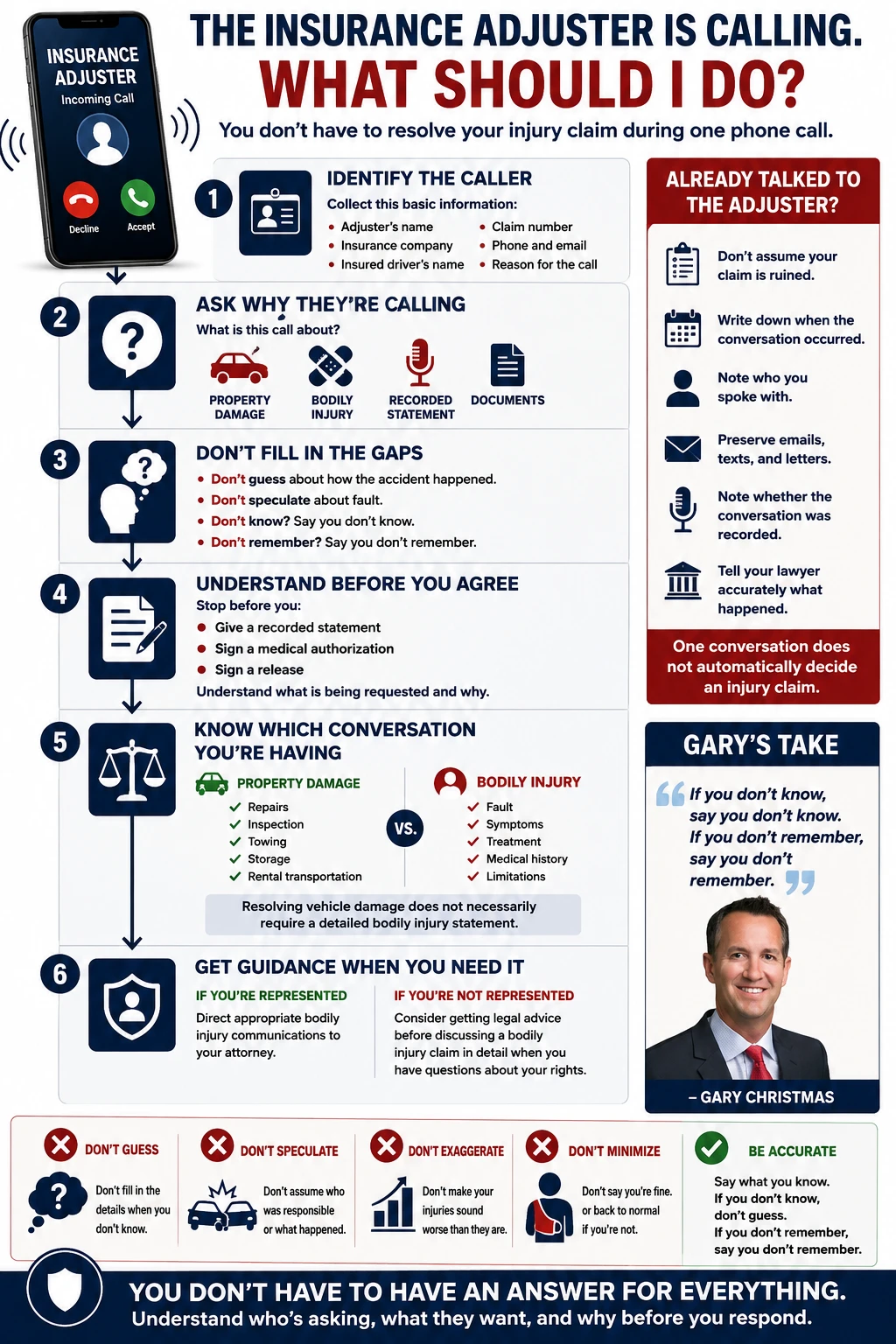
You don’t have to resolve your injury claim during one phone call.
If an Insurance Adjuster Calls You
- Stay calm and identify who is calling
- Get the insurance company, claim number, and adjuster's contact information
- Ask why the adjuster is calling
- Determine whether the issue involves property damage or bodily injury
- Do not guess about how the accident happened
- Do not speculate about fault
- Do not minimize or exaggerate your injuries
- Do not predict future medical treatment
- Do not guess about prior medical history
- If you do not know, say you do not know
- If you do not remember, say you do not remember
- Understand why a recorded statement is being requested before agreeing to one
- Understand the scope of a medical authorization before signing it
- Understand which claims a release affects before signing it
- Preserve emails, letters, texts, and other insurance communications
- Remember that property-damage discussions and bodily injury discussions may involve different issues
- Understand that your own insurer may have different rights and obligations under your policy
- If you already gave a statement, tell your lawyer what happened
- If you are represented, direct appropriate bodily injury communications to your attorney
- Get legal guidance when you are unsure what information you are required to provide
Summary
After a South Carolina car accident, you may hear from an insurance adjuster before you fully understand what happened, how seriously you are injured, or what medical treatment you may need. You do not need to have an answer for every question simply because an adjuster asks one.
When dealing with the other driver’s insurance company, be especially careful about discussing fault, your injuries, prior medical conditions, future treatment, work limitations, or your recovery before you are prepared to answer accurately. Avoid guessing about facts you do not know, speculating about responsibility, minimizing real symptoms, or exaggerating your limitations.
A recorded statement creates a record of what you say and may later be compared with medical records, photographs, witness statements, deposition testimony, and other evidence. Before agreeing to one, determine who is requesting the statement, why they want it, and whether you have any obligation to provide it. Your own insurance company may have different rights under your policy, including cooperation requirements.
You should also understand documents before signing them. Medical authorizations, employment authorizations, settlement agreements, and releases can affect different information, claims, or rights. Likewise, communicating with an insurer about vehicle repairs or other property-damage issues does not necessarily require you to provide a detailed bodily injury statement at the same time.
If you have already spoken with an adjuster, do not assume you have ruined your claim. Preserve the communications, write down what you remember about the conversation, and tell your lawyer what occurred. One conversation does not automatically determine the outcome of an injury claim.
The most important principle is simple:
Don’t guess. Don’t speculate. Don’t exaggerate. Don’t minimize.
Be truthful about what you know and equally truthful about what you do not know. If you do not understand what an insurance company is asking you to say, sign, or authorize, understand the request before agreeing to it.