


What Should I Do If the Insurance Adjuster Won't Call Me Back?
If calls and messages are going unanswered, focus on creating a clear record and protecting the underlying accident claim rather than repeatedly leaving the same voicemail.
| What to Do | Why It Matters |
|---|---|
| Confirm you have the correct adjuster's contact information | Claims can be reassigned, and contact information can change |
| Keep a communication log | Creates a timeline of your follow-up efforts |
| Follow up in writing | Email or written correspondence can document exactly what you requested |
| Keep your claim number on communications | Helps identify the correct claim |
| Save emails, letters, and voicemails | Preserves the communication history |
| Ask whether anything is outstanding | The insurer may be waiting for records, statements, estimates, or other information |
| Continue appropriate medical care | Your health and injury documentation should not depend on whether an adjuster calls back |
| Preserve accident evidence | Evidence can disappear while the insurance claim is delayed |
| Remain accurate and professional | Angry or speculative communications generally do not help resolve the issue |
| Pay attention to legal deadlines | Insurance negotiations do not necessarily stop a filing deadline from running |
| Seek legal advice when the claim remains stalled | An attorney can evaluate the reason for the delay and available next steps |
Why Might an Insurance Adjuster Stop Returning My Calls?
An unanswered phone call does not necessarily mean the insurance company is intentionally ignoring your claim.
There are several possible explanations.
An adjuster may be handling a large number of claims. The claim may have been reassigned. The insurer may be waiting for information from another driver, a police report, medical records, repair documentation, coverage information, or another part of its investigation.
There may also be a disagreement about liability, coverage, causation, damages, or the information necessary to evaluate the claim.
And sometimes communication simply breaks down.
That is why the reason for the silence matters more than assuming what the silence means.
If you are not receiving a response, try to determine:
- Is the same adjuster still assigned to the claim?
- Is the insurer waiting for information?
- Has liability been accepted, denied, or left under investigation?
- Is there a coverage issue?
- Has the insurer requested something from you?
- Is a particular decision still pending?
- Has the insurer actually communicated a denial in writing?
Do not automatically interpret silence as either a denial or evidence of wrongdoing. First determine what is actually happening with the claim.
How Long Should I Wait for an Insurance Adjuster to Call Me Back?
There is no single number of hours or days that automatically tells you an insurer’s response time is reasonable or unreasonable in every accident claim.
The more useful question is whether there is a pattern of unexplained delay and whether that delay is preventing an important part of the claim from moving forward.
For example, one missed call may mean very little. Repeated unanswered calls and written follow-ups over a meaningful period, especially when you are waiting for a liability decision, coverage information, property-damage decision, or another important response, deserve closer attention.
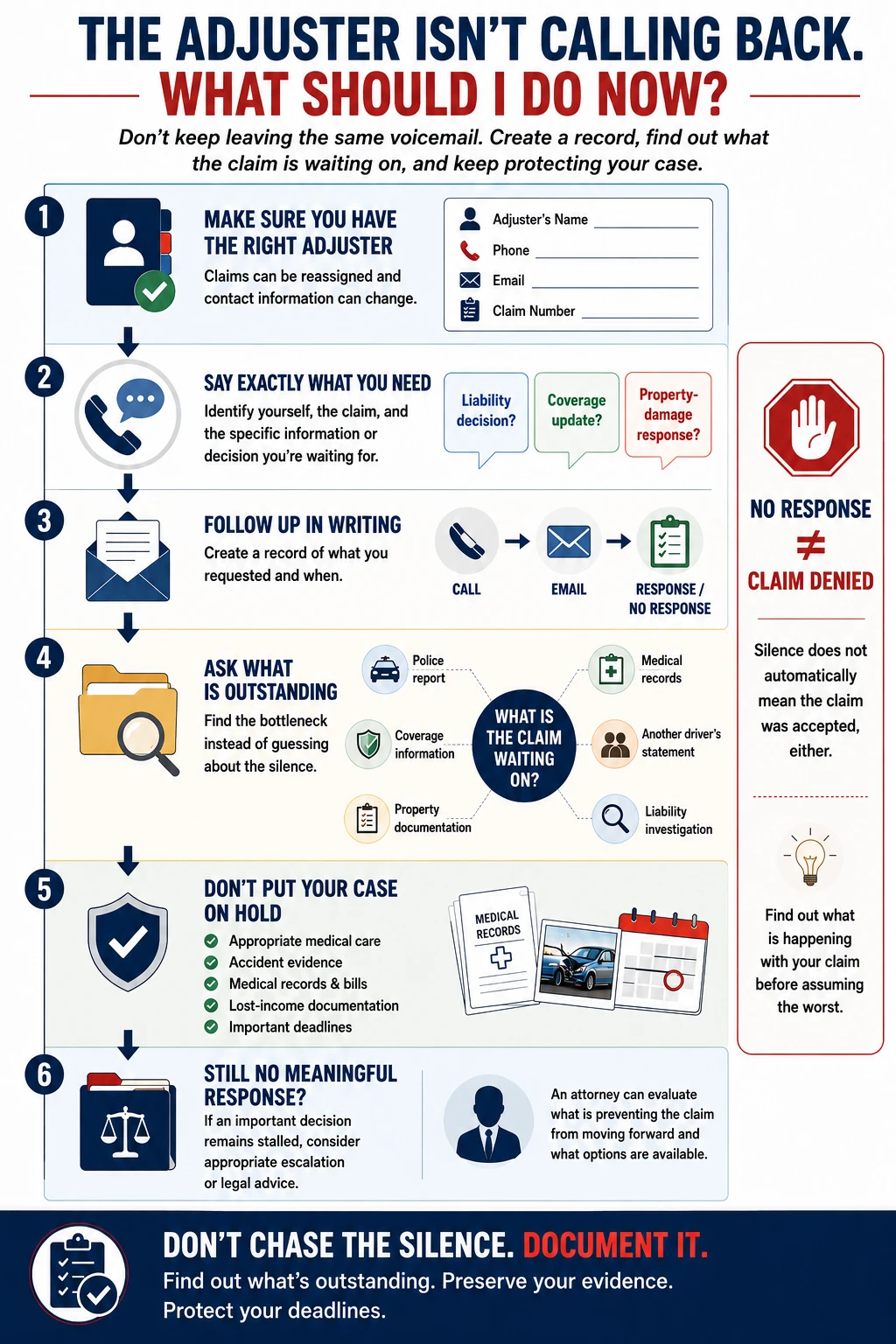
Don’t keep leaving the same voicemail. Create a record, find out what the claim is waiting on, and keep protecting your case.
Instead of calling repeatedly without changing your approach:
- Confirm the adjuster's contact information.
- Leave a clear message identifying yourself and the claim.
- Explain specifically what response or information you need.
- Follow up in writing.
- Keep a record of each attempt and response.
- If communication remains stalled, consider escalating the issue appropriately or obtaining legal advice.
There is an important difference between an adjuster taking time to investigate a claim and a claim sitting without meaningful communication or explanation.
Does No Response Mean the Insurance Company Denied My Claim?
Not necessarily. An unanswered call is not the same thing as a formal decision about your claim.
An insurance company may still be investigating liability, evaluating coverage, waiting for information, or simply experiencing a communication delay.
If you are unsure about the status of the claim, ask directly:
- Has liability been accepted or denied?
- Is coverage still being investigated?
- Is anything needed from me before a decision can be made?
- Has a decision been made that I should receive in writing?
Getting clarity about the status of the claim is more useful than trying to interpret silence.
At the same time, do not assume that the absence of a denial means the claim has been accepted. Until you know the insurer’s position, continue preserving evidence and protecting your rights.
What Mistakes Should I Avoid When the Insurance Company Stops Responding?
When communication breaks down, frustration can cause injured people to make decisions that create additional problems.
Common mistakes include:
- Calling repeatedly without documenting the attempts. A clear communication record is generally more useful than dozens of undocumented calls.
- Leaving angry, threatening, or profane messages. Frustration is understandable, but hostile communications rarely help move the claim forward.
- Guessing about why the insurer is not responding. Silence does not automatically mean your claim was denied or that the insurer is acting in bad faith.
- Failing to follow up in writing. Written communication can establish what information or decision you requested and when you requested it.
- Ignoring requests you previously received from the insurer. Determine whether the claim is stalled because information is outstanding.
- Stopping appropriate medical treatment while waiting for the adjuster. Your medical care should be based on your medical needs, not on whether an insurance representative returns a call.
- Failing to preserve evidence while waiting. Photographs, video, vehicle evidence, witness information, and other proof may become harder to obtain over time.
- Posting angry accusations about the insurer or accident publicly. Public statements can create unnecessary issues and may become relevant to the claim.
- Assuming negotiations stop legal deadlines. An open insurance claim does not necessarily preserve your right to file a lawsuit indefinitely.
- Accepting a rushed settlement simply because the adjuster finally responds. Evaluate the substance of any offer or release, not merely the relief of receiving a response.
- Signing documents you do not understand. Know what information you are authorizing and what claims or rights a release may affect.
The insurer’s lack of communication should not cause you to stop protecting your own claim. Keep documenting, preserve the evidence, meet your obligations, and pay attention to deadlines.
What Can a Lawyer Do If the Insurance Company Will Not Respond?
Hiring a lawyer does not automatically force an insurance company to agree with your claim. But legal representation can change how communication is handled and what options are available when informal claim discussions are not working.
An attorney can communicate with the insurer on your behalf, determine what issues remain unresolved, gather and present supporting evidence, evaluate coverage and liability disputes, and create a documented record of the claim.
If a lawsuit becomes appropriate, the case moves into a formal legal process. Depending on the case, litigation can provide tools for obtaining relevant information and evidence through discovery and asking a court to address appropriate legal issues.
That does not mean every unanswered phone call requires a lawsuit.
The purpose of legal representation is not simply to make an adjuster return a call. It is to identify what is preventing the claim from moving forward and use the appropriate process to address it.
Does an Insurance Company's Delay Mean It Is Acting in Bad Faith?
Not necessarily. Delay, poor communication, or an unanswered call does not automatically establish insurance bad faith.
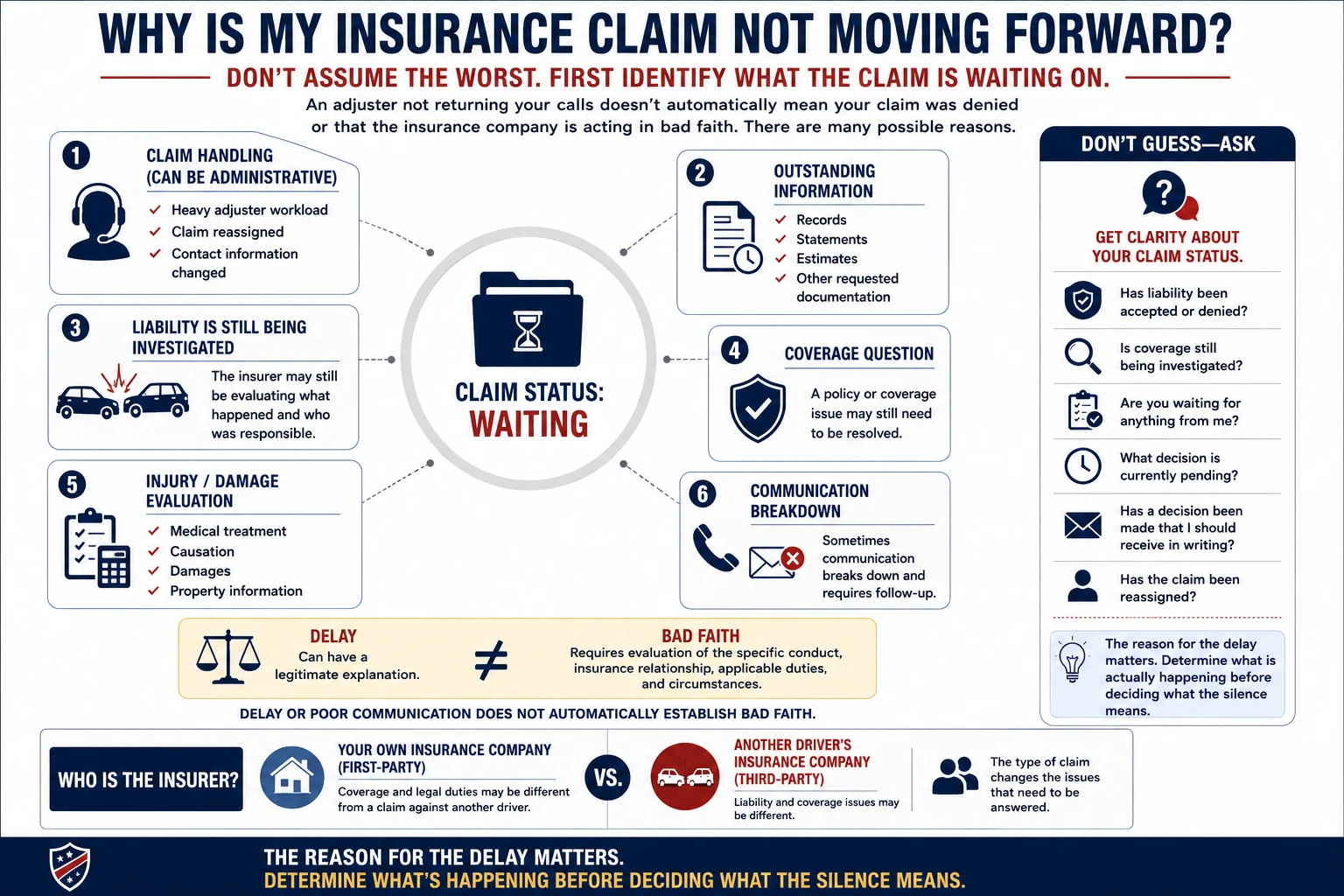
Don’t assume the worst. First identify what the claim is actually waiting on.
There can be legitimate reasons why a claim takes time to investigate or evaluate. Liability may be disputed. Coverage questions may need to be resolved. Medical treatment may still be developing. Records may be outstanding. The insurer may need information from multiple people or sources.
Bad-faith issues are also legally different from an ordinary disagreement about what an accident claim is worth.
If you believe an insurer is unreasonably delaying or mishandling a claim, the first questions should be:
- Which insurance company and policy are involved?
- Are you making a claim under your own insurance policy or against another person's liability coverage?
- What has the insurer actually done or failed to do?
- What explanations has it provided?
- What information was available to the insurer at the time?
- What duties apply under the particular circumstances?
Those distinctions matter.
Do not assume that frustrating communication automatically creates a separate bad-faith claim. If the conduct appears serious or persistent, preserve the communications and have an attorney evaluate the specific facts and applicable law.
What If My Own Insurance Company Is Not Returning My Calls?
A claim involving your own insurance company can raise different issues from a liability claim against another driver’s insurer.
Depending on the accident and your policy, you may be dealing with your own carrier for collision coverage, uninsured or underinsured motorist coverage, medical-payments coverage, or another form of applicable insurance.
If your own insurer is not responding, document your communications and review what the company has requested, what coverage is involved, and whether a decision remains outstanding.
You should also preserve the policy, declarations page, claim correspondence, emails, letters, and other communications relating to the claim.
The legal duties and coverage issues involved in a first-party insurance claim may differ from those involved when you are seeking compensation from another person’s liability insurer. If the communication problem continues or an important coverage issue is unresolved, an attorney can evaluate the policy and the insurer’s handling of the claim.
What Can I Do Before Hiring a Lawyer If the Insurer Won't Respond?
There are several practical things you can do while deciding whether you need legal representation.
Create a communication file. Keep the claim number, adjuster’s name, phone number, email address, letters, emails, voicemail records, and dates of attempted communications together.
Follow up in writing. Clearly identify what you are waiting for, for example, a liability decision, property-damage update, coverage information, or response to documents you submitted.
Ask whether anything is missing. A claim can sometimes stall because the insurer is waiting for information that has not been received.
Preserve your accident evidence. Keep photographs, video, witness information, crash documentation, damaged-property information, and other relevant records.
Continue appropriate medical care. Do not let an adjuster’s communication schedule determine whether you follow medical recommendations.
Keep records of your losses. Preserve medical bills, wage-loss information, receipts, and other documentation related to the accident.
Watch the calendar. Do not assume that an open claim, ongoing negotiation, or unanswered communication extends the legal deadline for filing a lawsuit.
If the insurer remains unresponsive, an important decision is being delayed, or you are unsure how to protect the claim, that is an appropriate time to consider speaking with a South Carolina personal injury lawyer.
Should I Keep Calling the Insurance Company Every Day?
Generally, repeatedly calling every day is not the most effective approach.
If an adjuster has not responded, make a reasonable follow-up attempt and leave a clear message identifying:
- Your name
- The claim number
- Your contact information
- What you are waiting for
- The best way to reach you
Then consider following up in writing so there is a record of the request.
The goal is to establish consistent, reasonable, documented communication, not to overwhelm the adjuster with repeated messages.
If you continue receiving no meaningful response, determine whether there is another appropriate contact, whether the claim has been reassigned, or whether legal assistance is warranted.
More calls do not necessarily create more leverage. Better documentation and a clear understanding of what the claim is waiting on are usually more useful.
Does a Friendly Insurance Adjuster Represent My Interests?
An insurance adjuster can be professional, courteous, and genuinely helpful in explaining parts of the claims process. That does not mean the adjuster represents you or has the same interests you do.
The adjuster works for the insurance company and handles the claim on its behalf.
That distinction does not require you to treat the adjuster as an adversary. It simply means you should communicate accurately, preserve your own records, understand what information you are providing, and independently evaluate important decisions about your claim.
Professional communication works both ways. You can be cooperative and respectful without assuming the insurance company is responsible for protecting your legal interests.
Why Does Acting Quickly Matter If the Insurance Company Is Not Responding?
Insurance-company silence does not stop everything else from moving forward.
Evidence can disappear with time. Vehicles may be repaired or destroyed. Surveillance footage may be overwritten. Witnesses can become harder to locate, and memories can fade.
Your medical condition may also continue developing, which makes it important to follow appropriate medical recommendations and maintain accurate records of treatment, symptoms, work restrictions, and other accident-related losses.
There is another critical issue: an insurance claim and the legal deadline for filing a lawsuit are not the same thing.
An adjuster continuing to investigate a claim, or failing to return your calls, does not necessarily extend the applicable filing deadline.
South Carolina limitation periods can depend on the type of claim, defendant, and circumstances involved. Certain claims may have different notice requirements or deadlines.
Do not allow an unanswered insurance claim to create a missed legal deadline. If you are unsure how much time remains, obtain advice about the deadline that applies to your particular case.
What Should I Include in a Follow-Up Email to the Insurance Adjuster?
A follow-up message does not need to be angry or complicated. Its purpose is to identify the claim, explain what you are waiting for, and create a written record of the request.
Include:
- Your name
- Claim number
- Date of the accident
- Adjuster's name
- The specific issue you need addressed
- Any earlier communication you are following up on
- Your current contact information
- A request for a response or status update
For example:
Subject: Follow-Up Regarding Claim [Claim Number]
I am following up regarding my claim arising from the accident on [date]. I previously contacted you on [date/dates] regarding [specific issue].
Please let me know the current status of this issue, whether you need any additional information from me, and when I can expect a response.
Thank you.
Keep the message factual and professional.
A useful follow-up says what you need and creates a record. It does not need to accuse, threaten, or speculate about why the adjuster has not responded.
Gary's Take: What Should You Do When an Insurance Company Goes Silent?
“When an adjuster stops returning calls, I don’t want a client spending every day leaving more voicemails and getting more frustrated. I want to know what we’re waiting on, what has been documented, and what needs to happen next.”
“Sometimes there is a reasonable explanation for a delay. Sometimes there is a disagreement that needs to be addressed. And sometimes the informal claims process simply isn’t moving the case forward.”
“The important thing is not to let somebody else’s silence cause you to stop protecting your own case. Preserve the evidence, keep your records, pay attention to the deadlines, and use the appropriate legal process when it becomes necessary,” says Gary Christmas.
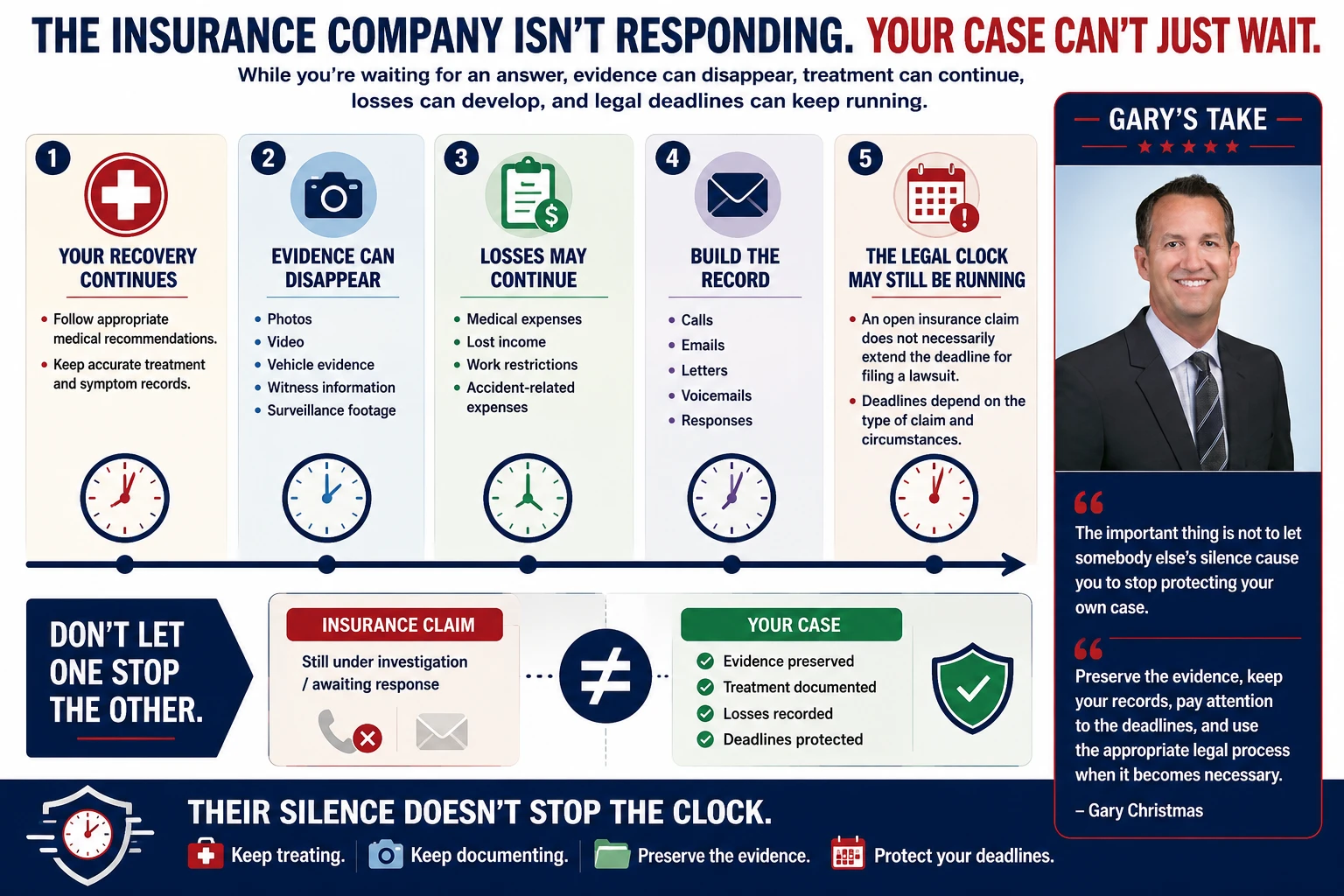
While you’re waiting for an answer, evidence can disappear, treatment can continue, losses can develop, and legal deadlines can keep running.
Insurance Company Communication Checklist
- Confirm the correct adjuster and contact information
- Keep your claim number readily available
- Maintain a dated communication log
- Save emails, letters, and voicemails
- Follow up important requests in writing
- Clearly identify what information or decision you are waiting for
- Ask whether the insurer needs anything else from you
- Keep communications factual, accurate, and professional
- Do not guess about why the insurer is not responding
- Continue appropriate medical care
- Preserve photographs, video, witness information, and other accident evidence
- Keep records of medical expenses, lost income, and other claimed losses
- Do not post angry accusations about the claim publicly
- Do not assume silence means the claim has been denied
- Do not assume an open insurance claim extends your legal filing deadline
- Read settlement documents and releases carefully
- Seek legal advice if an important claim decision remains stalled or you are unsure how to protect your rights
In Summary
If an insurance adjuster stops returning your calls, do not assume that your claim has been denied, that the insurer is acting in bad faith, or that you have no options. There may be a reasonable explanation for the delay, including workload, a reassigned claim, missing information, an ongoing investigation, or an unresolved liability or coverage issue.
Your first step should be to determine what the claim is actually waiting on. Confirm the correct adjuster, document your communication attempts, follow up important requests in writing, and ask whether the insurance company needs additional information from you. The goal is not to make as many calls as possible. It is to create a clear record of reasonable communication and identify what is preventing the claim from moving forward.
At the same time, continue protecting the underlying accident claim. Follow appropriate medical recommendations, preserve photographs and other evidence, maintain records of your expenses and lost income, and pay attention to legal deadlines. An open insurance claim, ongoing investigation, or unanswered voicemail does not necessarily extend the time you have to file a lawsuit.
If reasonable efforts to obtain a meaningful response are getting nowhere, a South Carolina personal injury attorney can evaluate the reason for the delay, determine what issues remain unresolved, and identify the appropriate next steps. The insurance company’s silence does not decide your case, but you should not allow that silence to stop you from protecting it.