


What Is the Difference Between a Car Accident Claim and a Lawsuit?
A car accident claim and a car accident lawsuit are related, but they are not the same thing.
The insurance claim may begin shortly after the accident. During this period, the parties may investigate what happened, identify available insurance coverage, gather medical and financial documentation, and discuss whether the claim can be resolved without filing suit.
A lawsuit begins when a legal action is formally filed in court.
That distinction matters when someone asks, “How long will my case take?”
There may be time spent developing the claim before a lawsuit is filed, followed by additional time for litigation if filing suit becomes necessary.
A case may therefore involve two broad phases:
Pre-Lawsuit Claim: Accident → Investigation → Medical Treatment → Documentation → Insurance Evaluation → Settlement Discussions
Filed Lawsuit: Complaint → Responses → Discovery → Depositions/Experts → Motions/Mediation → Trial or Resolution
Not every car accident claim becomes a lawsuit, and not every lawsuit reaches a jury trial.
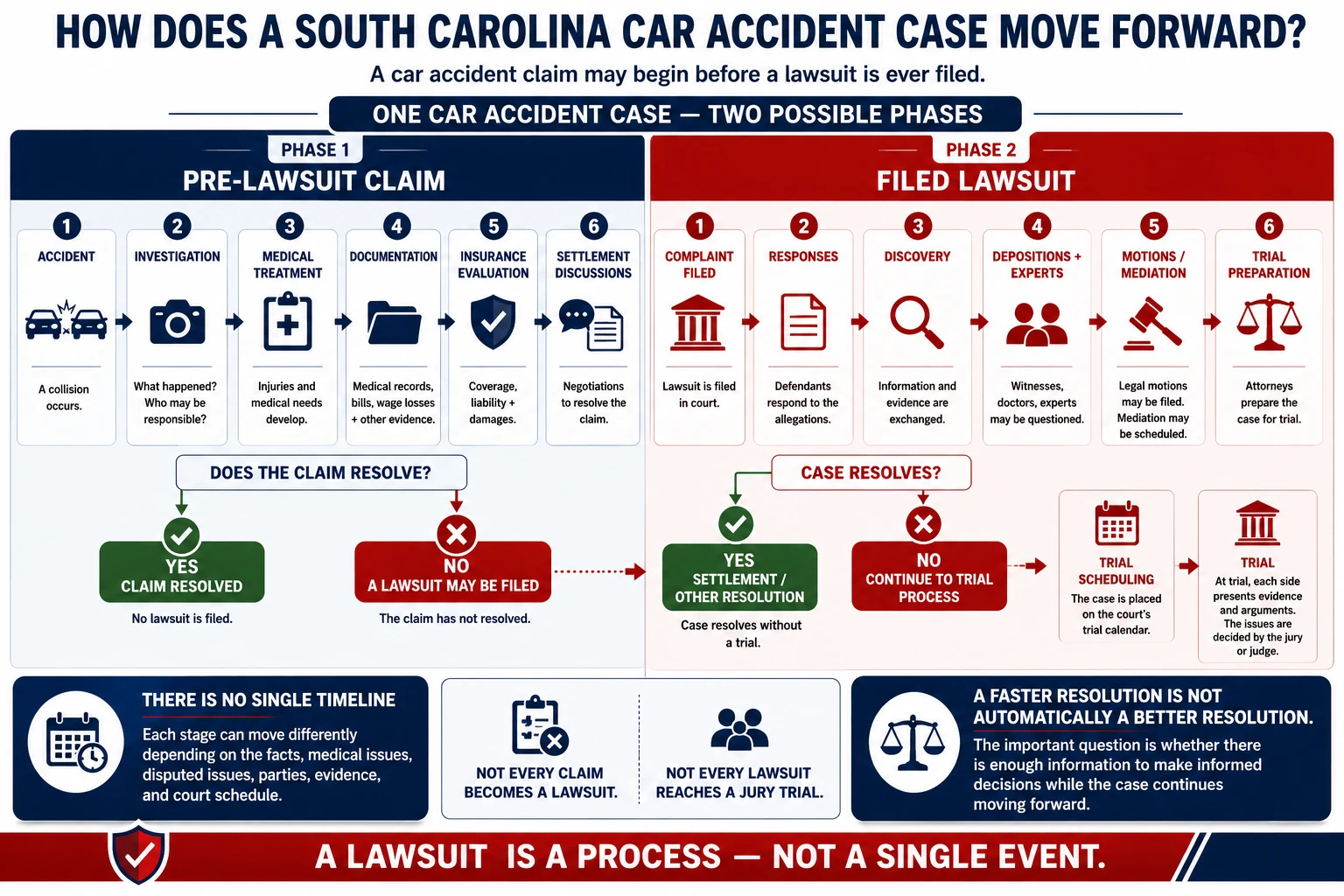
A car accident claim may begin before a lawsuit is ever filed.
What Happens After a South Carolina Car Accident Lawsuit Is Filed?
Once a lawsuit is filed, the case moves through a litigation process that may include several stages.
Filing and Service
The lawsuit is filed and the appropriate defendants must be formally notified through the legal process.
Responses and Early Motions
Defendants generally have an opportunity to respond to the allegations. Depending on the case, legal issues may also be raised through motions.
Written Discovery
The parties may exchange written questions, requests for documents, medical information, photographs, insurance information, and other evidence relevant to the claims and defenses.
Depositions
Attorneys may question parties, witnesses, medical professionals, experts, or others under oath.
Expert and Medical Evidence
Some cases require expert opinions concerning issues such as accident reconstruction, medical causation, future medical needs, vocational limitations, or other disputed matters.
Settlement Discussions or Mediation
A case can potentially resolve while litigation is underway. Settlement discussions may occur at different stages, and mediation may provide an opportunity for the parties to explore resolution.
Trial Preparation and Scheduling
If the case does not resolve, the attorneys prepare for trial and the case proceeds according to the applicable court procedures and schedule.
Trial
At trial, the parties present evidence and arguments, and the disputed issues are decided through the judicial process.
Not every lawsuit requires every one of these steps, and a case can potentially resolve at different points along the way.
What Factors Can Affect How Long a Car Accident Case Takes?
| Factor | How It May Affect the Timeline |
|---|---|
| Ongoing medical treatment | More time may be needed to understand the injuries and future medical needs |
| Serious or multiple injuries | Can require more treatment, medical evidence, and expert evaluation |
| Disputed liability | Additional investigation, discovery, or testimony may be necessary |
| Comparative-fault allegations | Evidence may be needed concerning each party's responsibility |
| Multiple defendants | More parties can mean additional attorneys, discovery, and scheduling issues |
| Insurance coverage disputes | Coverage questions may need to be investigated or litigated |
| Extensive discovery | Large amounts of documents, electronic evidence, or testimony can add time |
| Depositions | Coordinating parties, witnesses, doctors, and experts can affect scheduling |
| Expert witnesses | Expert review, reports, and depositions can add additional stages |
| Motions | Legal disputes may require briefing, hearings, and court decisions |
| Mediation or settlement negotiations | May resolve the case before trial or occur while litigation continues |
| Court scheduling | Trial timing depends partly on the court's calendar |
| Jury trial | Trial preparation and scheduling can extend the overall timeline |
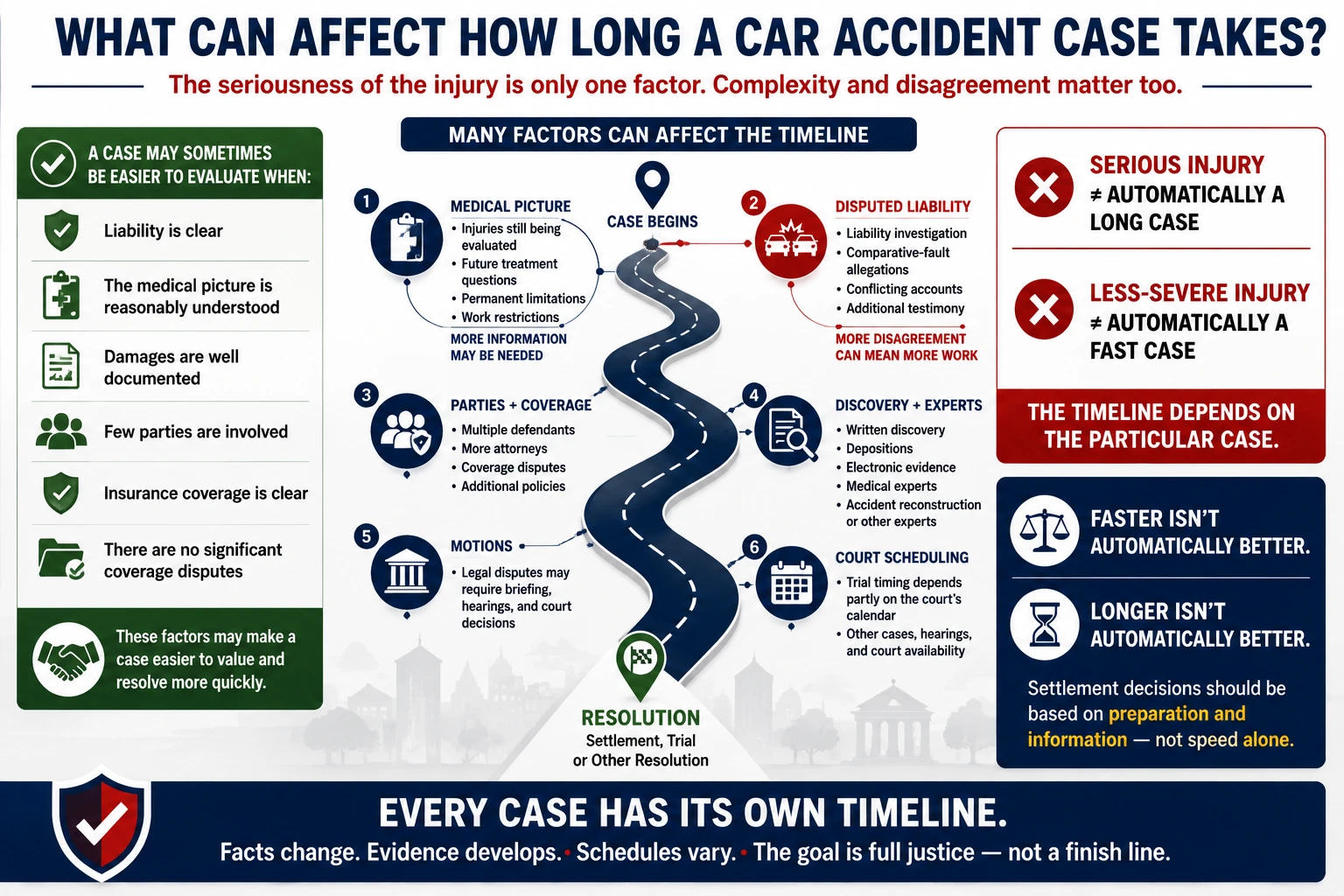
The seriousness of the injury is only one factor. Complexity and disagreement matter too.
Why Can Medical Treatment Affect the Timeline?
One reason an injury case may take time is that the medical picture may still be developing.
For example, someone injured in a collision may require treatment for more than one injury. One condition may require surgery and recovery before another condition can be fully evaluated or treated. Rehabilitation may take time, additional testing may be necessary, or doctors may need more information before giving opinions about future medical needs or permanent limitations.
Important questions may include:
- What injuries were caused by the collision?
- What treatment has been necessary?
- Is additional treatment reasonably anticipated?
- Is surgery being recommended?
- Are there permanent limitations or impairment?
- Will the injuries affect the person's ability to work?
- What future medical expenses are reasonably supported?
This does not mean every case must remain open until every symptom disappears or every person reaches a particular medical milestone.
It means there may be value in having enough medical evidence to reasonably understand the injuries and their effects before making an irreversible settlement decision.
The legal case and the medical recovery can move forward at the same time, but they do not always move at the same speed.
What Can Cause Delays in a Car Accident Case?
Some delays are outside your control. Others may result from missing information, difficulty communicating, or unresolved documentation.
Potential issues include:
- Missing important requests from your legal team
- Failing to provide requested documents or information
- Not keeping your lawyer informed about changes in medical treatment
- Failing to preserve relevant records or evidence
- Difficulty obtaining medical, employment, insurance, or other records
- Scheduling problems involving depositions, experts, or witnesses
- New medical developments that require additional evaluation
- New parties, insurance policies, or legal issues being identified
For your medical care, follow the recommendations of your treating medical professionals based on your health and circumstances. If treatment changes, an appointment is missed, or a doctor releases you from care, keep your legal team informed so the case records accurately reflect what happened.
Good communication and organization cannot eliminate every delay, but they can help prevent avoidable ones.
What Types of Car Accident Cases May Resolve More Quickly?
No particular type of case is guaranteed to resolve quickly. However, a claim may sometimes be easier to evaluate when:
- Liability is clear
- The parties agree about how the collision occurred
- The medical picture is reasonably understood
- The injuries and damages are well documented
- Few parties are involved
- Insurance coverage is clear
- There are no significant coverage disputes
- The supported damages clearly exceed the available insurance coverage
The last situation can sometimes occur in a catastrophic injury case. A very serious case is not necessarily a slow case if liability is clear, the damages are well documented, and the available coverage is readily identifiable.
Conversely, even a case involving less severe injuries can take longer when fault, causation, treatment, insurance coverage, or other issues are disputed.
The seriousness of the injury is only one factor affecting the timeline. Complexity and disagreement matter too.
Is a Faster Settlement Always Better?
No. But a longer case is not automatically better either.
The goal should be to make an informed decision based on the available evidence and circumstances, not to settle simply because an offer arrived quickly or delay simply for the sake of delay.
Before resolving an injury claim, important questions may include:
- Is liability reasonably understood?
- What insurance coverage is available?
- What injuries are supported by the medical evidence?
- Is significant treatment still ongoing?
- Are future medical needs reasonably understood?
- Have lost income and other financial losses been documented?
- Are there permanent restrictions or limitations?
- Are there unresolved liens, reimbursement claims, or other issues that may affect the recovery?
- What are the risks, costs, and potential benefits of continued litigation?
At Christmas Injury Lawyers, we prepare cases with the possibility of litigation in mind. That does not mean every case should go to trial or that a longer case is necessarily a stronger case.
It means settlement decisions should be based on preparation and information rather than speed alone.
Can a Serious Injury Case Ever Resolve Relatively Quickly?
Yes. A serious injury does not automatically mean a case will take years.
In one prior matter, our client spent approximately three weeks in the hospital and incurred substantial medical expenses. The at-fault driver had $100,000 in liability coverage, and an additional $300,000 in underinsured motorist coverage was available.
Based on the facts and available coverage in that particular case, our client recovered the available $400,000 in insurance proceeds relatively quickly.
That result depended on the particular facts, injuries, liability evidence, and insurance coverage involved. It does not mean another case will resolve on the same timeline or produce the same result.
What Surprises People Most About How Long a Lawsuit Takes?
One surprise is that filing a lawsuit does not mean the case immediately receives a trial date.
Litigation involves multiple stages. The parties may exchange documents and written discovery, take depositions, obtain expert opinions, address motions, participate in mediation, and prepare for trial.
Some of those steps depend on schedules outside your lawyer’s direct control, including:
- Opposing attorneys
- Parties and witnesses
- Medical professionals
- Expert witnesses
- Mediators
- Court hearings
- The trial calendar
Another surprise is that settlement discussions and litigation can happen at the same time. Filing suit does not necessarily end negotiations. A case may resolve during discovery, after depositions, at mediation, shortly before trial, or at another point in the process.
A lawsuit is a process, not a single event.
Does Filing a Car Accident Lawsuit Mean My Case Will Go to Trial?
No.
Filing a lawsuit begins the formal litigation process, but a case may still resolve before trial.
Settlement discussions can occur:
- Before a lawsuit is filed
- During written discovery
- After depositions
- During or after expert discovery
- At mediation
- While motions are pending
- During trial preparation
- Shortly before trial
Whether settlement makes sense depends on the facts, evidence, available insurance, disputed issues, and the terms being offered.
Preparing for trial and being willing to consider a reasonable settlement are not contradictory. Thorough trial preparation can continue while settlement options are evaluated.
Can a Lawyer Tell Me Exactly How Long My Car Accident Lawsuit Will Take?
No lawyer can responsibly guarantee the exact date a car accident lawsuit will end.
Your attorney may be able to explain the stages ahead and provide context based on the circumstances, but several factors are outside any one lawyer’s control.
Those may include:
- How medical issues develop
- Actions taken by opposing parties
- Discovery disputes
- Witness and expert availability
- Motions
- Mediation scheduling
- Court hearings
- Trial-calendar availability
- Whether settlement becomes possible
A useful question to ask your lawyer is not simply:
“When will this be over?”
Also ask:
“What stage are we in now, what needs to happen next, and what could affect the timeline from here?”
Gary's Take: Think of the Trial Roster Like a Grocery Store Line
“One way I explain trial scheduling to clients is to think about standing in line at the grocery store. You may know you’re in line, but you don’t necessarily know exactly how long each person ahead of you will take.”
“Court scheduling can work in a similar way. Cases ahead of yours may settle, proceed to trial, require more time than expected, or otherwise affect when your case is reached.”
“That’s one reason I don’t like promising clients that a lawsuit will be finished on a particular date. We can control how diligently we prepare the case. We cannot control every medical development, every decision made by another party, or the court’s calendar.”
“Our job is to keep the case moving, prepare it thoroughly, and make sure you understand where things stand along the way,” says Gary Christmas.
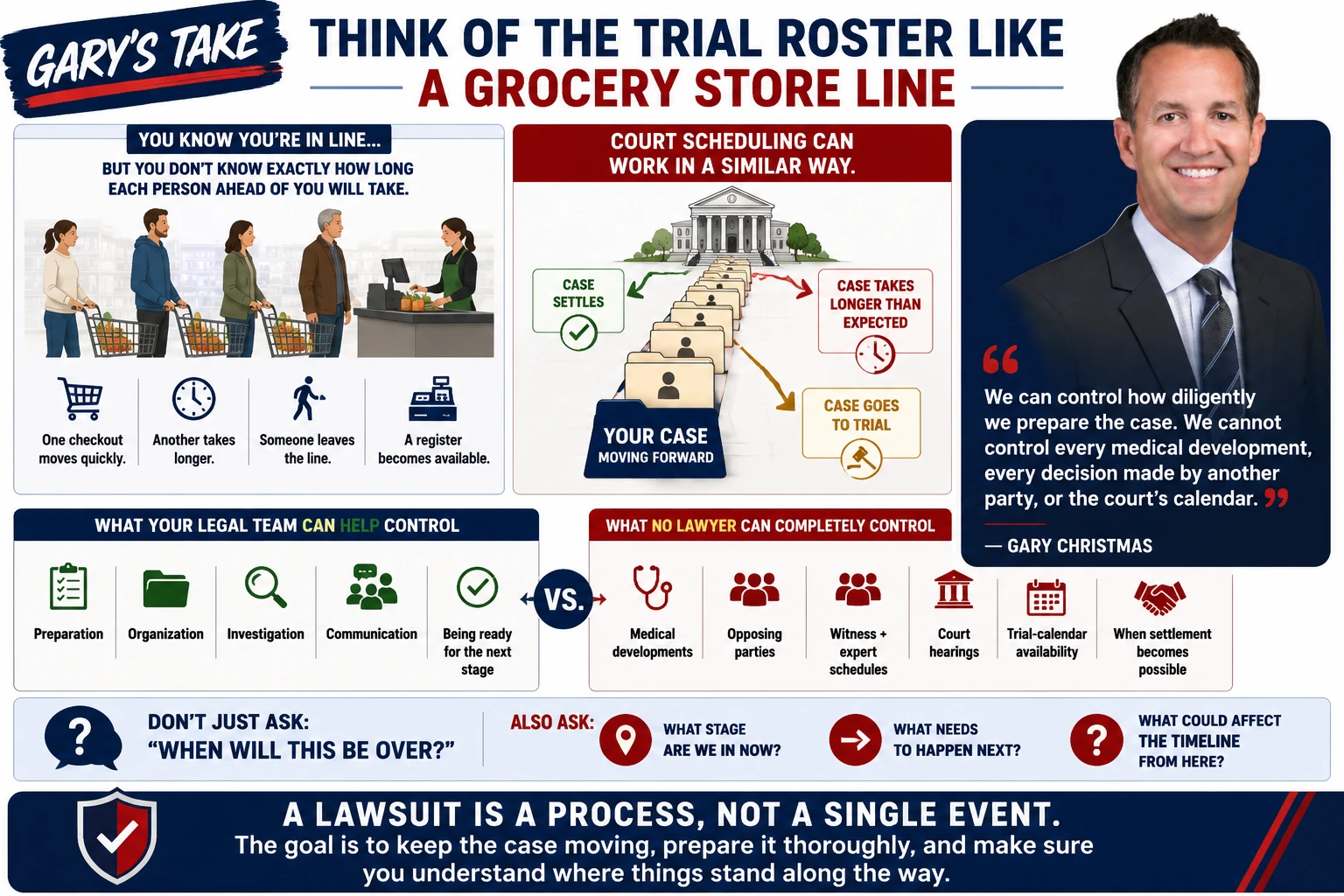
A lawsuit is a process, not a single event. The goal is to keep the case moving, prepare it thoroughly, and make sure you understand where things stand along the way.
What Can I Do While My Car Accident Lawsuit Is Pending?
You cannot control every part of the litigation timeline, but you can help keep your legal team informed and your records organized.
- Respond to reasonable requests from your legal team
- Keep your lawyer informed about changes in contact information
- Update your legal team about significant medical developments
- Preserve relevant documents, photographs, and communications
- Keep employment and income-loss information organized
- Tell your lawyer about insurance communications or documents you receive
- Attend required depositions, medical examinations, mediation, or court proceedings
- Ask questions when you do not understand what is happening next
For medical decisions, follow the advice of appropriate medical professionals based on your health, not because you believe a particular treatment decision will increase or decrease the value of the lawsuit.
You do not need to manage the litigation yourself, but staying responsive and informed can help your legal team keep the case moving. Some delays are unavoidable. Good communication, accurate information, and organized records can help prevent unnecessary ones.
Summary
There is no single timeline for a South Carolina car accident lawsuit. Some lawsuits may resolve within months after filing, while others can take a year or longer. The timeline depends on the particular facts of the case, including the injuries, medical treatment, disputed issues, number of parties, insurance coverage, discovery, expert testimony, motions, settlement negotiations, court scheduling, and whether the case ultimately proceeds to trial.
It is also important to understand the difference between a car accident claim and a car accident lawsuit. A claim may begin shortly after the collision while the accident is being investigated, medical treatment is developing, insurance coverage is being identified, and losses are being documented. A lawsuit begins when a legal action is formally filed in court.
Once a lawsuit is filed, the case may move through several stages, including filing and service, responses, written discovery, depositions, expert evaluation, motions, mediation or settlement discussions, trial preparation, and potentially trial. Not every lawsuit requires every stage, and a case may resolve at different points along the way.
Medical treatment can also affect the timeline because the medical picture may still be developing. Before making an irreversible settlement decision, it may be important to reasonably understand the injuries, treatment, future medical needs, work limitations, and other supported effects of the collision. The legal case and medical recovery can move forward at the same time, but they do not always move at the same speed.
A faster settlement is not automatically better, and a longer case is not automatically stronger. Settlement decisions should be based on preparation, evidence, and the circumstances of the individual case rather than speed alone. Even a serious injury case may sometimes resolve relatively quickly when liability, damages, and available insurance coverage are clear, while a case involving less severe injuries may take longer when important issues are disputed.
Filing a lawsuit also does not necessarily mean the case will go to trial. Settlement discussions can continue throughout litigation, including during discovery, after depositions, at mediation, while motions are pending, and during trial preparation.
No lawyer can responsibly guarantee exactly how long a lawsuit will take. Court schedules, opposing parties, witnesses, experts, medical developments, motions, and settlement opportunities can all affect the timing. A more useful question to ask as the case progresses is: “What stage are we in now, what needs to happen next, and what could affect the timeline from here?”
While you cannot control every part of the process, staying responsive, keeping your legal team informed, preserving relevant records, and maintaining organized documentation can help prevent unnecessary delays.
A car accident lawsuit is a process, not a single event. The goal is not simply to finish as quickly as possible, it is to keep the case moving, prepare it thoroughly, and make informed decisions as the facts, medical evidence, and legal issues develop.