

Common Ways Medical Bills Are Paid After a Car Accident
There are several different ways medical bills may be paid after a car accident, and the answer often depends on the type of insurance coverage available.
| Payment Source | How It Typically Works |
|---|---|
| Private Health Insurance | Pays covered treatment as received |
| Medicare | Pays covered treatment subject to reimbursement rules |
| Medicaid | Pays covered treatment subject to reimbursement rules |
| TRICARE | Pays covered treatment subject to reimbursement rules |
| Letter of Protection | Provider agrees to wait for payment |
| Medical Payments Coverage (MedPay) | May pay certain accident-related medical expenses, depending on the policy |
| Settlement or Verdict | May ultimately address outstanding bills |
If you have private health insurance, your health insurance company will typically pay covered medical bills as treatment is received. In many situations, that health insurance company may later seek reimbursement for some of the amounts it paid once your injury case is resolved. This process is often referred to as subrogation.
Another common option is a letter of protection. A letter of protection does not make the medical bill disappear. It generally means the provider agrees to postpone collection while the injury claim is pending, subject to the terms of the agreement.
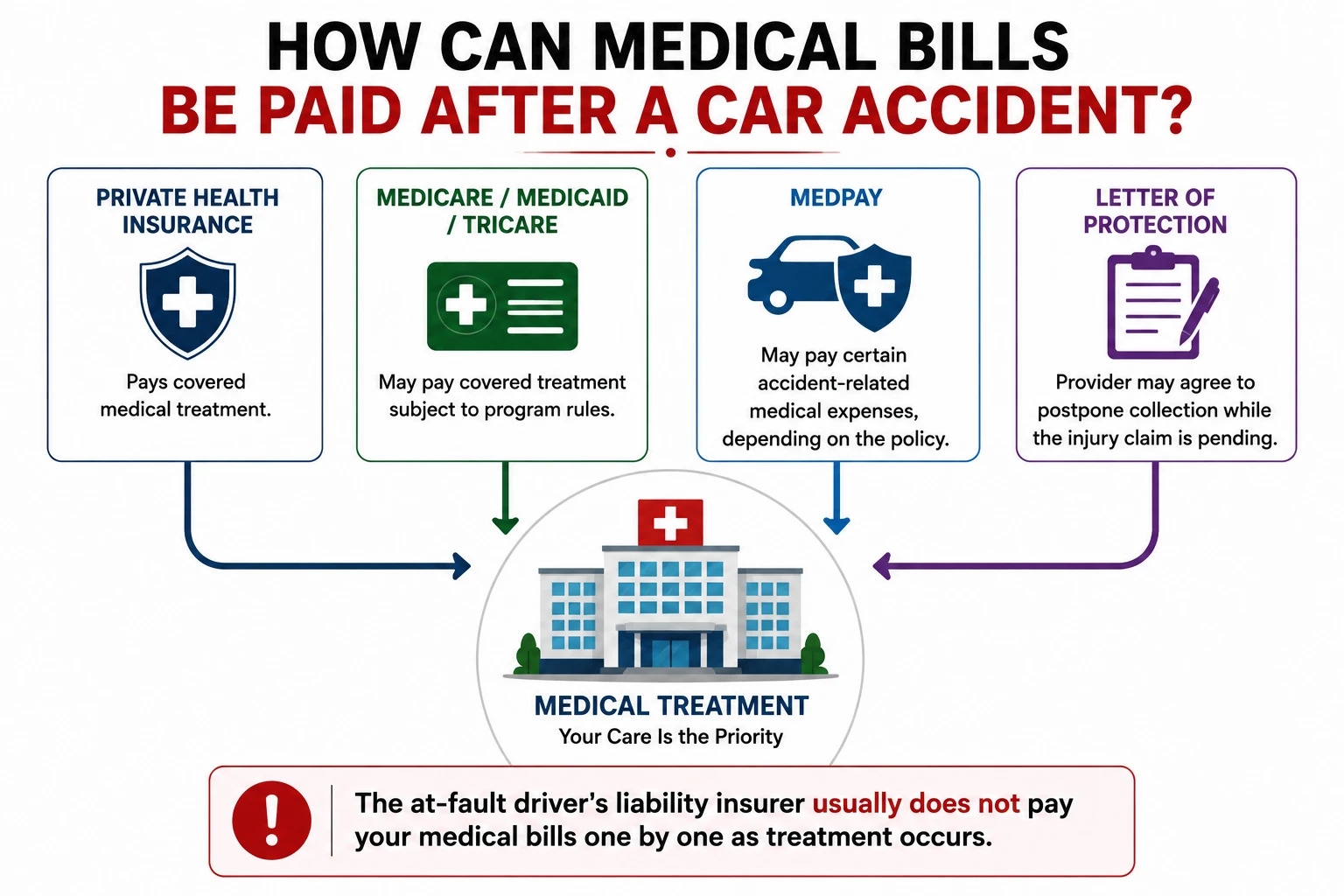
The at-fault driver’s liability insurer usually does not pay your medical bills one by one as treatment occurs. Your care is the priority.
Will the At-Fault Driver's Insurance Company Pay My Medical Bills Right Away?
One of the biggest misconceptions is that the at-fault driver’s insurance company will simply pay medical bills and lost wages as they arise.
Generally speaking, that is not how the process works.
While the at-fault party may ultimately be responsible for the damages caused by the accident, the at-fault driver’s liability insurer usually does not pay your medical bills one by one as treatment occurs. Instead, those damages are usually addressed as part of a settlement or jury verdict after the injuries, treatment, and losses have been fully evaluated.
This misunderstanding often creates confusion and financial stress for injured people who are already dealing with medical issues and lost income.
What Happens to Medical Bills When My Case Settles?
When an injury case settles, the settlement check does not necessarily go directly into the client’s pocket.
Before the client’s net settlement is distributed, the legal team may need to identify and address outstanding medical bills, valid liens, and reimbursement claims connected to the accident.
Depending on the case, this may include unpaid providers, Medicare, Medicaid, TRICARE, health plans, MedPay issues, or providers who treated under a letter of protection.
The important point is that we do not simply assume every bill or reimbursement demand is correct. We determine what is actually owed, whether a claimed right to payment is valid, and whether the amount can appropriately be reduced or resolved before final distribution.
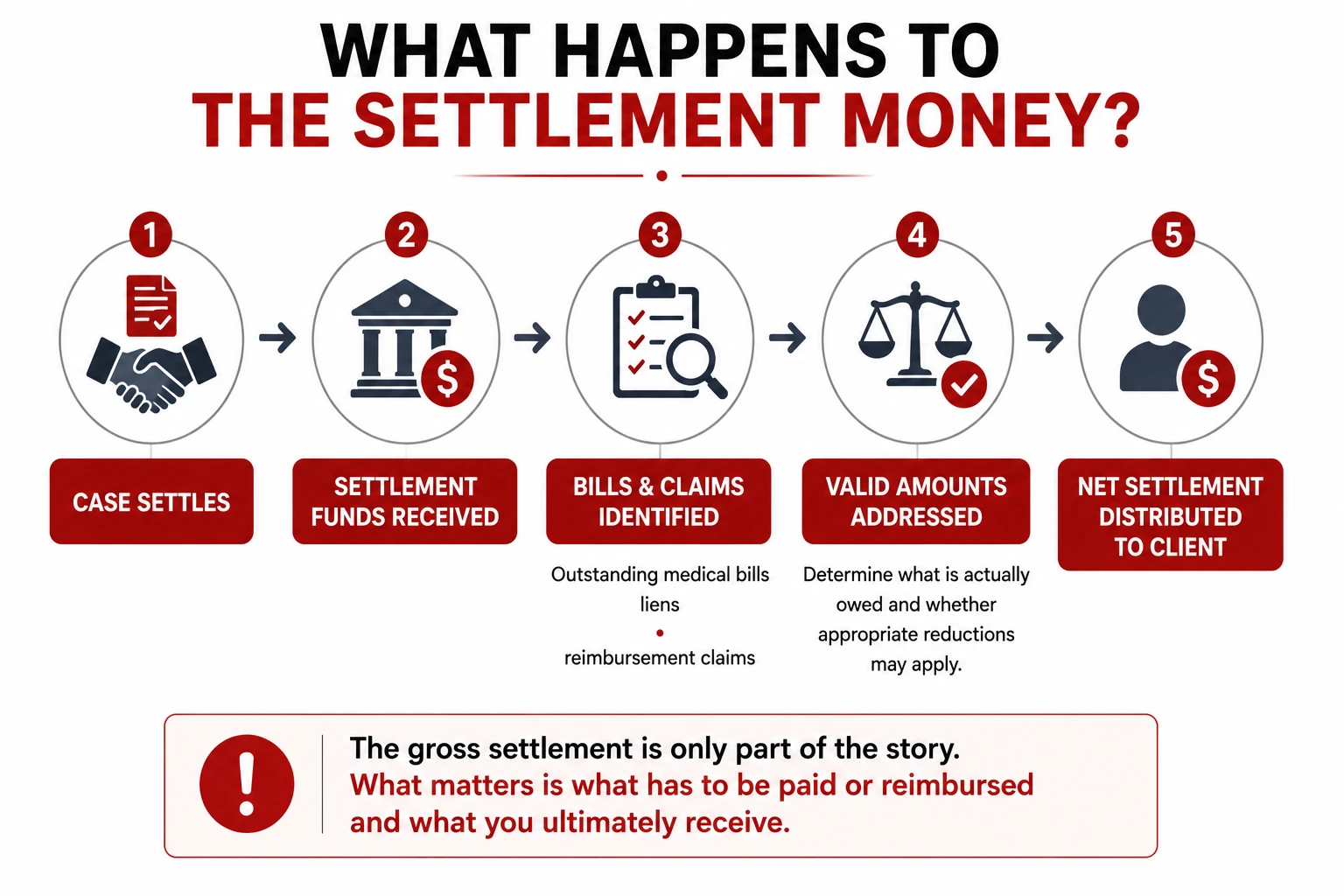
The gross settlement is only part of the story. What matters is what has to be paid or reimbursed and what you ultimately receive.
How Are Medical Bills Usually Paid During a Car Accident Case?
The answer depends largely on your insurance situation.
If you have private health insurance, that insurance will often pay covered medical expenses as treatment is received. If the client has Medicare, Medicaid, TRICARE, or another government healthcare program, those programs may pay covered expenses subject to their own reimbursement rules.
If you do not have health insurance, there may be other options available, including letters of protection with certain medical providers.
Our job is to evaluate your circumstances, explain the available options, and help you understand how you may be able to obtain the medical care you need. Every case is different, but our goal is always the same: help you get appropriate medical treatment while protecting your legal rights.
What Is a Medical Lien or Reimbursement Claim?
Different entities may claim a right to be paid from an injury settlement, but those rights do not all arise in the same way. A medical provider may have an unpaid bill or enforceable lien. A health plan may assert a contractual or statutory right of reimbursement. Medicare, Medicaid, and TRICARE may have their own recovery rights.
That is why we identify exactly who claims money, why they claim it, and what law or agreement gives them that right before settlement funds are distributed.
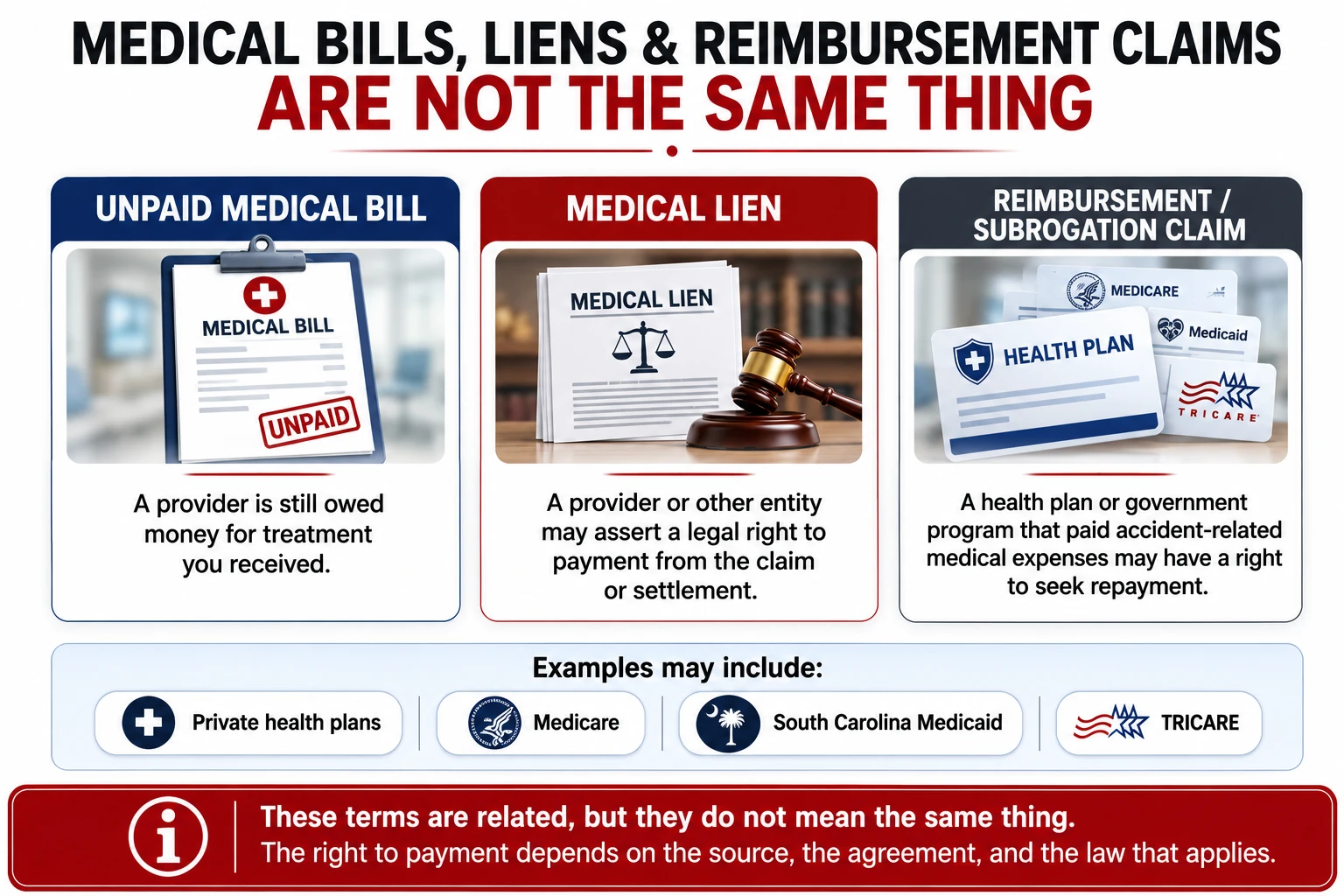
These terms are related, but they do not mean the same thing. The right to payment depends on the source, the agreement, and the law that applies.
What Are the Most Common Medical Bill Situations After an Accident?
Every injury case involves medical bills in some form.
Some clients have private health insurance. Others receive benefits through Medicare, Medicaid, TRICARE, employer-sponsored plans, or other healthcare programs. Some receive treatment through letters of protection.
The point is that no two cases are exactly alike.
The gross settlement number is only part of the story. What matters is what has to be paid back, what bills remain outstanding, and what you actually receive when the case is finished. That is why we identify these issues before the case is resolved instead of waiting until the settlement money arrives.
What Mistakes Can Make Medical Bill Problems Worse?
One of the biggest mistakes is failing to use available health insurance when treatment is covered.
Another common mistake is avoiding medical treatment altogether because the person believes they cannot afford it.
Both mistakes can have serious consequences.
If you fail to obtain medical treatment, you may hurt your health and your legal claim. Injuries that are not documented are often much harder to prove later.
If you are unsure how your medical care is going to be paid for, get legal guidance before delaying treatment because of the cost. There may be insurance coverage or other options you have not considered.
Why Are Medical Billing Issues So Complicated?
Many hospitals, insurance companies, healthcare plans, and government programs have their own procedures, reimbursement requirements, and billing practices.
The reality is that these organizations deal with these issues every day, while most injured people encounter them only once or twice in their lifetime.
Simply put, you do not know what you do not know.
That is where experience matters. We deal with these issues every day. Our job is to understand the different systems, identify potential problems, and help our clients know what needs to be addressed before the case is resolved.
Do I Have to Repay My Health Insurance After My Settlement?
Maybe. Some health plans have reimbursement or subrogation rights, while others may have different limitations or requirements. Medicare, Medicaid, TRICARE, and other government programs also have their own rules.
South Carolina Medicaid has statutory recovery rights in many accident cases, so Medicaid payments for accident-related medical care may need to be addressed when the case resolves. The specific rights and obligations can vary significantly depending on the type of coverage involved and the facts of your case.
What Should I Know About Medical Bills Before My Case Settles?
Medical treatment and medical billing issues are often more complicated than people realize. The decisions you make about treatment, health insurance, medical bills, reimbursement claims, and liens can affect both your recovery and what ultimately happens with your settlement.
The goal is not just to settle the case. The goal is to understand every dollar that may have to come out of the settlement before you sign off on it.
After more than 30 years of handling injury cases, we have seen how expensive medical-billing mistakes can become. That is why we work to identify these issues, understand who may have a valid right to be paid, and help our clients know what to expect before the case is resolved.
How to Protect Yourself From Medical Bill Problems
- Seek medical treatment promptly
- Use available health insurance when appropriate
- Keep copies of all medical bills
- Save explanation-of-benefits forms
- Track out-of-pocket expenses
- Understand whether liens exist
- Ask questions before signing settlement documents
- Consult an experienced trial lawyer
In Summary
Medical bills after a South Carolina car accident may be paid during the case through health insurance, Medicare, Medicaid, TRICARE, MedPay, or arrangements with medical providers. The at-fault driver’s liability insurer usually does not pay each bill as treatment occurs. When the injury case resolves, outstanding medical bills, valid liens, and reimbursement claims may need to be addressed from the settlement proceeds. Because each payment source has different rules, it is important to identify what was paid, who may claim reimbursement, and what must be resolved before settlement funds are distributed.