

What Medical Records Are Most Important in an Accident Claim?
| Medical Record | What It May Help Document |
|---|---|
| EMS / Ambulance Records | Symptoms, complaints, observations, and care immediately after the accident |
| Emergency Room Records | Initial complaints, examination findings, diagnoses, testing, and treatment |
| Urgent Care Records | Early symptoms and treatment when emergency-room care was not required |
| Primary-Care Records | Follow-up complaints, referrals, ongoing symptoms, and relevant medical history |
| Diagnostic Imaging | X-rays, CT scans, MRIs, and other studies used to evaluate injuries |
| Specialist Records | Diagnoses, causation opinions when provided, treatment plans, restrictions, and prognosis |
| Physical Therapy / Rehabilitation Records | Functional limitations, treatment, progress, and recovery over time |
| Pain Management Records | Symptoms, procedures, medications, and response to treatment |
| Surgical / Procedure Records | The nature of procedures performed and related findings |
| Prescription Records | Accident-related medications when relevant to the claim |
| Work Restrictions | Medically supported limitations affecting your ability to work |
| Medical Bills | Charges associated with accident-related medical care |
| Future-Treatment Recommendations | Reasonably anticipated medical care when supported by a provider |
| Impairment / Permanent-Restriction Opinions | Long-term effects when medically supported |
| Relevant Prior Medical Records | Prior symptoms, injuries, treatment, and preexisting conditions that may affect causation analysis |
No single record proves an entire injury claim. Medical evidence is usually strongest when the records collectively show what you reported, what providers observed, what testing revealed, what treatment was recommended, and how your condition changed over time.
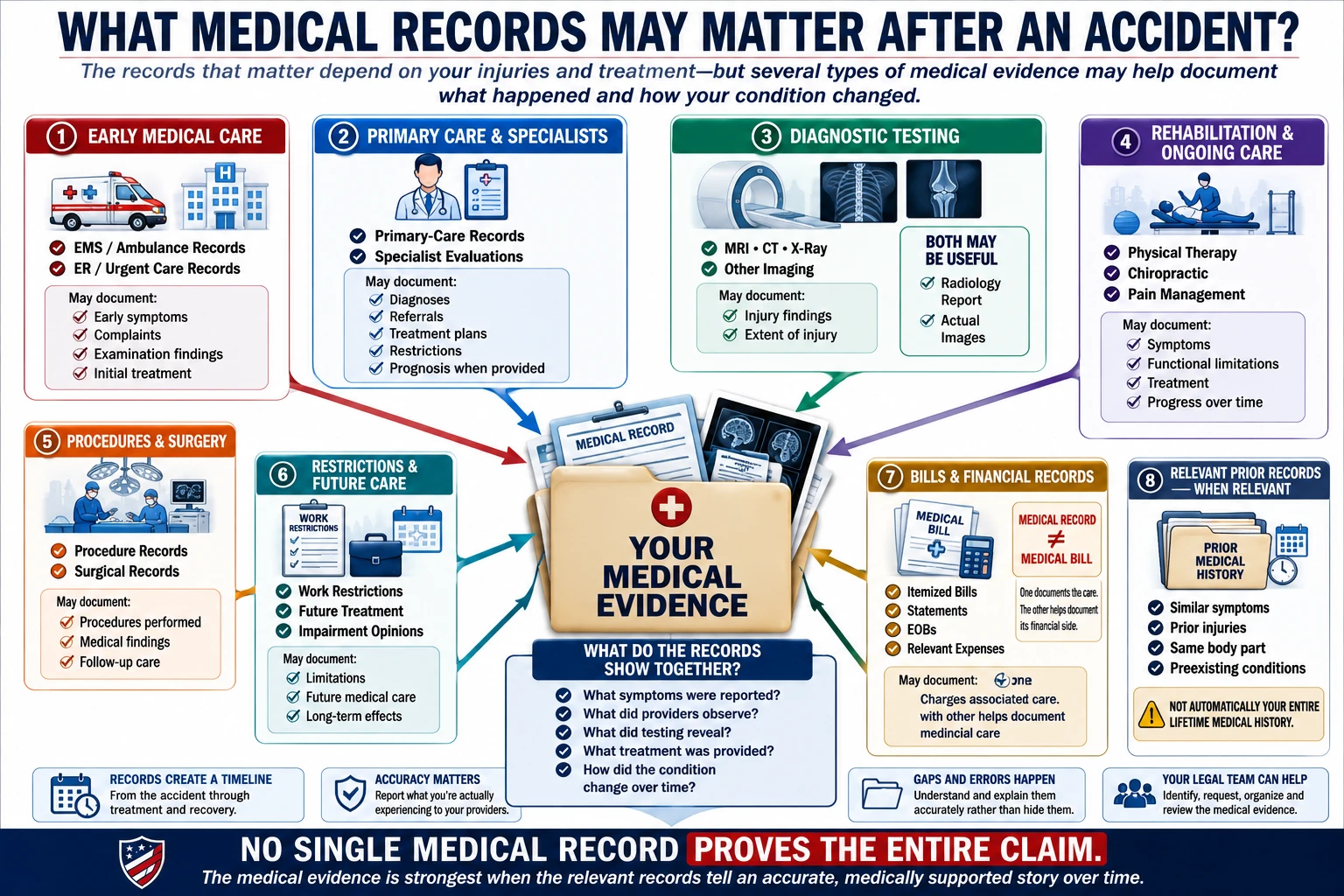
The records that matter depend on your injuries and treatment, but several types of medical evidence may help document what happened and how your condition changed.
Do I Need the Actual MRI, CT, or X-Ray Images, or Just the Radiology Report?
Sometimes both may be useful.
A radiology report contains the radiologist’s written interpretation of an MRI, CT scan, X-ray, or other imaging study. That report can be important medical evidence because it documents the findings identified when the study was reviewed.
But the actual images may also matter. A treating physician, consulting specialist, or retained medical expert may want to review the imaging personally rather than rely only on another provider’s written interpretation.
For that reason, accident cases may require preservation of:
- The radiology report
- The actual imaging study
- Related physician notes discussing the imaging
- Earlier or later imaging of the same body part when medically relevant
The report tells you what one medical professional documented. The underlying images may allow another qualified medical professional to evaluate the study independently.
You do not need to personally interpret medical imaging. The important thing is making sure relevant studies can be identified and obtained when needed.
Do I Need Medical Bills as Well as Medical Records?
Yes. Medical records and medical bills serve different purposes, so an injury claim may require both.
Medical records help document what happened medically: your complaints, examination findings, diagnoses, testing, treatment, restrictions, and recovery.
Medical bills help document the charges associated with that care.
Depending on the claim, it may also be useful to preserve:
- Itemized bills
- Account statements
- Health-insurance explanations of benefits
- Receipts for accident-related medical expenses
- Prescription expenses
- Records showing amounts paid or outstanding
- Correspondence involving medical-payment or reimbursement issues
A treatment note and a medical bill are not interchangeable. One helps explain the care you received. The other helps document the financial side of that care.
What Medical-Record Mistakes Can Hurt an Accident Claim?
Medical records are created primarily for your medical care, but the information in them may later become important evidence in an injury claim.
Common problems include:
- Failing to report an injured body part. If your neck hurts the most but your shoulder, wrist, back, or knee also hurts, accurately report those symptoms rather than assuming they do not matter.
- Waiting to mention new or changing symptoms. If your condition changes, tell your medical provider rather than waiting until much later.
- Exaggerating symptoms or limitations. Accuracy matters. Describe what you are actually experiencing.
- Minimizing genuine symptoms. Saying you are "fine" out of politeness when you are still experiencing significant problems can create an inaccurate medical history.
- Guessing about medical history. If you do not remember the date of a prior injury, surgery, or treatment, say that rather than inventing an answer.
- Failing to explain a significant treatment gap. If there was a reason you could not attend treatment, make sure your lawyer knows what happened.
- Ignoring medically recommended follow-up care solely because an insurance company questions it. Treatment decisions should be made with your healthcare providers based on your medical needs.
- Failing to preserve work restrictions. Written restrictions can become important when an injury affects your employment.
- Discarding bills, explanations of benefits, or medical correspondence. Keep financial documentation as well as treatment records.
- Assuming the medical chart will automatically contain everything you remember discussing. Review important medical information with your lawyer if something appears inaccurate or incomplete.
The goal is not to create a “perfect” medical record. It is to make sure you communicate honestly and accurately with your providers so the record reflects your actual medical condition and treatment.
Why Are My Treating Doctors' Records and Opinions Important?
Medical records do more than document that you went to an appointment. They can help show what your providers observed, what they diagnosed, what treatment they recommended, and how your condition changed over time.
Depending on the case, a treating physician or specialist may also address issues such as:
- Diagnosis
- Whether a condition is related to the accident
- Treatment recommendations
- Work restrictions
- Functional limitations
- Future medical care
- Prognosis
- Permanent impairment when medically supported
Those issues can become particularly important when an insurer disputes whether an accident caused a particular condition or questions the extent of the injury.
A lawyer should not decide the medical diagnosis. Qualified medical providers supply the medical evidence. The lawyer’s role is to understand that evidence and present the legally relevant portions of it accurately.
Are the Medical Records I Receive Through a Patient Portal the Same Records Used in an Injury Claim?
Not always. A patient portal may give you access to important medical information, but it may not display every document that could become relevant to an injury claim.
Depending on the provider and the case, additional materials may include:
- Detailed treatment notes
- Diagnostic reports
- Imaging studies
- Procedure or operative reports
- Therapy documentation
- Referral records
- Billing records
- Work restrictions
- Other records reasonably relevant to the injuries and treatment
Different healthcare systems maintain and release records differently.
The goal is not simply to download whatever appears in the portal. It is to identify which medical and billing records are relevant to the claim and obtain the documentation needed to evaluate those issues.
If you have a lawyer, the firm can help determine which records should be requested and whether additional documentation is missing.
Do I Need Medical Records From Before the Accident?
Sometimes. Prior medical records can become important when they relate to a condition, symptom, injury, or body part that is relevant to the current claim.
For example, suppose you injured your lower back in an earlier accident and then injured the same area in a new collision. Prior records may help establish:
- What symptoms existed before the new accident
- What diagnosis you previously received
- What treatment you underwent
- Whether your condition had improved or resolved
- Whether the new accident caused a new injury or aggravated an existing condition
- How your condition before the accident compares with your condition afterward
A preexisting condition does not automatically mean the new accident caused no additional injury.
The important question is what changed. Medical records before and after the accident may help qualified providers evaluate that issue.
At the same time, you should not assume that every medical record from your entire life is automatically relevant. The appropriate scope depends on the injuries, history, disputed issues, and circumstances of the claim.
What If Something in My Medical Record Is Wrong?
Medical records can sometimes contain information that you believe is incomplete, inaccurate, or misunderstood.
For example, a note may list the wrong date, omit a symptom you remember discussing, describe an old injury incorrectly, or use wording that does not match your understanding of the conversation.
Do not alter the record yourself or ask a provider to change accurate information simply because it may be unfavorable to the claim.
If you believe there is a genuine factual error, tell your lawyer and ask the medical provider about the appropriate process for addressing or requesting an amendment to the record.
Also remember that a single sentence should usually be considered in the context of the entire medical history and treatment record.
Accuracy is the goal, not rewriting the medical chart to make the legal case look better.
Why Are Complete Medical Records So Important After an Accident?
There have been many cases over the years where medical records played a significant role in the outcome.
For example, we often see situations where an insurance company acknowledges one injury, such as a neck injury, but disputes injuries to other body parts, such as the shoulder, elbow, wrist, or back. In those cases, early medical records from emergency medical services, ambulance reports, emergency room visits, and initial physician evaluations can be critical.
Medical records frequently determine whether injuries are accepted or disputed, and they often provide the foundation for opinions regarding permanent impairment, work restrictions, future medical care, and other important issues. That is why we believe every relevant medical record should be obtained, analyzed, and used effectively when presenting an injury claim.
Do Urgent Care, Chiropractic, Physical Therapy, or Other Treatment Records Count?
Yes. Relevant records can matter regardless of whether the treatment occurred in an emergency room, physician’s office, urgent-care center, physical-therapy clinic, chiropractic office, or another healthcare setting.
The importance of a particular record depends on what it documents and how it relates to the injury.
For example:
- Urgent-care records may document early symptoms and examination findings.
- Physical-therapy records may document range of motion, functional limitations, treatment, and progress.
- Chiropractic records may document symptoms, examination findings, treatment, and response to care.
- Specialist records may address diagnosis, treatment options, restrictions, prognosis, or other medically supported issues.
The legal claim should not determine which provider you choose simply to make the case “look better.”
Your treatment decisions should be based on your medical needs and the recommendations of qualified healthcare providers. The legal importance of the records comes from accurately documenting the care you actually received.
What If There Is a Gap in My Medical Treatment?
A significant gap in treatment may raise questions about what was happening medically during that period, but a gap does not automatically mean an injury disappeared or was unrelated to the accident.
There can be many reasons treatment is interrupted, including:
- Improvement followed by recurring symptoms
- Referral or scheduling delays
- Transportation problems
- Work or caregiving responsibilities
- Insurance or payment issues
- Illness or another medical problem
- A provider directing the patient to return only if symptoms worsen
- Other case-specific circumstances
If there is a significant gap, do not invent an explanation or try to hide it. Tell your lawyer what happened and accurately discuss your medical history with your providers.
The medical records before and after the gap, along with the reason for the interruption, may help explain the treatment history.
A treatment gap is something to understand and explain accurately, not something to panic about or manufacture around.
How Can an Insurance Company Use My Medical Records When Evaluating My Claim?
Medical records may be reviewed to evaluate what injuries were reported, when symptoms appeared, what treatment was provided, and whether the medical evidence supports the injuries and damages being claimed.
An insurer may compare records from different providers or different points in time and may look at issues such as:
- Initial symptoms
- Diagnoses
- Prior similar complaints
- Treatment recommendations
- Missed or interrupted treatment
- Statements about improvement
- Work restrictions
- Activity limitations
- Medical causation
- Future treatment recommendations
This is why accuracy matters.
If a doctor asks how you are doing, do not exaggerate and do not minimize. Saying “I’m doing fine” out of politeness when significant symptoms continue may create a different impression than you intended.
Your job is not to create language for the legal claim. Your job is to give your healthcare providers truthful and accurate information about your condition.
Should I Keep a Pain or Recovery Journal After an Accident?
A simple recovery journal can sometimes help you remember how symptoms and limitations changed over time, particularly when a recovery lasts for months.
If you keep one, focus on factual observations such as:
- Significant symptoms
- Changes in symptoms
- Medical appointments or procedures
- Sleep problems related to the injury
- Activities you could not perform or had to modify
- Work limitations
- Important recovery milestones
You do not need to write pages every day or assign a dramatic pain score to every moment.
Keep it accurate, factual, and consistent with what you report to your medical providers. Do not exaggerate or create entries because you think they will increase the value of the claim.
And remember that written materials relating to an accident may become relevant during litigation. If you have questions about keeping a journal, discuss them with your lawyer.
Should I Tell My Doctor About Every Injury and Symptom?
Yes. Accurately tell your medical providers about every accident-related symptom and injured body part you are experiencing, even when one area hurts much more than another.
After an accident, it is natural to focus on the most painful injury. But shoulder pain, headaches, numbness, back pain, wrist pain, or other symptoms may become more significant as treatment progresses.
That does not mean you should attribute every physical problem to the accident.
Report what you are actually experiencing and let qualified medical providers evaluate the cause.
If symptoms appear, worsen, improve, or change, accurately communicate that information during your medical care. Complete documentation helps your providers understand your condition and creates a clearer medical history of your recovery.
How Do I Get Copies of My Medical Records After an Accident?
You can generally request medical records directly from the healthcare provider or the provider’s medical-records department. Many healthcare systems also provide access to portions of the record through an online patient portal.
Depending on the provider, a request may require:
- A written or electronic authorization
- Your identifying information
- Dates of treatment
- The type of records requested
- Where the records should be sent
- Payment of an authorized copying or processing charge when applicable
If you have treated with several providers, the records may need to be requested separately.
If you are represented by a lawyer, you generally do not need to become your own medical-records department. Your legal team can help identify which records are needed, obtain appropriate authorizations, request the relevant records, follow up on missing documentation, and organize the medical evidence.
How Do Medical Records Help Prove an Injury Claim?
Medical records can help establish a timeline of your condition from the accident through treatment and recovery.
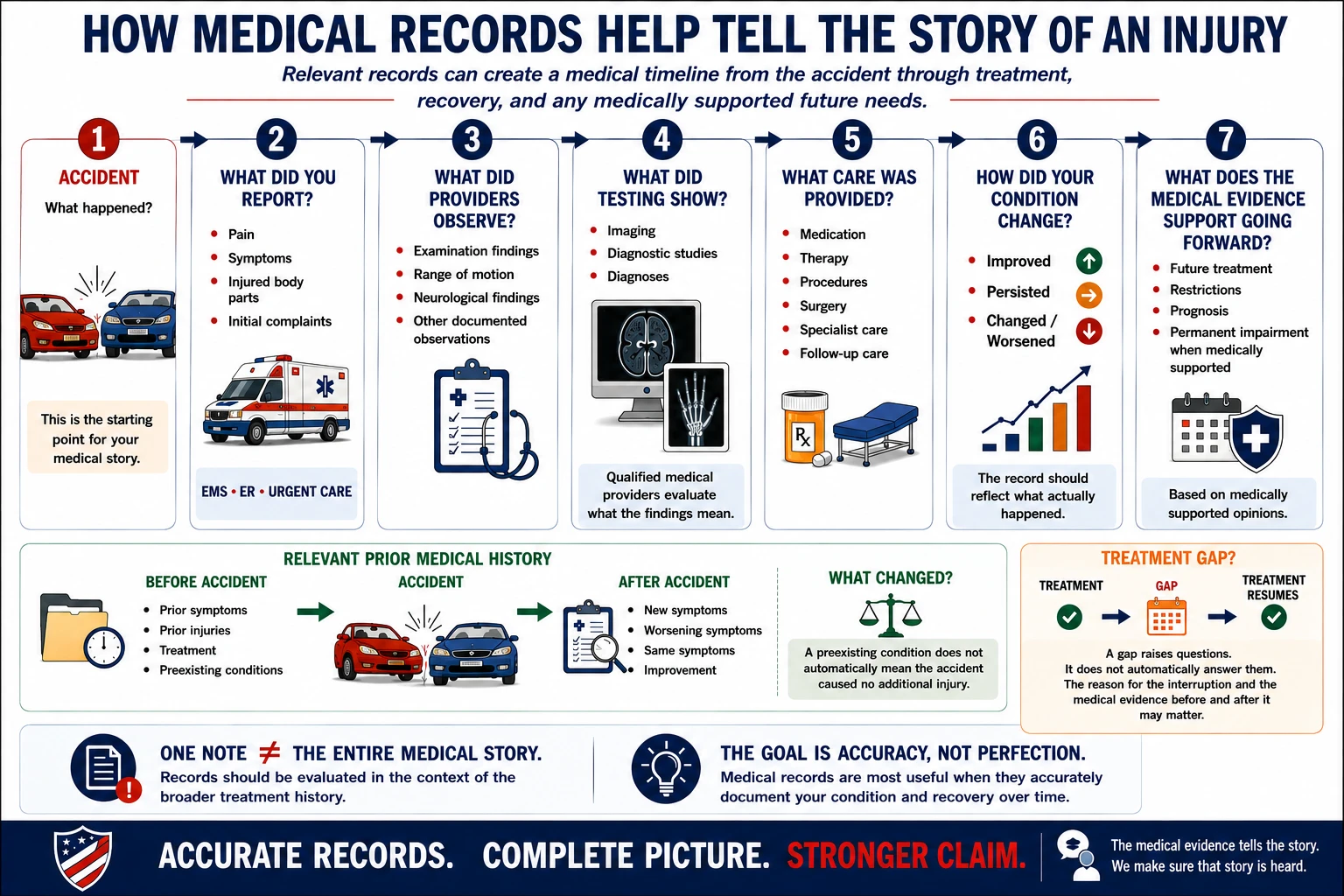
Relevant records can create a medical timeline from the accident through treatment, recovery, and any medically supported future needs.
Taken together, relevant records may help answer questions such as:
What did you report after the accident? Early records may document symptoms and injured body parts.
What did providers observe? Examinations and testing may contain medical findings.
What was diagnosed? Provider records and diagnostic studies may identify particular conditions.
What treatment was recommended and provided? Records can show medications, therapy, procedures, surgery, referrals, and follow-up care.
How did the condition change? Later records may document improvement, persistent symptoms, worsening problems, restrictions, or additional treatment.
What does the medical evidence say about the future? When medically supported, providers may address future treatment, restrictions, prognosis, or permanent impairment.
Medical records are most useful when they tell an accurate, medically supported story over time, not when one isolated note is treated as the entire case.
Should I Sign a Medical Authorization for the Insurance Company?
Do not sign a medical authorization without understanding what records it allows the insurer to obtain and how broad the authorization is.
Medical information can be relevant to an injury claim, particularly records involving the accident injuries and reasonably relevant prior medical history. But that does not mean you should assume every authorization presented to you is identical or appropriately limited.
Before signing, understand:
- Which providers or records the authorization covers
- What time period it covers
- What types of information may be released
- How long the authorization remains effective
- Who is permitted to receive the information
If you are represented, send the authorization to your lawyer before signing it so the scope can be evaluated in the context of your particular claim.
The goal is not to hide relevant medical information. It is to make sure medical information is obtained and disclosed through an appropriate process.
How Does Christmas Injury Lawyers Handle Medical Records in an Injury Case?
At Christmas Injury Lawyers, obtaining the records is only one part of the medical-evidence process.
Depending on the case, our legal team may:
- Identify the providers who treated your accident-related injuries
- Obtain appropriate authorizations
- Request relevant treatment and billing records
- Follow up on missing documentation
- Organize records chronologically
- Review diagnostic reports and treatment histories
- Compare relevant prior and post-accident medical history
- Identify potential causation or preexisting-condition issues
- Track medical bills and related documentation
- Review work restrictions and future-treatment recommendations
- Work with treating providers or other qualified medical professionals when appropriate
We prepare cases with litigation in mind, which means we want to understand both the medical evidence that supports the claim and the medical evidence that may raise questions.
Our goal is not to collect the largest possible stack of records. It is to identify, understand, and use the medical evidence that matters to your case.
Do I Need to Gather All of My Medical Records Before Contacting a Lawyer?
No. You do not need to assemble a complete medical file before speaking with an injury lawyer.
If you already have discharge instructions, bills, imaging reports, work notes, or other records, keep them. But do not delay asking for legal guidance simply because you have not collected every medical document.
A lawyer can help identify:
- Which medical records are likely to matter
- Which prior records may be relevant
- Whether imaging should be obtained
- Which bills and financial records should be preserved
- Whether additional documentation is missing
- How medical evidence relates to causation and damages
At Christmas Injury Lawyers, we can help manage the record-gathering process so you can focus on your medical care while your legal team focuses on developing the evidence.
Gary's Take: What Makes Medical Records Helpful in an Injury Case?
“I don’t expect a client’s medical records to be perfect, and I don’t want a client going into a doctor’s appointment thinking about what they need to say for the legal case.”
“Tell your doctors what is actually happening. If something hurts, tell them. If you’re improving, tell them that too. If you don’t remember something about your medical history, don’t guess.”
“Our job is to gather the relevant records, understand what they show, and deal with the medical evidence honestly. Your job is to focus on getting appropriate care and being accurate about what you’re experiencing,” says Gary Christmas.
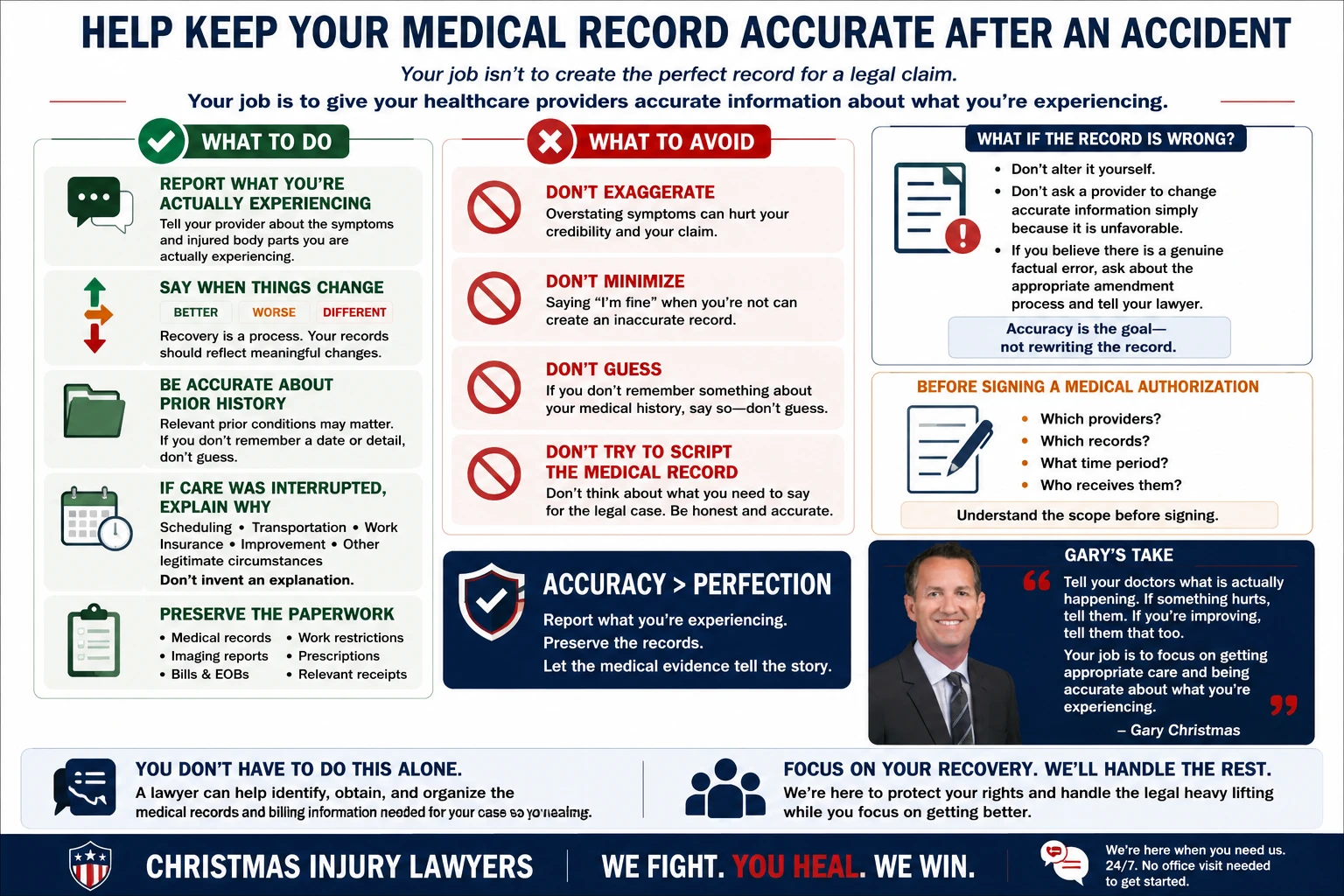
Your job isn’t to create the perfect record for a legal claim. Your job is to give your healthcare providers accurate information about what you’re experiencing.
Medical Records Checklist After an Accident
- Seek appropriate medical evaluation for accident-related symptoms
- Accurately report every injured body part and symptom
- Report new, worsening, improving, or changing symptoms
- Follow medically recommended treatment and follow-up care
- Keep discharge instructions and treatment paperwork
- Preserve emergency room and urgent-care records you receive
- Keep specialist and therapy documentation
- Preserve MRI, CT, X-ray, and other diagnostic reports
- Ask whether the actual imaging may also need to be obtained
- Keep medical bills and itemized statements
- Preserve explanations of benefits and payment records
- Keep prescription and accident-related expense records when relevant
- Preserve written work restrictions and disability documentation
- Tell your lawyer about prior injuries or treatment involving the same body part
- Explain significant treatment gaps accurately
- Do not exaggerate or minimize symptoms
- Do not guess about medical history you cannot remember
- Tell your lawyer if you believe an important medical record contains an error
- Understand a medical authorization before signing it
- Do not assume your patient portal contains every record needed for the claim
- Keep any recovery journal factual and accurate
- Do not worry about personally collecting every record before speaking with a lawyer
In Summary
Medical records can play an important role in a South Carolina accident claim because they help document what symptoms you reported, what healthcare providers observed, what testing revealed, what treatment you received, and how your condition changed over time. Depending on the injuries and issues involved, relevant evidence may include EMS and emergency-room records, urgent-care and primary-care records, specialist evaluations, diagnostic imaging, therapy records, surgical records, work restrictions, future-treatment recommendations, and other medically relevant documentation.
Medical records and medical bills serve different purposes, and an injury claim may require both. Treatment records help explain the medical care you received, while bills and related financial documentation help establish the charges associated with that care. In some cases, both a radiology report and the underlying MRI, CT, or X-ray images may also be important.
Prior medical records can matter when a preexisting condition, prior injury, similar symptom, or previously treated body part is relevant to the current claim. That does not mean every medical record from your entire life is automatically relevant. The appropriate scope depends on the injuries, medical history, disputed issues, and circumstances of the case.
Accuracy matters throughout the process. Report what you are actually experiencing to your healthcare providers, including meaningful changes in your symptoms. Do not exaggerate, minimize, or guess. If there is a significant treatment gap, an error in a medical record, or something about your prior medical history you do not remember, address the issue accurately rather than trying to create a perfect-looking medical history.
You also do not have to collect every medical record yourself before speaking with a lawyer. A legal team can help identify which records may be relevant, obtain appropriate authorizations, request missing documentation, organize the records, and evaluate how the medical evidence relates to causation and damages. The goal is not to collect the biggest possible medical file. It is to identify and understand the medical evidence that actually matters to your claim.