

What Should I Do If My Recovery Is Taking Longer Than Expected?
| Situation | Practical Next Step |
|---|---|
| Symptoms are worsening or changing | Communicate the change to an appropriate medical provider |
| New symptoms develop | Make sure your medical provider knows about them |
| You are concerned about numbness, weakness, or other significant symptoms | Seek appropriate medical guidance |
| You missed appointments or had a treatment gap | Explain what happened to your provider and keep accurate records |
| Your treatment plan changes | Preserve updated medical records and recommendations |
| You still cannot work normally | Continue documenting wage loss and work restrictions |
| The insurer questions ongoing treatment | Do not change medically appropriate care simply because of an insurance argument |
Why Might an Accident Injury Be Diagnosed Later?
Not every accident-related injury is necessarily identified immediately after a collision. Some symptoms may become more noticeable over time, while other injuries may not be fully understood until medical evaluation and treatment progress.
Immediately after an accident, you may naturally focus on the area causing the most obvious or severe symptoms. For example, we have represented clients who initially focused on significant neck pain but also experienced symptoms involving the shoulder or arm. As their medical care progressed, their providers evaluated whether those symptoms were related to the neck, a separate injury, or another condition.
There can also be overlapping symptoms involving different parts of the body. Determining what is causing a particular symptom is a medical question. Your doctors may use examinations, your reported symptoms, diagnostic testing when appropriate, and your response to treatment to evaluate your condition and determine whether additional injuries or diagnoses are involved.
That is why it is important to accurately tell your medical providers about the symptoms you are experiencing, including symptoms that are new, changing, persistent, or becoming more noticeable. Do not assume that every symptom comes from the same injury, and do not try to diagnose the cause yourself.
From an injury-claim perspective, a later diagnosis does not automatically establish, or rule out, a connection to the accident. The important question is what the medical evidence shows about the condition, when the symptoms developed or were reported, and whether the evidence supports a causal relationship between the accident and the injury being claimed.
Do I Have to Be Fully Recovered Before My Injury Case Can Move Forward?
No. Your legal claim and your medical treatment can move forward at the same time. Evidence can be gathered, liability can be investigated, insurance coverage can be identified, and legal deadlines can be protected while you continue receiving appropriate medical care.
What may require more patience is making a final evaluation of damages when your future medical condition, treatment needs, work limitations, or other consequences are not yet reasonably understood.
Moving the case forward and settling the case are not the same thing. You do not necessarily have to wait until you are fully recovered to protect or develop your claim, but resolving it before important future consequences are understood can create risks.
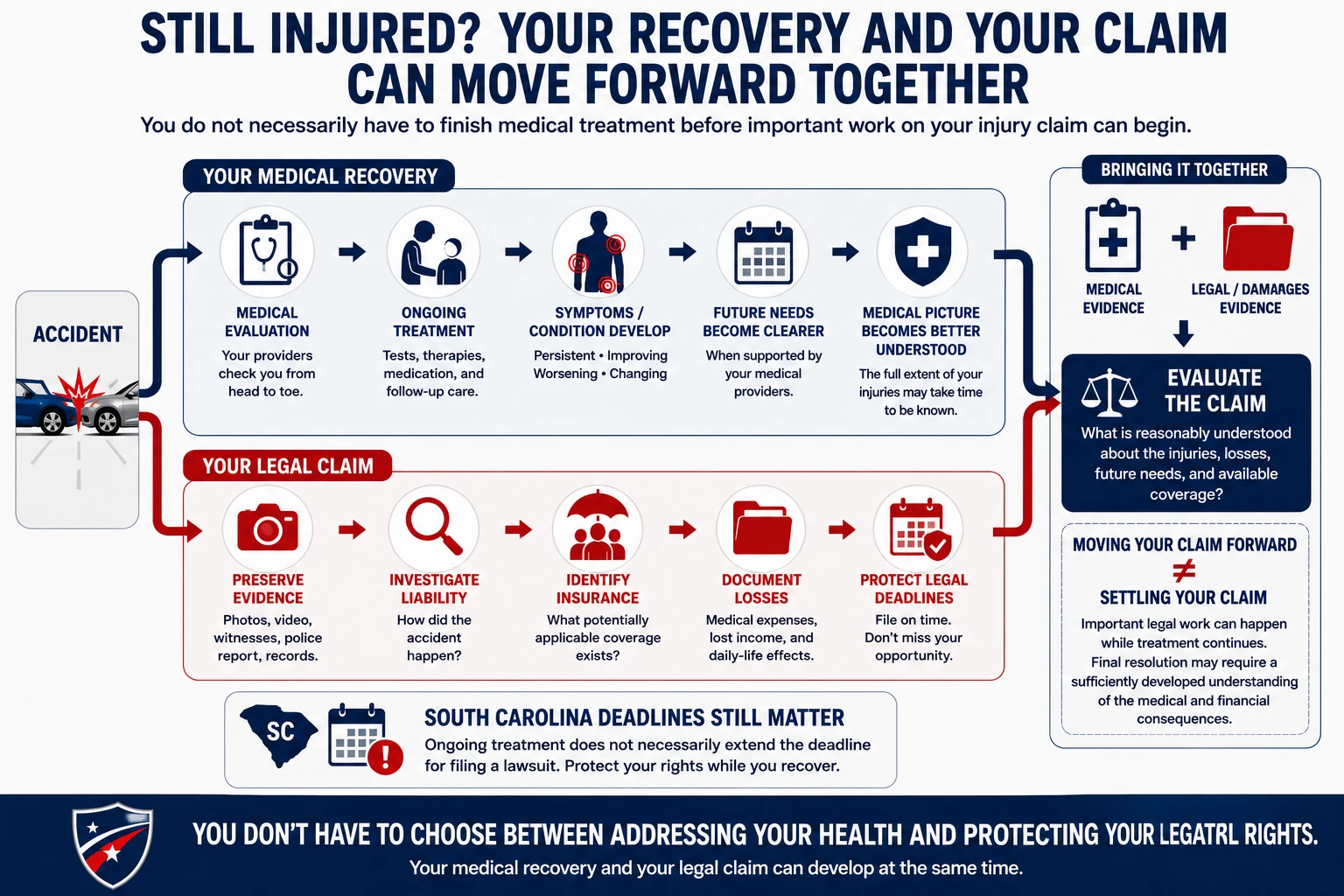
You do not necessarily have to finish medical treatment before important work on your injury claim can begin.
Can I Settle My Injury Claim While I Am Still Receiving Treatment?
A claim can sometimes be resolved before every medical issue is finished, but settling before the future consequences of an injury are sufficiently understood can create important risks. Once a claim is finally released, you generally cannot return later simply because additional treatment, surgery, expenses, or limitations develop.
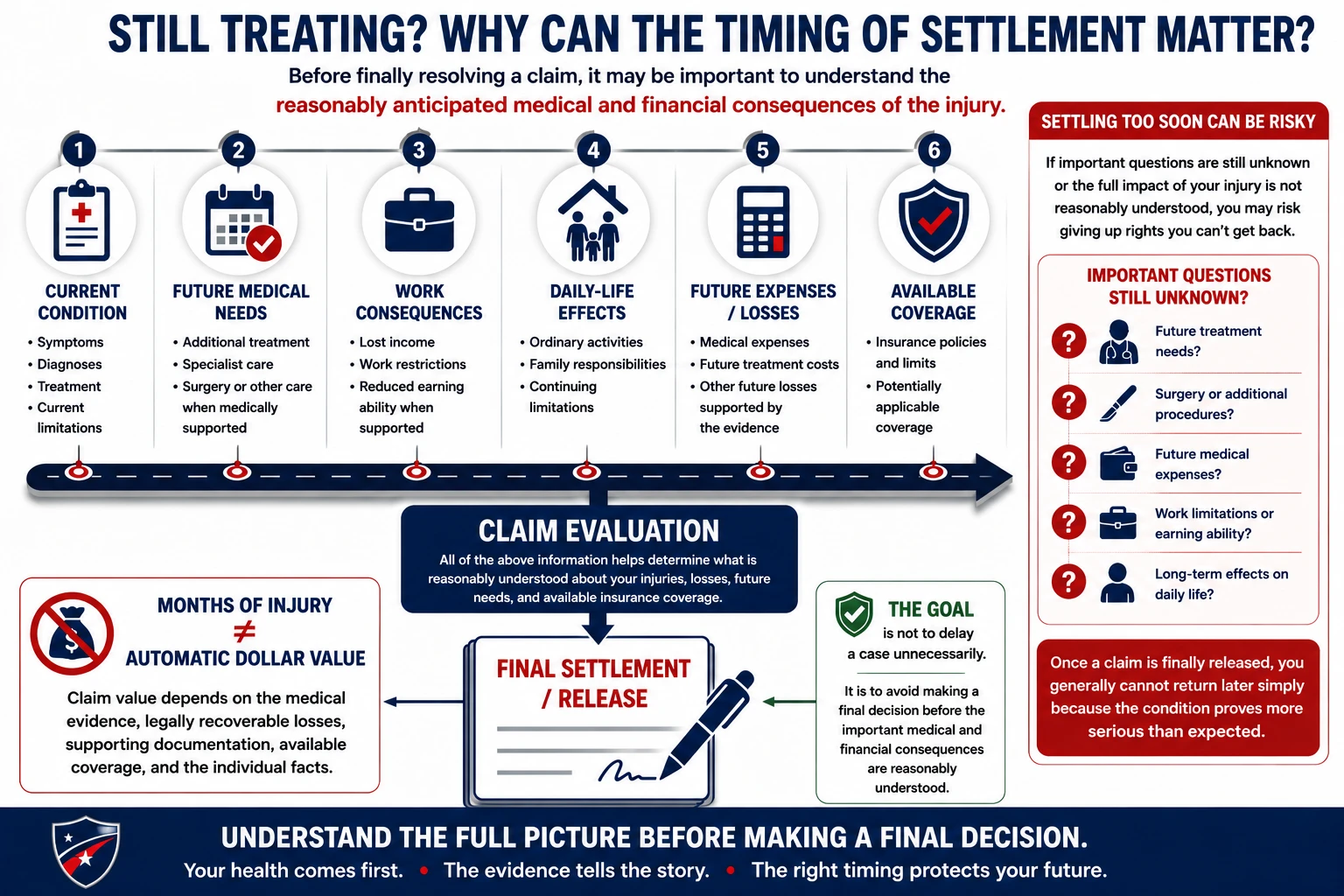
Before finally resolving a claim, it may be important to understand the reasonably anticipated medical and financial consequences of the injury.
That is why the medical picture matters when evaluating settlement. Depending on the case, relevant questions may include your current condition, prognosis, future treatment recommendations, permanent restrictions, expected medical expenses, and how the injury may affect your ability to work or function.
The goal is not to delay a case unnecessarily. It is to avoid making a final legal decision before the important medical and financial consequences are reasonably understood.
What If My Doctor Says I May Need Surgery or Future Treatment?
If a treating provider recommends surgery, additional therapy, specialist care, injections, or other future treatment, that information may become important to evaluating future damages.
Medically supported future treatment may become part of the damages evaluation when it is legally recoverable and supported by the evidence. That may include anticipated medical expenses as well as evidence of how an ongoing condition is expected to affect work, ordinary activities, or quality of life.
How Can Ongoing Injuries Affect the Value of My Claim?
If you are still dealing with injuries months after an accident, the length of your recovery may be relevant to the value of your injury claim. But the fact that an injury lasts a long time does not automatically make a claim worth a particular amount. The value depends on the facts of the case and the evidence supporting the losses you are claiming.
When evaluating the effect of ongoing injuries, important considerations may include:
- The duration and severity of your symptoms. How long have the symptoms continued, how significant are they, and how have they changed during your recovery?
- The medical treatment you have received. Medical records can document your symptoms, diagnoses, treatment, response to treatment, and the progression of your condition.
- Medical causation. There must be evidence supporting a connection between the accident and the injuries or aggravations for which you are seeking damages.
- Future medical treatment. If your medical providers anticipate additional treatment, those future needs may become part of the claim when they are supported by the medical evidence.
- Permanent impairment or limitations. If a medical provider determines that an accident-related condition has caused permanent impairment, restrictions, or limitations, that may affect the evaluation of damages.
- Past and future medical expenses. The cost of treatment already received and medically supported future care may be relevant to the claim.
- Lost income and reduced earning ability. If your injuries have kept you from working, reduced your hours, changed the work you can perform, or are expected to affect your future earning ability, those losses may be considered when supported by appropriate evidence.
- The effect on your daily life. Ongoing injuries may affect your ability to perform ordinary activities, care for yourself or your family, participate in activities you previously enjoyed, or function as you did before the accident.
- Available insurance coverage. Even when significant damages can be established, the amount and type of applicable insurance coverage can affect the practical recovery available in a particular case.
- The evidence supporting each claimed loss. Medical records, bills, employment records, wage documentation, medical opinions, testimony, and other evidence may be necessary to establish different components of the claim.
Two people can experience similar accidents and have very different recoveries, medical needs, financial losses, and effects on their daily lives. That is why an injury claim should be evaluated based on the individual evidence rather than a formula based simply on how many weeks or months someone has been hurt.
The fact that you are still injured months later does not create an automatic dollar value. The significance depends on what the medical evidence shows and how the injuries have affected your life.
What If I Have a Gap in Medical Treatment?
A gap in treatment does not automatically end an injury claim, but it may raise questions about the condition, causation, recovery, or why treatment stopped. There may be legitimate reasons for a gap, including improvement followed by recurring symptoms, difficulty obtaining appointments, financial issues, work obligations, transportation problems, or other circumstances.
Be accurate about what happened. Do not invent a reason for the gap, and do not try to hide it. Medical records and your own explanation may become part of the evaluation of the claim.
Does Ongoing Medical Treatment Extend the Deadline to File a South Carolina Injury Lawsuit?
Generally, no. Continuing medical treatment does not by itself stop or extend the deadline for filing an injury lawsuit. South Carolina law generally provides a three-year limitations period for an action involving injury to a person, although different deadlines and exceptions can apply depending on the type of defendant and circumstances. The deadline applicable to a particular case should be determined from the specific facts rather than assumed from the general three-year rule.
That is one reason you should not assume you can wait until every medical issue is resolved before protecting your legal rights.
What If My Symptoms Change or New Problems Are Identified During Treatment?
Recovery is not always a straight line. Symptoms may improve, worsen, change location, or lead a medical provider to investigate whether another condition is involved.
If your symptoms change, accurately communicate those changes to the medical professionals treating you. Your medical records can then document what you reported, what was evaluated, what diagnoses were made, and what treatment was recommended.
From a legal standpoint, the important issue is medical causation: whether the evidence supports a connection between the collision and the injuries or aggravations being claimed.
What If I Waited to Get Medical Treatment After the Accident?
An insurer may examine the timing of medical treatment when evaluating whether an accident caused the injuries being claimed. A delay does not automatically mean the injury is unrelated to the collision, but the reason for the delay and the medical evidence may become important.
There can be many reasons someone does not seek treatment immediately, including initially mild symptoms, changing symptoms, access to care, work or family responsibilities, or believing the condition will improve.
The important point is to be accurate about when symptoms began, how they changed, when you sought care, and why any significant treatment gap occurred.
Why Might I Not Notice Every Symptom Immediately After an Accident?
Many people underestimate the impact that adrenaline and shock can have on the body after a serious accident.
People do not always appreciate every symptom immediately after a frightening collision. If symptoms develop, persist, or change afterward, tell an appropriate medical provider what you are experiencing and when you first noticed it.
If you develop symptoms after the collision, or symptoms persist, worsen, or change, accurately tell an appropriate medical provider what you are experiencing and when you first noticed it.
What Should I Do If My Symptoms Are Not Improving?
If symptoms are persisting, worsening, or changing, communicate that information to the medical provider treating you. Your medical provider, not the insurance company or your lawyer, should determine whether additional evaluation, testing, referral, or treatment is appropriate.
From the legal side, consistent medical documentation can help establish what symptoms you reported, how your condition changed, what treatment was recommended, and whether the medical evidence connects those problems to the accident.
What Mistakes Can Hurt a Claim When Injuries Last for Months?
When an injury continues for months after an accident, the claim often develops alongside the medical treatment. What happens during that period can become important because insurers may evaluate not only the original accident, but also the medical records, treatment history, work limitations, and other evidence documenting your recovery.
Some mistakes to avoid include:
- Assuming ongoing symptoms will simply disappear without telling your medical provider. If you continue experiencing symptoms, accurately communicate what you are experiencing rather than assuming they will eventually resolve on their own.
- Failing to report new or changing symptoms accurately. If symptoms become worse, improve, move to another area, or change in some other way, tell your medical provider what has actually changed. Your medical records can become important evidence of how your condition developed over time.
- Leaving significant treatment gaps unexplained. A gap does not automatically defeat an injury claim, but it may raise questions about your condition and treatment. If there is a legitimate reason for a significant gap, be accurate about what happened.
- Stopping medically recommended care solely because an insurance company questions it. Decisions about your medical treatment should be made with your medical providers based on your health and circumstances, not simply because an adjuster questions whether additional treatment is necessary.
- Exaggerating your symptoms or limitations. Credibility matters. Describe your pain, limitations, abilities, and recovery accurately rather than making the condition sound worse than it is.
- Minimizing legitimate symptoms or limitations. The opposite can also create problems. You may be frustrated, embarrassed, or simply tired of talking about your injuries, but minimizing what you are actually experiencing can make it harder for medical providers and others to understand how the condition is affecting you.
- Failing to preserve updated medical and work documentation. Keep records related to continuing treatment, medical expenses, work restrictions, disability notes, and other documentation showing how the injury and recovery have progressed.
- Failing to document continuing financial and daily-life effects. If the injury continues to cause missed work, reduced hours, changes in job duties, or limitations in ordinary activities, preserve appropriate records and information supporting those effects.
- Posting accident-, injury-, or activity-related content publicly without considering how it may be interpreted. Public photographs, videos, comments, and activity-related posts may be reviewed and compared with what you have reported elsewhere. Be accurate, and do not delete or alter potentially relevant existing material simply because a claim is pending.
- Resolving the claim before reasonably anticipated future consequences are understood. If medical evidence supports future treatment, continuing restrictions, additional expenses, or other ongoing effects, those issues may be important when evaluating a potential resolution. Once a claim is finally released, you generally cannot reopen it simply because your condition later proves more serious than expected.
- Assuming continued treatment extends the deadline for filing a lawsuit. The fact that you are still receiving medical treatment does not necessarily stop or extend an applicable legal deadline. Your medical recovery and the deadline for protecting your legal rights are separate issues.
The goal is not to create a “perfect” medical history. Real recoveries can involve setbacks, changing symptoms, missed appointments, and uncertainty. What matters is being accurate about what you are experiencing, following appropriate medical guidance, preserving the evidence of your ongoing losses, and protecting the legal claim while your medical condition develops.
When Should I Talk to a Medical Provider About Ongoing or Changing Symptoms?
If symptoms persist, worsen, change, or new symptoms develop after an accident, communicate what you are experiencing to an appropriate medical provider. Do not try to determine on your own whether a new symptom is related to the original injury, a separate condition, or something else.
Some symptoms may require more prompt medical attention than others. Your medical providers are in the best position to evaluate your condition, determine whether additional testing or treatment is appropriate, and advise you about symptoms that may require urgent care.
From the legal side, accurate and timely communication about changing symptoms can also create important medical documentation showing what you experienced, when you reported it, how it was evaluated, and what treatment was recommended.
Delayed Injury Recovery Checklist
- Report persistent, worsening, or changing symptoms accurately
- Follow the medical plan recommended by your providers
- Explain significant treatment gaps honestly
- Keep updated medical records and bills
- Preserve work restrictions and lost-income documentation
- Document how ongoing injuries affect everyday activities
- Do not exaggerate or minimize symptoms
- Be careful with public accident-, injury-, or activity-related posts
- Do not let an insurer determine what medical treatment you receive
- Understand future medical recommendations before resolving your claim
- Do not assume ongoing treatment extends South Carolina filing deadlines
- Understand what a release resolves before signing it
- Remember that moving your claim forward does not necessarily mean settling it before treatment is complete
Gary's Take: What If I Feel Frustrated or Guilty That I'm Still Injured?
“One of the hardest things I see is a client who thinks they should be better by now and starts blaming themselves because recovery is taking longer than they expected. You don’t have to prove toughness by minimizing what you’re experiencing. Be accurate with your doctors, be accurate with us, and let the medical evidence tell us what is happening.”
“Your job is to take care of your health. Our job is to understand how the injury has affected your life and protect the legal claim while that medical picture develops,” says Gary Christmas.
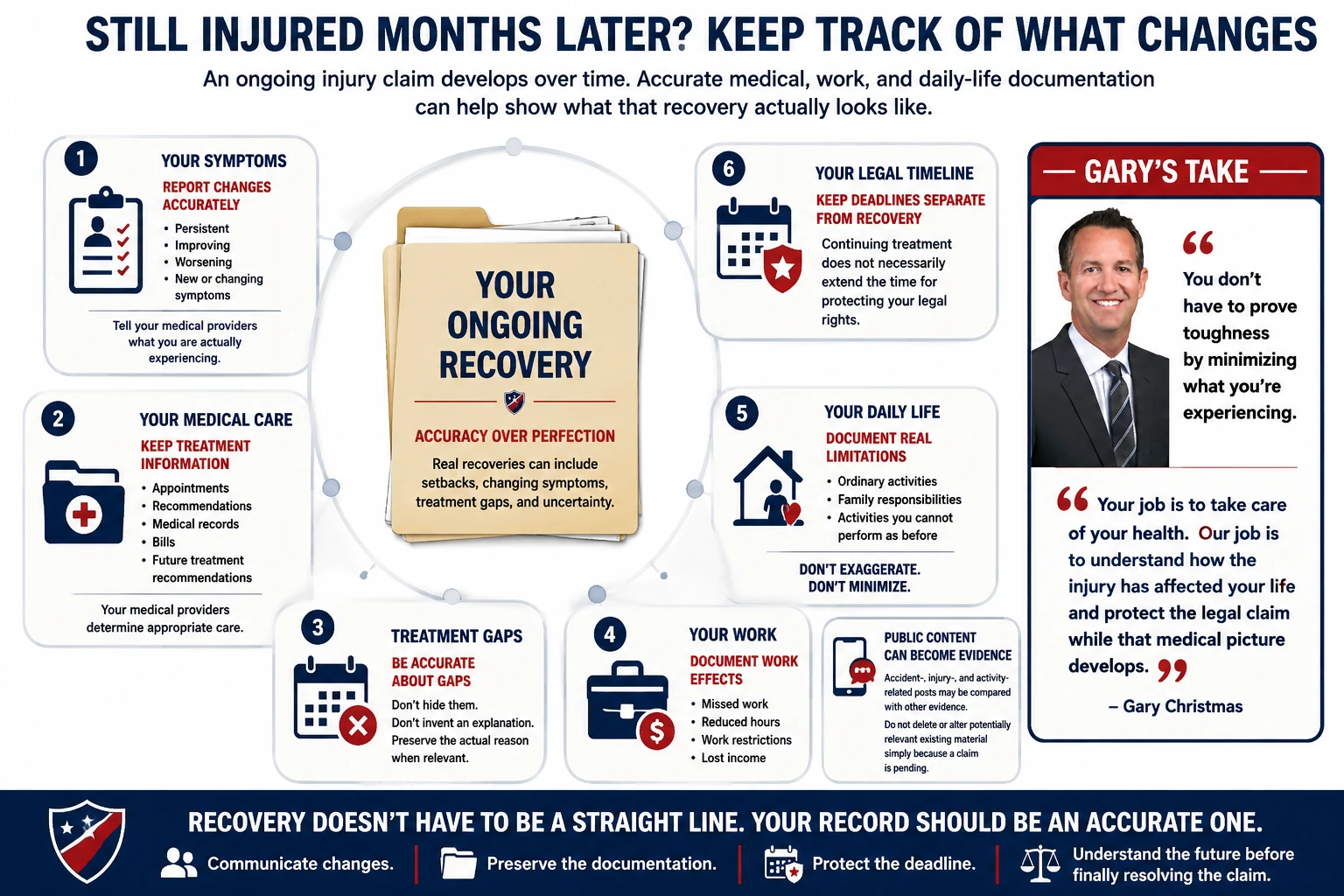
Recovery doesn’t have to be a straight line. Your record should be an accurate one.
In Summary
If you are still injured months after an accident, the fact that your recovery is taking longer than expected does not automatically mean something has gone wrong with your injury claim. Symptoms can change over time, diagnoses may develop as medical evaluation and treatment progress, and some injuries may require extended care or result in ongoing limitations.
Your medical treatment and your legal claim can also move forward at the same time. You do not necessarily have to be fully recovered before evidence is gathered, liability is investigated, insurance coverage is evaluated, and legal deadlines are protected. Final resolution is a different question. Before settling a claim, it may be important to understand reasonably anticipated future treatment, medical expenses, work limitations, and other consequences supported by the evidence.
If your recovery continues for months, accuracy and documentation become especially important. Communicate persistent, new, or changing symptoms to your medical providers, explain significant treatment gaps honestly, preserve medical and employment records, and document how the injuries continue to affect your work and everyday life. Your medical providers should determine what care is appropriate. An insurance company should not make those medical decisions for you.
Most importantly, do not assume that continued treatment gives you unlimited time to address the legal side of the accident. Medical recovery and legal filing deadlines are separate issues. Protecting your rights while the medical picture develops can help you avoid making important decisions before the full consequences of the injury are reasonably understood.