

What Happens If You Are Partially at Fault?
| Situation | What It May Mean |
|---|---|
| You are 0% at fault | No comparative-negligence reduction applies |
| You are 10% at fault | Your recovery may be reduced by 10% |
| You are 30% at fault | Your recovery may be reduced by 30% |
| You are 50% at fault | You may still recover, but damages may be reduced |
| You are more than 50% at fault | You may be barred from recovery |
| Insurance company blames you | Evidence can be used to challenge that claim |
Who Decides What Percentage of Fault I Have?
An insurance adjuster may assign a percentage of fault when evaluating a claim, but that does not make the insurer’s percentage legally binding. During settlement negotiations, the parties may disagree about how responsibility should be divided.
If the case is litigated and fault remains disputed, the percentage of comparative negligence may ultimately be determined by the jury, or by the judge in a case tried without a jury, based on the evidence and applicable law.
That is why an insurer saying “we think you’re 30% at fault” is not necessarily the final answer.
Can Both Drivers Be Negligent in the Same Accident?
Yes. More than one driver’s actions can contribute to causing the same accident. In fact, that is one of the reasons South Carolina’s comparative negligence rule can become important in a car accident claim.
For example, one driver might make an unsafe lane change while another driver is traveling too fast for the conditions. Or one driver might fail to yield while the other is distracted and does not react as quickly as they otherwise might have. In situations like these, the fact that one driver was negligent does not necessarily mean the other driver was completely free from fault.
When both drivers may have contributed to the collision, the question becomes how each person’s conduct contributed to causing the accident and how responsibility should be allocated under South Carolina law.
That determination should be based on the evidence, not simply on which driver believes the other was responsible. Photographs, video, witness testimony, vehicle damage, roadway evidence, driver statements, electronic vehicle data when relevant, and other evidence may all help establish what each driver did before the collision.
Being partially responsible does not automatically mean you cannot recover. The percentage of fault matters, which is why understanding exactly how the accident happened is so important.
How Is My Percentage of Fault Determined?
Your percentage of fault is determined by looking at what each person did, or failed to do, and how that conduct contributed to causing the accident. It is not necessarily based on one fact, one driver’s opinion, or an insurance adjuster’s initial assessment.
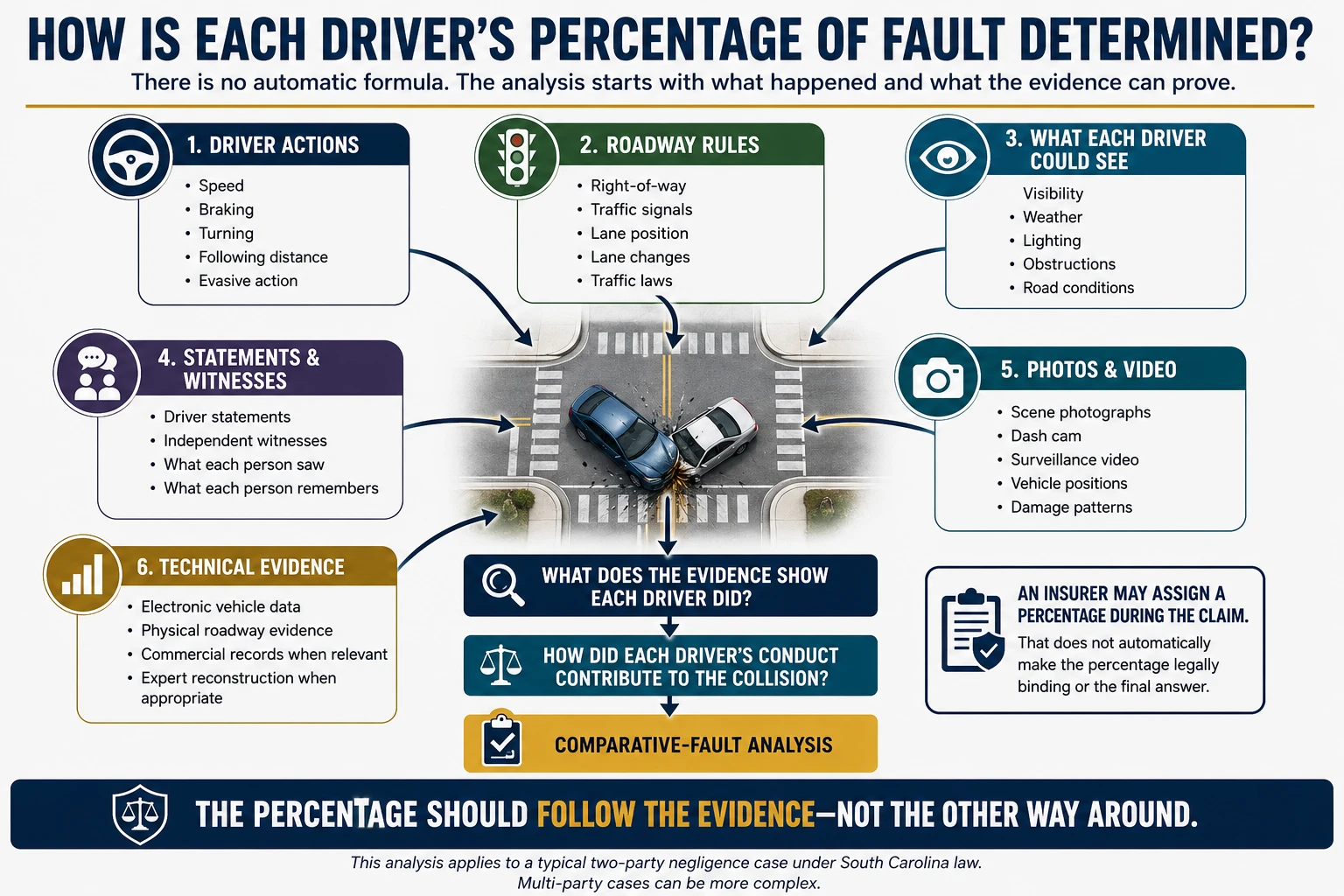
There is no automatic formula. The comparative-fault analysis starts with what happened and what the evidence can prove.
Depending on the type of collision, the comparative-fault analysis may consider:
- What each driver did before the collision, including braking, turning, accelerating, merging, or attempting to avoid the crash.
- Traffic laws and right-of-way, including which driver was required to stop, yield, maintain a lane, or obey a traffic-control device.
- Speed and following distance, including whether either driver was traveling too fast for the circumstances or following too closely.
- Lane position and lane changes, particularly in merging, sideswipe, and multi-lane accidents.
- Visibility and roadway conditions, including weather, lighting, obstructions, traffic, and other conditions affecting what each driver could reasonably see or do.
- Distraction, including evidence that a driver was using a phone or otherwise not paying adequate attention to the roadway.
- Driver statements about what happened before and during the collision.
- Independent witness testimony from people who saw the accident or events leading up to it.
- Photographs and video, including accident-scene photographs, dash cam footage, surveillance video, and other available recordings.
- Physical evidence, such as vehicle damage, final resting positions, skid marks, debris, and roadway evidence.
- Vehicle data, when relevant and available, that may provide information about speed, braking, steering, or other vehicle activity.
- Expert analysis, such as accident reconstruction, when the circumstances justify it.
For example, an insurer might initially argue that you were partially responsible because of something you said at the scene. But dash cam footage, an independent witness, vehicle data, or physical evidence could provide additional context about what each driver actually did. Conversely, evidence may also support a legitimate finding that both drivers contributed to the collision.
There is no automatic formula that turns a particular fact into a particular percentage. Fault percentages are determined from the circumstances of the accident and the evidence showing whose conduct contributed to causing it.
That is why the percentage of fault should follow the evidence, rather than beginning with an assumption about who should receive the blame.
Can Both Drivers Be Negligent in the Same Accident? A Closer Look
Yes. Comparative negligence exists precisely because more than one person’s conduct can contribute to causing an accident. For example, one driver might make an unsafe maneuver while another driver is speeding or following too closely. The fact that one driver was negligent does not necessarily mean the other driver was completely free from fault.
The question is how each person’s conduct contributed to causing the collision and, when comparative negligence applies, how responsibility should be allocated under South Carolina law.
Sometimes the evidence supports assigning some responsibility to both drivers. Other times, the parties may strongly disagree about what happened or how responsibility should be divided.
The important question is not simply whether an insurance adjuster says you are 10%, 30%, or 50% at fault. The important question is what evidence supports that proposed percentage.
What If I Disagree With the Insurance Company's Percentage of Fault?
You do not have to assume an insurer’s liability assessment is correct simply because an adjuster assigns you a percentage of fault. Ask what facts and evidence support that position.
Photographs, witness statements, dash cam or surveillance footage, vehicle damage, roadway evidence, electronic vehicle data, accident reports, and other evidence may support, or contradict, the insurer’s assessment.
If fault remains disputed, the insurer’s percentage is not necessarily the percentage a jury or court would ultimately assign.
Can I Still Recover If I Was Partially at Fault?
One of the biggest misconceptions is that being partially at fault automatically prevents someone from bringing a claim.
That is simply not true in South Carolina.
Under South Carolina’s comparative negligence system, an injured person may still recover damages even if they share some responsibility for the accident. For example, if you suffered $100,000 in damages and were found to be 30% at fault while the other driver was 70% at fault, you could still recover $70,000.
The important point is not to assume that contributing to an accident automatically eliminates your claim. The percentage of fault matters. In a typical two-party South Carolina negligence case, there is a significant legal difference between being 50% at fault and being more than 50% at fault.
What Happens If I Am Exactly 50% at Fault?
In a typical two-party South Carolina negligence case, being exactly 50% at fault does not automatically bar recovery. South Carolina’s rule allows a plaintiff to recover when the plaintiff’s negligence is not greater than the defendant’s negligence.
If your damages were $100,000 and you were determined to be 50% at fault, the comparative-negligence reduction would generally leave $50,000 in recoverable damages. If your negligence were greater than the defendant’s, for example, 51% in a two-party case, you would be barred from recovery.
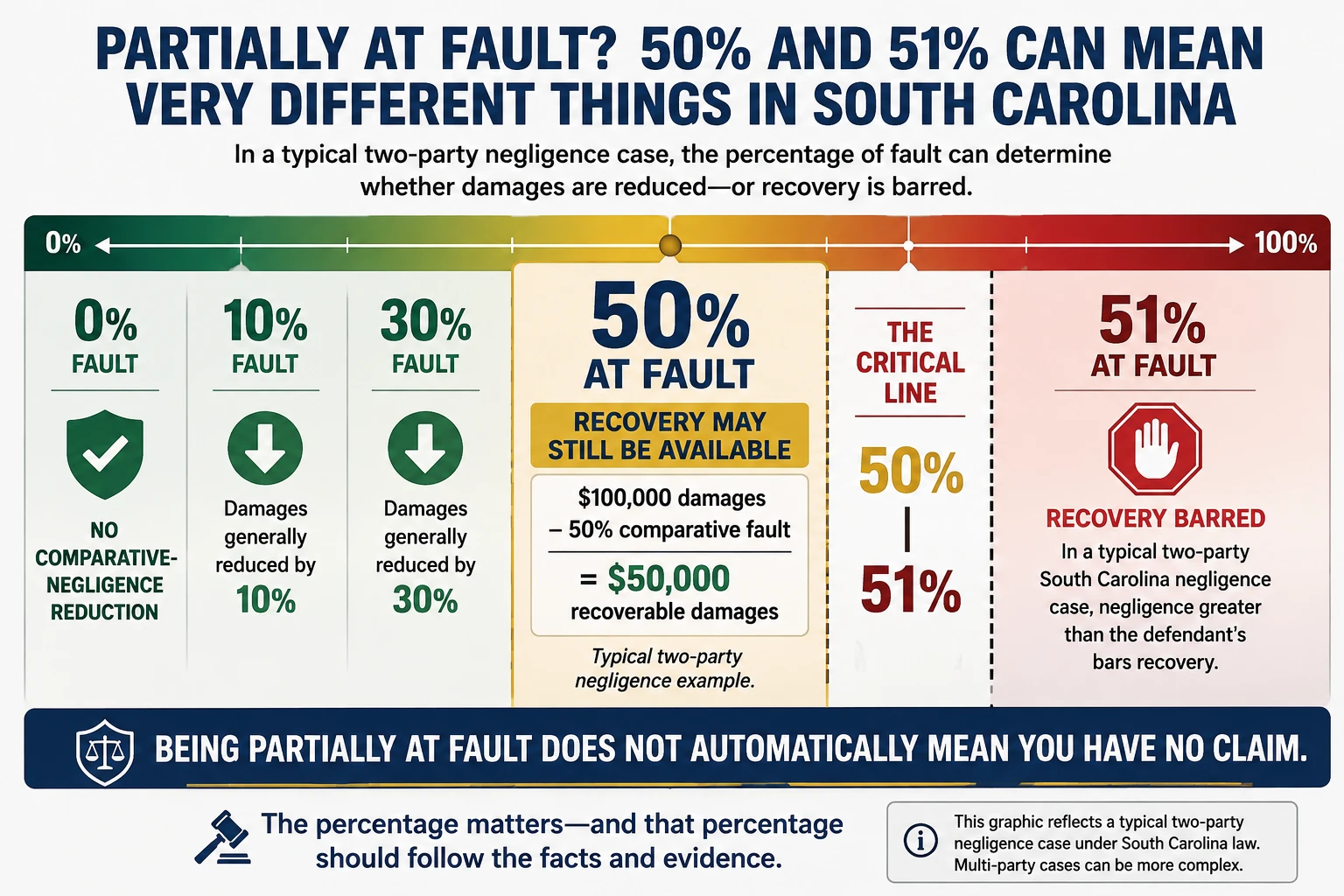
In a typical two-party South Carolina negligence case, the line between 50% and 51% fault can determine whether damages are reduced or recovery is barred entirely.
What Questions Might an Adjuster Ask When Fault Is Disputed?
When fault is disputed after a South Carolina car accident, an insurance adjuster may ask detailed questions about what you were doing before the collision, what you observed, and whether anything you did may have contributed to the accident. These questions can help the insurer evaluate whether comparative negligence may apply and, if so, how responsibility might be divided.
Questions may include:
- Where were you traveling?
- Which lane were you in?
- How fast were you going?
- When did you first see the other vehicle?
- Did you brake, steer away, or take any other evasive action?
- Were you using a phone at the time of the accident?
- Were you distracted by anything inside or outside the vehicle?
- What did the traffic signal show as you approached the intersection?
- Did you see the other vehicle's turn signal?
- What happened immediately before impact?
The adjuster may also compare your answers with other available evidence, such as the accident report, photographs, witness accounts, vehicle damage, dash cam or surveillance footage, and other evidence concerning how the collision occurred.
These questions are not necessarily improper. They concern facts an insurer may investigate when evaluating comparative negligence. The important point is that your answers can become part of the claim, so accuracy matters. If you do not know or remember something, do not guess.
For example, if you do not know exactly how fast you were traveling or cannot remember precisely how many seconds passed between seeing the other vehicle and the collision, it is better to say that you do not know or do not remember than to estimate simply because you feel expected to provide an answer.
When fault is disputed, small factual details can become important. Stick to what you actually know, avoid speculation, and make sure your description of the accident is as accurate as possible.
What Mistakes Can Hurt Me When Fault Is Disputed?
When fault is disputed after a South Carolina car accident, small details can become important. Comparative negligence can reduce the amount you may recover, and, depending on the percentage of fault assigned, can potentially prevent recovery altogether. That makes it especially important to preserve evidence and avoid assumptions about responsibility before all of the facts are known.
Some mistakes to avoid include:
- Assuming an apology determines legal fault. People sometimes apologize instinctively after an accident because someone was hurt or because the situation is upsetting. An apology by itself does not necessarily establish who was legally responsible for causing the collision.
- Guessing about speed, distance, timing, or visibility. If you do not know exactly how fast you were traveling, how far away another vehicle was, or how much time passed before impact, do not invent an estimate simply because someone asks. Stick to what you actually know and remember.
- Agreeing with a percentage of fault before understanding the evidence. An insurer may tell you that it believes you were 20%, 30%, or some other percentage responsible. Do not assume that assessment is automatically correct or legally binding. Ask what evidence supports it.
- Failing to photograph all of the vehicles and the overall accident scene. Close-up photographs of your vehicle are useful, but wide photographs showing vehicle positions, lanes, intersections, traffic controls, roadway conditions, and damage to all vehicles involved may provide important context.
- Failing to identify independent witnesses. A neutral witness may have seen something neither driver remembers, or may help resolve conflicting accounts of how the collision occurred. When safely possible, preserve names and contact information.
- Failing to preserve dash cam or surveillance footage. Video can be overwritten or deleted. If dash cam, business surveillance, doorbell-camera, or other footage may exist, identifying and preserving it early can be important.
- Focusing only on evidence about your own actions. Comparative negligence requires examining what each driver did. Evidence concerning the other driver's speed, lane position, distraction, right-of-way, braking, or other conduct may be just as important.
- Guessing or giving materially inconsistent descriptions of the accident. Differences between statements to police, insurers, medical providers, or others can become an issue when liability is disputed. Be accurate, and if you do not know or remember something, say so rather than guessing.
- Posting accident-related information publicly. Photographs, videos, comments about how the crash happened, or statements about fault can create unnecessary issues if they are later compared with other evidence in the claim.
- Assuming the insurance company's percentage of fault is the final answer. An adjuster's liability assessment is part of the claim process, but it does not necessarily determine what percentage of fault would ultimately be assigned if the dispute were litigated.
The goal is not to prove that you did absolutely nothing wrong before you know what the evidence shows. It is to preserve the evidence, describe what happened accurately, and allow the comparative-fault analysis to follow the facts rather than assumptions.
Does Getting a Traffic Ticket Mean I Am Automatically at Fault?
No. Receiving a traffic citation does not automatically determine your percentage of fault in a civil injury claim. A citation, its disposition, an accident report, and civil negligence are different legal concepts.
The comparative-negligence analysis still depends on the applicable law and admissible evidence concerning how the collision occurred.
Can Fault Percentages Change as More Evidence Is Discovered?
Yes. An early liability assessment may be based on incomplete information. Additional witnesses, video, photographs, vehicle data, physical evidence, or expert analysis may provide facts that were not available when the claim was first evaluated.
A percentage assigned during the insurance claim process is therefore not necessarily fixed simply because an adjuster stated it early in the investigation.
That is one reason you should not assume an initial percentage assigned by an insurer, or your own immediate impression at the accident scene, is necessarily the final answer.
What Evidence Can Help Determine Each Driver's Percentage of Fault?
When comparative fault is disputed, the percentage assigned to each driver should be based on the evidence showing how the collision occurred and how each person’s conduct contributed to causing it. No single piece of evidence necessarily tells the entire story, which is why several different sources may need to be considered together.
Depending on the accident, useful evidence may include:
- Accident-scene photographs. Wide and close-up photographs can document vehicle positions, lanes, intersections, traffic controls, skid marks, debris, sight obstructions, and roadway conditions.
- Vehicle damage. The location and pattern of damage to each vehicle may help show the direction and area of impact.
- Dash cam and surveillance footage. Video may capture vehicle movements, traffic signals, lane changes, speed-related information, or events immediately before the collision.
- Independent witnesses. Someone who saw the accident may provide information about what each driver did before impact.
- Roadway and physical evidence. Skid or tire marks, debris, vehicle resting positions, and other physical evidence may help explain how the collision happened.
- Driver statements. What the drivers reported seeing and doing before the crash may become part of the liability analysis.
- Vehicle electronic data. When relevant and available, electronic vehicle data may provide information about speed, braking, steering, acceleration, or other vehicle activity.
- Commercial-vehicle records. In truck or other commercial-vehicle cases, onboard systems and business records may provide additional information about the vehicle or driver's actions.
- Accident reports and investigative materials. These may contain useful information about the scene, drivers, witnesses, and investigation, although they should be considered alongside the other available evidence.
- Expert accident reconstruction. In appropriate cases, an expert may analyze physical evidence, vehicle damage, electronic data, measurements, photographs, and other information to help explain how the collision occurred.
Evidence can also change an early assessment of fault. A claim that initially appears to involve significant responsibility by both drivers may look different after video is discovered, witnesses are interviewed, or electronic and physical evidence is analyzed.
That is why gathering and preserving evidence early can be so important when comparative negligence is disputed. The goal is not to find evidence that automatically lowers your percentage of fault. It is to develop the most complete and accurate picture possible of what each driver did and how those actions contributed to the collision.
What If More Than Two Drivers or Parties Share Fault?
Comparative-fault issues can become more complicated when more than two people or entities may have contributed to the accident. Fault may need to be evaluated among multiple drivers, businesses, vehicle owners, or other potentially responsible parties depending on the facts.
South Carolina law contains specific rules governing the allocation of fault in cases involving multiple responsible parties. That means a multi-vehicle or multi-defendant accident should not necessarily be analyzed as a simple “you versus the other driver” percentage calculation.
Gary's Take: How Should Fault Be Evaluated?
“I try not to begin with a percentage. I begin with the evidence. What did each driver do? What do the photographs show? What do the witnesses say? Is there video? What does the physical evidence tell us? Only after we understand how the collision occurred does it make sense to evaluate comparative fault.”
“Follow the facts, follow the evidence, and follow the law,” says Gary Christmas.
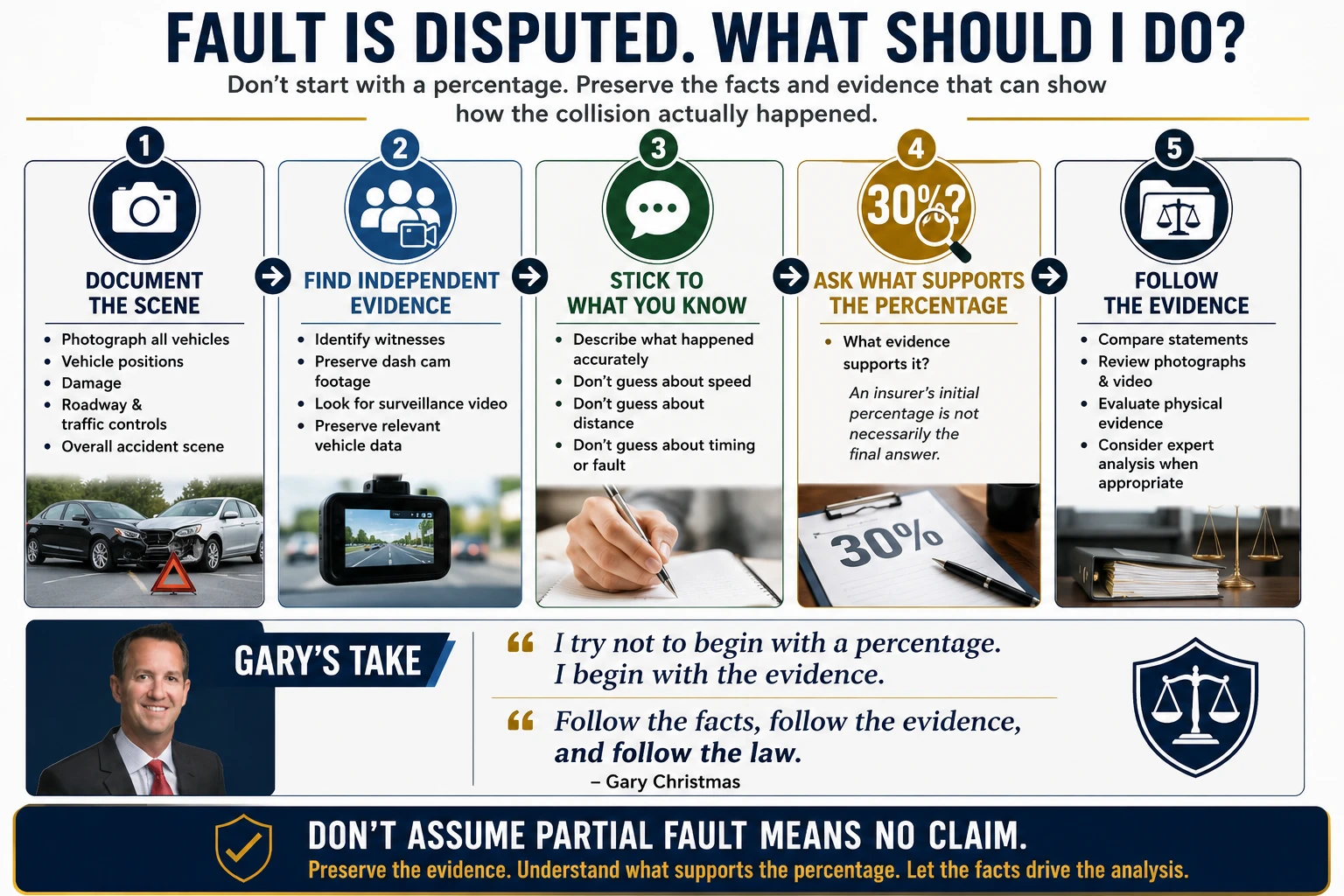
When fault is disputed, don’t start with a percentage. Document the scene, find independent evidence, stick to the facts, and let the evidence support the number.
Partial Fault Accident Checklist
- Do not assume being partially at fault means you have no claim
- Do not guess about speed, distance, timing, or fault
- Photograph vehicle positions and damage to all vehicles
- Preserve dash cam and surveillance footage
- Identify independent witnesses
- Obtain the accident report
- Preserve relevant vehicle or electronic data when appropriate
- Keep your description of the accident accurate and consistent
- Ask what evidence supports any percentage of fault assigned to you
- Do not assume an insurer's percentage is legally binding
- Remember that 50% and 51% can produce very different results
- Consider whether multiple drivers or parties may share responsibility
- Preserve evidence as early as possible before it disappears or changes
In Summary
Being partially responsible for a South Carolina car accident does not automatically mean you cannot recover damages. Under South Carolina’s modified comparative negligence rule, your recovery is generally reduced according to your percentage of fault. In a typical two-party case, you may still recover if your negligence is not greater than the other party’s negligence. That means 50% and 51% fault can produce very different results.
Fault percentages should be based on the circumstances of the collision and the available evidence, not simply on an insurance company’s initial assessment or one statement made after the accident. Photographs, video, witnesses, vehicle damage, roadway evidence, electronic vehicle data, and other evidence may all help determine what each driver did and how those actions contributed to causing the collision.
The important point is not to assume you have no claim simply because you may have contributed to the accident. Follow the facts, preserve the evidence, and understand how South Carolina’s comparative negligence rule applies to the circumstances of your case.