


What Factors Affect the Value of a Car Accident Settlement?
There are many factors that must be evaluated and quantified, including both economic and non-economic damages. So, the short answer is this: the value of a case depends on the damages the accident caused and how well those damages can be connected to the collision and proven. Liability, comparative fault, available insurance coverage, and the strength of the evidence can also affect what may ultimately be recovered.
| Factor | Why It Matters |
|---|---|
| Nature and severity of injuries | Helps establish the extent of the harm |
| Medical treatment and prognosis | Documents diagnosis, recovery, and future needs |
| Past and future medical expenses | Economic losses |
| Lost income and earning capacity | Financial impact of the injuries |
| Permanent impairment | May affect future work and daily life |
| Pain and suffering | Noneconomic damages |
| Loss of enjoyment of life | Impact on normal activities and quality of life |
| Liability and comparative fault | Can affect whether and how much may be recovered |
| Causation | Connects the collision to the claimed injuries |
| Available insurance and other recovery sources | Can affect practical recovery |
| Strength of the evidence | Affects the ability to prove liability and damages |
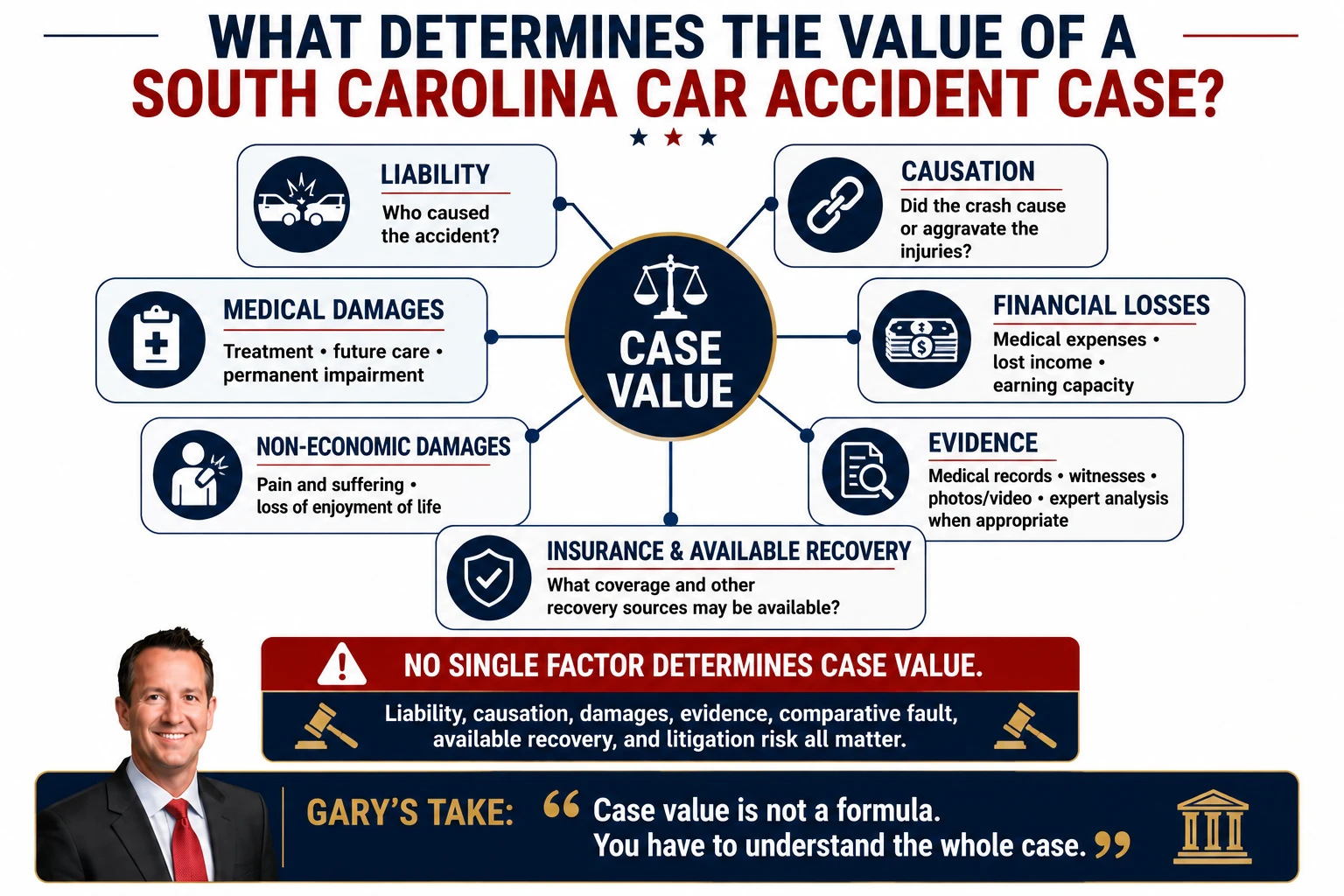
No single factor determines case value. Liability, causation, damages, evidence, comparative fault, available recovery, and litigation risk all matter.
Does Fault Affect How Much My Case Is Worth?
Yes. The strength of the liability case can have a major effect on what may ultimately be recovered.
South Carolina follows a modified comparative negligence system. If you are partly responsible for causing the accident, your recoverable damages may be reduced according to your percentage of fault. If your negligence is greater than the negligence of the defendant or defendants, you may be barred from recovering damages.
For example, two people could suffer very similar injuries but have very different cases if liability is clear in one accident and heavily disputed in the other.
That is why we evaluate more than the injuries. We also look closely at how the collision happened, what the evidence shows, whether anyone is alleging that our client shares fault, and how those issues may affect the claim.
Does the Amount of Insurance Coverage Determine What My Case Is Worth?
Not by itself. Insurance coverage and case value are related, but they are not the same thing.
The extent of your legally recoverable damages depends on the facts of the accident, your injuries, your losses, liability, causation, and the evidence. The amount and type of available insurance coverage can affect how much money may practically be available to satisfy those damages.
That is why identifying all potentially available insurance coverage is part of evaluating a serious accident claim.
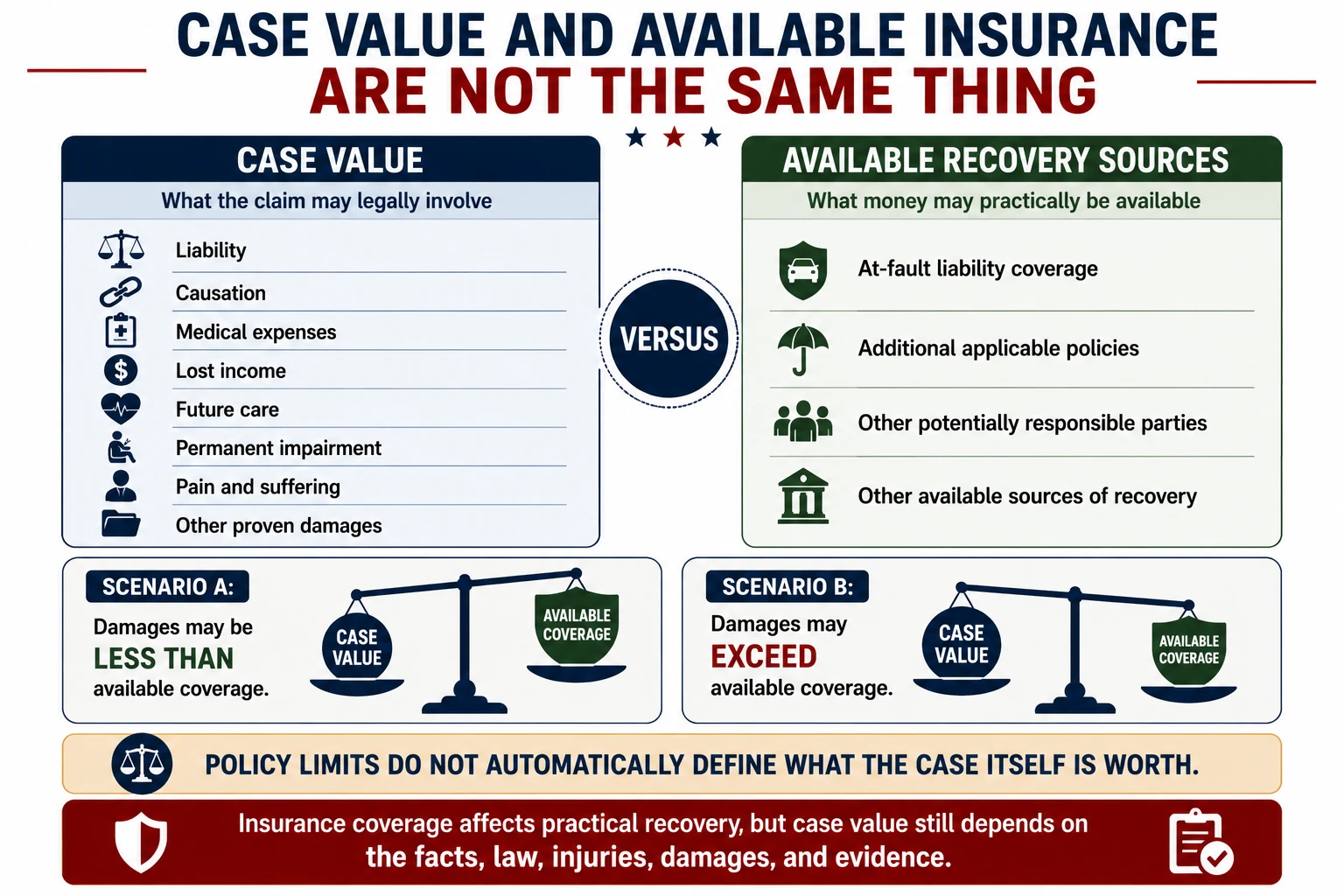
Policy limits do not automatically define what the case itself is worth. Insurance coverage affects practical recovery, but case value still depends on the facts, law, injuries, damages, and evidence.
Can I Compare My Settlement to Someone Else's?
One of the biggest misconceptions is that people try to compare their case to a friend’s case, a family member’s case, or something they read online.
The problem is that every case is different. The facts, injuries, medical treatment, insurance coverage, and damages in one case may be completely different from another. In nearly 30 years of practicing injury law, I can honestly say that I have never seen two cases that were exactly the same.
What happened in someone else’s case does not guarantee what will happen in yours. Each case must be evaluated on its own unique facts and circumstances.
Even cases involving similar injuries can have different liability evidence, medical histories, insurance coverage, future treatment needs, and economic losses.
What Factors Have the Biggest Impact on Settlement Value?
Some of the most important factors in evaluating a case are the economic and non-economic damages suffered by the injured person. But damages are only part of the analysis. Liability, causation, comparative fault, available insurance or other recovery sources, and the strength of the evidence can also materially affect how a case is evaluated.
These damages may include past and future medical expenses, past and future lost wages, loss of earning capacity, pain and suffering, loss of enjoyment of life, permanent impairment, and other damages recognized under South Carolina law.
Liability and causation matter too. Serious injuries do not automatically create a strong case if there is a major dispute about who caused the accident or whether the accident caused the medical condition being claimed.
We believe preparing a case as though it may ultimately be presented to a jury puts us in a stronger position to evaluate the evidence, negotiate the claim, and litigate the case if necessary.
Can a More Complete Medical Diagnosis Change How My Case Is Valued?
We have handled many cases where the medical picture changed significantly after additional evaluation. An injury that initially appears to be a sprain or strain may later be diagnosed as something more significant after appropriate imaging or specialist evaluation.
When the diagnosis changes, the treatment needs, prognosis, work restrictions, permanent impairment, and other damages may also look very different.
Often, a client comes to us after seeing only a family doctor or urgent care provider. While those providers play an important role, the injured person sometimes needs additional evaluation by a specialist and advanced imaging studies to fully understand the nature and extent of the injury.
When additional medical evaluation results in a more complete diagnosis, the condition often becomes clear. In many cases, that proper diagnosis dramatically changes how the claim is evaluated and valued.
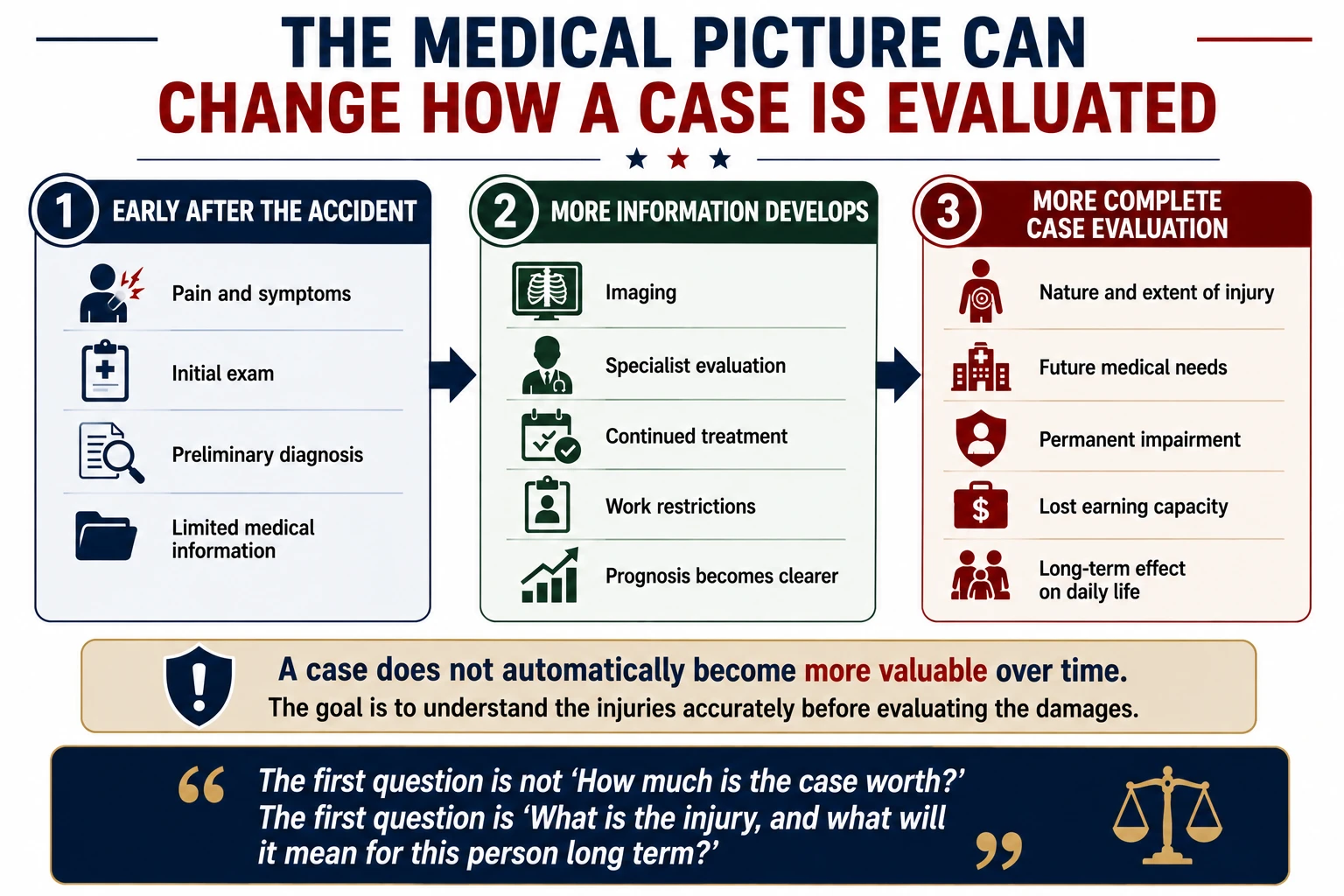
The first question is not “How much is the case worth?” The first question is “What is the injury, and what will it mean for this person long term?”
Why Can a More Complete Diagnosis Change the Evaluation of a Case?
In many cases, a more complete diagnosis gives us a much clearer understanding of the nature and severity of the injury and what it may mean for the person’s future.
For example, a family doctor may initially diagnose a shoulder sprain based on the symptoms presented at the time. Later, an orthopedic specialist may order an MRI that reveals a torn rotator cuff and a torn labrum.
Those are serious injuries that may require surgery, extensive rehabilitation, and long-term treatment. A shoulder strain that resolves quickly and a torn rotator cuff requiring surgery can involve very different treatment, recovery time, work restrictions, future medical needs, and effects on daily life. Those differences can materially affect the damages being evaluated in the case.
The first priority is getting appropriate medical care for your health. That treatment also creates the medical information needed to understand the nature, extent, and long-term effects of your injuries.
What Mistakes Can Reduce the Value of My Settlement?
One mistake is giving the at-fault driver’s insurance company detailed or recorded statements before you understand how that information may affect the claim.
Something you say early may later become important if there are disputes about how the accident happened, your symptoms, your medical history, or the effect the injuries have had on your life.
Anything you say can potentially be used against you later. Whether it is a recorded statement or simply a casual conversation with an adjuster, the insurance company may later use those statements when evaluating or disputing liability, causation, the extent of your injuries, or the damages being claimed.
I tell injured clients to be extremely cautious about social media while a claim is pending. Photographs, videos, comments, check-ins, and other posts can be viewed without the full context of what you were experiencing and may later become part of a dispute about your injuries or limitations.
Insurance companies and defense lawyers may review publicly available social-media content when evaluating claims, looking for evidence they can use to challenge your credibility or minimize your damages.
Are Online Car Accident Settlement Calculators Accurate?
I would not rely on an online calculator to determine what an individual South Carolina car accident claim is worth.
Most calculators use a limited set of inputs, such as medical expenses and lost wages. But actual case evaluation can involve liability, comparative fault, causation, the nature and duration of treatment, permanent impairment, future medical needs, earning capacity, credibility, available insurance coverage, and the strength of the evidence.
A calculator cannot examine medical records, evaluate witnesses, understand how an injury affects your particular life, or assess disputed liability.
That is why there is no reliable mathematical formula that can tell you what a specific car accident case is worth.
Should I Accept the Insurance Company's First Settlement Offer?
In my opinion, you should be very cautious about accepting the insurance company’s first settlement offer. Many early offers are made before the long-term medical picture is clear. The reality is that you cannot accurately value a case until you know whether your injuries are temporary, permanent, or somewhere in between.
Once a settlement is finalized and a valid release resolves the claim, you generally cannot reopen the case simply because your injuries later turn out to be worse than expected. Our philosophy is simple: do not rush into a settlement before you reasonably understand your injuries, prognosis, future treatment needs, and the damages being resolved.
Why Does Trial Experience Matter When Valuing a Case?
Our firm has a long-standing commitment to litigation and trial work.
We prepare every case from day one as though it will ultimately be presented to a jury. That experience matters because there is a significant difference between reading about case value and actually presenting evidence and testimony before judges, commissioners, and juries.
When you have spent decades trying cases, you gain a practical understanding of how damages are evaluated in the real world. You learn what evidence is persuasive, what juries respond to, and how different injuries are viewed when a case reaches the courtroom.
That experience helps us evaluate cases from a position of knowledge rather than speculation.
Why Are People So Worried About Settlement Value?
Most people are not financially prepared for a serious accident.
It does not matter whether you are a doctor, a teacher, a business owner, or someone working an hourly job. Very few people have enough money saved to absorb months of lost income, expensive medical treatment, and all of the other financial burdens that often follow a serious accident.
When clients ask how much their case is worth, they are often trying to gain some sense of certainty during a very uncertain time. They are trying to understand how they will pay their bills, support their family, keep up with their household expenses, and move forward after a life-changing event.
Those concerns are completely understandable. Part of our job is to help clients understand what losses the law allows them to pursue and what the available evidence tells us about their case.
Is Settlement Value the Same as What a Jury Might Award?
Not necessarily. A settlement is a negotiated resolution. A jury verdict is a decision reached after evidence is presented at trial.
When evaluating a potential settlement, both sides may consider the strength of liability evidence, medical proof, damages, comparative fault, insurance coverage, litigation risk, and what a judge or jury might ultimately decide.
That is why case valuation is usually a range and a risk assessment, not a single number that can be calculated in advance.
Protecting the Value of Your Case
- Seek appropriate medical care
- Follow reasonable treatment recommendations
- Understand your diagnosis and long-term prognosis
- Keep medical bills, wage records, and other documentation of your losses
- Preserve photographs, video, witness information, and other accident evidence
- Document how your injuries affect your work and daily life
- Be careful about detailed or recorded statements to the at-fault driver's insurer
- Be cautious about social-media activity while the claim is pending
- Do not rely on an online settlement calculator or another person's case
- Identify available insurance coverage and other potential recovery sources
- Understand liability and any allegation of comparative fault
In Summary
There is no reliable formula that can tell you exactly what a South Carolina car accident settlement is worth. The value of a claim depends on the specific facts of the accident, the injuries involved, the available evidence, and how those facts fit within South Carolina law.
Important factors can include who caused the accident, whether the crash caused or aggravated the injuries being claimed, the nature and severity of those injuries, past and future medical treatment, long-term prognosis, lost income, diminished earning capacity, permanent impairment, pain and suffering, loss of enjoyment of life, available insurance coverage, and the strength of the evidence.
Comparative fault can also affect what may ultimately be recovered. Even when the injuries are serious, a dispute about liability or causation can materially affect how the case is evaluated.
The medical picture often needs time to develop. An injury that initially appears minor may later be better understood through additional medical evaluation, imaging, specialist care, or a clearer long-term prognosis. That does not mean every case becomes more valuable over time. It means that a case should be evaluated using the most complete and accurate information reasonably available.
Insurance coverage matters too, but coverage limits do not automatically determine what a case is worth. A case may involve damages that exceed available coverage, or there may be additional sources of insurance or recovery that need to be identified.
The practical lesson is simple: case value is usually a range and a risk assessment, not a number generated by a calculator or based on what happened in someone else’s case. Every claim has to be evaluated on its own facts, medical evidence, liability issues, damages, coverage, and litigation risks.