

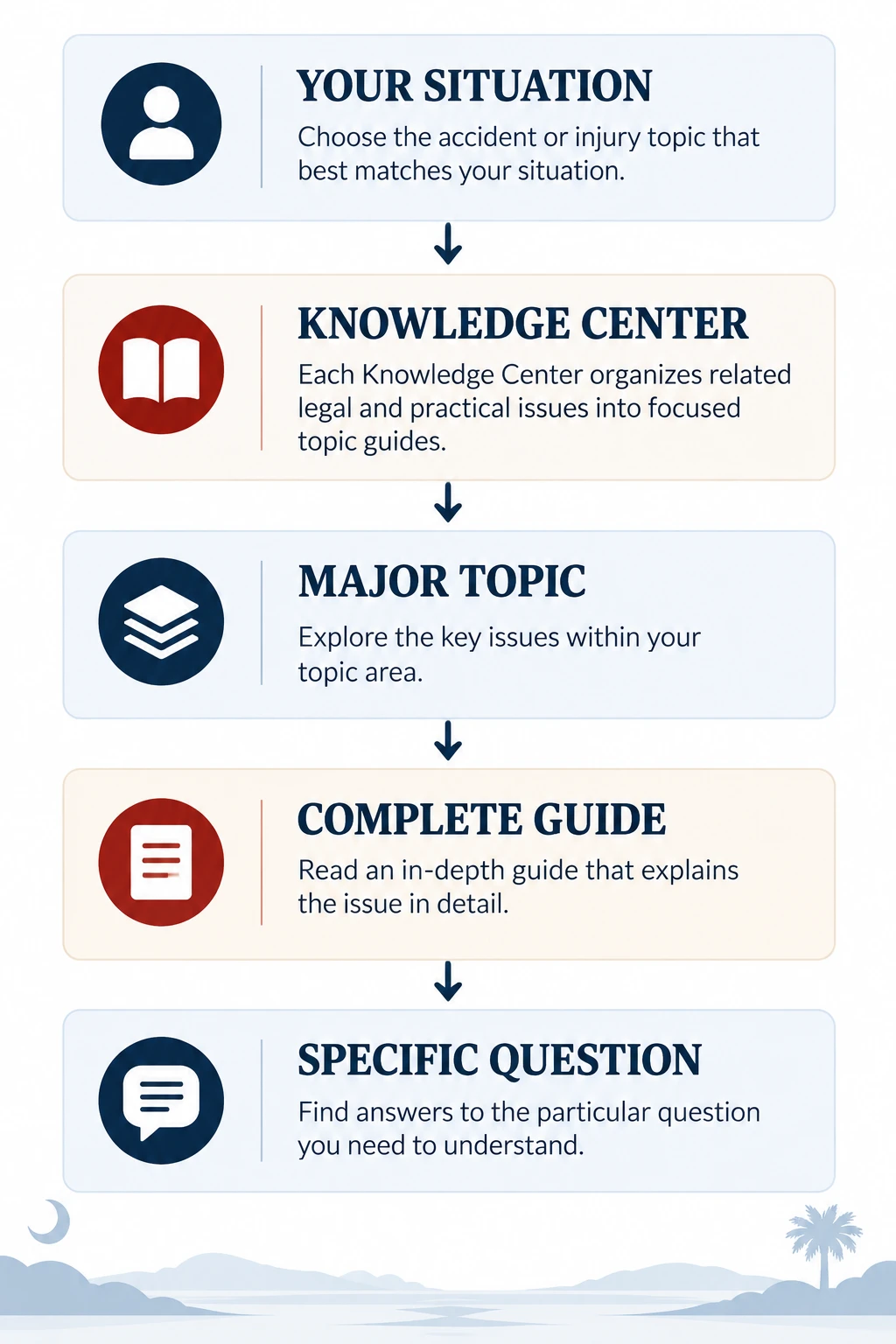
What Settlement or Financial Issue Are You Dealing With?
You do not need to calculate the value of your entire claim before finding the information you need. Start with the question that most closely matches the issue you are facing.
I want to know what my car accident claim may be worth
There is no universal formula for valuing a car accident claim. Injury severity, medical treatment, future effects, lost income, pain and suffering, liability, causation, evidence, and available insurance may all affect the evaluation.
I received a settlement offer from the insurance company
A settlement offer is a proposal to resolve a claim. Before accepting one, it can be important to understand what the offer resolves, whether your medical condition is sufficiently understood, what losses remain, and what rights a release may affect.
I keep seeing settlement calculators online
Online calculators can make claim valuation appear more predictable than it really is. A car accident claim generally cannot be valued accurately by entering medical bills into a fixed formula or multiplier.
I have questions about a $50,000 injury claim
A dollar figure by itself does not tell you whether a settlement is fair. The answer depends on what the amount represents, the damages involved, available insurance, disputed issues, and other facts specific to the claim.
I want to understand pain and suffering
Medical bills and lost income can document certain financial losses, but an injury may also affect your comfort, activities, independence, sleep, emotional well-being, and everyday life.
I’m worried medical bills or liens will reduce my settlement
The amount of a settlement and the amount ultimately distributed to you may be different. Medical balances, valid liens, reimbursement claims, fees, and case costs may need to be addressed when a case resolves.
I want to know what I would actually receive
A gross settlement is the total amount paid to resolve the claim. Net recovery is what remains for the client after applicable fees, costs, medical obligations, liens, reimbursement claims, or other amounts that must be resolved.
My losses may be greater than the available insurance
The value of your losses and the amount of insurance coverage available to pay them are separate questions. When policy limits may be inadequate, identifying all potentially applicable coverage can become particularly important.
I already signed a settlement or release
Settlements can have important consequences. Whether additional claims remain after an agreement is signed depends on the agreement, release language, parties involved, and other circumstances.
How Is Car Accident Financial Recovery Evaluated?
There is no single calculation that determines financial recovery in every car accident case.
A more useful approach is to separate the losses themselves from the evidence supporting them, the legal issues affecting the claim, the sources available to pay the claim, and the obligations that may need to be resolved afterward.
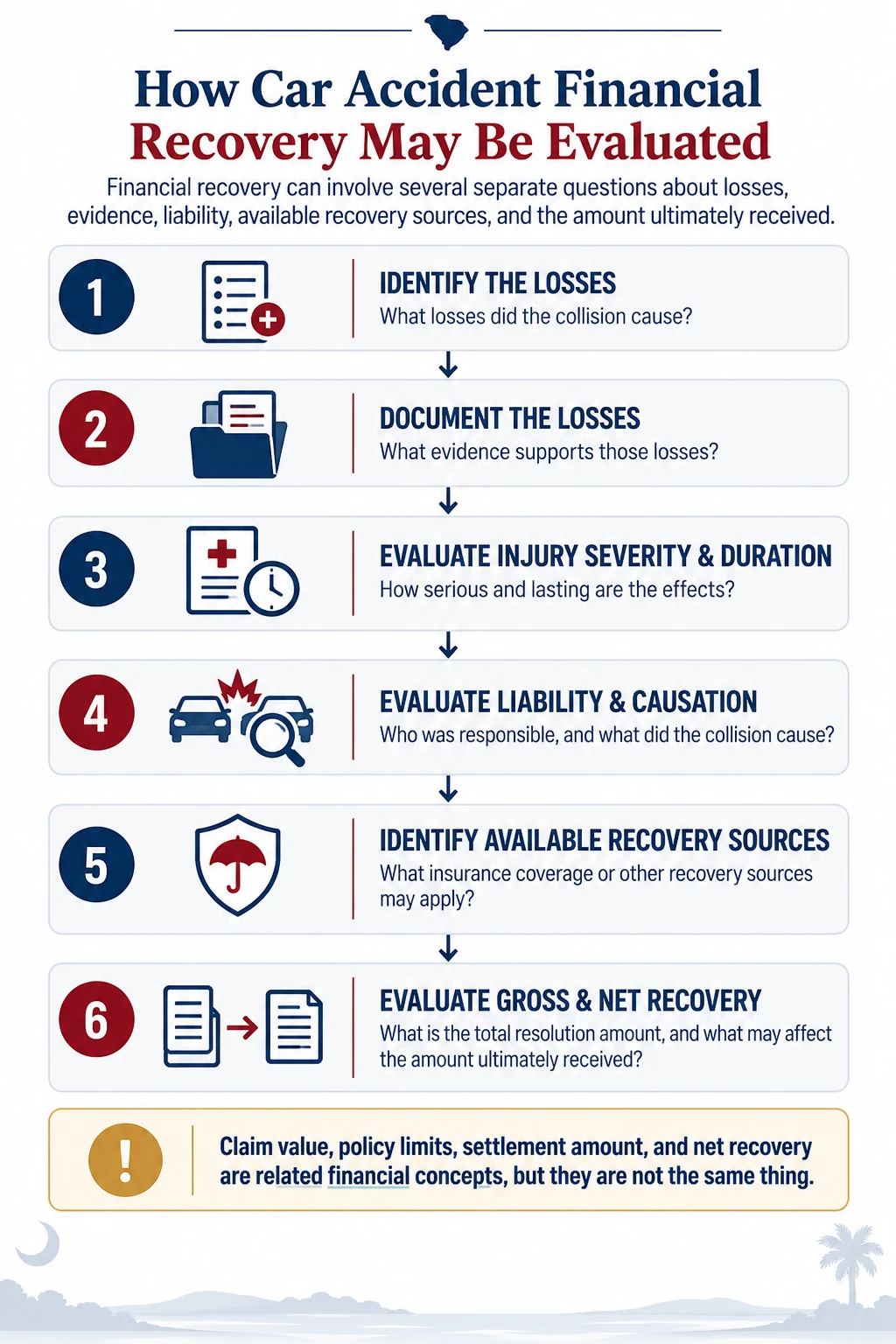
Financial recovery can involve several separate questions about losses, evidence, liability, available recovery sources, and the amount ultimately received.
1. Identify the Losses
Start with what the collision actually caused you to lose.
Depending on the case, that may include medical expenses, lost income, property damage, out-of-pocket costs, pain and suffering, limitations, or future losses.
2. Document the Losses
The next question is what evidence supports those losses.
Medical records and bills may document treatment and medical expenses. Employment and wage records may support time missed from work. Receipts, invoices, photographs, testimony, and other information may help establish additional financial and personal effects.
The amount of documentation matters less than whether reliable evidence supports the loss being claimed.
For more about evidence, visit Evidence, Liability & Case Strength →
3. Evaluate Injury Severity and Duration
Two people can incur similar medical expenses while experiencing very different injuries and recoveries.
Relevant considerations may include the nature of the injury, treatment required, length of recovery, continuing symptoms, physical restrictions, future medical recommendations, and whether the injury continues to affect work or everyday life.
That is one reason medical bills alone cannot determine claim value.
For more about injuries and prognosis, visit Medical Treatment, Injuries & Recovery →
4. Evaluate Liability and Causation
Damages do not exist in isolation from the rest of the claim.
If responsibility for the collision is disputed, that dispute may affect the evaluation. There can also be a separate disagreement over whether the accident caused a particular injury or loss.
A substantial loss does not automatically establish that another party is legally responsible for paying it.
For more about these issues, visit Evidence, Liability & Case Strength →
5. Identify Available Insurance or Other Recovery Sources
Once the losses and legal issues are understood, the available sources of recovery also need to be considered.
Liability coverage, underinsured motorist coverage, commercial policies, or other potentially applicable sources may matter depending on the accident. Policy limits can become particularly important when the damages are substantial.
The existence of a policy, however, does not necessarily mean that all of its limits are available or that the claim is worth the policy limit.
6. Evaluate Gross and Net Recovery
The amount paid to resolve a claim and the amount ultimately received by the client may not be identical.
Depending on the case, attorney fees, case expenses, medical balances, liens, reimbursement claims, or other obligations may need to be addressed before final distribution.
Four Questions That Can Affect Settlement Value
When people ask, “What is my case worth?” they are often combining several different financial questions.
Separating those questions can make the valuation process easier to understand.
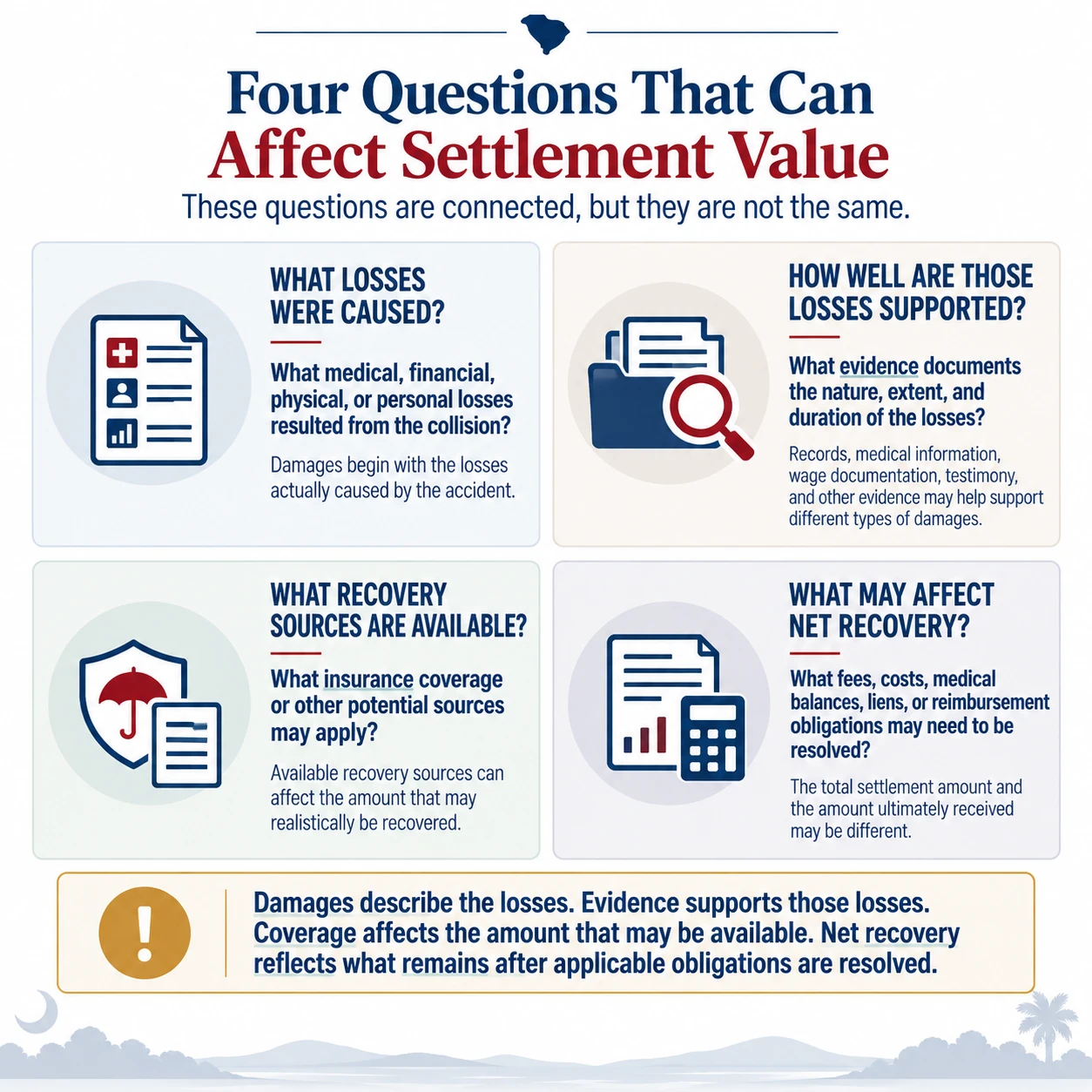
These questions are connected, but they are not the same.
What Losses Were Caused?
What medical, financial, physical, and personal effects resulted from the collision?
Damages begin with the actual losses associated with the accident. Depending on the facts, those losses may involve medical care, income, future needs, pain, limitations, or other supported effects.
How Well Are Those Losses Supported?
What evidence establishes the nature, extent, and duration of the claimed damages?
Records, testimony, medical information, wage documentation, receipts, and other evidence may help establish different types of loss.
The important question is whether the proof reliably supports what is being claimed.
What Recovery Sources Are Available?
What insurance coverage or other sources may be available to satisfy the claim?
A claim can involve significant damages while the available liability coverage is limited. Other insurance may sometimes become relevant depending on the circumstances.
That makes the value of the damages and the available sources of recovery separate questions.
What May Affect Net Recovery?
What obligations may need to be addressed before settlement funds are ultimately distributed?
Depending on the case, attorney fees, litigation or case costs, medical balances, liens, subrogation interests, or reimbursement obligations may affect the final distribution.
Damages describe the losses. Evidence supports those losses. Coverage affects the amount that may be available. Net recovery reflects what remains after applicable obligations are resolved.
Start With Our Complete Settlement Value and Financial Recovery Guides
If you want to understand the larger financial picture before focusing on one specific settlement question, start with these two guides.
How Is a South Carolina Car Accident Claim Valued?
This guide explains the factors that may affect claim value, including injury severity, medical treatment, future care, lost income, pain and suffering, liability, causation, evidence, and available insurance.
It also explains why there is no universal settlement formula that can accurately value every South Carolina car accident claim.
Understanding Law Suit Litigation in a South Carolina Car Accident
This guide explains how a South Carolina car accident lawsuit may develop, including filing the lawsuit, discovery, depositions, motions, settlement discussions, trial preparation, and the different ways a case may ultimately be resolved.
Common Settlement and Financial Recovery Questions
If you already know the financial question you are trying to answer, these resources provide a more focused place to start.
Settlement Offers & Claim Value
Should I Accept the Insurance Company’s First Offer?
An early settlement offer can arrive while medical treatment, recovery, or the full extent of the losses is still developing. Learn what to consider before accepting an offer, including the injuries, treatment, future medical issues, lost income, available coverage, and the scope of the proposed release.
How Much Is My Car Accident Settlement Worth?
There is no dependable calculator that can determine the value of an individual injury claim from a few numbers. Learn how medical evidence, injury severity, recovery, liability, causation, financial losses, non-economic damages, insurance coverage, and other facts may affect valuation.
What’s a Fair Settlement for a $50,000 Injury Claim in South Carolina?
A $50,000 figure can mean different things depending on the case. It might describe an offer, claimed damages, available policy limits, or another financial reference point. Learn why the number has to be evaluated in the context of the injuries, evidence, insurance, and terms of the proposed resolution.
Non-Economic Damages
Can I Get Compensation for Pain and Suffering?
An injury can affect more than medical expenses and wages. This resource explains how physical pain, emotional effects, inconvenience, limitations, and changes in everyday life may become part of evaluating damages and why those losses are not necessarily determined by a fixed multiplier.
Settlement Finality & Recovery Consequences
Can I Still Sue if I Signed a Settlement with Insurance?
Signing a settlement or release can have significant consequences, but the effect depends on what was agreed to and what the release actually covers.
Important Settlement and Financial Recovery Distinctions
Several financial terms used during a car accident claim sound similar but answer different questions.
Medical Bills ≠ Claim Value
Medical expenses may be an important part of damages, but the total amount billed does not by itself determine what an injury claim is worth.
Policy Limit ≠ Claim Value
A policy limit describes the maximum coverage available under a particular policy for a covered claim, subject to the policy and circumstances. It does not necessarily establish the value of the underlying damages.
Settlement Offer ≠ Fair Value
An insurance company’s offer is a proposal to resolve a claim. It is not an independent determination of what the claim is worth.
Gross Settlement ≠ Net Recovery
Gross settlement refers to the total amount paid to resolve the claim. Net recovery refers to the amount remaining for the client after applicable fees, costs, medical obligations, liens, reimbursement claims, or other required payments are addressed.
Economic Damages ≠ Non-Economic Damages
Economic damages generally involve financial losses that can be documented in monetary terms. Non-economic damages concern personal effects such as physical pain, emotional suffering, and limitations on normal life.
Pain and Suffering ≠ Arbitrary Multiplier
There is no universal multiplier that automatically converts medical expenses into pain-and-suffering damages.
Settlement ≠ Trial Value
A negotiated settlement may reflect disputed evidence, litigation risk, insurance limits, timing, and other practical considerations. A settlement amount therefore should not automatically be treated as a prediction of what a jury would award.
What Types of Losses Can Affect a Car Accident Claim?
Different losses can contribute to the financial evaluation of a claim. The categories that matter depend on what the collision actually caused and what the evidence supports.
Medical Expenses
Past medical expenses and supported future medical needs may be relevant when evaluating damages. Medical records can also help explain the treatment associated with those expenses and the nature of the underlying injury.
Lost Income & Earning Impact
If an injury prevents you from working, wage and employment records may help document income you lost during recovery. More serious injuries can sometimes raise separate questions about future earning ability.
Property & Out-of-Pocket Losses
Vehicle damage, towing, transportation expenses, and other documented accident-related costs may create separate financial issues. Property damage and bodily injury are not necessarily handled as the same claim.
Pain, Suffering & Life Impact
Physical discomfort, emotional effects, inconvenience, and limitations on activities may be relevant even though they do not come with an invoice. The evaluation depends on the facts and supporting evidence rather than a universal mathematical formula.
Future Losses. Some injuries may involve future medical treatment, continuing restrictions, care needs, or effects on earning capacity. Future losses generally require support rather than speculation.
What If the Insurance Company Makes a Settlement Offer?
A settlement offer is a proposal to resolve some or all of a claim.
Before deciding what to do, it can be important to understand what is being offered, what the release would resolve, and whether the medical and financial picture is developed enough to evaluate the proposal.
An early offer is not automatically fair or unfair simply because it arrives quickly.
Read: Should I Accept the Insurance Company’s First Offer? →
What If My Losses Are Greater Than the Available Insurance?
This situation illustrates one of the most important distinctions in the entire Knowledge Center:
The value of the underlying damages and the amount of available insurance are not the same thing.
For example, a person’s supported losses could potentially exceed the liability limits available under one driver’s policy. That does not make the losses disappear. It means practical recovery may depend on identifying and evaluating all potentially applicable sources.
Depending on the circumstances, that analysis might involve liability coverage, underinsured motorist coverage, commercial or employer-related coverage, multiple policies, or other potential sources. Whether any particular coverage applies depends on the policy and facts.
Why Can the Settlement Amount Differ From What You Receive?
When someone hears that a case settled for a particular amount, it is easy to assume that the client simply receives a check for that entire figure.
That is not necessarily how settlement distribution works.
The gross settlement is the total amount paid to resolve the claim. Before the client’s final distribution, applicable attorney fees and case costs may need to be deducted. Outstanding medical balances, valid liens, subrogation claims, or reimbursement rights may also need to be identified and resolved.
That is why these are two different questions:
What is the settlement? · What will I actually receive?
What Can Make a Car Accident Claim More or Less Valuable?
No single factor determines the value of every car accident claim. Valuation usually requires looking at how several issues fit together.
Injury Severity
How serious was the injury, how much treatment was necessary, how long did the effects last, and are continuing or future problems supported by the medical evidence?
A short-lived injury and an injury involving lasting restrictions may present very different damages even if one isolated number looks similar.
Evidence
How well does reliable evidence support the injuries, treatment, income loss, limitations, and other claimed damages?
Documentation can be particularly important when an insurer disputes the nature, duration, or extent of a loss.
Liability & Causation
How clear is responsibility for the collision, and how well does the evidence connect the claimed injuries and losses to that collision?
A dispute over either issue can affect how the parties evaluate a claim.
Available Recovery
What insurance coverage or other potential recovery sources are available?
A claim can involve substantial damages while practical recovery is constrained by available coverage or other circumstances.
A higher medical bill does not automatically mean a higher-value claim. Claim value depends on how the damages, evidence, liability, causation, and available recovery sources fit together.
Gary's Take: Separate Value From Available Recovery
“When someone asks me what a car accident case is worth, I think there are several different questions we need to answer.”
“First, what losses did the client actually suffer? What do the medical evidence, lost income, future needs, and effects on the client’s life show? Then we look at liability and causation and determine how well the evidence supports those losses.”
“After that, we have to ask a different question: what insurance or other recovery sources are actually available? A case can involve substantial damages without the same amount necessarily being collectible.”
“And finally, we need to understand what medical bills, liens, fees, costs, or reimbursement obligations may have to be resolved. The value of the claim, the amount available to recover, and the client’s net recovery are connected, but they are not the same number,” says Gary Christmas.
Related South Carolina Car Accident Topics
Settlement value is connected to several other parts of a car accident claim. If the question you are dealing with belongs primarily to another area, continue with the corresponding Knowledge Center section.
| If You're Trying to Understand… | Start Here |
|---|---|
| The insurance claim, adjuster, or coverage | Insurance & Claims → |
| Your injuries, symptoms, or medical treatment | Medical Treatment, Injuries & Recovery → |
| Who was at fault or what evidence matters | Evidence, Liability & Case Strength → |
| What losses may be recoverable or how settlement works | Settlement Value & Financial Recovery → |
| What happens if the dispute goes to court | Lawsuits & Litigation → |
| Whether, when, or how to hire an attorney | Hiring a Lawyer & Legal Strategy → |
Questions About Settlement Value or Financial Recovery?
It is understandable to want a clear number after an accident. But when injuries, insurance coverage, and financial obligations are still developing, a quick estimate may leave out issues that matter to your actual recovery.
Legal guidance may be useful when:
- Your injuries are significant or continuing.
- Future treatment or long-term limitations are possible.
- You have lost income or your future earning ability may be affected.
- The available policy limits may be lower than your losses.
- Liability or medical causation is disputed.
- The insurer has made a settlement offer.
- Medical bills, liens, or reimbursement claims may affect your recovery.
- You are being asked to sign a settlement or release.
- You do not understand the difference between the proposed settlement and what you may ultimately receive.
Christmas Injury Lawyers represents injured people throughout South Carolina. If you have questions about the value of a car accident claim, a settlement offer, available insurance, medical bills, liens, or what a financial recovery may look like, the firm can review the circumstances and explain the issues that may affect your case.