

What Happens After You Sign a Settlement Agreement?
A settlement usually involves more than the insurance company simply offering you a dollar amount.
The parties may first agree on the basic terms of the settlement. The insurance company may then send settlement documents, including a release of claims, for you to review and sign.
Here is the important point: do not assume the settlement only affects what is written on the check. The settlement documents may determine which claims you are giving up, which people or companies are being released, and whether you can ever seek additional money for injuries related to the accident.
In South Carolina, whether a binding settlement exists can also depend on whether the parties reached an agreement on the essential and material terms. A later formal release is important, but the legal analysis does not always begin and end with whether you signed the final piece of paperwork.
The process may involve several steps:
- The settlement terms are agreed upon.
- The insurance company provides settlement or release documents.
- You review and sign the required documents.
- The signed documents are returned to the insurer.
- Any applicable medical liens, reimbursement claims, or other payment obligations may need to be addressed.
- Settlement funds are issued and distributed.
- Claims covered by the release are generally considered resolved once the settlement is finalized.
The precise process can vary depending on the case and the language of the settlement documents. For that reason, it is important to understand exactly what claims and parties a release covers before signing it.
| Situation | Possible Result |
|---|---|
| Settlement agreement signed | Claim may be resolved |
| Full and final release executed | Future claims may be barred |
| Funds already paid | More difficult to reopen |
| Injuries turn out to be worse than expected | Usually does not, by itself, undo a valid settlement |
| Previously unknown existing injury discovered | May require review of the release and what the parties intended to settle |
| Documents not reviewed by a lawyer | Rights may have been waived |
| Unique legal circumstances exist | Additional evaluation may be needed |
| Unsure about your rights | Speak with a personal injury lawyer immediately |
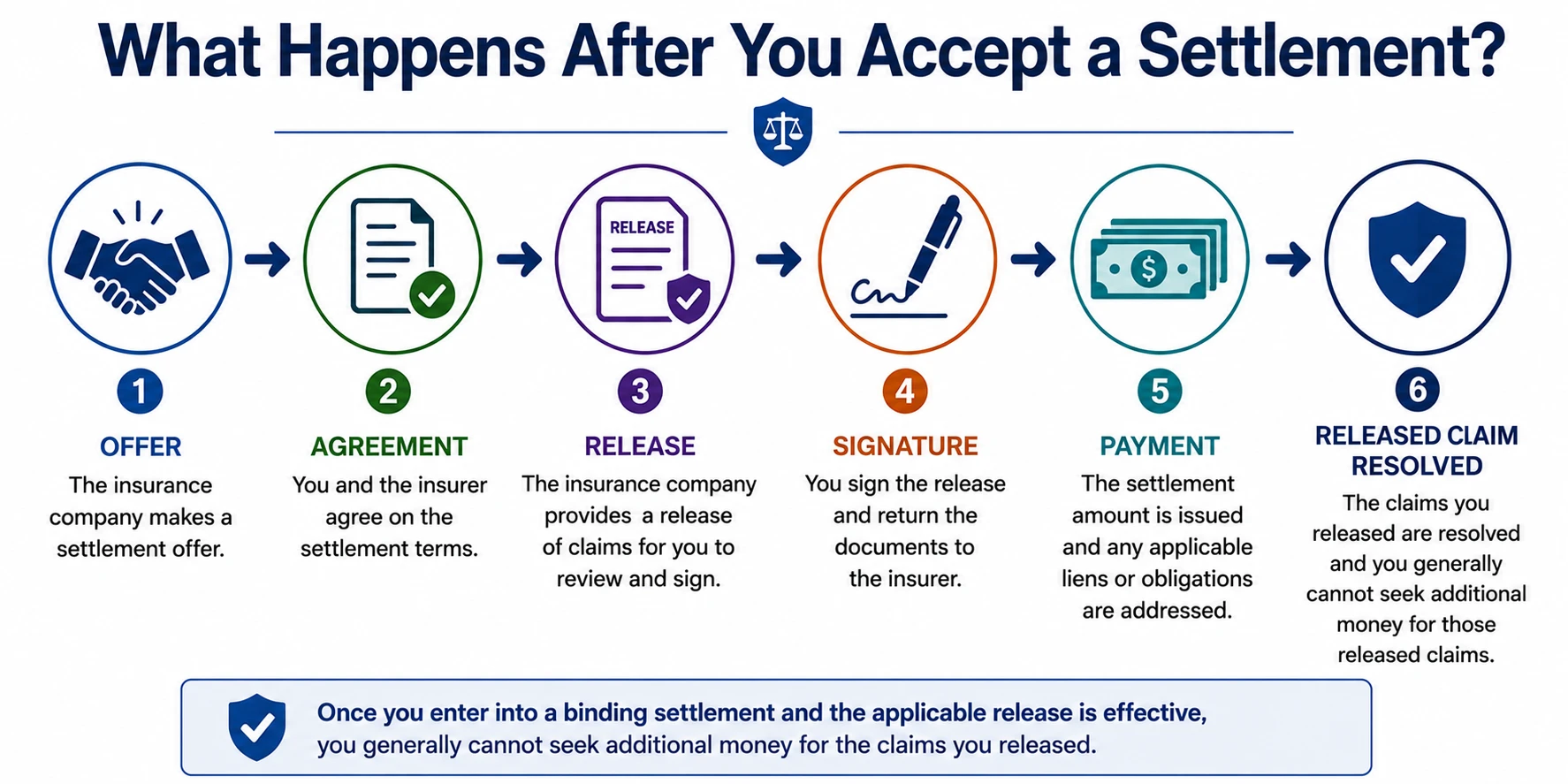
Once you enter into a binding settlement and the applicable release is effective, you generally cannot seek additional money for the claims you released.
Can I Reopen, Cancel, or Sue After Signing a Settlement?
Possibly, but it can be difficult.
Once a valid settlement has been reached and a valid release applies to your injury claim, the insurance company will generally take the position that the matter is over.
The real questions are more specific.
- What did you agree to?
- What does the release cover?
- Was there an agreement on all of the material settlement terms?
- Were all required conditions satisfied?
- Did both sides intend to resolve the particular claim you now want to pursue?
- Is there a legally recognized reason the agreement or release could be challenged?
Those are questions that usually require us to look at the paperwork. Do not assume that you can cancel a settlement simply because you changed your mind. At the same time, do not automatically assume you have no options simply because your signature appears on a document. Get the documents reviewed.
What Mistakes Do People Make Before Signing a Settlement?
The most common problem is not that an injured person did something foolish. It is that they made an important decision without having all of the information.
They may not yet understand the extent of the injury, know whether additional treatment will be needed, or have considered future lost income or permanent limitations. They may assume the adjuster’s offer represents the full value of the claim, or sign a release without realizing how broad it is. Financial pressure makes all of this harder.
Common mistakes include:
- Signing before understanding the full extent of the injuries
- Failing to consider future medical treatment
- Assuming the insurer's offer represents the full value of the claim
- Signing a release without understanding which claims or parties it covers
- Failing to account for medical bills, liens, lost income, or future damages
- Accepting an offer because of immediate financial pressure
- Failing to keep a copy of the settlement agreement and release
Once a settlement is finalized, correcting these mistakes may be extremely difficult. Reviewing the terms before signing is considerably easier than trying to challenge the agreement afterward.
What Should I Do if I Already Signed and Now I Am Worried?
First, do not throw anything away. Keep the settlement agreement, release, settlement check, check stub, letters, emails, text messages, medical records, and any other communication concerning the settlement. Do not rely on your memory of what the adjuster told you.
Second, write down what happened while it is still fresh in your mind. Include when the offer was made, what you were told, when you signed, what documents you received, whether money was paid, and why you now believe there may be a problem.
Then have the matter reviewed promptly. Sometimes the answer will be that the settlement is binding and the released claim is over. Sometimes the documents raise additional questions. Either way, getting an answer is better than sitting at home wondering.
Can a Signed Settlement Ever Be Challenged?
Sometimes, but these cases are very fact-specific.
Settlement agreements are intended to bring disputes to an end. Courts generally do not set them aside simply because one side later regrets the decision. However, there are limited situations in which enforceability may need to be examined.
For example, a lawyer may need to investigate whether there was fraud or a material misrepresentation, whether there was a mutual mistake of material fact, whether the person had the legal capacity to enter the agreement, whether improper pressure affected the agreement, whether the parties ever reached agreement on the material settlement terms, or whether the release actually applies to the particular claim or party now in dispute.
The existence of one of those issues does not automatically mean the settlement will be set aside. It means the facts and documents deserve a closer look.
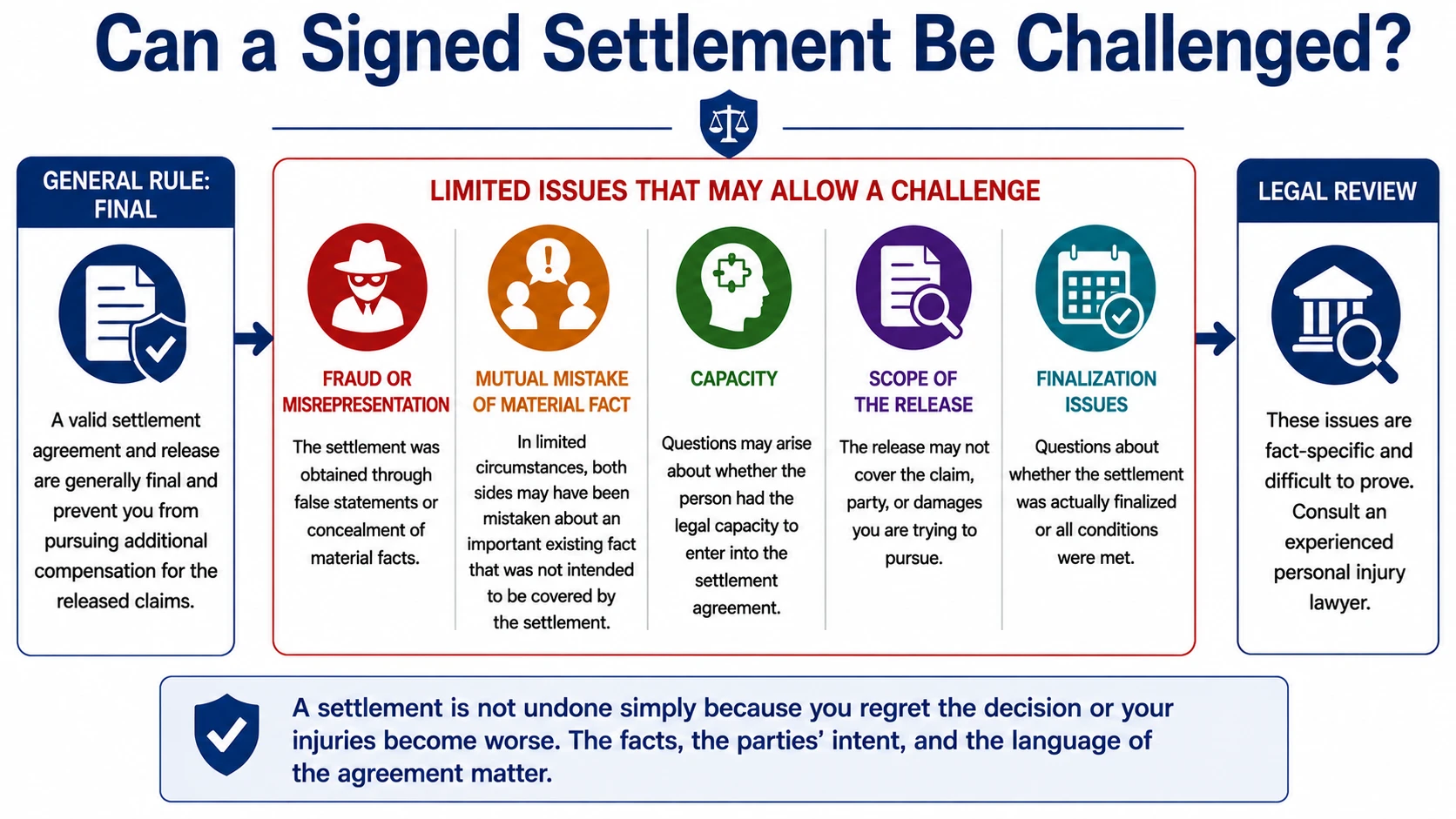
A settlement is not undone simply because you regret the decision or your injuries become worse. The facts, the parties’ intent, and the language of the agreement matter.
A Special Word About "Mistake" Under South Carolina Law
This point deserves more explanation because “I made a mistake by settling” and a legal mistake that could affect a release are not the same thing.
Suppose you knew you had a back injury when you settled, but you thought it would improve in a few months. A year later, you discover that it is more serious than expected. That does not automatically mean the settlement can be undone.
South Carolina courts have addressed situations involving an unknown injury that already existed when the settlement was reached. Whether that kind of issue can affect a release depends heavily on what the parties knew, what they intended to settle, and whether the release was intended to include unknown injuries. That is very different from simply deciding afterward that you should have asked for more money.
Is Signing a Settlement the Same as Finalizing It?
Not always.
Signing a release can be a very important part of a settlement, but the legal question may involve more than the signature itself. We may need to determine whether there was an agreement on the material terms, whether the release was delivered, whether additional signatures were required, whether other conditions remained, and what happened before and after you signed.
This is one reason we do not want someone calling our office to say, “I signed something, so I guess there is nothing anybody can do.” Maybe there is not. But we would rather look at the document before reaching that conclusion.
What if I Signed the Release but Did Not Cash the Settlement Check?
Do not assume that refusing to cash or deposit the settlement check automatically cancels the settlement.
Whether a settlement is binding can depend on much more than what happened to the check. South Carolina contract law looks at whether the parties reached a meeting of the minds concerning the essential and material terms of the agreement. That means the timing of the offer, acceptance, release, signatures, communications between the parties, and any remaining conditions may all matter.
If you signed paperwork and then immediately realized you may have made a mistake, preserve everything and speak with a lawyer before taking additional action.
Does a Settlement Release Every Possible Claim?
Not necessarily. A release only means what its language legally provides. Some releases are narrow. Others are written very broadly.
A settlement document may release claims against the at-fault driver, an employer, a business, an insurance company, additional insured parties, agents, employees, related companies, or other individuals and entities. It may address known injuries, and it may also contain language concerning unknown or future-discovered injuries arising from the accident.
That is why you should never assume a release is “just standard paperwork.” Read it. Understand who you are releasing. Understand which claims you are releasing. Understand what you are receiving in exchange. And keep a complete copy.
What Settlement Documents Should I Review Carefully?
Before you sign anything related to an insurance settlement, read the entire document. Pay particular attention to the following:
- Release of Claims: A release generally gives up your right to pursue certain claims arising from the accident. Pay close attention to exactly which claims and parties are included.
- Settlement Agreement: This document may establish the amount being paid, the claims being resolved, the obligations of each party, and other conditions of the settlement.
- Release of All Claims: Some releases contain broad language intended to resolve all claims arising from an accident, including claims involving injuries or damages that may not yet be fully known. The actual language of the release matters.
- Indemnification Provisions: Some settlement agreements contain provisions requiring you to address certain claims, liens, reimbursement obligations, or other expenses. These provisions should be understood before you agree to them.
- Confidentiality Provisions: When included, confidentiality language may restrict what you can disclose about the settlement, its terms, or the underlying dispute.
- Identification of Released Parties: Review who is actually being released. Depending on the language, a document may address the at-fault driver, an insurance company, other individuals or entities, or multiple parties.
- Identification of Released Claims: Determine whether the agreement resolves only specific claims or contains broader language affecting additional claims or damages arising from the accident.
Do not assume settlement paperwork is routine simply because it was provided by an insurance company. Read the entire agreement, keep a copy of everything you sign, and ask questions about language you do not understand.
Why Can Settling Too Early Be Risky?
After an accident, you may be under enormous financial pressure. You may have medical bills coming in, be missing work, have a damaged car, and have a family depending on you. Then the insurance company offers money, and it is easy to understand why that offer can look attractive.
The problem is that your body does not always operate on the insurance company’s timetable. It may take weeks or months before doctors understand the full extent of an injury. Some people eventually need surgery. Others develop permanent restrictions. Some cannot return to the work they were doing before the accident.
If you settle the injury claim before those issues are reasonably understood, you may give up the right to seek additional money for problems that become clear later. Once the settlement is final, the insurance company is not ordinarily going to volunteer to reopen the file because your medical condition got worse.
Why Do Insurance Companies Want Quick Settlements?
Sometimes an insurance company will make an offer before you fully understand your injuries and future needs.
Remember who the insurance adjuster works for. The adjuster may be polite and may sound concerned, but the insurance company does not represent you. Its representatives are protecting the company’s interests.
That does not mean every early offer is unfair. It does mean you should evaluate the offer based on your own medical condition, lost income, future needs, legal rights, available insurance coverage, and the evidence in your case. Do not let the existence of a check make the decision for you.
Are Quick Settlement Offers a Red Flag?
No. Sometimes an early settlement can make sense. The real issue is whether you have enough information to make an informed decision.
- Do you understand the diagnosis?
- Do your doctors know whether you will need additional treatment?
- Are you back at work?
- Do you have permanent restrictions?
- Could you need surgery?
- Have all of the available insurance policies been identified?
- Do you know what the release requires you to give up?
Those questions matter much more than how quickly the offer arrived.
What if My Injuries Turn Out to Be Worse Than I Thought?
This is where injured people can get hurt twice. You may settle believing your injury will heal, then the pain does not go away. You may later learn that you need surgery, injections, additional therapy, another specialist, or long-term medical care. You may discover that you cannot return to the same job or do the things you could do before the accident.
Unfortunately, learning that your injuries are more serious than you expected does not automatically allow you to reopen a valid settlement. That is one reason settling too early can be dangerous.
South Carolina law also makes an important distinction when it comes to previously unknown injuries. In limited circumstances, a mutual mistake involving an existing injury that was unknown and was not within the contemplation of the parties may require legal analysis. But if the settlement and release were intended to include unknown or unanticipated injuries, a later diagnosis does not necessarily undo the agreement. The exact wording of the release and what the parties intended matter.
Why Can Trial Experience Matter When Evaluating a Settlement?
A settlement offer cannot be evaluated in a vacuum. You have to look at liability, the medical evidence, lost income, future medical treatment, permanent impairment, available insurance coverage, non-economic damages, weaknesses in the evidence, and the risks involved if the case continues into litigation.
Not every injury case should go to trial. But you should understand what could happen if negotiations fail. For nearly 30 years, Gary Christmas has evaluated injury cases in the context of both settlement negotiations and courtroom litigation. That experience affects how we look at an offer, because a settlement decision should be based on the evidence and the realistic alternatives, not simply on the number an insurance company puts on the table.
What Should I Do Before Signing Any Insurance Settlement?
Here is the approach we would want a member of our own family to take.
- Understand your injuries
- Understand the treatment your doctors reasonably expect you to need
- Understand how the accident has affected your ability to work and live your life
- Read the complete settlement agreement and release
- Know who is being released and what claims you are giving up
And do not let immediate financial pressure rush you into a decision that may affect the rest of your life. If you are unsure, have an experienced South Carolina personal injury lawyer look at the paperwork before you sign it. It is much easier to ask questions before the settlement becomes final than to try to undo one afterward.
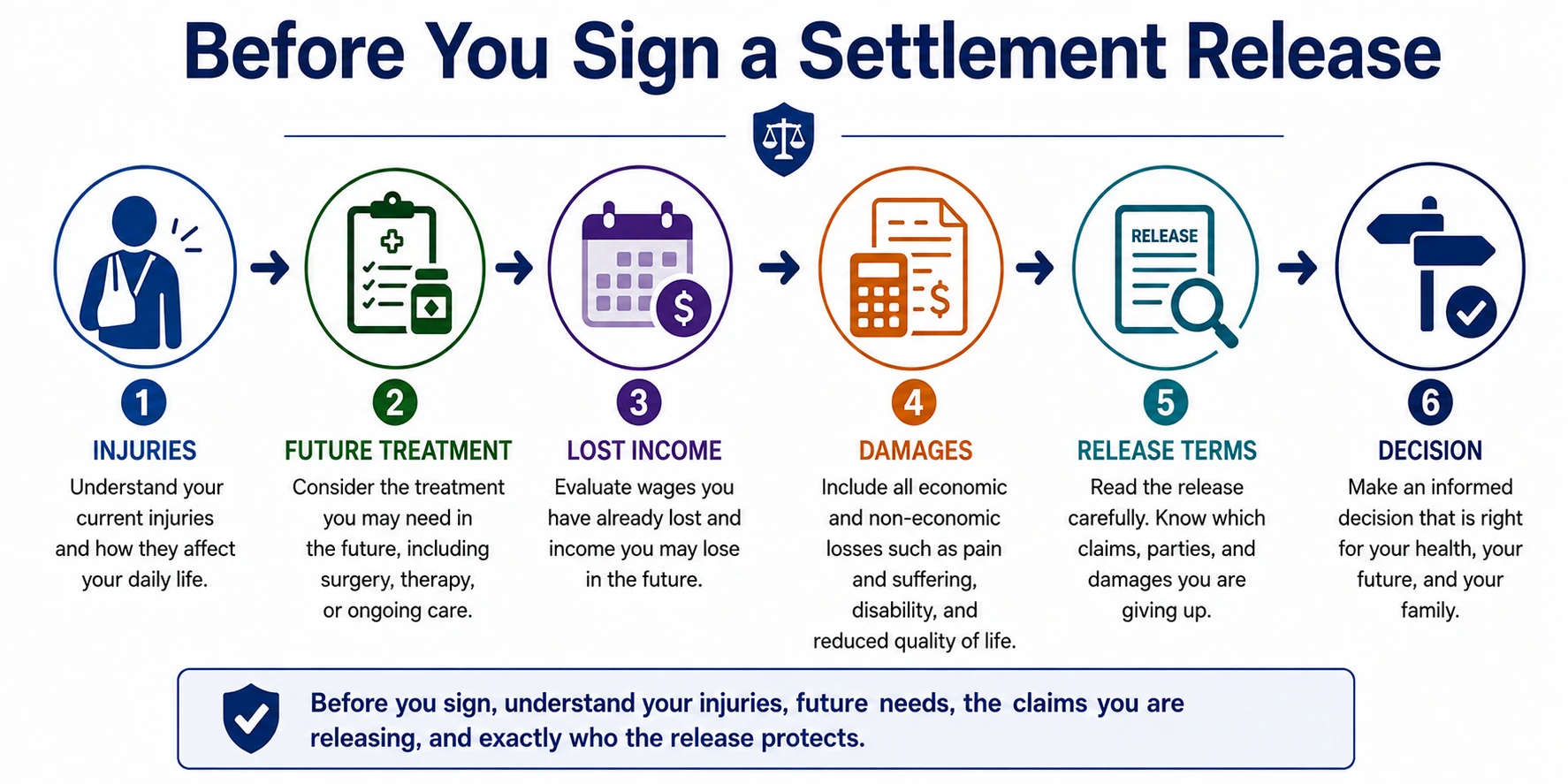
Before you sign, understand your injuries, future needs, the claims you are releasing, and exactly who the release protects.
In Summary
Signing a settlement agreement and release usually has serious consequences and may end your ability to seek additional compensation for the claims covered by the agreement. However, whether a settlement is final and enforceable depends on the language of the documents and the circumstances surrounding the agreement. Limited issues involving enforceability, finalization, or the scope of the release may require further legal analysis. If you have already signed settlement documents and have questions about your rights, preserve every document and have the agreement reviewed promptly.