


What Are the Three Most Important Parts of a Strong Car Accident Case?
We focus on three primary areas: liability, causation, and damages.
Liability refers to who caused the accident. A strong liability case is one where the evidence clearly shows that the other driver was responsible for causing the collision.
Damages refer to the losses suffered by the injured person. Those damages may include property damage, medical expenses, lost wages, pain and suffering, loss of enjoyment of life, permanent impairment, and other recognized losses.
The third component is causation. In simple terms, causation is the connection between the accident and the damages. You must be able to show that the accident caused the injuries and losses being claimed.
At our law firm, we evaluate the strength of an injury case by looking closely at liability, causation, and damages.
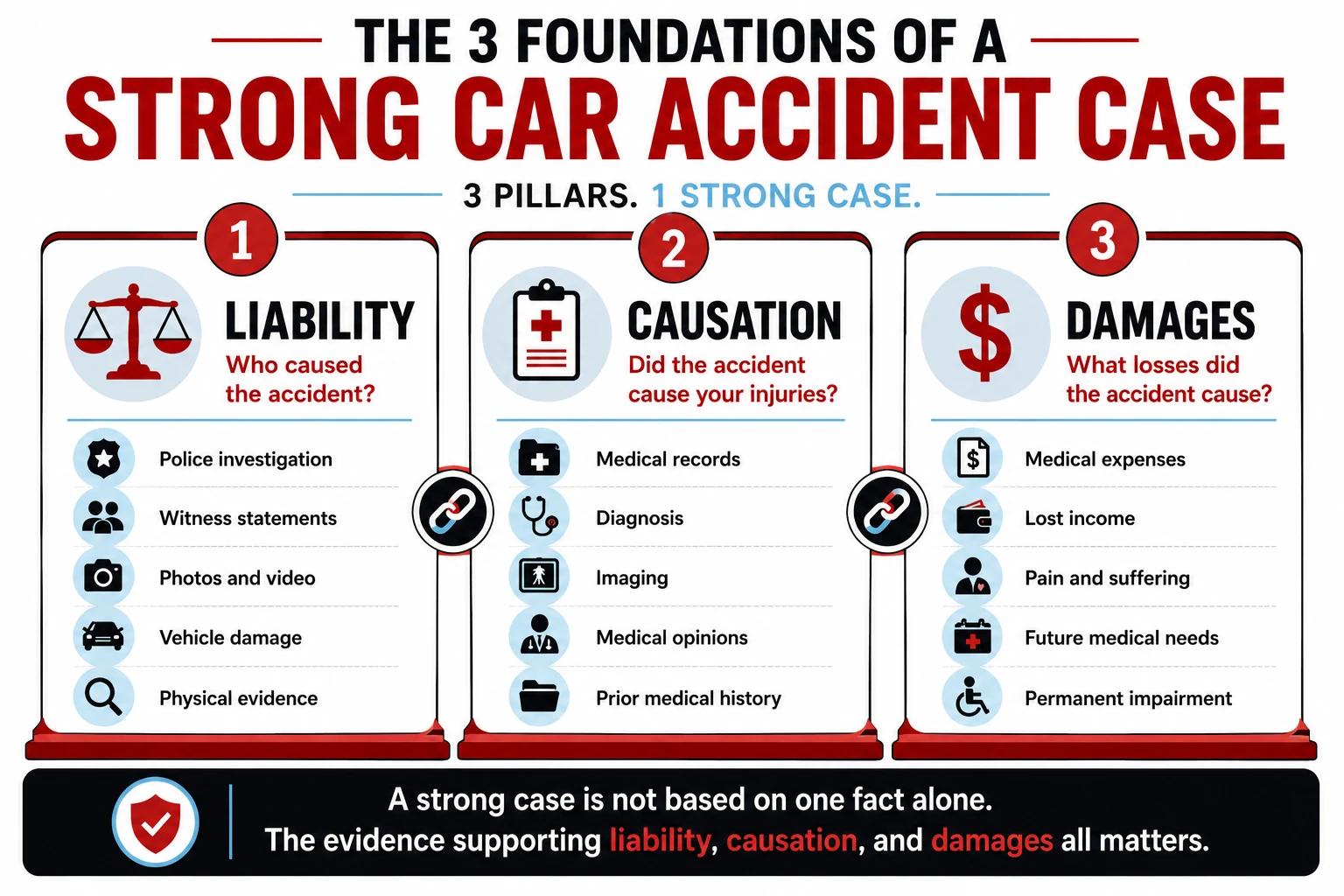
A strong case is not based on one fact alone. The evidence supporting liability, causation, and damages all matters.
What Mistakes Can Weaken a Strong Car Accident Case?
One of the biggest mistakes we see is giving the at-fault driver’s insurance company more information than necessary before understanding how that information may affect the claim.
If you are injured, be careful about giving the at-fault driver’s insurance company a recorded statement, discussing your injuries in detail, or signing authorizations before you understand what is being requested and why.
If you are injured, having a lawyer handle communications with the at-fault driver’s insurance company can provide an important buffer while you focus on your medical treatment and recovery.
The insurance company’s financial interests are not the same as yours. Anything you say can potentially be used against you later. Whether it is a recorded statement, a casual conversation, or an offhand comment, something you say may later be used to question liability, the severity of your injuries, or the value of your claim.
Can a Weak Car Accident Case Become Stronger?
We have seen many cases where a claim initially appeared weak because the injured person had not yet received the appropriate medical evaluation.
For example, someone may have been told they suffered only a sprain or strain, only to later discover through advanced imaging and specialist treatment that they had a torn ligament, herniated disc, or other serious injury. Once the nature and extent of the injury became clearer, the way the case was evaluated changed.
On the other hand, we have also seen cases where people believed they had a very strong claim, only to learn that there were significant liability issues, causation problems, or gaps in the evidence that weakened the case. This is one reason we strongly encourage every injured person to seek an experienced legal evaluation rather than relying on assumptions about the strength of their claim.
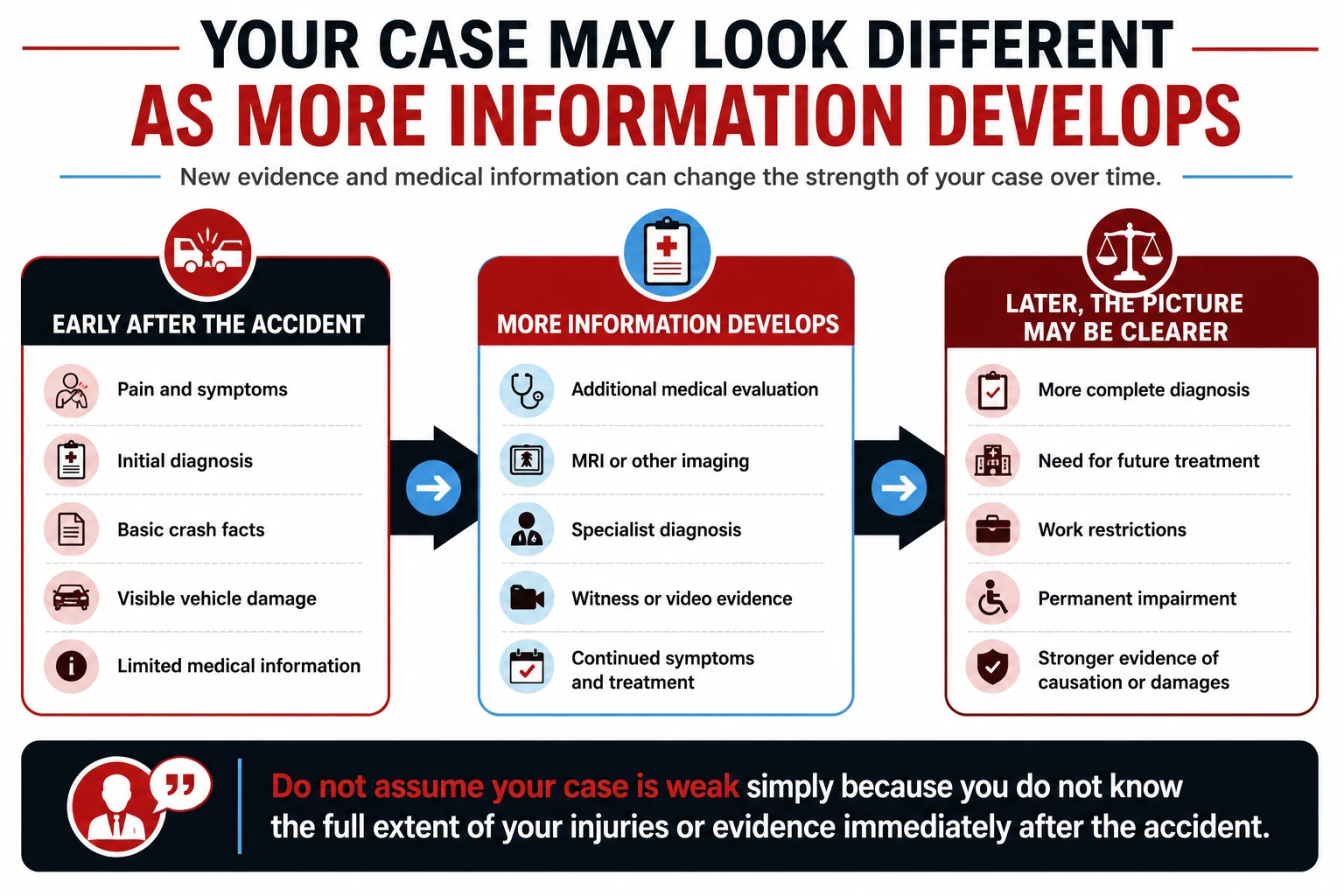
Do not assume your case is weak simply because you do not know the full extent of your injuries or evidence immediately after the accident.
Why Is Medical Treatment So Important?
Medical treatment is one of the most important components of a strong injury case.
First, you need an appropriate medical evaluation so your injuries can be properly diagnosed and an appropriate treatment plan can be developed. Second, it is important that your doctors are able to provide medical opinions connecting your injuries and treatment to the accident.
Finally, you must follow the treatment plan. Attend your appointments, follow your doctor’s recommendations, and complete the prescribed treatment. At the conclusion of your care, your doctors may be able to provide important opinions regarding permanent impairment, future medical treatment, work restrictions, and other issues that significantly affect case value.
Our firm strongly believes that one of the best ways to build a strong case is to seek medical treatment early and follow the treatment plan carefully.
Can Delays in Medical Treatment Hurt My Case?
Absolutely.
Failing to seek medical treatment, delaying treatment, or failing to follow medical recommendations can significantly hurt a case. Medical treatment serves two important purposes. First, it helps you recover physically. Second, it documents the nature and extent of your injuries.
It can be difficult to document an injury if you do not receive the medical evaluation and treatment needed to diagnose the condition and understand its effects. Simply telling the insurance company that your neck, back, shoulder, or knee hurts is rarely enough.
Insurance companies often view missed appointments, treatment gaps, and noncompliance with medical recommendations as evidence that the injuries are not serious. Whether that interpretation is fair or not, it is a reality of how claims are often evaluated.
A treatment gap does not automatically mean you were not hurt. There may be a legitimate reason treatment was interrupted. What matters is understanding the reason and documenting what actually happened.
How Does Fault Affect a South Carolina Car Accident Case?
Fault is extremely important in South Carolina car accident cases.
South Carolina follows a modified comparative negligence system. That means more than one person can share responsibility for causing an accident.
If you are found partly at fault, you may still be able to recover damages as long as your share of the fault is not greater than the other side’s. However, your recovery is reduced according to your percentage of fault.
For example, if your damages are determined to be $300,000 and you are found 30% at fault, your recovery would be reduced by 30%, or $90,000.
If you are found to be more than 50% at fault, South Carolina’s comparative negligence rule generally prevents you from recovering damages from the other party.
Fault percentages are not always obvious immediately after a crash. Witness testimony, photographs, video, vehicle damage, roadway evidence, and other information can all affect how responsibility is evaluated.
That is why we believe it is important to investigate liability thoroughly and preserve available evidence as early as possible.
What Evidence Makes the Biggest Difference?
Virtually any piece of evidence can become the key piece of evidence in a case.
It may be eyewitness testimony, dashcam footage, surveillance video from a nearby home or business, photographs of the accident scene, black box data, vehicle damage, physical evidence from the roadway, or testimony from the parties involved.
The reality is that you never know which piece of evidence will ultimately make the difference.
That is why our law firm strongly believes in gathering and preserving all available evidence immediately and preparing every case as though it will ultimately be presented to a jury.
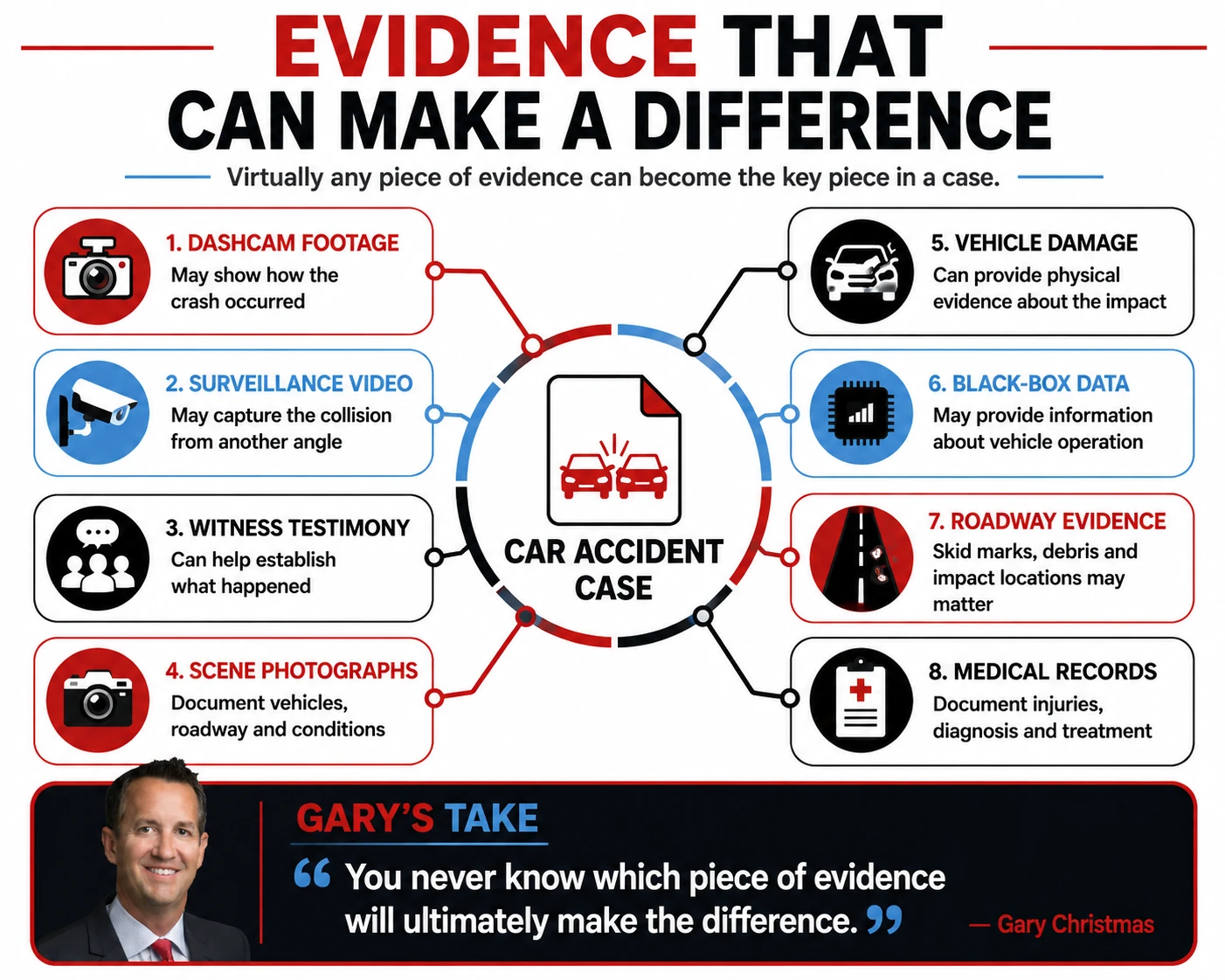
You never know which piece of evidence will ultimately make the difference.
What Do Insurance Companies Look for to Deny or Reduce a Claim?
Insurance companies evaluate accident claims carefully for issues that may reduce or defeat liability. Over nearly 30 years of practice, we have seen insurers raise questions about fault, the severity of injuries, medical treatment, prior medical conditions, causation, and the amount of claimed damages.
That is why we look for those issues early. If there is a weakness in the case, we want to understand it. If there is evidence that answers an insurance company’s argument, we want to identify and preserve it.
Insurance companies may begin evaluating potential defenses from the beginning of a claim. We believe injured people should have someone looking just as carefully at the evidence, medical issues, and potential problems while protecting their interests from the beginning.
Can I Still Have a Strong Case If My Injuries Seem Minor at First?
Absolutely. Over the last 30 years, we have seen many cases where an injury initially appeared minor but later turned out to be much more serious. What may first be diagnosed as a sprain, strain, bruise, or soft tissue injury can sometimes be revealed through additional testing and specialist evaluations to be a herniated disc, torn ligament, torn rotator cuff, fracture, or another significant condition. That is why we always encourage injured people to seek medical treatment early and make sure they receive the proper medical evaluation.
In our experience, the true strength of a case is often not known immediately after an accident. It takes time for doctors to diagnose the injury, develop a treatment plan, and determine whether there will be permanent impairment, future medical treatment, or work restrictions. Simply put, do not assume your case is weak just because your injuries seem minor in the beginning. One of the biggest mistakes people make is settling too early before they fully understand the nature and extent of their injuries.
Why Should Every Injury Case Be Prepared for Trial?
One of the strongest beliefs we hold is that every case should be prepared from day one as though it is going to trial.
That does not mean every case should be tried. In fact, most cases are resolved without a trial. However, we firmly believe that the best way to position a case for success is to prepare it as though a jury will ultimately decide it.
In our experience, thorough preparation can put a case in a stronger position for settlement and, when necessary, trial. The irony is that the best way to avoid trial is often to be fully prepared for trial.
What Makes Your Firm's Approach Different?
At our law firm, everything begins with one guiding principle: prepare every case for trial from day one.
That philosophy influences every decision we make. We gather evidence early. We investigate thoroughly. We identify witnesses. We analyze medical issues. We evaluate damages. We prepare the case as though it may one day be presented before a judge and jury.
While many cases never see the inside of a courtroom, our experience has taught us that thorough preparation puts us in a stronger position to evaluate, negotiate, and, when necessary, try the case.
We believe preparing a case for trial from the beginning puts us in a stronger position to pursue a fair result and to litigate the case when necessary.
Should I Have My Car Accident Case Evaluated?
- Another driver may have caused the crash
- You were physically injured
- You needed medical treatment
- You missed work or lost income
- An insurance adjuster has contacted you
- Witnesses or video may exist
- Your injuries are still being evaluated
- You are unsure who was at fault
- You do not know what your claim may involve
You do not need to check every box to have a case worth evaluating.
In Summary
A strong South Carolina car accident case generally depends on three core elements: liability, causation, and damages. You need evidence showing who caused the accident, a connection between the accident and the injuries being claimed, and proof of the financial and personal losses that resulted.
The strength of a case is not always clear immediately after an accident. Medical diagnoses can change, additional evidence may be discovered, and questions involving fault or causation may become clearer as the case develops. Consistent medical treatment, preserved evidence, credible testimony, and careful preparation can all affect how a claim is evaluated.
Every case has its own strengths and weaknesses. That is why you should not assume your case is strong, or weak, based only on what you know in the first days or weeks after an accident.