


What Can Affect an Older Accident Claim?
For a typical South Carolina car accident personal injury claim, the lawsuit filing period is generally three years. Different rules can apply when a South Carolina governmental entity is involved. Claims under the South Carolina Tort Claims Act can involve different filing periods and procedures, so you should not assume the ordinary three-year car-accident rule answers the question.
| Issue | Why It Matters |
|---|---|
| Applicable filing deadline | Determines whether a lawsuit may still be timely |
| Identity of the responsible parties | Different defendants can involve different rules |
| Available evidence | Photos, video, witnesses, records, and physical evidence may become harder to obtain over time |
| Medical history and treatment | Delays may create disputes about injury and causation |
| Prior statements | Earlier statements may become important if liability or injuries are disputed |
| Insurance coverage | Available policies and notice requirements may need to be identified |
| Prior settlement or release | A resolved claim may present a different issue than an unfiled claim |
| Current procedural status | An open insurance claim is not the same thing as a filed lawsuit |
What Factors Can Make an Older Accident Claim Still Viable?
The fact that time has passed does not automatically determine whether a case is still viable.
When someone contacts us months or years after an accident, some of the first questions are whether the applicable deadlines are still open, whether the responsible parties can be identified, what evidence still exists, what the medical records show, whether insurance coverage can still be identified, and what the person may already have said or done while handling the claim.
A delayed case may still have a viable path forward when the legal deadline has not expired and the available evidence can still establish liability, causation, injuries, and damages.
The longer someone waits, however, the greater the possibility that witnesses become difficult to locate, video is overwritten, physical evidence disappears, memories fade, or other issues become harder to investigate.
Does an Open Insurance Claim Mean I Still Have Time to File a Lawsuit?
No. An open insurance claim does not, by itself, mean the deadline for filing a lawsuit has stopped or been extended.
You may still be exchanging medical records, communicating with an adjuster, or discussing settlement while the statute-of-limitations period continues to run.
An insurance claim and a lawsuit are different things. If you are dealing with an older accident, one of the first questions should be whether the applicable lawsuit deadline is still open, not simply whether the insurance company is still communicating with you.
Can I Still Have a Case Months or Years After an Accident?
Possibly. We have had people contact us months, and sometimes years, after an accident when there were still legal issues and potential claims that needed to be evaluated.
Some older claims may still be legally viable. Others may have problems that cannot be overcome because a filing deadline expired, the claim was previously resolved, or critical evidence is no longer available. The important point is that the age of the accident, by itself, does not answer the question.
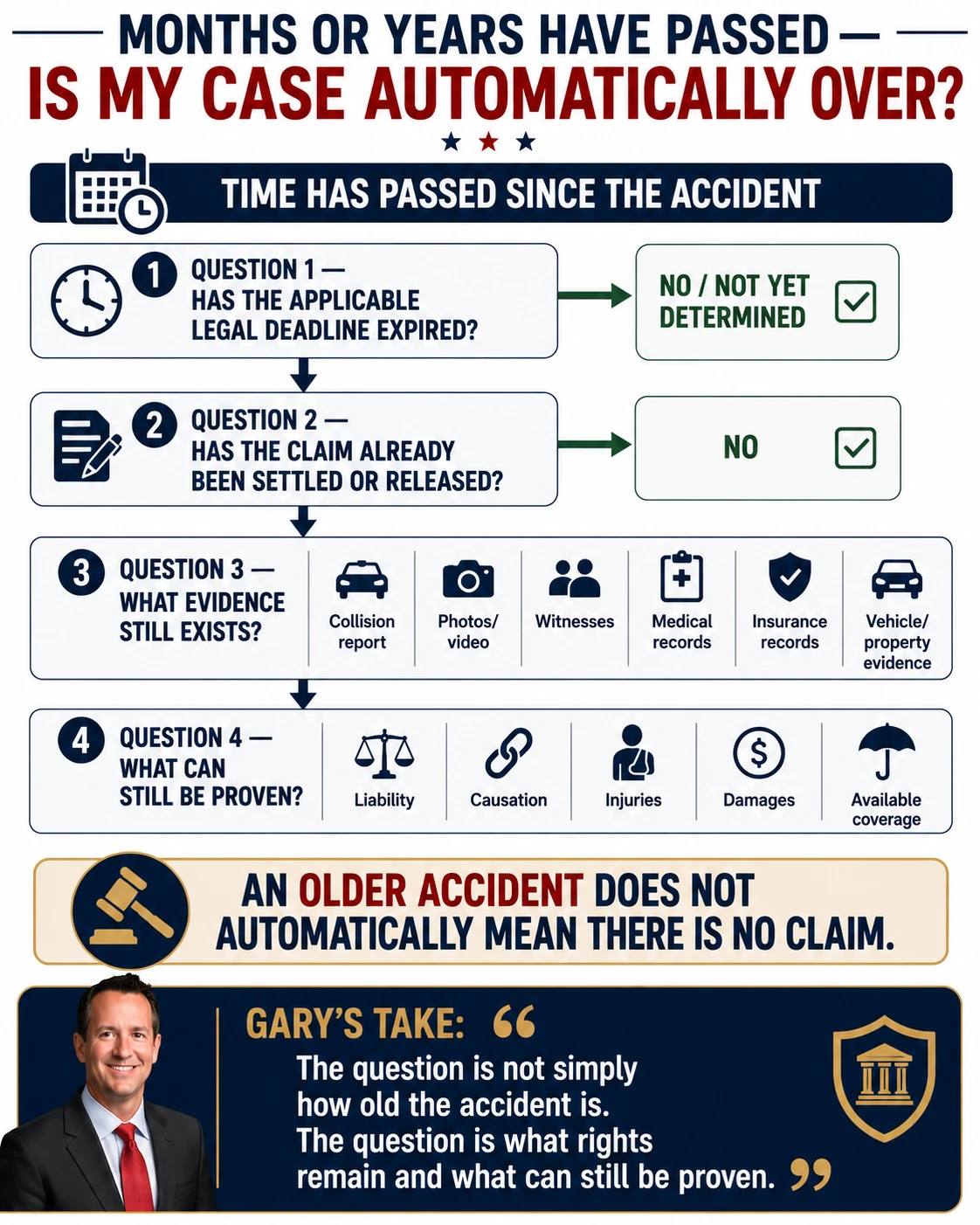
An older accident does not automatically mean there is no claim. The question is not simply how old the accident is. The question is what rights remain and what can still be proven.
Why Do People Wait Too Long to Hire a Lawyer?
The most common reason is that people believe they can handle the case themselves.
Some rely on information they find online. Others trust what the insurance company tells them.
The problem is simple: you do not know what you do not know.
General information online can help you understand the basics, but it cannot tell you which deadline applies to your particular accident, whether a government entity is involved, whether an exception may apply, what evidence has been preserved, or what effect prior statements or actions may have on the claim.
Any advice you receive is only as good as the information provided. Accident cases often involve complex medical issues, insurance issues, evidentiary issues, and legal issues that are not immediately obvious.
I tell people the same thing whether the accident happened last week or last year: do not spend more time worrying about whether you waited too long. Find out what deadlines still apply and what evidence can still be preserved.
How Do You Evaluate Whether an Older Accident Claim May Still Be Viable?
The first question is whether the applicable legal deadlines have expired. If the claim is still timely, the next step is determining what can still be proven.
We would typically look at:
- When the accident occurred
- Who may be legally responsible
- Whether a governmental entity is involved
- Whether a lawsuit has already been filed
- Whether the claim was previously settled or released
- What insurance coverage may be available
- What medical treatment and diagnoses are documented
- Whether photographs, video, witnesses, crash reports, or other evidence still exist
- What statements have already been made
- Whether any other legal or policy-based deadlines may apply
The question is not simply, “How old is the accident?” The question is, “What rights are still available, and what can still be proven?”
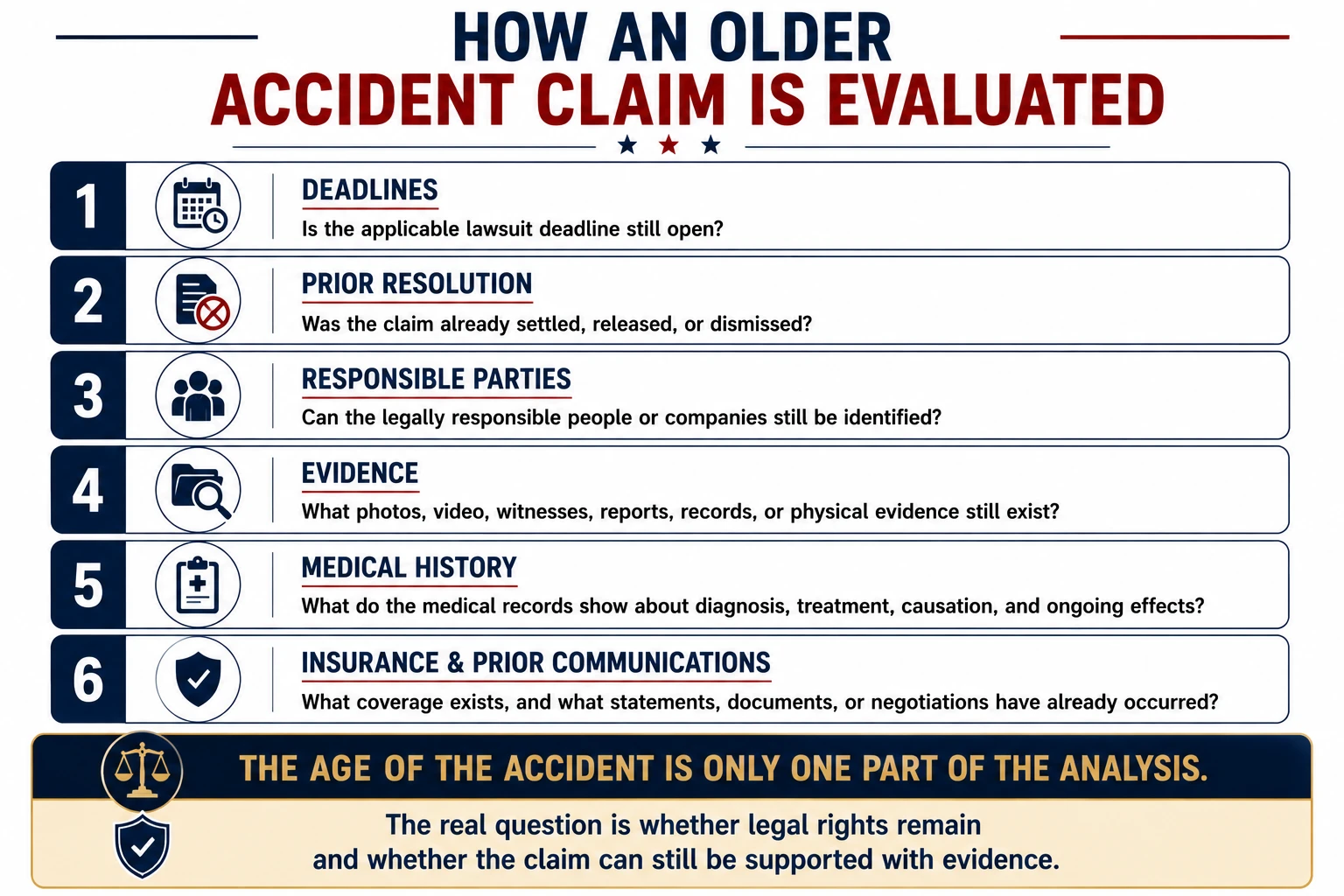
The age of the accident is only one part of the analysis. The real question is whether legal rights remain and whether the claim can still be supported with evidence.
How Can Delay Affect an Insurance Claim?
Delay can create questions that may need to be explained with evidence.
For example, a significant gap between the accident and medical treatment may lead to a dispute about whether the accident caused the condition being claimed. A delay in reporting the accident may create questions about how the collision occurred. And as time passes, witnesses, photographs, video, vehicle evidence, and other information may become more difficult to locate.
None of those issues automatically means a claim is lost. But they can make liability, causation, injuries, or damages more difficult to prove.
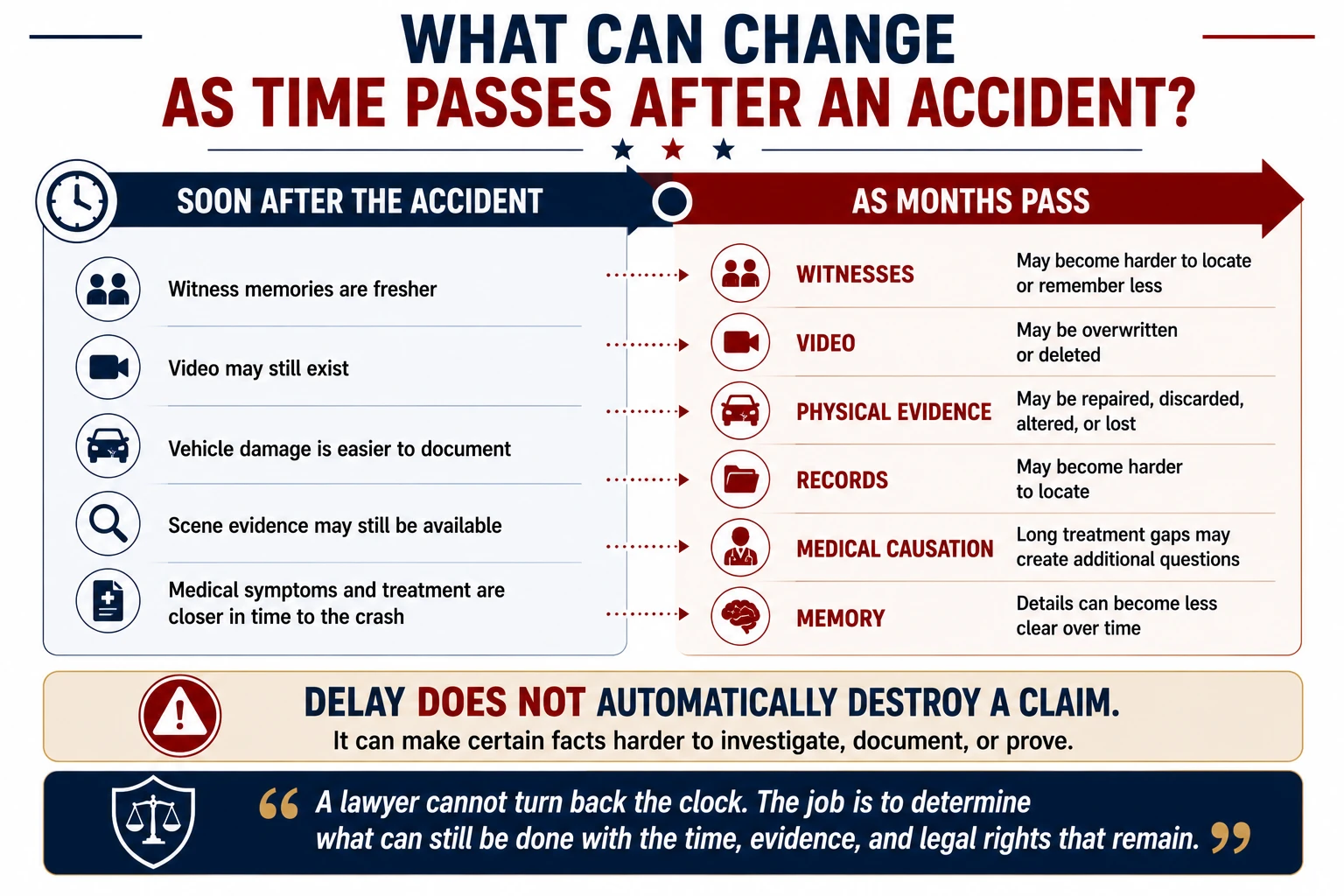
Delay does not automatically destroy a claim. It can make certain facts harder to investigate, document, or prove.
Can Problems in an Older Claim Sometimes Be Addressed?
The insurance company is evaluating the claim from its own perspective. It is not responsible for identifying every legal issue, preserving evidence for you, or making sure you file a lawsuit before the applicable deadline expires.
Some problems can be addressed through additional investigation, medical documentation, witness evidence, insurance research, or a more complete understanding of what happened earlier in the claim. Other problems, particularly an expired filing deadline or evidence that no longer exists, may not be fixable.
A lawyer cannot turn back the clock. The job is to determine what can still be done with the time, evidence, and legal rights that remain.
Can I Still Hire a Lawyer If I Already Talked to the Insurance Company?
Absolutely. We regularly speak with people who have already talked to the insurance company before contacting our law firm. In many cases, they have provided statements, answered questions, exchanged emails, or attempted to negotiate the claim on their own. While those actions can sometimes create challenges, it does not automatically mean the case is lost or that you can no longer benefit from hiring an experienced personal injury lawyer.
The real question is whether anything that was said, signed, or provided may affect the claim. Sometimes we can overcome those issues, and sometimes the damage is more difficult to repair.
The important thing is to determine what was said, what documents were provided, whether any agreements were made, and how those earlier communications may affect the claim moving forward.
Do not assume you ruined your case simply because you already spoke with an insurance company.
What Should I Do If I Think It Is Too Late?
Do not assume the answer either way. Start by identifying the accident date, the people or entities involved, whether a lawsuit has been filed, whether you signed a settlement or release, what insurance claims remain open, and what records or evidence you still have.
Then determine which legal deadlines apply.
If a deadline is approaching, time matters. If a deadline has already passed, the facts still need to be evaluated before assuming there is no possible legal issue left to consider.
The worst approach is to lose additional time because you are afraid you may have already waited too long.
What If the Three-Year Deadline Has Already Passed?
Do not assume that the three-year rule automatically answers every case.
South Carolina law contains different limitation periods and rules depending on the type of claim, the defendant, and particular circumstances. For example, claims involving governmental entities can follow different rules, and South Carolina law recognizes certain disability and accrual provisions that can affect how a limitations period is calculated.
At the same time, you should never assume that an exception gives you more time. South Carolina’s discovery rule focuses on when a person knew or, through reasonable diligence, should have known that a cause of action existed. The fact that you later learned the full extent of an injury does not necessarily restart the limitations period.
The practical question is whether the particular claim is still legally viable under the rules that apply to it.
How Does Christmas Injury Lawyers Evaluate Delayed Cases?
An older case needs a focused investigation of what still exists and what deadlines still matter.
We start by determining the applicable deadlines and procedural status of the claim. From there, we look at liability evidence, medical records, prior statements, insurance coverage, witnesses, photographs, video, and other information that may still be available.
We prepare cases with litigation in mind, so we also ask an important question early: if this claim ultimately had to be proven in court, what evidence would still be available to prove it?
That approach helps identify both the strengths of an older claim and the problems that may need to be addressed.
What to Gather If Your Accident Happened Months or Years Ago
- Write down the exact accident date
- Identify everyone who may have been involved or responsible
- Gather the crash report and any photographs or video you still have
- Locate witness names and contact information
- Gather medical records and bills related to the accident
- Collect insurance letters, emails, claim numbers, and settlement communications
- Determine whether you signed any settlement agreement or release
- Write down what statements you remember giving to any insurance company
- Preserve damaged-property photographs, repair records, and other physical evidence
- Identify whether a governmental vehicle, employee, or entity may have been involved
- Find out whether a lawsuit has ever been filed
- Determine which legal and policy deadlines may still apply
In Summary
An older South Carolina car accident does not automatically mean the claim is over. The first questions are whether the applicable legal deadlines are still open, whether the claim has already been settled or released, what evidence and medical documentation still exist, and whether the responsible parties and available insurance coverage can still be identified. For many South Carolina car accident personal injury claims, the general filing period is three years, but different rules can apply depending on the type of claim, the parties involved, and other circumstances.
Time can still make a case harder even before a legal deadline expires. Witnesses can become difficult to locate, video may be overwritten, memories can fade, and delays in treatment or reporting can create issues that need to be explained. The practical lesson is simple: do not assume you waited too long just because months or years have passed. Determine which deadlines apply, what rights remain, and what can still be proven.