

What Are My Options If the Other Driver Has No Insurance?
When an at-fault driver is uninsured, do not stop the investigation at that driver’s missing insurance card. Several questions may need to be explored.
| Potential Issue | What May Need to Be Investigated |
|---|---|
| Uninsured Motorist (UM) Coverage | Whether applicable UM coverage is available under an automobile policy |
| Hit-and-Run Accident | Whether UM coverage may apply and whether applicable hit-and-run requirements can be satisfied |
| Other Applicable Policies | Whether another policy may provide relevant coverage based on the people, vehicles, and circumstances involved |
| More Than One Responsible Party | Whether another driver, vehicle owner, business, or other party may share legal responsibility |
| Commercial or Work-Related Accident | Whether business or commercial insurance issues need to be investigated |
| At-Fault Driver's Assets | Whether pursuing the uninsured driver's personal assets is legally and practically appropriate in the particular case |
Finding a potential policy or defendant is only the first step. The next question is whether that coverage or source of recovery actually applies to the accident and the damages being claimed.
What Is the Difference Between Uninsured and Underinsured Motorist Coverage?
Uninsured motorist coverage and underinsured motorist coverage address different insurance problems.
Uninsured motorist (UM) coverage may become relevant when the responsible driver does not have applicable liability insurance or in certain situations involving an unidentified hit-and-run driver.
Underinsured motorist (UIM) coverage addresses a different situation: the responsible driver has liability insurance, but the available liability coverage may not be enough to compensate the injured person for the damages supported by the claim.
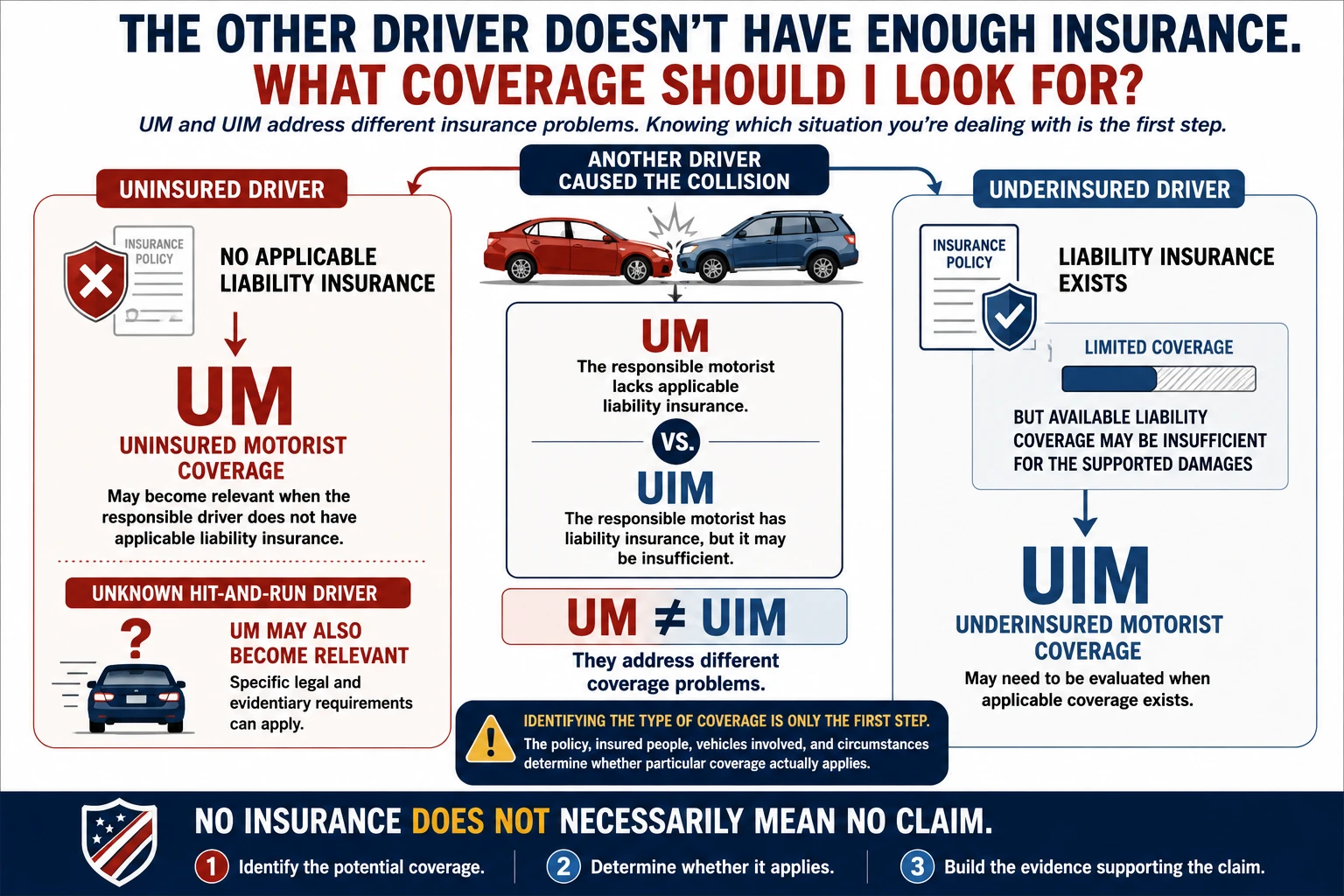
UM and UIM address different insurance problems. Knowing which situation you’re dealing with is the first step.
That distinction matters because the existence, amount, and application of UM and UIM coverage are not necessarily the same.
For example:
No applicable liability insurance on the at-fault vehicle → UM may need to be evaluated.
At-fault driver has liability insurance, but it may be insufficient for the supported damages → UIM may need to be evaluated if applicable coverage exists.
The policies, coverage elections, vehicles involved, and circumstances of the accident can affect the analysis.
Do not assume that UM and UIM are interchangeable. Identifying which coverage may apply is an important early step in evaluating an accident involving inadequate insurance.
Whose Uninsured Motorist Coverage Might Apply After an Accident?
The answer depends on the people involved, the vehicle involved, the applicable insurance policies, and the policy terms.
In many cases, an injured person begins by looking at UM coverage connected with an automobile policy that may apply to them or the vehicle involved in the accident.
But the coverage investigation should not automatically stop with the first policy identified.
Depending on the circumstances, questions may include:
- Which vehicle was the injured person occupying?
- Who owned that vehicle?
- Which automobile policies may apply?
- Is the injured person an insured under another potentially relevant policy?
- Was the injured person a passenger rather than the driver?
- Was a work, commercial, or rideshare vehicle involved?
- Are there multiple potentially applicable policies?
- What do those policies actually provide?
The fact that a policy exists does not automatically mean its UM coverage applies to a particular person, accident, or loss. Coverage must be evaluated under the policy and the circumstances.
Can I Make an Uninsured Motorist Claim After a Hit-and-Run Accident?
Potentially. Uninsured motorist coverage can become important when a driver causes an accident and leaves the scene, including some situations where the driver is never identified.
But an unidentified-driver claim should not be treated as automatic.
South Carolina law can impose specific requirements on claims involving an unknown driver, and the requirements can depend on how the accident occurred and what evidence exists.
That makes immediate documentation especially important.
If you are physically able to do so safely:
- Call law enforcement and report the collision
- Record whatever you remember about the fleeing vehicle
- Preserve the license plate or partial plate if you saw it
- Note the make, model, color, direction of travel, and distinguishing features
- Identify witnesses and obtain their contact information
- Photograph the scene, vehicle damage, roadway, and any physical evidence
- Identify nearby businesses, homes, traffic cameras, or vehicles that may have recorded the incident
- Preserve dash-cam or other available video
- Notify the appropriate insurance company promptly
Do not assume that the inability to identify the driver automatically eliminates the claim, but do not assume UM coverage automatically applies, either.
The evidence and applicable legal requirements matter.
How Does Uninsured Motorist Coverage Work in South Carolina?
When applicable UM coverage exists, the claim is made under an insurance policy that provides protection for losses caused by an uninsured motorist.
That can feel strange to injured people because the claim may involve their own insurance company, or another policy under which they qualify for coverage, even though someone else caused the accident.
But UM coverage exists for precisely this type of risk.
A UM claim still requires evidence.
Depending on the case, issues may include:
- Whether the other driver was legally responsible
- Whether the other vehicle was uninsured
- Whether the injured person qualifies for coverage
- Whether the particular UM policy applies
- Whether the accident caused the injuries being claimed
- The nature and extent of the injuries
- Medical treatment and future medical needs
- Lost income or reduced earning ability
- Other supported damages
- Applicable coverage limits
Using UM coverage does not mean fault no longer matters. It changes the potential source of insurance coverage, not the need to prove the underlying claim.
Will My Insurance Rates Go Up If I Make an Uninsured Motorist Claim?
There is no universal answer that applies to every driver, insurer, policy, and accident.
A person’s future premium can be affected by multiple underwriting and rating factors. The fact that you were not responsible for an accident is important, but it would be too broad to promise that making a UM claim can never affect what you pay for insurance.
If this is a concern, ask the insurer or insurance professional how the claim may be treated and review the applicable policy information.
From the injury-claim perspective, the more immediate question is whether valid UM coverage applies and what benefits may be available under the policy.
Do not give up potentially important coverage based solely on an assumption about what might happen to your premium. Get accurate information about both the claim and the policy before making that decision.
Can My Insurance Company Dispute an Uninsured Motorist Claim?
Yes. The existence of UM coverage does not mean every claim under that coverage will automatically be accepted or paid in the amount requested.
Depending on the circumstances, an insurer may investigate or dispute:
- Whether the other driver was uninsured
- Whether the unidentified-driver requirements are satisfied in a hit-and-run case
- Whether the person making the claim qualifies for coverage
- Whether the policy applies to the accident
- Who caused the collision
- Whether responsibility is shared
- Whether the collision caused the claimed injuries
- The nature and extent of those injuries
- The amount of damages supported by the evidence
- The applicable policy limits or other coverage issues
That does not mean the insurance company’s position automatically determines the outcome.
A UM claim is still an evidence-based injury claim. The coverage question and the underlying liability-and-damages questions all need to be evaluated.
What Should I Do If I Learn the Other Driver Has No Insurance?
Finding out the other driver is uninsured can be alarming, but your next steps should focus on preserving the accident evidence and identifying other potentially applicable coverage.
If possible:
- Call law enforcement. A collision report can help document the drivers, vehicles, and available insurance information.
- Preserve the other driver's information. Record the driver's name, address, license information, vehicle information, and license plate when available.
- Photograph the accident scene and vehicles. Include damage, vehicle positions, traffic controls, roadway conditions, and the surrounding scene.
- Identify witnesses. Preserve names and contact information.
- Preserve video. Save dash-cam footage and identify nearby surveillance cameras as quickly as possible.
- Seek appropriate medical evaluation. Accurately report your symptoms and follow appropriate medical recommendations.
- Notify the appropriate insurer. UM claims can involve policy requirements and notice issues.
- Locate your automobile insurance documents. Preserve the policy, declarations page, endorsements, and related coverage information if available.
- Do not assume the first policy you find is the only potentially relevant policy. Other coverage may need to be investigated depending on the people, vehicles, and circumstances involved.
- Keep records of your losses. Preserve medical bills, lost-income information, receipts, and other accident-related documentation.
The absence of liability insurance on the other driver’s vehicle changes the coverage investigation. It does not eliminate the need to prove what happened and what damages the accident caused.
Does the Other Driver Having No Insurance Mean I Have to Pay My Own Medical Bills?
Not necessarily, but an uninsured driver can make the payment and reimbursement issues more complicated.
Medical bills after an accident and the ultimate injury claim are related, but they are not always handled through the same payment mechanism.
Depending on the circumstances, medical expenses may involve health insurance, applicable automobile coverage, UM benefits as part of the injury claim, or other potential sources.
The important thing is not to assume: “The other driver has no insurance, so nobody can ever be responsible for these bills.”
At the same time, UM coverage does not necessarily mean every medical bill is immediately paid as it arrives.
Keep the bills, explanations of benefits, medical records, and payment information organized. Determining who pays a bill initially and determining who may ultimately be legally responsible for accident-related damages can be different questions.
What If My Uninsured Motorist Coverage Is Not Enough?
UM coverage can provide an important source of recovery, but the amount of available coverage may not always equal the full amount of damages supported by a serious injury claim.
If the injuries are substantial, the coverage investigation may need to look beyond a single policy or coverage limit.
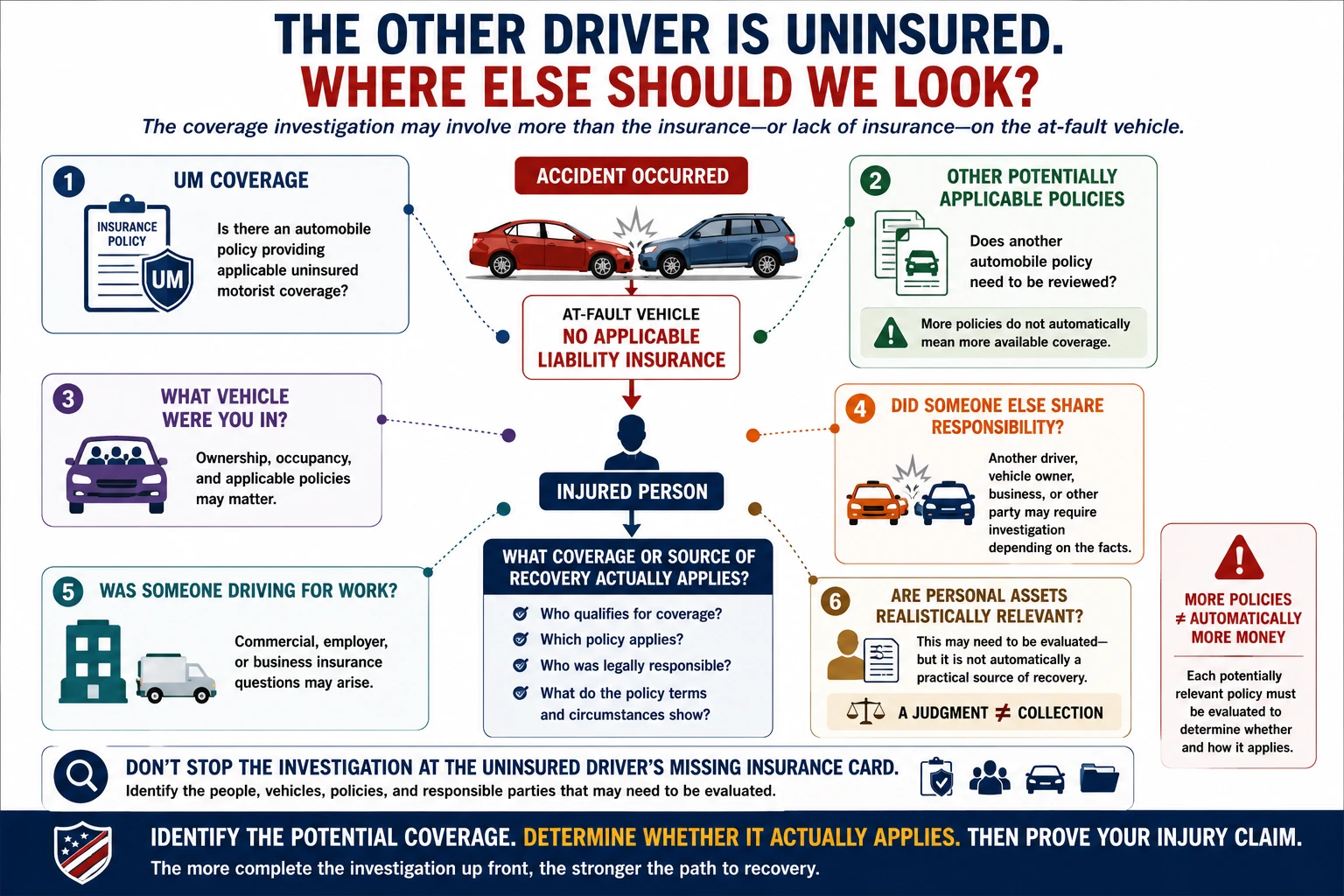
The coverage investigation may involve more than the insurance, or lack of insurance, on the at-fault vehicle.
Questions can include:
- What UM limits apply?
- Are there other potentially applicable automobile policies?
- Does another responsible party exist?
- Was a business, employer, vehicle owner, or other person involved in circumstances that require investigation?
- Are there other legally available sources of recovery?
- Does the uninsured driver have assets that are realistically worth pursuing?
That last question requires practical judgment.
Obtaining a judgment and collecting a judgment are not the same thing. An uninsured individual may have limited assets or resources, so pursuing personal assets is not automatically a realistic solution in every case.
The goal should be to identify every legally supportable and practically meaningful source of recovery, rather than assuming that the first UM limit identified is necessarily the end of the analysis.
Can More Than One Insurance Policy Provide Uninsured Motorist Coverage?
Potentially, depending on the policies, vehicles, insured people, and circumstances involved.
An accident may involve more than one automobile policy that deserves review. But identifying multiple policies does not mean that every policy can automatically be combined or that every coverage limit is available.
Questions about multiple policies can involve:
- Who qualifies as an insured
- Which vehicle was involved
- Which policy applies first
- The type of coverage involved
- Policy language and endorsements
- Applicable South Carolina insurance law
- Whether and to what extent coverage can be combined
More policies do not automatically mean more recoverable money. Each policy has to be analyzed to determine whether and how it applies.
Why Is Uninsured Motorist Coverage So Important?
In our experience, most clients assume the other driver has insurance because South Carolina law requires drivers to carry automobile insurance.
Unfortunately, that assumption is not always correct. Over the years, we have handled many cases involving uninsured drivers who caused serious or even catastrophic injuries.
In those situations, uninsured motorist coverage often becomes the primary source of recovery for the injured person. Many clients are surprised to learn they have this protection available through their own policy.
For nearly 30 years, we have handled uninsured motorist claims involving drivers who did not carry applicable liability insurance. That experience helps us identify potentially available coverage, evaluate how the policy applies, and build the evidence needed to support the injury claim.
What Damages May Be Included in an Uninsured Motorist Claim?
When UM coverage applies, an injured person may be able to pursue legally recoverable accident-related damages supported by the evidence, subject to the applicable coverage and circumstances.
Depending on the case, those damages may include:
- Past medical expenses
- Reasonably anticipated future medical expenses when supported
- Past lost income
- Reduced future earning ability when supported
- Physical pain and suffering
- Physical limitations or impairment
- Loss of enjoyment of ordinary activities
- Other legally recoverable accident-related damages
The amount is not determined simply by adding up insurance limits.
The analysis still requires evidence showing what injuries the accident caused, what treatment was necessary, how the injuries affected the person’s life and work, and what losses are legally supported.
Coverage tells you what insurance may be available. The evidence helps determine what damages the claim can support.
What If the Uninsured Driver Was Working When the Accident Happened?
If the driver who caused the collision was working, making a delivery, operating a company vehicle, or otherwise acting for a business, do not assume the driver’s lack of personal automobile insurance ends the coverage investigation.
Depending on the circumstances, questions may arise about:
- Who owned the vehicle
- Who employed the driver
- What the driver was doing at the time
- Whether a commercial automobile policy exists
- Whether another business or entity may bear legal responsibility
- Whether other insurance coverage may apply
The fact that an individual driver is uninsured does not automatically tell you whether another legally responsible person or business has applicable insurance.
The driver’s employment status and purpose of the trip can materially change the investigation.
What If I Was a Passenger and the At-Fault Driver Was Uninsured?
Being a passenger does not automatically mean you are limited to the insurance carried by the driver who caused the collision.
Depending on the circumstances, the coverage investigation may need to consider the vehicle you occupied, the drivers involved, the automobile policies that may apply to you, and whether more than one person contributed to causing the accident.
For example, if two drivers share responsibility and one is uninsured, liability coverage involving the other responsible driver may also need to be evaluated.
UM coverage may also become relevant, depending on the applicable policies and circumstances.
Do not assume that “the at-fault driver is uninsured” identifies every available source of coverage for an injured passenger.
How Can a Lawyer Help If the Other Driver Doesn't Have Insurance?
An uninsured-driver case can require a broader coverage investigation than a straightforward liability claim.
A lawyer can help determine:
- Whether UM coverage may apply
- Which automobile policies need to be reviewed
- Whether the injured person qualifies for coverage under those policies
- Whether hit-and-run requirements are relevant
- Whether another driver or party shares responsibility
- Whether a commercial, employer, or other policy may apply
- What policy limits and coverage issues need to be evaluated
- What evidence supports liability, medical causation, and damages
- Whether another legally and practically meaningful source of recovery exists
When litigation becomes appropriate, formal discovery may also provide tools for obtaining relevant information from parties and other sources.
But filing a lawsuit is not itself a source of money, and the existence of personal assets should not be assumed.
The goal is to identify every potentially applicable source of recovery, determine what actually applies, and build the evidence necessary to support the underlying injury claim.
Gary's Take: What Should I Do When I Learn the Other Driver Is Uninsured?
“When a client tells me the other driver doesn’t have insurance, I don’t assume that means there is nowhere else to look. I start with the policies, the vehicles, the people involved, and the facts of the accident.”
“The first question is what coverage may exist. The next question is whether that coverage actually applies. Then we still have to prove what happened, what injuries the collision caused, and what damages the evidence supports.”
“An uninsured driver can make a case more complicated. It does not necessarily mean the investigation is over,” says Gary Christmas.
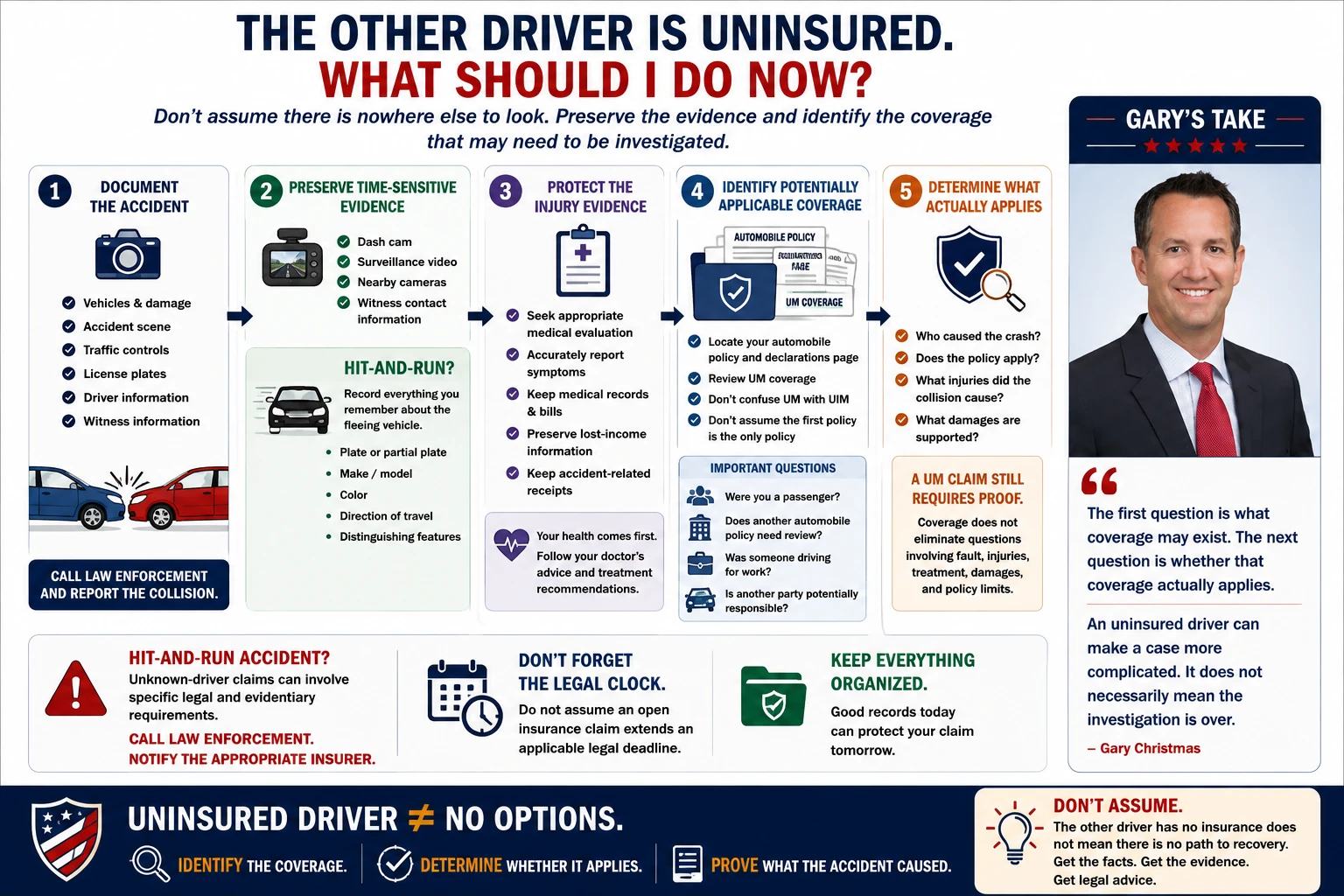
Don’t assume there is nowhere else to look. Preserve the evidence and identify the coverage that may need to be investigated.
Uninsured Driver Accident Checklist
- Call law enforcement and report the accident
- Seek appropriate medical evaluation
- Identify every driver and vehicle involved
- Preserve names, license information, and license plates
- Photograph the vehicles, damage, roadway, and overall scene
- Identify witnesses and preserve their contact information
- Preserve dash-cam, surveillance, or other available video
- Document identifying information in a hit-and-run when possible
- Notify the appropriate insurance company
- Locate your automobile policy and declarations page
- Review potentially applicable UM coverage
- Do not confuse UM coverage with UIM coverage
- Do not assume only one automobile policy may be relevant
- Do not assume every identified policy automatically applies
- Tell your lawyer if you were a passenger
- Tell your lawyer if any driver was working or driving for a business
- Keep medical records, bills, lost-income documentation, and receipts
- Do not assume the uninsured driver's personal assets will provide meaningful recovery
- Do not assume an open insurance claim extends an applicable legal deadline
- Seek legal advice if coverage is disputed or you are unsure which policies may apply
In Summary
Learning that the driver who caused your South Carolina car accident does not have insurance can be unsettling, but an uninsured driver does not necessarily mean there is no path to compensation. Uninsured motorist coverage may provide an important source of protection, and depending on the people, vehicles, policies, and circumstances involved, other potential sources of coverage or recovery may also need to be investigated.
The first step is to understand what type of insurance problem you actually have. Uninsured motorist (UM) coverage and underinsured motorist (UIM) coverage are not interchangeable. UM may become relevant when a responsible driver lacks applicable liability insurance or in certain unidentified hit-and-run situations. UIM addresses a different problem, when a responsible driver has liability insurance, but that coverage may be insufficient for the damages supported by the claim.
The coverage investigation should not necessarily stop with the first automobile policy you identify. Depending on the circumstances, it may be necessary to examine the vehicle you occupied, other potentially applicable policies, additional responsible drivers or parties, commercial or employer coverage, and whether you qualify as an insured under a particular policy. The existence of a policy does not automatically mean its coverage applies. The policy terms and circumstances still matter.
Hit-and-run accidents require particular attention. Even when the responsible driver is never identified, UM coverage may potentially provide a path to recovery, but these claims can involve specific legal and evidentiary requirements. Calling law enforcement, identifying witnesses, preserving photographs and video, recording whatever you remember about the fleeing vehicle, and notifying the appropriate insurer can become especially important.
Most importantly, UM coverage changes the potential source of insurance, it does not eliminate the need to prove the injury claim. Liability, coverage, medical causation, the nature and extent of the injuries, and the damages being claimed may all require supporting evidence. Preserve the accident evidence, obtain appropriate medical care, keep records of your losses, and investigate the coverage before assuming an uninsured driver has left you without options.