

What Can a Car Accident Lawyer Do That Most People Cannot Do Alone?
| A Lawyer Can | Why It Matters |
|---|---|
| Preserve evidence | Important evidence can disappear |
| Investigate liability | Helps identify who may be legally responsible |
| Identify insurance coverage | More than one policy or coverage source may apply |
| Handle insurer communications | Helps keep communications accurate and organized |
| Develop medical evidence | Helps address injuries and medical causation |
| Analyze damages | Helps identify legally recoverable losses |
| Track legal deadlines | Helps avoid procedural mistakes |
| Prepare for litigation | Preserves the ability to pursue the claim in court if necessary |
| Coordinate liens/reimbursement issues | Helps determine what may need to be addressed from a recovery |
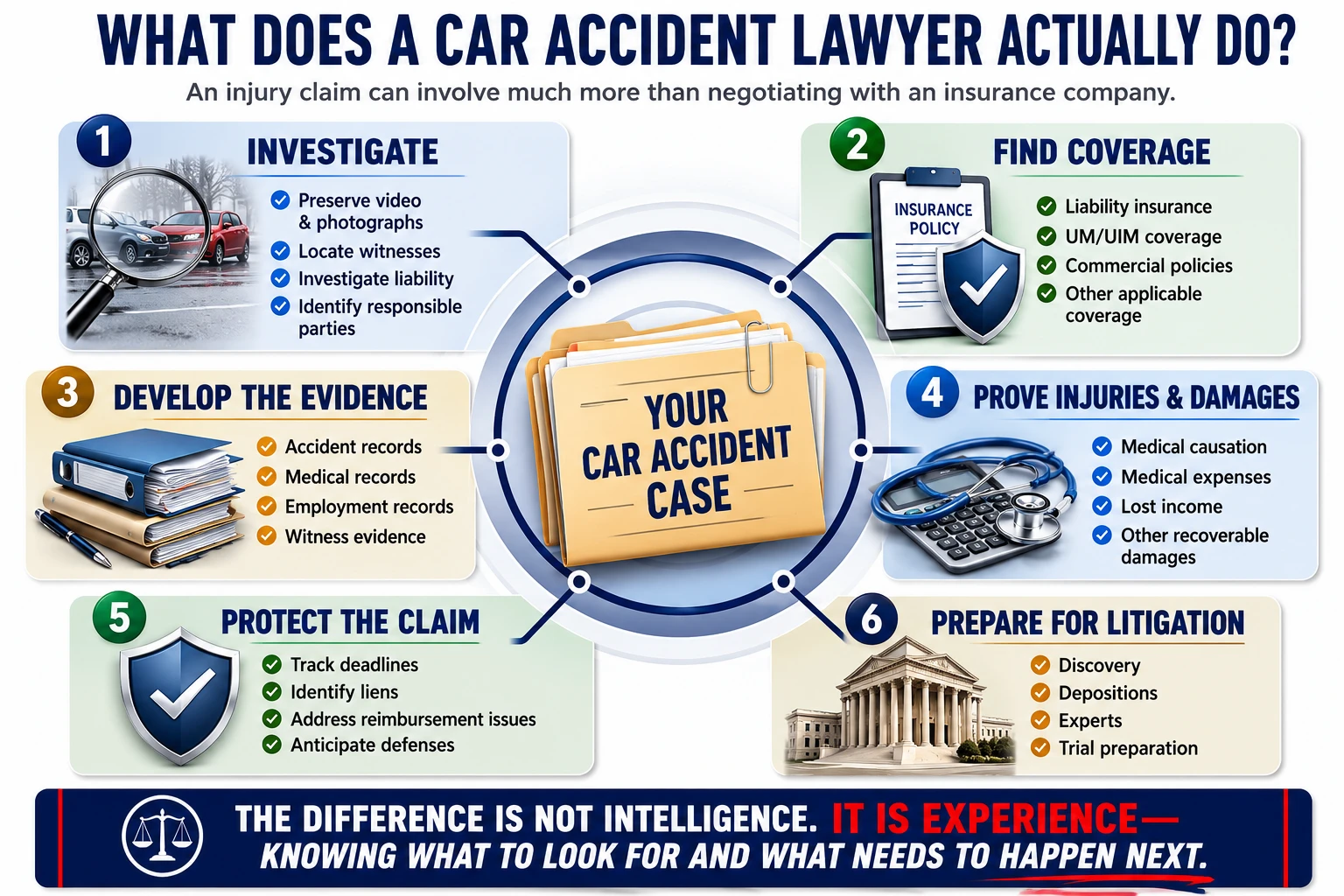
The difference is not intelligence. It is experience, knowing what to look for and what needs to happen next.
What Do Most People Underestimate About Handling Their Own Injury Claim?
Most people underestimate how many separate issues can exist inside what initially looks like one simple car accident claim.
You may need to determine fault, preserve evidence, identify every applicable insurance policy, understand medical causation, document past and future damages, address liens or reimbursement claims, communicate with insurers, track filing deadlines, and decide whether litigation is necessary.
None of those issues makes the injured person unintelligent. They simply involve rules and procedures most people do not deal with in everyday life.
That is where experience matters. A lawyer who handles injury cases regularly knows which questions to ask early and which problems can become much harder to fix later.
What Happens If Someone Tries to Handle the Case Alone First?
People sometimes contact us after handling an injury claim on their own for a period of time. That does not automatically mean the case has been harmed.
But issues can arise if evidence was not preserved, important deadlines were missed, an early statement created a dispute, coverage was overlooked, or the claim was evaluated before the medical picture was clear.
The earlier those issues are identified, the more opportunity there may be to address them.
What Can a Lawyer Investigate That I Might Not Know to Look For?
One of the biggest differences between handling a car accident claim yourself and having an experienced lawyer involved is knowing what to investigate in the first place. The evidence you see at the accident scene may be only one part of the picture.
I tell clients that a good investigation is not just about proving that a collision happened. It is about understanding how it happened, who may be legally responsible, what insurance coverage may apply, how the accident caused the injuries being claimed, and what evidence exists to prove the resulting damages.
Depending on the circumstances, that investigation may include:
- Dash cam and surveillance footage. Video may exist on the vehicles involved, nearby businesses, homes, doorbell cameras, parking facilities, commercial vehicles, or other sources. Some recordings may be overwritten or deleted, which can make early preservation important.
- Independent witnesses. A witness may have seen the collision, the vehicles immediately before impact, statements made at the scene, or other facts that later become disputed.
- Other vehicles involved in the crash. In a multi-vehicle collision, determining the sequence of impacts and the actions of each driver may reveal that responsibility extends beyond the vehicle that directly struck you.
- Vehicle ownership. The person driving a vehicle is not necessarily the person or business that owns it. Ownership information can become important when investigating responsibility and potential insurance coverage.
- Employer or business involvement. If a driver was working or acting within the scope of employment when the collision occurred, there may be additional legal and insurance issues to investigate.
- Commercial insurance policies. Crashes involving commercial vehicles can involve different policies, coverage limits, companies, and potentially responsible parties.
- Uninsured and underinsured motorist coverage. Your own automobile policy may provide UM or UIM coverage depending on the circumstances.
- Other potentially applicable insurance policies. The policy covering the vehicle involved in the crash may not always be the end of the insurance investigation.
- Accident reports and related records. Collision reports and other available records can help identify drivers, vehicle owners, witnesses, insurance information, and facts that may lead to additional evidence.
- Medical causation evidence. It is not enough to show that you received medical treatment after an accident. An injury claim can involve questions about whether the collision caused an injury, aggravated a preexisting condition, or contributed to the symptoms and limitations being claimed.
- Prior medical records when relevant. Previous injuries or medical conditions can become important when causation is disputed.
- Lost-income and employment records. Pay records, employment information, tax documents, work restrictions, and other evidence may be relevant.
- Liens and reimbursement claims. Health insurers, government benefit programs, medical providers, or other entities may have reimbursement or lien issues.
- Potentially responsible third parties. Vehicle owners, employers, businesses, governmental entities, or other parties may become relevant.
This is where experience matters. You cannot preserve evidence you do not know exists, investigate coverage you do not know may apply, or address a legal issue you do not know is part of the case.
Most people have never had a reason to investigate these issues before. A lawyer who regularly handles South Carolina injury cases knows which questions to ask, what information to look for, and which issues need closer investigation based on the facts of the particular accident.
The goal is not to make a car accident claim more complicated than it needs to be. The goal is to make sure important evidence, responsible parties, available coverage, and legally recoverable damages are not overlooked simply because no one knew to look for them.
Why Does Trial Preparation Matter Even If My Case Settles?
Most injury cases resolve without a jury trial, but preparing a case with litigation in mind can still matter. Trial preparation requires the lawyer to understand the evidence, witnesses, medical proof, damages, defenses, and weaknesses in the case.
If the claim cannot be resolved, that preparation also means the case is not being built from scratch when a lawsuit becomes necessary.
Our philosophy is to prepare early so we understand what we can prove, not simply what we hope the insurance company will accept.
What Does It Mean to Prepare a Car Accident Case Thoroughly?
Thorough preparation means understanding the case from every important angle rather than simply collecting medical bills and sending a demand to the insurance company.
Depending on the case, that may include:
- Preserving evidence before photographs, video, or other information disappears
- Investigating liability and determining who may be legally responsible
- Identifying available insurance coverage, including policies that may not be immediately obvious
- Gathering medical, employment, accident, and other relevant records
- Understanding medical causation, including whether the accident caused or aggravated the injuries being claimed
- Calculating and documenting damages, including medical expenses, lost income, and other legally recoverable losses
- Identifying potential defenses and weaknesses that may need to be addressed
- Preparing witnesses and understanding what their testimony may establish
- Using qualified experts when appropriate to address medical, financial, accident-related, or other disputed issues
- Preparing for litigation if the claim cannot be resolved without filing a lawsuit
That preparation helps us understand what we can prove, what issues may be disputed, and what still needs to be developed before important decisions are made about the case.
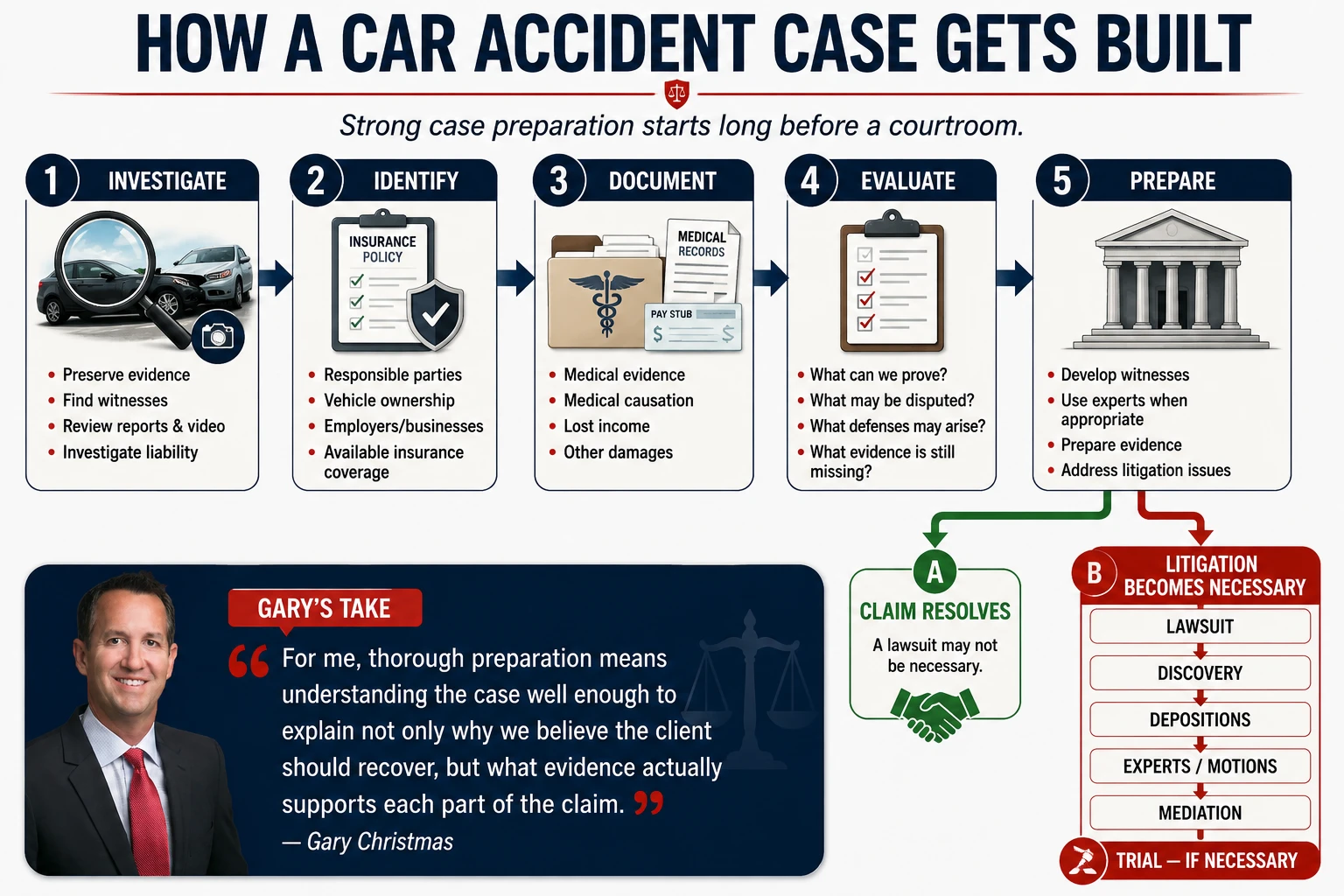
For me, thorough preparation means understanding the case well enough to explain not only why we believe the client should recover, but what evidence actually supports each part of the claim.
What Can a Lawyer Do Before a Lawsuit Is Filed?
A significant amount of work on a car accident claim can happen before a lawsuit is ever filed. The goal is to understand the case, develop the evidence, and determine whether the claim can be resolved without litigation.
Before filing suit, a lawyer may:
- Investigate the accident and preserve important evidence
- Identify potentially responsible parties and available insurance coverage
- Gather medical records, bills, wage-loss documentation, and other evidence of damages
- Evaluate medical causation and the injuries being claimed
- Handle communications with insurance companies
- Identify potential liens or reimbursement claims
- Evaluate liability, damages, and potential defenses
- Determine whether the claim can be resolved without filing a lawsuit
If litigation becomes necessary, additional legal tools become available, including formal discovery, depositions, subpoenas, motions, expert testimony, and ultimately trial.
A lawyer’s work does not begin when a lawsuit is filed. Much of the foundation for the case should be developed well before that point.
What Changes Once a Lawsuit Is Filed?
Once a car accident lawsuit is filed, the case enters the formal litigation process. The parties must follow court rules and procedures, and additional legal tools become available to gather evidence, develop testimony, and prepare the case for resolution or trial.
Depending on the case, the litigation process may involve:
- Formal pleadings that set out the parties' claims and defenses
- Discovery to obtain information and evidence from the other parties
- Interrogatories, which are written questions answered under oath
- Requests for production seeking documents, photographs, records, electronic information, and other evidence
- Subpoenas to obtain relevant evidence or testimony from third parties
- Depositions, where witnesses and parties provide sworn testimony before trial
- Expert testimony when specialized knowledge is needed to address medical, accident-related, financial, or other disputed issues
- Motions asking the court to decide particular legal or procedural issues
- Mediation or other efforts to resolve the case before trial
- Trial preparation, including organizing evidence, preparing witnesses, addressing evidentiary issues, and developing the case for presentation in court
Those are formal litigation tools an unrepresented claimant may have little experience using effectively.
Filing a lawsuit does not necessarily mean the case will go to trial. It means the claim has entered a formal court process where deadlines, rules of evidence, discovery procedures, and litigation strategy can become increasingly important.
How Does Hiring a Lawyer Reduce Stress After an Accident?
After nearly 30 years of practicing injury law, I can tell you that one of the biggest benefits we provide is peace of mind.
When clients know that someone is handling the legal issues, gathering evidence, communicating with insurance companies, and protecting their interests, it removes an enormous amount of stress from their lives.
Our job is to handle the legal work, evidence, insurance issues, deadlines, and case preparation. Your focus can remain on your health, your family, your work, and the things you need to do to move forward.
Clients often tell us that this approach is a tremendous relief. They no longer feel responsible for fighting with insurance companies, navigating complex legal issues, or worrying about every development in the case. Instead, they can focus on their health and their lives while we focus on the legal work and keeping the case moving forward.
Can I Handle My Own Car Accident Claim?
Yes, there are situations where you may be able to handle a car accident claim without hiring a lawyer.
The clearest example is a routine property-damage-only claim where no one was injured. Many people are able to work directly with the insurance company to address vehicle repairs, an inspection or estimate, rental-car issues, or the value of a vehicle that has been declared a total loss.
Many routine property-damage-only claims can be handled without legal representation, although disputes can still arise over repair costs, total-loss value, rental expenses, or other property-damage issues.
The situation can become different once bodily injuries are involved. An injury claim may raise additional questions involving who was legally responsible for the accident, whether comparative negligence applies, whether the accident caused or aggravated the injuries being claimed, what medical evidence is needed, what damages may be legally recoverable, whether more than one insurance policy applies, whether UM or UIM coverage may be available, whether liens or reimbursement claims must be addressed, what legal deadlines apply, and whether important evidence needs to be preserved.
Once bodily injuries are involved, those medical, legal, insurance, and evidentiary questions may make legal guidance more valuable.
I tell people that not every car accident automatically requires a lawyer. The important thing is understanding what kind of claim you actually have. A straightforward property-damage claim can be very different from a bodily-injury claim involving ongoing medical treatment, disputed liability, significant lost income, multiple insurance policies, or questions about future damages.
The question is not simply whether you can handle a claim yourself. It is whether you understand the issues involved well enough to make informed decisions about the claim before important evidence, coverage, or legal rights are overlooked.
What South Carolina Legal Issues Can Make a Car Accident Claim More Complicated?
A car accident claim can involve much more than determining who caused the collision. Depending on the circumstances, South Carolina law may raise additional issues that can affect who can recover, who may be responsible, what insurance coverage applies, and what must be done to preserve the claim.
Some of the issues that may need to be considered include:
- Modified comparative negligence. If the injured person shares responsibility for the accident, South Carolina's comparative-negligence rules can reduce or potentially prevent a recovery.
- Statutes of limitations. Many South Carolina car accident injury lawsuits are subject to a three-year statute of limitations, although different deadlines or procedural requirements can apply.
- Uninsured and underinsured motorist coverage. UM or UIM coverage may become important when the at-fault driver has no insurance or insufficient liability coverage.
- Unknown or hit-and-run drivers. South Carolina has specific requirements that can apply when the responsible driver cannot be identified.
- Medical liens and reimbursement claims. Health insurers, government benefit programs, medical providers, or others may have reimbursement or lien interests.
- Multiple defendants. More than one driver, vehicle owner, employer, business, or other party may potentially bear responsibility.
- Government-related claims. Accidents involving governmental entities or employees can raise issues under the South Carolina Tort Claims Act.
- Work-related accidents. If someone is injured while working, the case may involve both workers' compensation and a separate claim against a responsible third party.
- Wrongful-death claims. Fatal accidents involve additional South Carolina laws governing who may bring the claim and the damages that may be pursued.
- Evidence and authentication. Dash cam footage, surveillance video, photographs, electronic records, and other evidence may need to be properly preserved and supported for use in litigation.
- Insurance-policy requirements. Notice, cooperation, proof-of-loss, and other policy provisions may create requirements separate from the deadline for filing a lawsuit.
You may never encounter most of these issues in a single case. The difficulty is knowing which ones apply before a mistake is made.
That is what I mean when I tell clients: “You don’t know what you don’t know.” The purpose of having an experienced lawyer involved is to identify the legal, insurance, and evidentiary issues that actually apply to your particular case, and address them before they become problems.
When Legal Guidance May Be Especially Helpful
- You suffered bodily injuries
- Fault or comparative negligence is disputed
- Multiple vehicles or parties may be responsible
- More than one insurance policy may apply
- UM or UIM coverage may be involved
- You are being asked for a recorded statement or medical authorization
- Your injuries require significant or ongoing treatment
- You have missed work or may have future income loss
- Medical liens or reimbursement claims may apply
- Important evidence may need to be preserved
- A filing deadline is approaching
- The insurer disputes causation or damages
- You are unsure which South Carolina legal rules apply
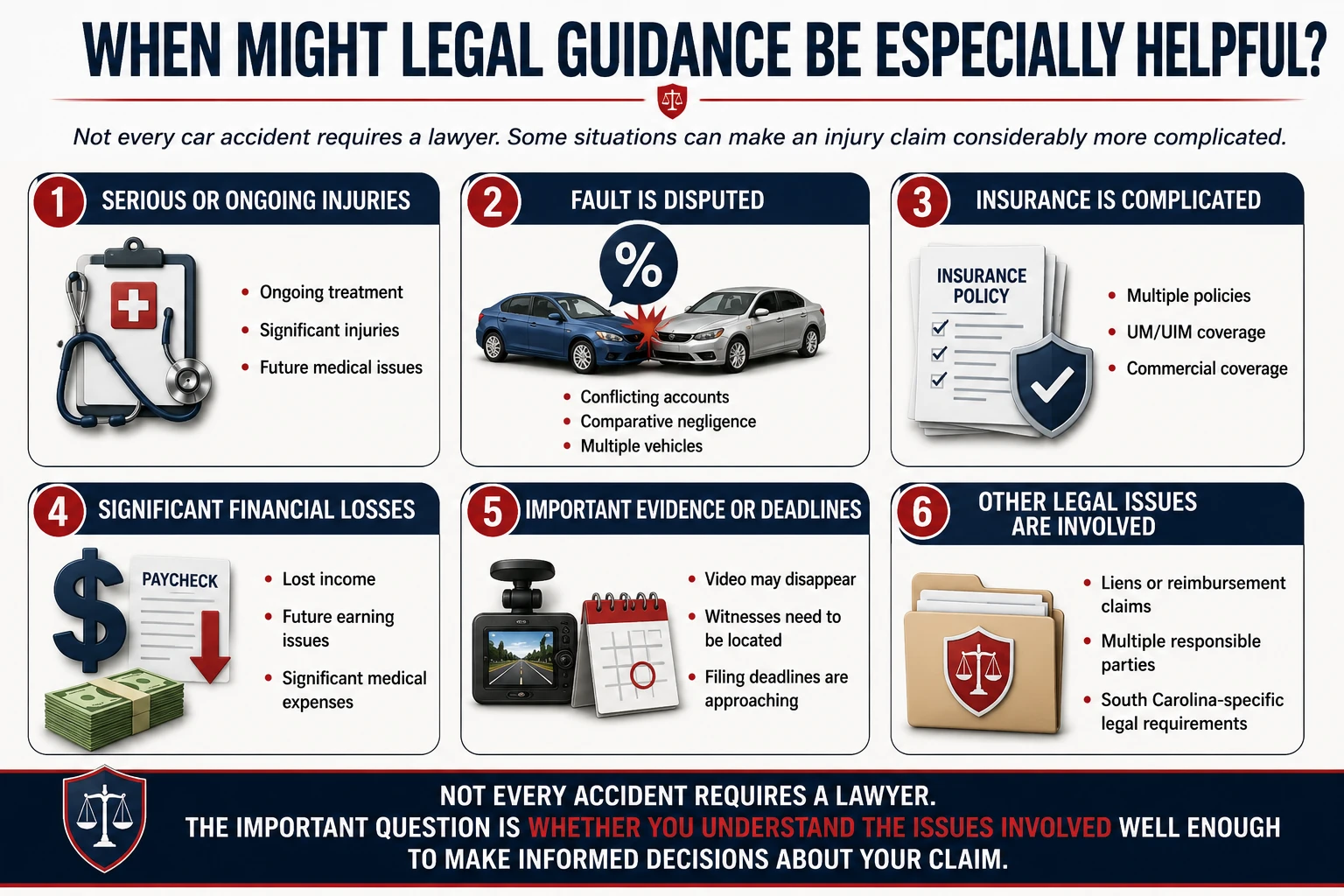
Not every accident requires a lawyer. The important question is whether you understand the issues involved well enough to make informed decisions about your claim.
In Summary
A South Carolina car accident lawyer can do much more than communicate with an insurance company or negotiate a settlement. A lawyer can investigate how the accident happened, preserve evidence, identify potentially responsible parties and available insurance coverage, develop medical and damages evidence, track legal deadlines, address liens or reimbursement issues, and prepare the case for litigation when necessary.
The difference is not whether an injured person is smart enough to handle a claim. It is experience, knowing what evidence to look for, which legal and insurance issues may apply, what problems need to be addressed early, and what will be necessary to prove each part of the claim.
Not every car accident requires a lawyer. Routine property-damage-only claims can often be handled without legal representation. But when bodily injuries, disputed fault, significant damages, multiple insurance policies, or complicated South Carolina legal issues are involved, experienced legal guidance may become much more valuable.