


What Does a Traffic Ticket Really Mean for My Injury Case?
| Situation | What It May Mean |
|---|---|
| You received a ticket | The citation itself does not automatically determine civil fault |
| Officer did not witness crash | Other evidence may provide additional information |
| You were convicted of a qualifying traffic offense | South Carolina law specifically addresses admissibility of traffic convictions in civil actions |
| Ticket was dismissed | A dismissal does not by itself determine who was negligent in the civil case |
| Fault is disputed | Witnesses, video, physical evidence, and other evidence may become important |
| New evidence is discovered | The civil liability analysis may change |

What to do after you receive a ticket at the accident scene, from identifying the citation to keeping the traffic matter and the injury claim connected.
Can a South Carolina Traffic Conviction Be Used Against Me in My Injury Lawsuit?
South Carolina has a specific statute addressing this issue. S.C. Code § 56-5-6160 provides that evidence of a conviction for a violation of the state’s Uniform Act Regulating Traffic on Highways is not admissible in a civil action.
That does not mean the facts surrounding the collision disappear. Witness testimony, photographs, video, physical evidence, vehicle data, and other admissible evidence may still be used to determine how the accident happened and whether either driver was negligent.
The important distinction is between the traffic conviction itself and the underlying evidence about the collision.
Does Getting a Ticket Mean I Lose My Injury Case?
No. Receiving a ticket does not automatically mean you lose your injury claim. Civil liability depends on the evidence concerning how the collision occurred and South Carolina’s negligence rules, not simply on which driver received a citation at the scene.
South Carolina follows modified comparative negligence. Generally, an injured person may recover when their own negligence is not greater than the negligence of the defendant, although the recovery is reduced according to the injured person’s percentage of fault.
That means the real civil question is not simply “Who got the ticket?” It is “What does the admissible evidence show about each driver’s responsibility for causing the collision?”
Can I Still Recover If I Received the Ticket?
Yes. Receiving a traffic ticket after a South Carolina car accident does not automatically mean you lose your injury claim or cannot recover compensation. The citation and the civil injury claim are separate matters, and civil liability ultimately depends on the evidence showing how the collision occurred and each driver’s responsibility for causing it.
South Carolina follows a modified comparative negligence rule. This means that even if you were partly responsible for the accident, you may still be able to recover compensation as long as your share of fault is not greater than the defendant’s. Any recovery would generally be reduced according to your percentage of fault.
For example, receiving a citation does not necessarily establish that you were primarily responsible for the collision. The investigating officer may not have witnessed the accident, and evidence discovered afterward, such as dash cam or surveillance footage, eyewitness testimony, photographs, physical evidence, vehicle data, or other records, may provide information that was not available when the ticket was issued.
The important question in the injury claim is not simply “Who received the ticket?” It is “What does the admissible evidence show about each driver’s responsibility for causing the collision?”
That is why I would not assume your case is over simply because you left the accident scene with a citation. The ticket should be taken seriously, but the underlying accident still needs to be evaluated on its own facts and evidence.
What Evidence Can Challenge the Officer's Initial Conclusion?
An investigating officer often arrives after a collision has already occurred. That means additional evidence discovered later may provide information the officer did not have when deciding whether to issue a citation.
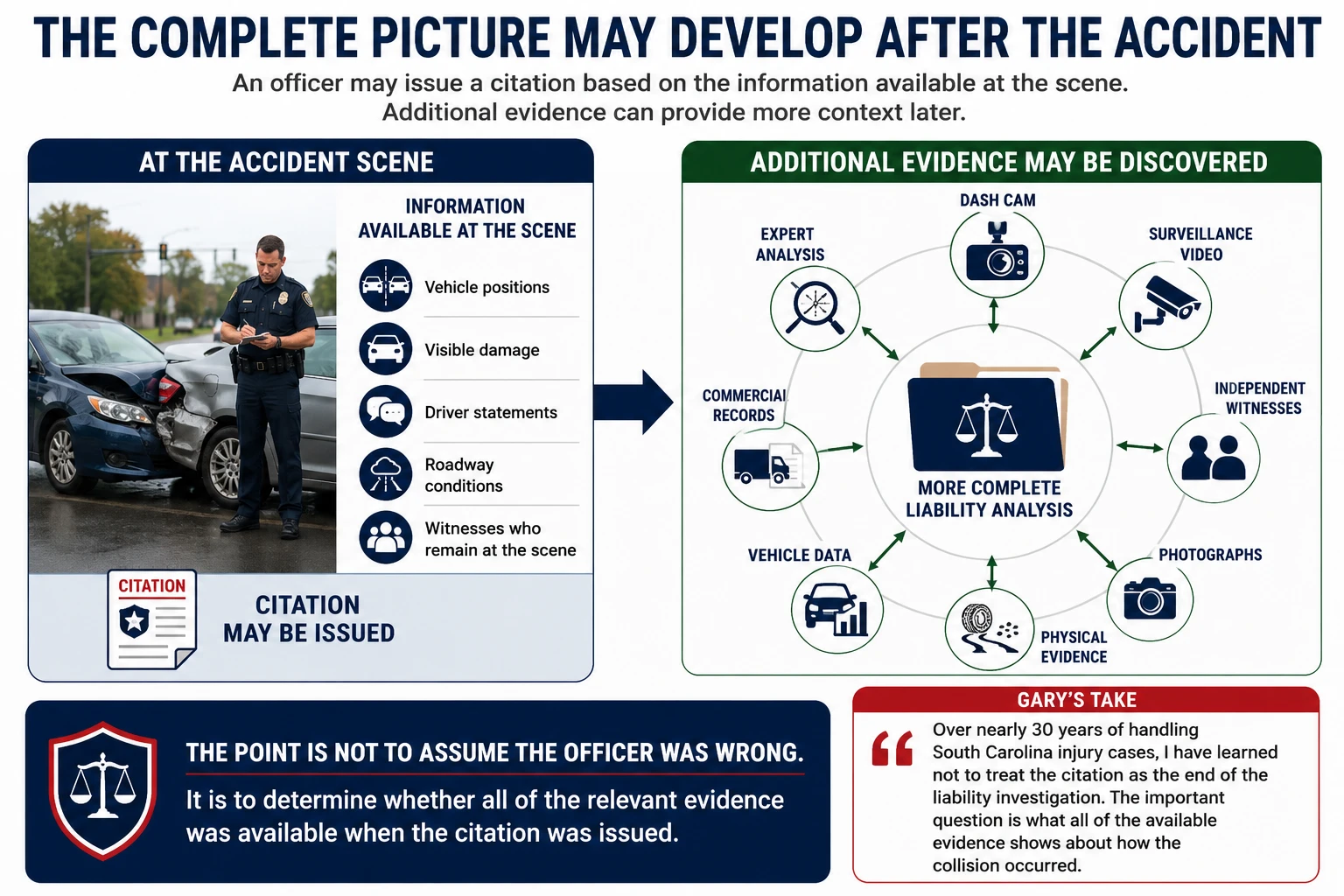
An officer issues a citation based on the information available at the scene. Additional evidence discovered afterward can provide a more complete picture.
Depending on the accident, relevant evidence may include:
- Dash cam footage
- Surveillance or doorbell camera video
- Independent witnesses
- Photographs of vehicle positions and damage
- Skid marks, debris, and other roadway evidence
- Traffic signal or roadway evidence
- Vehicle electronic data when relevant
- Commercial vehicle records when applicable
- Expert accident reconstruction analysis in appropriate cases
The purpose is not to assume the officer was wrong. It is to determine whether the officer had the complete picture when the citation was issued.
What Traffic Tickets Are Most Common After Car Accidents?
The type of traffic citation issued after a South Carolina car accident depends on how the investigating officer believes the collision occurred. Different accidents can result in very different citations, and the fact that a particular ticket was issued does not, by itself, resolve who is legally responsible for the accident in a civil injury claim.
Some traffic violations that may be associated with car accidents include:
- Following too closely. This may be cited when an officer believes a driver failed to maintain sufficient distance behind another vehicle. It commonly comes up in rear-end collisions, but the circumstances leading to the crash still matter.
- Failure to yield. A failure-to-yield citation may arise at intersections, while entering or crossing a roadway, during certain turns, or in other situations where one driver was required to yield the right-of-way.
- Improper lane change. Lane-change accidents can lead to a citation when an officer believes a driver moved from one lane to another without doing so safely or otherwise violated an applicable traffic rule.
- Disregarding a traffic-control device. Depending on the circumstances, a driver may be cited for failing to obey a traffic signal, stop sign, or other traffic-control device.
- Driving too fast for conditions. A driver does not necessarily have to exceed the posted speed limit for speed to become an issue. Weather, visibility, traffic, roadway conditions, and other circumstances may affect whether the driver's speed was reasonable under the conditions.
- Other accident-related moving violations. Depending on how the collision occurred, an officer may issue a citation for another alleged violation of South Carolina's traffic laws.
The citation can provide information about what the investigating officer believed occurred based on the information available at the scene, but it should not automatically be treated as the final determination of civil fault. An officer may not have witnessed the collision, and additional evidence, including photographs, witness testimony, dash cam or surveillance footage, physical evidence, and vehicle data when relevant, may provide a more complete picture.
The specific citation does not, by itself, resolve civil liability for the accident. The underlying facts and admissible evidence still matter when determining who was negligent and whether that negligence caused the collision.
Can an Insurance Adjuster Consider the Fact That I Received a Ticket?
An insurer investigating an accident may consider the citation, accident report, driver statements, photographs, witnesses, video, vehicle damage, and other information when evaluating liability. But an insurer’s claim decision is not the same thing as a court’s determination of negligence.
A traffic citation also does not eliminate the need to investigate the underlying accident. Evidence discovered later may provide facts that were unavailable at the scene.
The important question remains what the evidence shows about how the collision occurred.
Should I Pay the Traffic Ticket After an Accident?
Do not assume that simply paying a traffic ticket is the right decision without first understanding what paying it means. The traffic charge and your civil injury claim are separate legal matters, and the appropriate way to handle the citation depends on the particular charge and circumstances.
At the same time, do not ignore the ticket or miss a required court date or deadline. Make sure you understand what you have been charged with, when a response is required, and what options are available for addressing the citation.
If you are unsure how to proceed, consider speaking with an attorney who handles South Carolina traffic matters before resolving the ticket. If you also have an injury claim arising from the collision, make sure the lawyer evaluating that claim knows about the citation and its status. Because both matters arise from the same accident, they should be considered together even though they are separate legal proceedings.
The important point is not to make an automatic decision simply because paying the ticket seems like the easiest way to put it behind you. Understand the citation, your options, and the potential implications before deciding how to proceed.
Can I Fight the Ticket and Still Pursue an Injury Claim?
Yes. A traffic case and a civil injury claim are separate proceedings. Challenging a citation does not, by itself, prevent you from pursuing an injury claim arising from the same accident.
Because the two matters arise from the same collision, however, decisions and statements made in one proceeding should be considered carefully in light of the other. Depending on the circumstances, you may need advice from both a personal injury lawyer and an attorney who handles traffic matters.
What If I Already Paid the Ticket?
Do not assume that paying the ticket automatically ends your injury claim. South Carolina has specific rules governing the admissibility of convictions for violations of its traffic code in civil actions, and the underlying facts of the accident still must be evaluated.
If you have already paid a citation, tell the lawyer evaluating your injury claim exactly what citation you received, how it was resolved, and what documents you have from the traffic case. That information can be reviewed together with the other evidence concerning the collision.
What If the Accident Report and Other Evidence Do Not Match?
An accident report reflects information available to the investigating officer at the time. The officer may not have witnessed the collision, and video, additional witnesses, vehicle data, photographs, or other evidence may later provide information that was not available at the scene.
That does not mean the officer necessarily made a mistake. It means the accident report should be considered alongside the other available evidence when evaluating civil liability.
Is the Accident Report the Final Word on Fault?
No. An accident report can be an important source of information, but it does not automatically determine civil liability. South Carolina law also places restrictions on the evidentiary use of certain accident reports.
The underlying evidence, such as witness testimony, photographs, video, physical evidence, and other admissible information, may ultimately be more important in determining negligence.
Are the Ticket, Accident Report, and Injury Claim the Same Thing?
No. A traffic ticket, the accident report, and your civil injury claim are three different things. They may all arise from the same collision, but they serve different purposes and should not be treated as interchangeable.
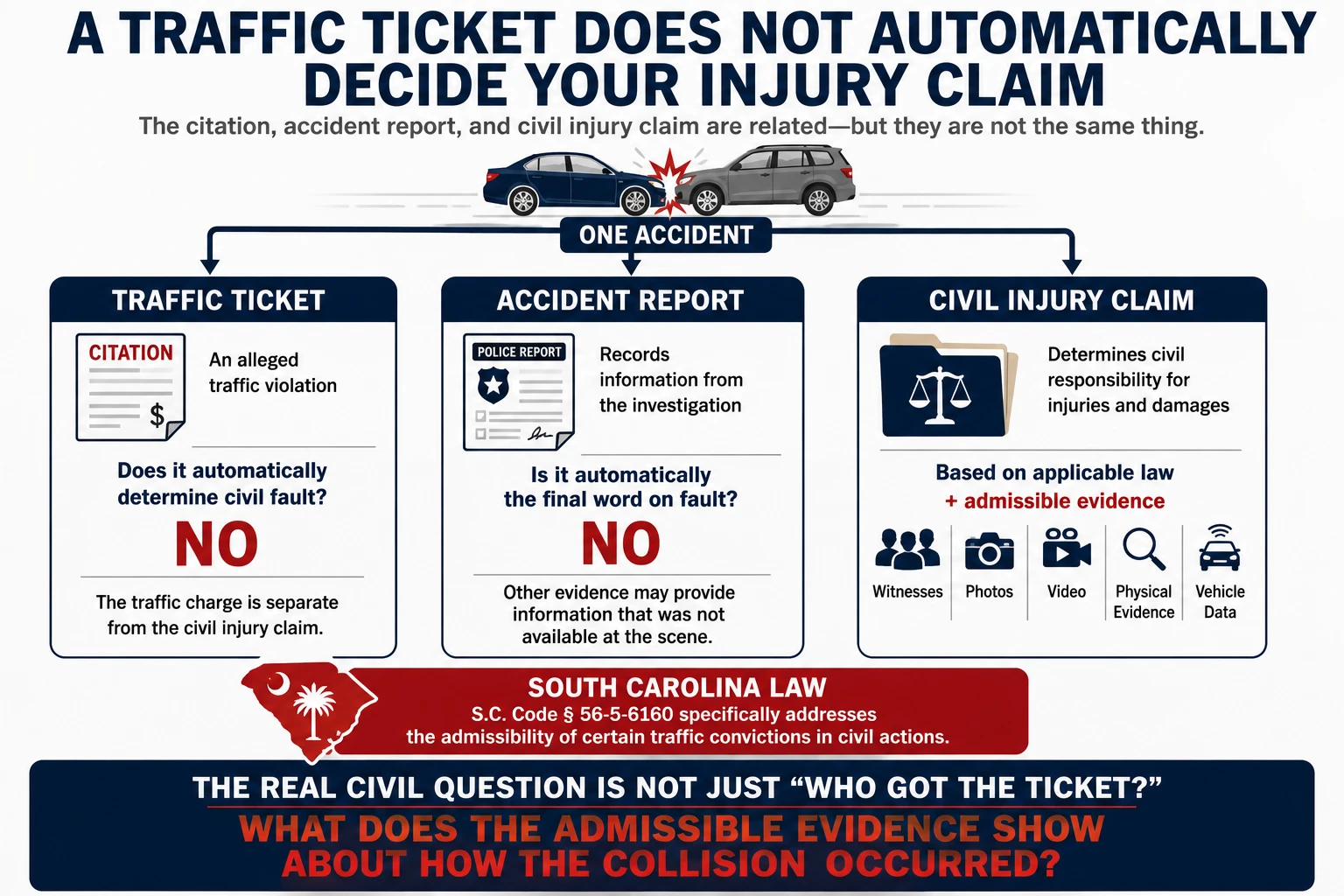
One accident, three separate legal concepts: the traffic ticket, the accident report, and the civil injury claim each serve a different purpose.
- The traffic ticket is a charge. A citation reflects an alleged violation of a traffic law. It does not, by itself, determine who is legally responsible for the injuries and damages caused by the collision.
- The accident report documents the investigation. It may contain information about the drivers and vehicles, witness information, statements, diagrams, roadway conditions, and observations made during the investigation. The officer may not have witnessed the collision, however, and additional evidence may later provide information that was not available at the scene.
- The injury claim is a civil matter. It focuses on whether another person or entity was negligent, whether that negligence caused the accident and your injuries, and what damages may legally be recovered. Liability may be evaluated using photographs, video, witness testimony, physical evidence, medical evidence, vehicle data when relevant, and other admissible evidence.
There is also an important distinction between receiving a ticket and the ultimate disposition of that traffic charge. A citation may later be contested, dismissed, or result in a conviction. Those are separate concepts, and South Carolina law contains specific rules governing how certain traffic convictions and accident-related reports may be used in civil litigation.
The practical takeaway is simple: do not assume that receiving a ticket, or seeing something unfavorable in the accident report, automatically decides your injury claim. The civil case requires its own evaluation of the applicable law and the evidence showing how the collision actually occurred.
Can What I Say About the Ticket Matter Later?
Potentially. The traffic case and civil injury claim arise from the same collision, so statements about how the accident happened should be accurate and consistent with the facts you actually know.
Do not guess about speed, distance, timing, visibility, or other facts simply because you feel pressured to provide an immediate answer. If you are unsure how a traffic proceeding could interact with an injury claim, obtain appropriate legal advice before making decisions about the citation.
Traffic Ticket After an Accident Checklist
- Identify the exact citation you received
- Keep the citation and all traffic-court paperwork
- Note the court date and response deadline
- Do not ignore the ticket
- Obtain the accident report
- Preserve photographs, video, and dash cam footage
- Identify witnesses and preserve their contact information
- Look for surveillance or other video
- Do not assume the citation determines civil fault
- Do not guess or speculate about how the collision occurred
- Understand your options before resolving the traffic charge
- If you have already resolved the ticket, preserve documentation showing what happened
- Make sure anyone evaluating your injury claim knows about the citation and its status
In Summary
Receiving a traffic ticket after a South Carolina car accident does not automatically mean you caused the collision, lose your injury claim, or cannot recover compensation. A traffic citation, the disposition of that charge, the accident report, and a civil injury claim are separate matters that serve different purposes.
South Carolina also has specific rules governing the use of certain traffic convictions and accident reports in civil cases. Ultimately, civil liability depends on the applicable law and the admissible evidence showing how the collision occurred. That evidence may include witness testimony, photographs, surveillance or dash cam footage, physical evidence, vehicle data, and other information that was not available when the officer issued the citation.
A traffic ticket should still be taken seriously. Do not ignore the citation or miss a court date or deadline, and do not automatically resolve it without understanding your options. If you are also pursuing an injury claim, make sure the citation, its status, and any related traffic-court documents are considered as part of the overall evaluation of the accident.