

Is a Deposition the Same as Testifying in Court?
No. A deposition usually takes place before trial as part of the discovery process rather than in front of a judge or jury. You will still answer questions under oath, and your testimony may be recorded by a court reporter and, in some cases, by video.
What you say can matter later in the case. Deposition testimony may be compared with other statements, records, evidence, or later trial testimony. That is one reason careful preparation and accurate answers are important.
What Happens During a Car Accident Deposition?
| Deposition Topic | What You May Be Asked About |
|---|---|
| Background | Work history, education, personal information |
| Accident facts | How the crash happened |
| Injuries | Body parts injured and symptoms |
| Medical treatment | Doctors, therapy, testing, and recovery |
| Prior medical history | Previous injuries or conditions |
| Daily life impact | Work limits, pain, activities, family impact |
| Social media | Posts, photos, videos, or activity history |
Who Will Be in the Room During My Deposition?
A deposition usually involves far fewer people than a courtroom proceeding, and knowing who will be there beforehand can make the process feel much less intimidating.
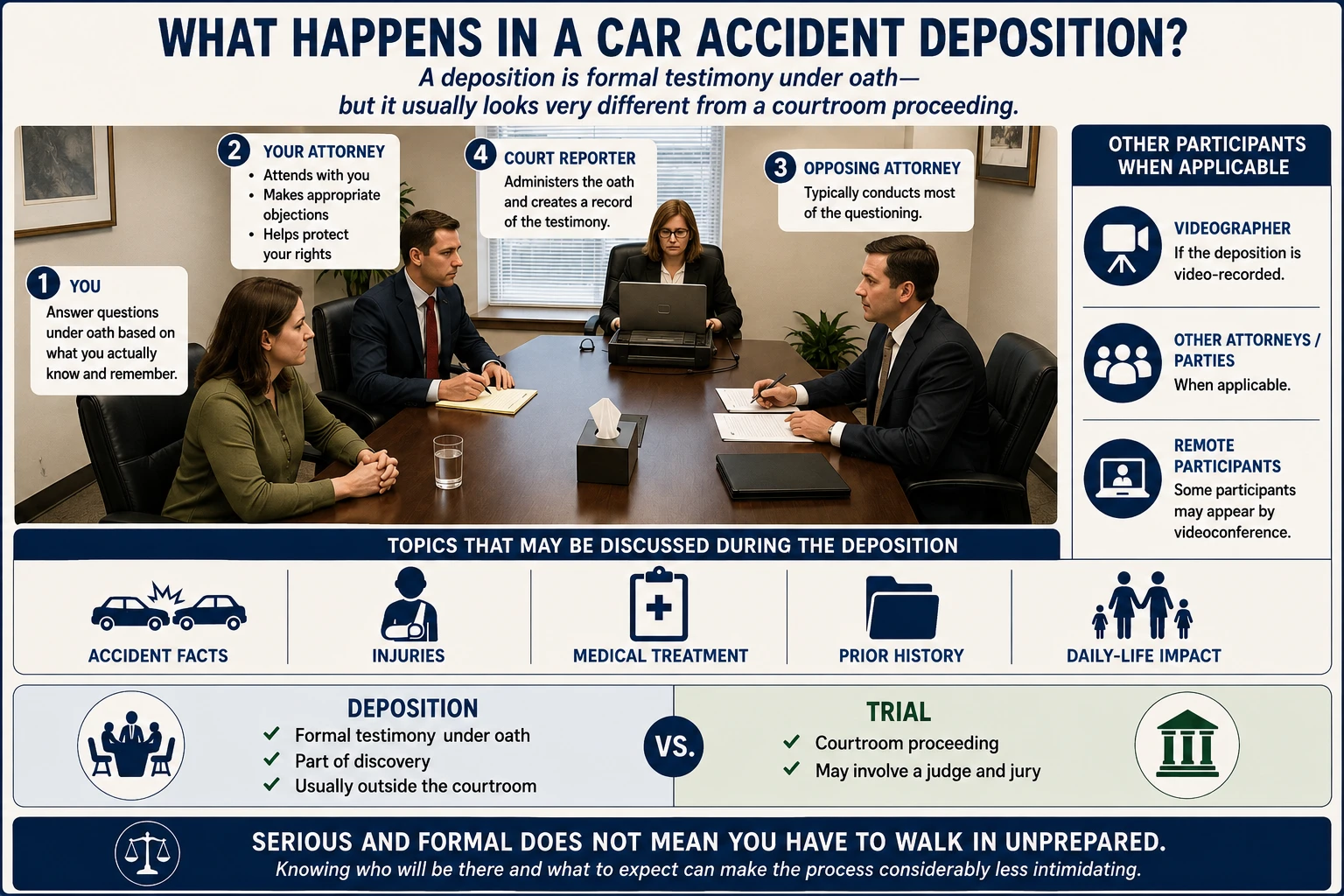
A deposition is formal testimony under oath, but it usually looks very different from a courtroom proceeding.
Depending on the case and how the deposition is conducted, the participants may include:
- You. You are the person giving testimony and answering questions under oath.
- Your attorney. Your lawyer will attend the deposition with you, listen to the questioning, make appropriate objections, and help protect your rights throughout the process.
- The defense attorney. In a car accident case, an attorney representing the defendant will typically conduct most of the questioning.
- A court reporter. The court reporter administers the oath and creates a record of the questions and answers given during the deposition.
- Other attorneys or parties. If the lawsuit involves multiple defendants, insurance issues, or other parties, additional attorneys or participants may sometimes attend.
- A videographer. If the deposition is being video-recorded, a videographer may also be present to record the testimony.
- Remote participants. Some depositions may be conducted entirely or partially by videoconference, so not everyone involved will necessarily be physically in the same room.
Your deposition generally will not look like a courtroom scene. There usually is no jury sitting in front of you, and the deposition ordinarily occurs outside the courtroom as part of the discovery process.
A deposition is generally much smaller and less formal than a courtroom proceeding, even though the testimony itself is formal and under oath.
Your attorney should explain beforehand where the deposition will take place, who is expected to participate, and how the questioning will be conducted so you know what to expect before it begins.
Who Asks the Questions in a Deposition?
The opposing attorney usually conducts most of the questioning. Your attorney attends with you, may make appropriate objections, and may ask questions when appropriate. A court reporter typically creates a record of the testimony.
The purpose is not for your lawyer to answer for you. Your job is to listen carefully, understand the question, and answer truthfully based on what you actually know and remember.
What Do People Often Misunderstand About Car Accident Depositions?
A deposition is important, but it is not automatically a sign that something has gone wrong with your case. It is a normal discovery tool used after a lawsuit has been filed.
Some common misconceptions include:
- "I need to memorize my case." You don't. Preparation should help you understand the issues and refresh your memory, not memorize scripted answers.
- "I have to know the answer to every question." You don't. If you genuinely do not know or remember, say so.
- "I should explain as much as possible." Answer the question that was asked accurately and completely, but don't speculate or volunteer guesses.
- "A prior injury ruins my case." Not necessarily. Prior medical history may be relevant, particularly when similar body parts or conditions are involved, but the facts matter.
- "Being nervous means I'll do badly." Nervousness is normal. Preparation can make the process much more understandable.
Why Do People Feel Nervous Before a Deposition?
For most clients, the biggest source of anxiety is simply the unknown.
People generally understand that they will be asked questions about the accident and their injuries. What often makes them uncomfortable are questions about their personal background, work history, driving record, or even criminal history, if applicable.
Some deposition questions may concern matters that ultimately are not presented to a jury. Discovery can extend beyond evidence that will necessarily be admitted at trial, although there are still legal limits on the scope and manner of questioning. If an improper question arises, your attorney can address it during the deposition.
How Should I Prepare for a Car Accident Deposition?
Good preparation can make a deposition feel much more manageable. The goal is not to memorize answers or rehearse a script. It is to understand the process, refresh your memory, and be ready to give truthful, accurate testimony.
Before the deposition, you should generally:
- Meet with your lawyer beforehand. Your attorney can explain how the deposition will work, who is likely to attend, and the types of questions you may be asked.
- Review the important facts of the accident. Refresh your memory about where you were going, how the collision happened, what you saw, and what occurred afterward.
- Review your relevant medical history. Be familiar with the injuries you are claiming, the treatment you received, and how your condition has changed over time.
- Review prior injuries or accidents when relevant. If you have had similar injuries, prior accidents, or related treatment, discuss those issues with your lawyer before the deposition.
- Review prior statements or discovery responses when appropriate. Your testimony may be compared with earlier answers, accident reports, written discovery, or other records.
- Know what documents or exhibits may come up. Your lawyer can help you understand which records, photographs, medical documents, or other materials may be discussed.
- Do not memorize answers. A deposition should not sound rehearsed. Answer based on what you actually know and remember.
- Do not rehearse a manufactured version of events. Preparation is about accuracy, not creating a more favorable story.
- Tell your lawyer about anything you are worried may come up. Prior injuries, old accidents, social media posts, criminal history, employment issues, or other concerns are better discussed before the deposition than discovered for the first time during questioning.
- Get appropriate rest and arrive ready to concentrate. Depositions require careful listening and attention, especially when questions become detailed or repetitive.
Preparation is not about learning what to say. It is about refreshing your memory, understanding the process, and being ready to answer truthfully and accurately.
A well-prepared client does not need to know every date, number, or detail from memory. If you genuinely do not know or do not remember something, say that rather than guessing. Your job is to be accurate and credible, not perfect.
What If I Don't Know or Don't Remember an Answer?
Say that you do not know or do not remember. A deposition is not a test of your ability to estimate or fill gaps in your memory.
Do not guess simply because the attorney asking the question appears to expect a number, date, distance, speed, or other specific answer. If you know an answer only approximately, make that clear.
An honest “I don’t remember” is different from avoiding a question you actually can answer. The goal is accuracy, not perfection.
Can I Ask the Attorney to Repeat or Clarify a Question?
Yes. If you do not hear, understand, or follow a question, ask for it to be repeated or clarified before answering. You should not answer a question you do not understand simply because you feel pressured to respond quickly.
Take the time you need to listen to the entire question. Then answer the question that was actually asked.
What Types of Questioning Can Be Difficult During a Deposition?
Some deposition questions are straightforward. Others may require you to slow down, listen carefully, and make sure you understand exactly what is being asked before you answer. That does not necessarily mean the question is improper. Depositions are designed, in part, to allow the opposing side to investigate the facts and test the evidence supporting the claim.
Questions that can sometimes be difficult include:
- Long or complicated questions. A question may contain several facts or ideas at once. If you do not understand it, ask the attorney to repeat, rephrase, or clarify the question before answering.
- Questions that contain assumptions. Listen carefully to the facts built into the question. You do not have to agree with an assumption that you believe is inaccurate simply to provide an answer.
- Repeated questions. You may be asked about the same event more than once or in different ways. Continue to answer truthfully rather than trying to figure out why the question is being repeated.
- Requests for precise estimates. You may be asked for an exact speed, distance, date, time, or number. If you do not know or remember precisely, do not turn an uncertain estimate into a fact.
- Yes-or-no questions that may need clarification. Some questions can be answered accurately with a simple yes or no. Others may require additional context to prevent the answer from creating a misleading impression. Listen to the question and provide the explanation necessary to make your answer accurate.
- Questions about events from years ago. Prior accidents, injuries, medical treatment, employment, or other historical events may be difficult to remember in detail. If you genuinely do not remember, say so rather than guessing.
- Questions comparing your testimony with earlier statements or records. You may be asked about something contained in an accident report, medical record, discovery response, prior statement, social media post, or other document. If you do not remember making a statement or need to see the document to understand the question, say that.
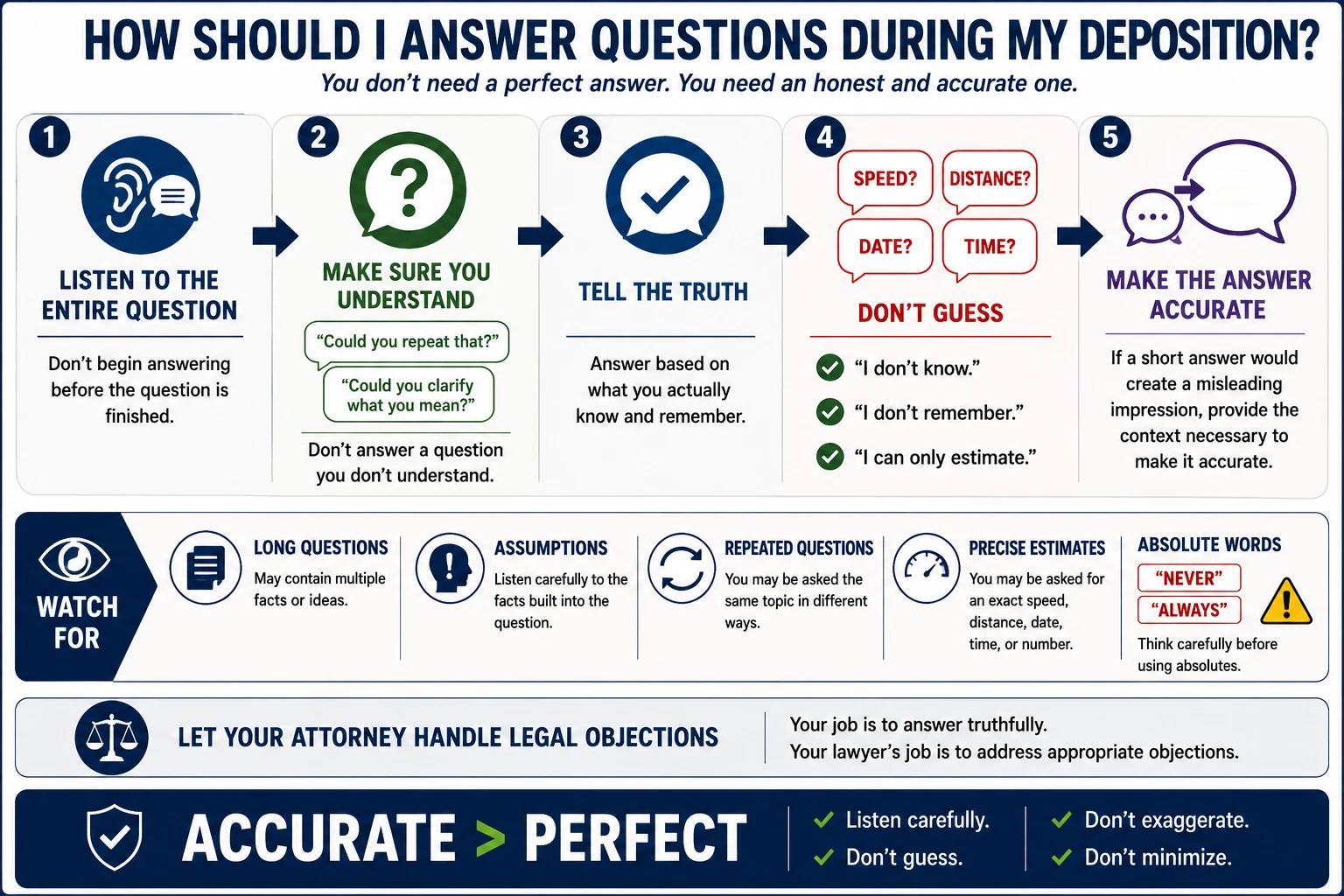
You don’t need a perfect answer. You need an honest and accurate one.
The goal is not to anticipate where every question is going or to outsmart the attorney asking it. Listen to the entire question, take the time you need to understand it, and answer truthfully based on what you actually know and remember.
Not every difficult question is improper. The opposing attorney is entitled to investigate relevant facts and test the evidence supporting the claim. Your job is to listen carefully and answer truthfully. Your attorney’s job is to address appropriate legal objections and help protect the integrity of the process.
Can My Deposition Affect the Outcome of My Car Accident Case?
Yes. Deposition testimony can become important evidence in a car accident lawsuit. It may help establish how the collision happened, what injuries you experienced, what treatment you received, and how those injuries affected your work and daily life.
The opposing side may also use the deposition to evaluate credibility, investigate defenses, clarify inconsistencies, explore prior medical history, and compare your testimony with records, photographs, video, discovery responses, or other evidence.
A deposition does not automatically help or hurt a case. What matters is the testimony and how it fits with the other evidence.
That is why preparation matters. The goal is not to give a “perfect” deposition. The goal is to give truthful, accurate, credible testimony.
What Mistakes Should I Avoid During a Car Accident Deposition?
A deposition is not a test of whether you can remember every detail perfectly or give the “right” answer to every question. Your goal is to listen carefully, understand what is being asked, and answer truthfully based on what you actually know and remember.
Some mistakes to avoid include:
- Guessing when you do not know or remember. Do not invent an answer because you feel pressured to provide one. If you genuinely do not know or do not remember, say so.
- Answering before the entire question has been asked. Listen carefully and allow the attorney to finish the question before you respond. This also gives your attorney an opportunity to make an appropriate objection.
- Answering a question you do not understand. If a question is confusing, unclear, or too complicated, ask for it to be repeated or rephrased.
- Exaggerating your injuries or limitations. Describe your symptoms and limitations accurately. Overstating what you can no longer do can create credibility problems if medical records, photographs, video, or other evidence show something different.
- Minimizing legitimate injuries because you do not want to complain. Accuracy works both ways. If an injury genuinely affects your work, sleep, activities, or daily life, do not minimize that impact simply because you are uncomfortable talking about it.
- Trying to memorize scripted answers. Preparation should refresh your memory and help you understand the process, not teach you a rehearsed version of your story.
- Volunteering unnecessary information. Answer the question that was asked and provide the context necessary to make your answer accurate. You do not need to turn every response into a lengthy explanation or introduce unrelated subjects.
- Arguing with the opposing attorney. Some questions may feel repetitive, skeptical, or uncomfortable. Stay focused on answering accurately and allow your lawyer to address appropriate legal issues or objections.
- Becoming careless because a question seems harmless. Even ordinary questions about dates, activities, prior medical treatment, employment, or the accident can become important when compared with other evidence.
- Denying prior injuries, accidents, or treatment that records may document. A prior injury or accident does not automatically defeat your current claim. Trying to conceal one, however, can create a credibility issue that did not need to exist.
- Using absolute words without thinking carefully. Statements such as "I never had back pain before this accident" or "I always wear my seat belt" can be significant if records or other evidence later show an exception. Use words such as never and always only when they are genuinely accurate.
- Forgetting that your testimony is under oath and being recorded. A deposition may feel conversational, but it creates formal testimony that can be reviewed and compared with other evidence later in the case.
You do not need to give a perfect deposition. You need to give an honest and accurate one. Listen carefully, do not guess, and do not exaggerate or minimize what happened. When an answer needs context to be accurate, provide the context necessary to tell the complete story.
How Long Does a Car Accident Deposition Usually Last?
There is no hard-and-fast rule regarding how long a deposition will last.
Some depositions may be completed in an hour. Others can last an entire day. The length generally depends on the complexity of the case, including the issues involving liability, damages, medical treatment, and the individual’s background.
The length and number of depositions can depend on the circumstances of the case. Your lawyer should explain what to expect based on the issues involved and the way discovery is proceeding. Knowing the process beforehand can make a lengthy question-and-answer session much easier to manage.
Can I Take a Break During a Deposition?
Depositions can include breaks, particularly when questioning lasts for an extended period. If you need a break, tell your attorney rather than simply struggling through because you are uncomfortable or losing concentration.
There may be circumstances where a question should be completed before a break is taken, so follow your attorney’s guidance about timing.
What Happens If the Defense Attorney Asks an Improper Question?
Your attorney can make appropriate objections during the deposition. Depending on the issue and applicable rules, you may still be required to answer after an objection is made, while in other circumstances your attorney may instruct you not to answer.
Do not try to decide the legal objection yourself. Listen to your attorney’s instructions and allow your lawyer to handle disputes about the questioning.
Can the Defense Ask About My Prior Medical History?
Yes. In a car accident deposition, the defense may ask questions about relevant prior medical history, particularly when you previously experienced symptoms, injuries, or treatment involving the same or similar parts of the body involved in your current claim.
Depending on the circumstances, you may be asked about:
- Prior injuries or medical conditions
- Previous accidents
- Earlier treatment involving the same body part
- Similar symptoms you experienced before the collision
- Prior surgeries or procedures
- Whether a condition existed before the accident and how it affected you
These questions do not necessarily mean the defense has discovered something that defeats your claim. They may be investigating medical causation, including whether your current symptoms were caused by the accident, whether the collision aggravated a preexisting condition, or whether some symptoms may have another cause.
That is why accuracy is important. Do not deny or minimize prior medical problems simply because you are concerned they may hurt your case. Medical records may later be compared with your deposition testimony.
At the same time, having a prior injury or medical condition does not automatically mean the current accident caused no additional harm.
A prior condition does not automatically mean the current accident caused no additional injury or aggravation. The medical evidence and facts matter.
Before your deposition, discuss relevant prior injuries, symptoms, and treatment with your attorney so you are prepared to answer questions about your medical history truthfully and accurately.
Can Social Media Come Up During My Deposition?
Yes. Social media content can become an issue in a car accident lawsuit, particularly when posts, photographs, videos, comments, or other activity relate to the accident, your injuries, your physical activities, or issues being claimed in the case.
For example, you could be asked about:
- Posts describing the accident or how it happened
- Comments about who you believe was at fault
- Photographs or videos showing physical activities
- Posts discussing your injuries, treatment, or recovery
- Content concerning work, travel, hobbies, or recreational activities
- Statements that appear inconsistent with something you said in your deposition or elsewhere in the case
A single photograph or short video may not tell the complete story. Someone could participate briefly in an activity and experience significant pain afterward, for example. But if social media content appears inconsistent with deposition testimony, you may be asked to explain the circumstances and provide the necessary context.
The safest approach is accuracy and preservation.
Assume that publicly available accident-, injury-, or activity-related content may be reviewed and compared with your testimony. Be accurate in what you post, and discuss questions about preserving or managing existing social media content with your lawyer. Do not delete or alter potentially relevant material simply because litigation is pending.
Your attorney can help you understand how potentially relevant social media should be handled during an active lawsuit.
Can the Defense Ask About Prior Accidents, Claims, or Lawsuits?
Yes. Depending on what is relevant to the case and the permissible scope of discovery, the defense may ask about prior accidents, injury claims, lawsuits, injuries, or medical treatment during your deposition.
For example, you may be asked about:
- Prior accidents, including earlier car accidents, work-related incidents, falls, or other events involving an injury.
- Prior injury claims, particularly claims involving injuries or symptoms similar to those involved in your current case.
- Prior lawsuits, including litigation arising from earlier accidents or injuries.
- Similar injuries or symptoms, especially when they involve the same part of the body you claim was injured in the current accident.
- Prior medical treatment, including treatment you received before the collision for conditions that may be relevant to your current injuries.
These questions may be used to investigate issues such as medical causation, preexisting conditions, prior symptoms, and whether some or all of your current complaints existed before the accident.
If you do not remember every detail of an accident, claim, or treatment from years ago, do not guess. Say what you actually remember. If you genuinely do not remember something, say so.
You also should not assume that a prior accident or injury automatically undermines your current case. A person can have a preexisting condition and still suffer a new injury or an aggravation of an existing condition in a later accident. What matters is what the medical evidence and other facts establish.
The existence of a prior accident or claim does not automatically determine the outcome of your current case. Accuracy matters because prior records may be compared with your testimony.
This is another reason to discuss prior accidents, claims, lawsuits, and relevant medical treatment with your attorney before the deposition, rather than being surprised by the subject for the first time during questioning.
Should I Be Nervous About My Car Accident Deposition?
It is completely understandable to feel nervous before giving sworn testimony, particularly if you have never been deposed before. Much of that anxiety comes from not knowing what will happen or worrying that you will say something wrong.
You do not need to memorize your case or give perfect answers. You need to listen carefully, tell the truth, avoid guessing, and answer based on what you actually know and remember.
Your attorney should prepare you beforehand so you understand the process, the subjects likely to be discussed, and how to handle questions you do not understand or cannot answer from memory.
A deposition is serious, but it is also a structured process that your lawyer can help you prepare for. Understanding what to expect can make it considerably less intimidating.
What Happens After My Deposition?
Once your deposition is finished, your case does not necessarily move directly to trial. The deposition is one part of the discovery process, and there may still be additional work to complete before the case is resolved.
After the deposition:
- A record of your testimony is created. A court reporter typically prepares a written transcript of the questions asked and the answers you gave. If the deposition was video-recorded, there may also be a video record.
- Your testimony becomes part of the discovery in the case. The attorneys may review the testimony and compare it with medical records, documents, photographs, witness testimony, prior statements, and other evidence.
- The testimony may affect how the parties evaluate the case. What was learned during the deposition may be relevant to questions involving liability, injuries, medical causation, damages, credibility, or potential defenses.
- Discovery may continue. Other witnesses may be deposed, additional records may be obtained, and the parties may continue exchanging and developing evidence.
- Other stages of litigation may follow. Depending on the case, that can include expert review or testimony, motions, mediation, settlement discussions, and continued trial preparation.
Your attorney should explain what comes next based on the particular stage and circumstances of your lawsuit.
Giving a deposition does not necessarily mean your case is about to go to trial. Many steps can occur after a deposition, and cases may be resolved at different points during the litigation process.
Car Accident Deposition Checklist
- Meet with your lawyer before the deposition
- Review important facts and relevant records
- Tell your lawyer beforehand about anything that concerns you
- Listen to the entire question
- Make sure you understand before answering
- Tell the truth
- Do not guess
- Do not exaggerate or minimize
- Say when you do not know or remember
- Be accurate about prior injuries, accidents, and treatment
- Do not argue with the questioning attorney
- Let your attorney handle objections
- Provide necessary context when an incomplete answer would be misleading
- Remember that your answers are under oath and recorded
- Preserve potentially relevant social media content
Gary's Take: What Makes a Good Deposition?
“After nearly 30 years of handling injury cases, I don’t expect a client to memorize every date, every medical record, or every detail of an accident. What matters to me is preparation and credibility. Listen to the question. Tell the truth. If you don’t know, say you don’t know. If you don’t remember, say you don’t remember. And when an answer needs context to be accurate, tell the rest of the story,” says Gary Christmas.
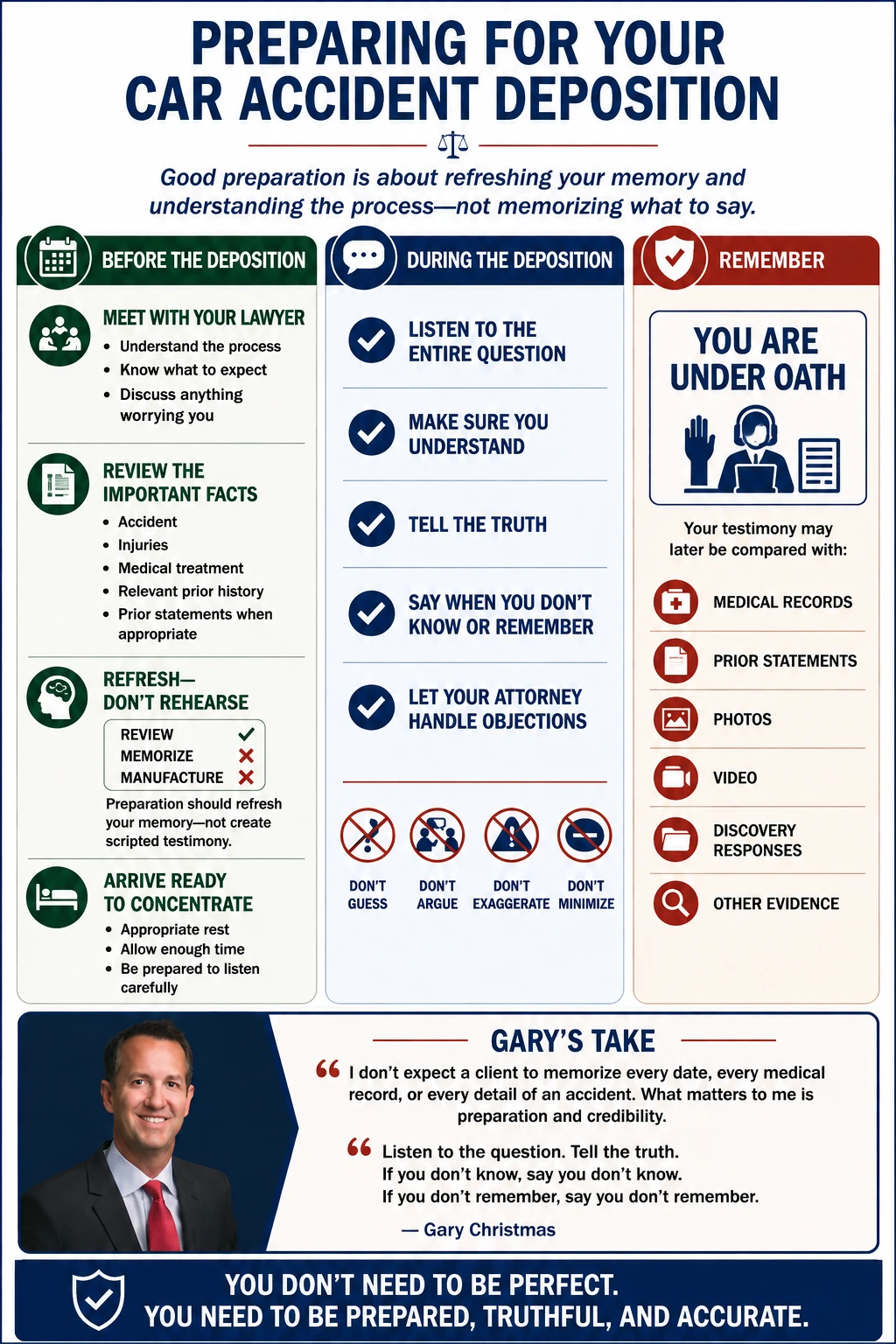
Good preparation is about refreshing your memory and understanding the process, not memorizing what to say.
In Summary
A car accident deposition is a formal part of the discovery process where you answer questions under oath about the accident, your injuries, medical treatment, background, and other issues relevant to the lawsuit. It can feel intimidating, especially if you have never been deposed before, but understanding the process and preparing with your attorney can make it much more manageable.
You do not need to memorize your case or give perfect answers. Listen carefully, tell the truth, do not guess, and answer based on what you actually know and remember. If you do not understand a question, ask for clarification. If you genuinely do not know or remember something, say so.
Most importantly, preparation is not about learning what to say. It is about understanding what to expect, refreshing your memory, and being prepared to give accurate, credible testimony.