


Whose Insurance May Cover an Injured Passenger?
There is no single answer that applies to every passenger accident. The insurance coverage that may apply depends on who caused the collision, which vehicles and people were insured, the types of coverage available, and the terms of the applicable policies.
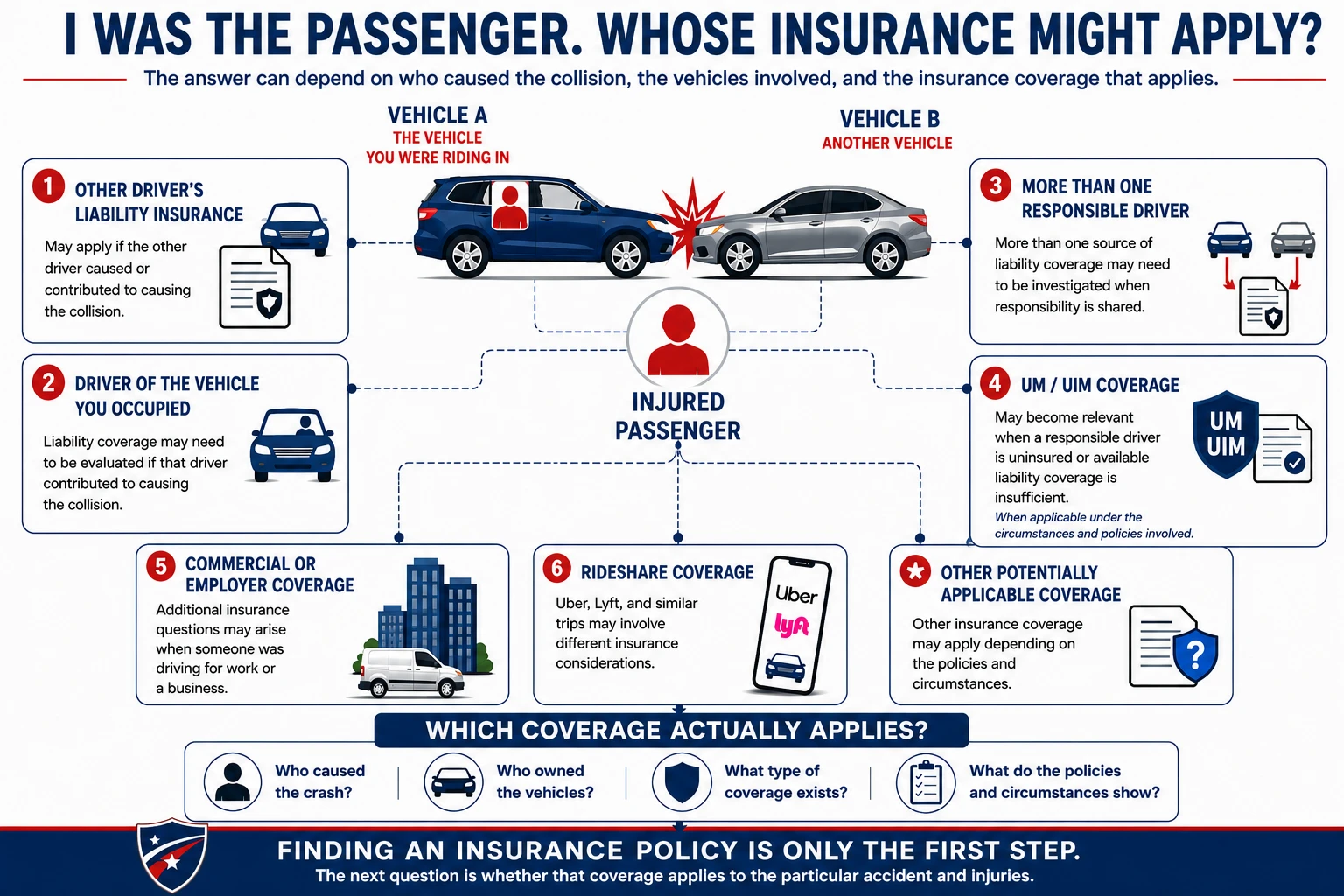
The answer can depend on who caused the collision, the vehicles involved, and the insurance coverage that applies.
Depending on the circumstances, potential sources of coverage may include:
- Liability coverage for another driver if that driver caused or contributed to causing the collision.
- Liability coverage applicable to the vehicle you occupied if its driver contributed to causing the collision.
- Coverage involving multiple negligent drivers when responsibility for the accident is shared.
- Uninsured motorist coverage when a responsible driver is uninsured and the coverage applies.
- Underinsured motorist coverage when available liability coverage is insufficient and applicable UIM coverage exists.
- Commercial or rideshare coverage when a business, employer, Uber, Lyft, or another commercial use is involved.
- Other potentially applicable coverage depending on the policies and circumstances.
The important question is not simply, “Which car was I riding in?” It is: who may be legally responsible for the collision, and what insurance coverage applies to the resulting claim?
What Should You Do If You Were Injured as a Passenger?
| Situation | What You Should Do |
|---|---|
| Injured while riding with a friend | Seek medical care |
| Unsure whose insurance applies | Identify all available policies |
| Friend may have contributed to crash | Evaluate both insurance claims |
| Multiple vehicles involved | Preserve evidence |
| You feel guilty about making a claim | Remember insurance exists for this purpose |
| Serious injuries | Speak with an experienced trial lawyer |
What If Both Drivers Were Partially at Fault for the Accident?
A passenger injury claim does not always involve one completely responsible driver and one completely blameless driver. In some collisions, the evidence may show that two or more drivers contributed to causing the accident.
For an injured passenger, that can mean liability and insurance coverage involving more than one responsible party need to be investigated.
Do not assume you must determine which driver was “the” at-fault driver before you can understand your rights. The evidence should be evaluated to determine what each driver did and how that conduct contributed to the collision.
What If I Don't Know Which Driver Caused the Accident?
You do not need to determine fault yourself before seeking information about your rights as an injured passenger. In many accidents, the drivers give different accounts of what happened, and a passenger may not have seen everything immediately before the collision.
Liability can be investigated using evidence such as the accident report, photographs, video, witness statements, vehicle damage, roadway evidence, and other available information.
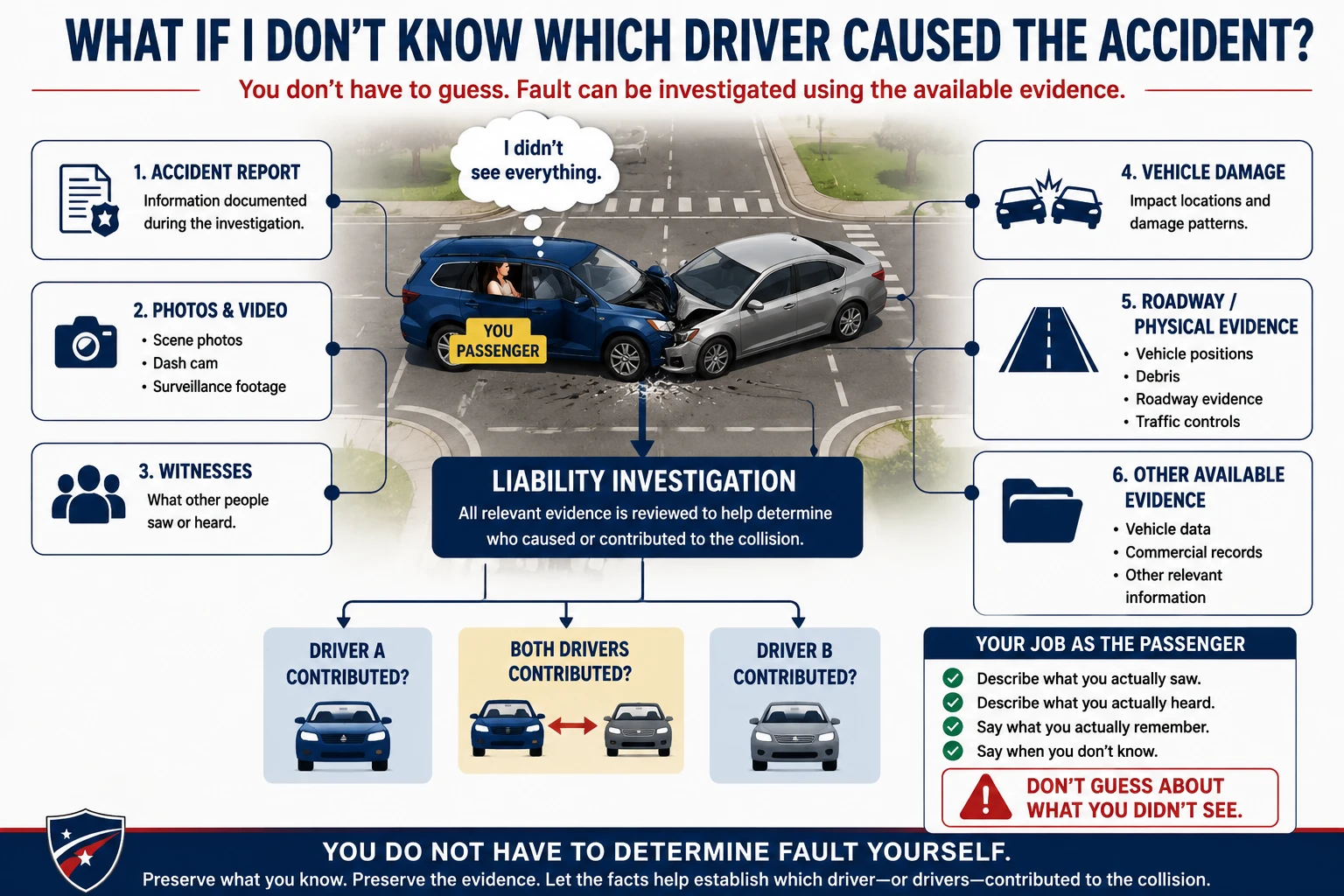
You don’t have to guess. Fault can be investigated using the available evidence, and it is not the passenger’s job to determine it alone.
If you did not see something or do not remember it, do not guess simply because an insurance company, attorney, or someone else asks you what happened. Describe what you actually saw, heard, and remember, and allow the evidence to help establish which driver, or drivers, contributed to causing the collision.
Can More Than One Insurance Policy Apply to a Passenger Injury Claim?
Potentially, yes. A serious passenger injury claim may involve more than one insurance policy, but that does not mean every policy automatically pays or that policy limits can simply be added together.
Which coverage applies can depend on who caused the collision, which vehicles and people are insured under particular policies, the type of coverage involved, policy terms and limits, and South Carolina insurance law.
For example, when two drivers both contributed to a collision, liability coverage associated with more than one responsible driver may need to be investigated. If an at-fault driver has no insurance or insufficient liability coverage, applicable UM or UIM coverage may also become important.
Identifying a policy is only the beginning. The next question is whether that coverage legally applies to the particular accident and injuries.
What Do Most People Get Wrong About Passenger Injury Claims?
One common mistake in passenger injury claims is focusing only on the insurance coverage associated with the other vehicle. Depending on the circumstances, that can result in potentially applicable coverage being overlooked.
It is important to remember that these are insurance claims. Pursuing insurance coverage does not necessarily mean you are pursuing the personal assets of the driver of the vehicle you were riding in. Instead, you are identifying every available source of insurance coverage that may help compensate you for your injuries.
At our firm, we believe potentially applicable insurance coverage should be identified and evaluated based on the facts, policy terms, and circumstances of the accident. In many cases, passengers actually have more potential avenues of recovery than the drivers involved in the accident.
Have You Helped Passengers Recover Compensation When Insurance Coverage Was Limited?
One memorable case involved a high school student who was riding as a passenger in the back seat of a friend’s SUV when a serious accident occurred.
Unfortunately, our client suffered a broken arm that required surgery, including the placement of rods and screws. The at-fault driver carried only the minimum insurance coverage required in South Carolina, and those policy limits were quickly exhausted due to the significant medical expenses and damages involved.
Because of the specific facts of the case, we were also able to pursue coverage through the insurance policy on the vehicle in which our client was riding. That does not mean coverage through the occupied vehicle is available in every passenger case. The policy language, type of coverage, accident circumstances, and other facts must be evaluated. By identifying and pursuing all available insurance coverage, we were able to maximize the benefits available to our client under the circumstances.
Every case is different, and past results do not guarantee future outcomes. However, this case highlights the importance of thoroughly investigating all available insurance coverage in passenger injury claims.
What Mistakes Should an Injured Passenger Avoid After an Accident?
Being a passenger can put you in a different position from the drivers involved in a crash, but that does not mean your injury claim will automatically be simple. One of the most important things you can do is avoid making assumptions about fault, insurance coverage, or the value of your claim before the facts have been investigated.
Common mistakes injured passengers should avoid include:
- Assuming you have no claim because you were "just the passenger." You did not have to be driving to have legal rights after being injured in a collision.
- Assuming only the other driver's insurance matters. Depending on who contributed to causing the accident and the coverage involved, more than one insurance policy may need to be investigated.
- Assuming the driver you were riding with could not share responsibility. Even when the driver is a friend or family member, the evidence may show that more than one driver contributed to the collision.
- Failing to obtain insurance information for every vehicle involved. When possible, preserve information about each driver, vehicle, and insurance policy rather than assuming someone else will gather it later.
- Failing to preserve evidence. Photographs, video, dash-cam footage, surveillance footage, witness information, and other evidence may help establish how the accident occurred.
- Guessing about what happened. As a passenger, you may not have seen everything immediately before impact. If you did not see something or do not remember it, say that rather than guessing about speed, distance, traffic signals, or which driver was at fault.
- Minimizing your injuries because you do not want to create problems for someone you know. Your relationship with the driver should not cause you to give an inaccurate description of your symptoms, medical treatment, or how the injuries are affecting your life.
- Delaying appropriate medical evaluation. If you are injured, getting appropriate medical attention is important for your health and can also create contemporaneous medical documentation of your symptoms and treatment.
- Assuming an insurance company has identified every potentially applicable policy. The existence of another policy does not necessarily mean coverage applies, but serious passenger claims may warrant a broader investigation of potentially available insurance.
- Signing a release before understanding what it affects. A release can potentially affect legal claims or insurance rights. Before signing one, make sure you understand which claims, parties, injuries, or coverage the document is intended to resolve.
The biggest mistake may be assuming the situation is simpler than it actually is. As an injured passenger, you do not need to decide immediately which driver was legally responsible or which insurance company should ultimately pay. Preserve the evidence, accurately describe what you know, and make sure the potentially responsible parties and applicable insurance coverage are properly investigated.
Identifying a policy is only the beginning. The next question is whether that coverage legally applies to the particular accident and injuries.
Can Uninsured or Underinsured Motorist Coverage Help an Injured Passenger?
If a responsible driver has no liability insurance or does not have enough coverage for the injuries involved, uninsured motorist (UM) or underinsured motorist (UIM) coverage may become relevant. A passenger’s potential access to this coverage depends on the circumstances and the applicable insurance policies.
Do not assume there is no additional coverage simply because the at-fault driver’s liability limits are insufficient. Identifying potentially applicable UM/UIM coverage can be an important part of investigating a serious passenger injury claim.
Am I Really Suing My Friend or Family Member?
This is one of the hardest parts of a passenger injury claim for many people. If the person driving the vehicle was a friend, spouse, relative, coworker, or someone else you care about, you may feel uncomfortable even asking whether their insurance applies.
An insurance claim and a lawsuit are not necessarily the same thing. In many cases, the first step is identifying applicable insurance coverage and making a claim. If the driver’s negligence contributed to the collision, liability coverage applicable to that driver may potentially respond to injuries caused by the accident.
If a lawsuit ultimately becomes necessary, the legal procedure can be more complicated, and the parties named will depend on the particular claim. Your lawyer should explain that process before decisions are made.
You do not have to choose between caring about someone and understanding the insurance coverage that may apply to your injuries. The first step is getting accurate information about your options.
What Types of Passenger Accident Cases Do You Handle?
Passenger injury claims can arise in many different situations. Sometimes you are riding with a friend or family member. Other times, you may be traveling for work, using a rideshare service, or riding in a commercial vehicle.
At Christmas Injury Lawyers, passenger accident cases may include:
- Passenger in a friend's or family member's vehicle. If someone you know was driving, we can investigate how the collision occurred and which insurance coverage may apply without simply assuming the other driver was entirely responsible.
- Rideshare passenger. Accidents involving Uber, Lyft, or another rideshare service can raise additional insurance questions that may depend on the circumstances of the trip and the coverage involved.
- Passenger in a company or work vehicle. If you were traveling for work when the accident occurred, there may be additional issues involving the employer, commercial insurance, workers' compensation, or potential claims against third parties.
- Passenger in a commercial vehicle. Company vans, trucks, shuttles, and other commercial vehicles may involve businesses and insurance policies that would not ordinarily be part of a collision between two personal vehicles.
- Passenger in a borrowed vehicle. When the driver does not own the vehicle, it may be necessary to investigate the driver, vehicle owner, and potentially applicable insurance policies.
- Passenger in a multi-vehicle collision. When three or more vehicles are involved, responsibility may be disputed among multiple drivers. The evidence may need to be evaluated to determine whose conduct contributed to causing the collision.
- Passenger injured by an uninsured or underinsured driver. If a responsible driver has no liability insurance or does not have enough coverage for the injuries involved, potentially applicable uninsured or underinsured motorist coverage may need to be investigated.
The type of vehicle and reason for the trip can matter because they may affect which people, businesses, and insurance policies need to be investigated.
That is why we do not begin a passenger injury case by assuming there is only one responsible driver or one applicable insurance policy. We begin with the facts: how the collision happened, who may be responsible, what vehicles and businesses were involved, and what potentially applicable coverage exists.
What If I Was Injured While Riding in an Uber or Lyft?
If you were injured while riding as a passenger in an Uber, Lyft, or another rideshare vehicle, the insurance analysis may be different from an accident involving a friend or family member driving a personal vehicle.
Rideshare accidents can involve additional coverage questions depending on the driver’s status, what the driver was doing when the collision occurred, who caused the accident, and the insurance policies involved.
A rideshare passenger should not assume the same insurance analysis applies as it would when riding with a friend in a personal vehicle. The circumstances of the trip and potentially applicable coverage should be investigated.
What If I Was Riding With a Coworker or in a Company Vehicle?
If you were injured while riding with a coworker or traveling in a company vehicle, the accident may involve additional legal and insurance issues beyond a typical passenger claim. Depending on why you were traveling and what you were doing at the time, workers’ compensation coverage may potentially apply. There may also be separate claims involving another driver or other third party whose negligence contributed to the collision.
For example, if you were traveling for work when another driver caused the crash, it may be necessary to evaluate both the workers’ compensation issues arising from your employment and a potential third-party injury claim arising from the collision. Commercial insurance, the ownership of the vehicle, the coworker’s employment status, and other coverage may also need to be investigated.
Do not assume that being injured while working means workers’ compensation is your only potential source of recovery. The circumstances of the trip, who caused the accident, and the available insurance coverage can all affect which claims may be available.
Example: Why Identifying Every Potential Policy Matters
Assume an injured passenger has damages that substantially exceed the liability limits available from the driver who caused the collision. The liability coverage may not be enough to address the passenger’s losses.
The investigation should not necessarily stop there. Depending on the circumstances, an attorney may need to determine whether another driver shares responsibility, whether UM/UIM coverage applies, whether a commercial or rideshare policy is involved, or whether another applicable policy exists.
The existence of another policy does not automatically mean additional benefits are payable. Coverage depends on the facts, policy language, and applicable law.
Passenger Accident Checklist
- Seek appropriate medical care for your injuries
- Identify every vehicle and driver involved
- Preserve insurance information for each vehicle when available
- Preserve photographs, video, witness information, and accident records
- Write down where you were sitting and what you remember seeing or hearing
- Do not guess about which driver caused the accident if you do not know
- Keep records of medical treatment and lost income
- Do not assume only one insurance policy may apply
- Do not assume the insurance on the vehicle you occupied automatically applies either
- Tell your lawyer if the driver was working, driving for a business, or operating a rideshare vehicle
- Do not let concern about a friend or relative prevent you from understanding your legal and insurance options
- Before signing a release, understand which claims and parties it may affect
Gary's Take: What Should an Injured Passenger Remember?
“When I’m looking at a passenger injury case, I don’t want to make assumptions about the insurance just because we know which car the client was riding in. I want to know who contributed to causing the collision, who owned the vehicles, whether anyone was driving for a business, and what potentially applicable insurance policies exist.”
“Passengers are often worried about creating a problem for the person who was driving them. I understand that. My job is to explain the options clearly so the client can make an informed decision based on the facts rather than fear or guilt,” says Gary Christmas.
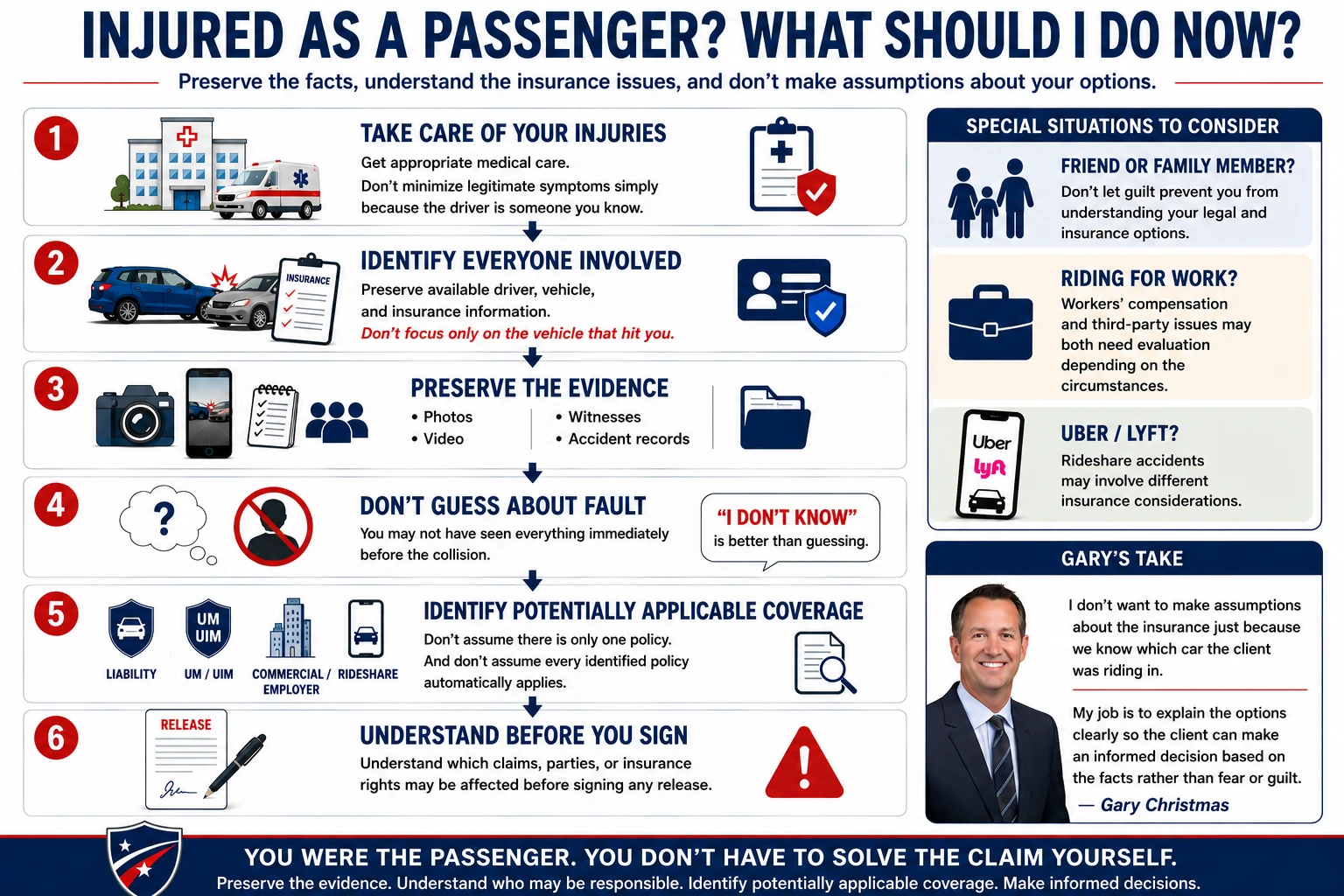
You were the passenger. You don’t have to solve the claim yourself. Preserve the evidence, understand who may be responsible, and identify potentially applicable coverage.
In Summary
If you were injured while riding as a passenger in someone else’s vehicle, do not assume your rights or insurance options are determined simply by which car you were riding in. A passenger injury claim may require investigating how the collision happened, which driver or drivers contributed to causing it, who owned the vehicles, whether a business or employer was involved, and what insurance coverage may apply.
Depending on the circumstances, potential sources of coverage may include liability insurance for one or more responsible drivers, uninsured or underinsured motorist coverage, or commercial, rideshare, or other applicable insurance. The existence of a policy does not automatically mean coverage applies, which is why identifying the policy is only part of the analysis.
Passengers can also face a very personal concern when the driver is a friend, family member, or coworker. Understanding whether insurance coverage may apply does not require you to stop caring about that person. The goal is to understand your legal and insurance options so you can make an informed decision based on the facts, not assumptions, fear, or guilt.