

When Is a Car Considered a Total Loss in South Carolina?
A vehicle can be declared a total loss when the damage is significant enough that repairing the vehicle no longer makes economic sense under the standards applicable to the claim. A car does not necessarily have to be completely destroyed or impossible to drive to be considered totaled.
The evaluation may involve the vehicle’s pre-accident value, the estimated cost of repairs, the extent of the damage, salvage considerations, and other information relevant to the total-loss determination.
That means two vehicles involved in similar-looking accidents may not receive the same total-loss decision. A newer or more valuable vehicle may justify repairs that would not make economic sense for an older vehicle with a substantially lower pre-accident value.
If an insurance company tells you your vehicle is a total loss, ask for documentation showing how the determination was made and how the vehicle was valued. Understanding those numbers is the starting point for evaluating the property-damage claim.
How Does the Insurance Company Determine What My Totaled Car Is Worth?
When a vehicle is declared a total loss, the insurance company generally evaluates what the vehicle was worth immediately before the accident. That is different from what you originally paid for the vehicle, what it would cost to buy a brand-new replacement, or what you still owe on your loan.
Information considered in a total-loss valuation may include:
- Year, make, and model
- Trim level and factory options
- Mileage
- Pre-accident condition
- Equipment and features
- Comparable vehicles
- Relevant market information
- Prior damage or condition issues when applicable
- Documented aftermarket equipment or modifications when relevant
The insurer may use a third-party valuation service or other vehicle-market information to generate its valuation. The important point is that a computer-generated valuation is only as reliable as the information used to produce it.
If the report identifies the wrong trim level, incorrect mileage, missing options, inaccurate condition, or questionable comparable vehicles, those issues may affect the final number.
Do not review only the dollar amount at the bottom of the valuation. Review how the insurance company arrived at that amount.
What Should You Do If Your Car Is Totaled?
| Situation | What You Should Do |
|---|---|
| Vehicle declared a total loss | Review the valuation carefully |
| You owe more than the car is worth | Check for gap insurance |
| Vehicle has aftermarket upgrades | Gather receipts and documentation |
| Personal property remains inside | Remove it before releasing the vehicle |
| You disagree with the value | Request supporting documentation |
| You were also injured | Protect your injury claim as well |
What Happens If the Insurance Company Undervalues My Totaled Car?
If you believe the insurance company has undervalued your vehicle, start by asking for the complete written valuation report and reviewing the information behind the number.
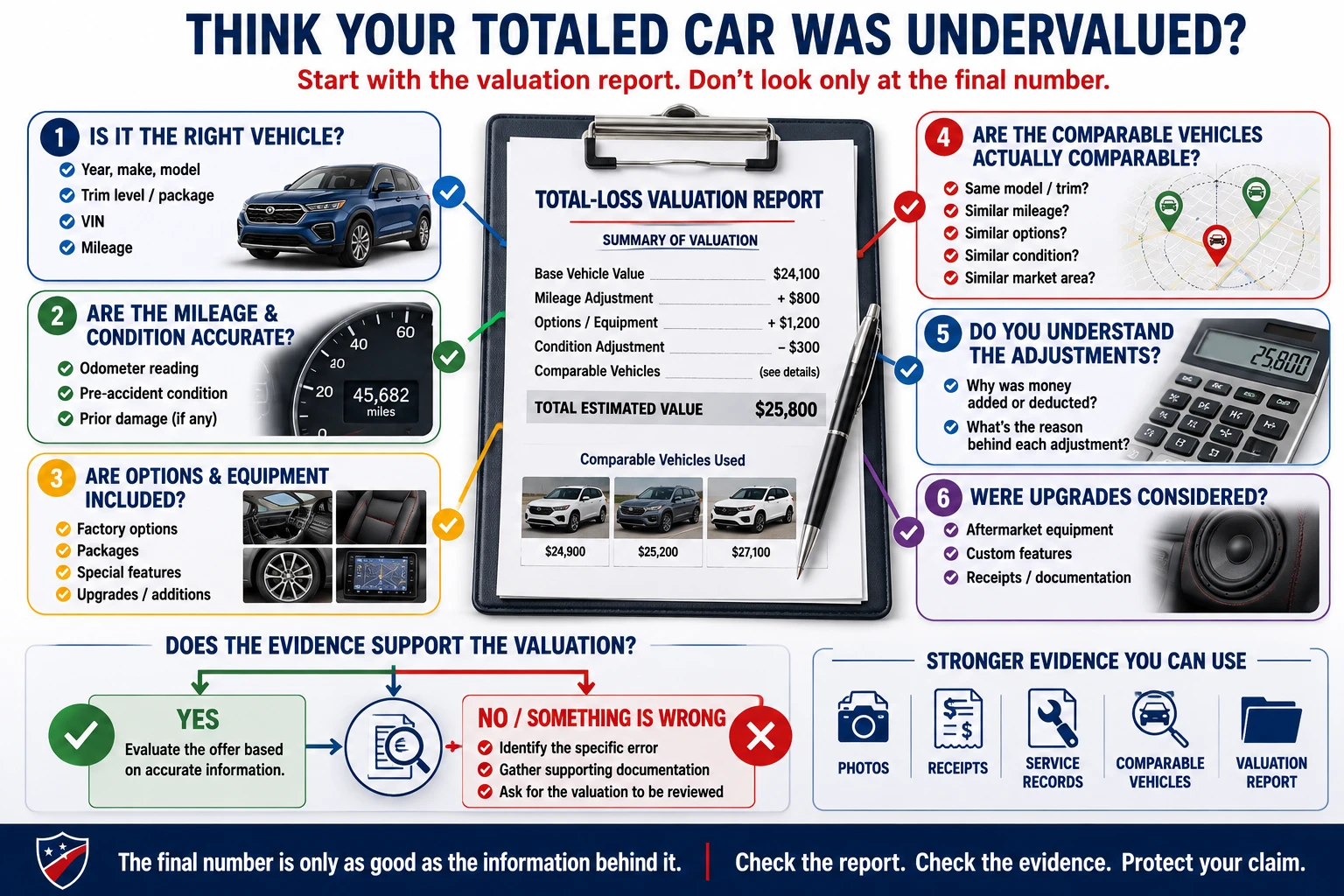
Start with the valuation report. Don’t look only at the final number.
A disagreement about value is much easier to evaluate when you can identify why you believe the valuation is inaccurate.
Look for issues such as:
- Incorrect mileage
- The wrong trim level or package
- Missing factory options
- An inaccurate description of the vehicle's pre-accident condition
- Comparable vehicles that are materially different from yours
- Missing equipment or documented upgrades
- Errors in the valuation report
- Adjustments that you do not understand
You may also have documentation that provides additional information about the vehicle, including photographs showing its pre-accident condition, maintenance or equipment records, receipts for relevant upgrades, and information about comparable vehicles.
The goal is not simply to tell the adjuster: “My car was worth more.”
A more useful question is: “What evidence supports this valuation, and is the information used to calculate it accurate?”
If you identify an error, explain it specifically and provide supporting documentation when available. A total-loss valuation can be questioned, but a stronger challenge is based on evidence rather than the owner’s personal attachment to the vehicle or the amount remaining on the loan.
Can I Negotiate the Value of My Totaled Car?
You can question or dispute a total-loss valuation if you have a legitimate reason to believe it does not accurately reflect the vehicle’s pre-accident value.
However, negotiating a total-loss claim is different from simply naming the amount you would like to receive. The most useful challenges generally identify specific problems with the insurer’s valuation or provide evidence supporting a different value.
For example, you might point out that:
- Your vehicle's trim level was entered incorrectly.
- Important factory options were omitted.
- The mileage is wrong.
- The condition rating does not accurately describe the vehicle before the accident.
- A comparable vehicle is a materially different model or trim.
- Documented equipment or upgrades were not considered.
You can also ask the adjuster to explain particular adjustments or comparable vehicles that you do not understand.
Focus the discussion on the vehicle and the evidence supporting its pre-accident value. The amount you owe on the loan, what you originally paid for the car, or what you personally believe the vehicle was worth does not necessarily establish its value for the total-loss claim.
What Mistakes Should I Avoid If My Car Is Totaled?
A total-loss claim can move quickly. Before the vehicle is released, sold as salvage, or the property-damage claim is finalized, make sure you understand what is happening and preserve the information you may need.
Common mistakes include:
- Accepting the valuation without reviewing the report. Look beyond the final number and check the information used to calculate it.
- Assuming your loan balance determines what the vehicle is worth. The vehicle's pre-accident value and your loan payoff are separate numbers.
- Failing to verify the vehicle information. Incorrect mileage, trim, options, equipment, or condition can potentially affect a valuation.
- Failing to document aftermarket equipment or modifications. Preserve receipts, photographs, and other available documentation.
- Leaving personal belongings in the vehicle. Remove personal property before the vehicle is surrendered when you are permitted to do so.
- Removing installed equipment without determining whether it was included in the valuation. Personal belongings and equipment incorporated into the vehicle are not necessarily treated the same way.
- Failing to photograph the vehicle before it is released. If you were injured, photographs of the collision damage may also be relevant to the broader accident investigation.
- Failing to check for gap coverage. If you owe more than the vehicle is worth, determine whether you purchased gap insurance or another product that may address some or all of the deficiency.
- Assuming rental coverage will continue indefinitely. Ask when rental authorization ends and preserve communications about the rental.
- Assuming settling the property-damage claim automatically settles the injury claim, or vice versa. These are different components of the accident.
- Signing a release without understanding what it covers. Before signing a settlement or release document, understand which claims, damages, and parties it is intended to resolve.
The goal is not to make the total-loss process unnecessarily complicated. It is to make sure you understand the valuation, preserve important evidence, and know exactly what you are agreeing to before the property-damage claim is closed.
What Is the Difference Between My Car's Value, My Loan Balance, and Gap Insurance?
These are three different things, and confusing them can make the total-loss process particularly frustrating.
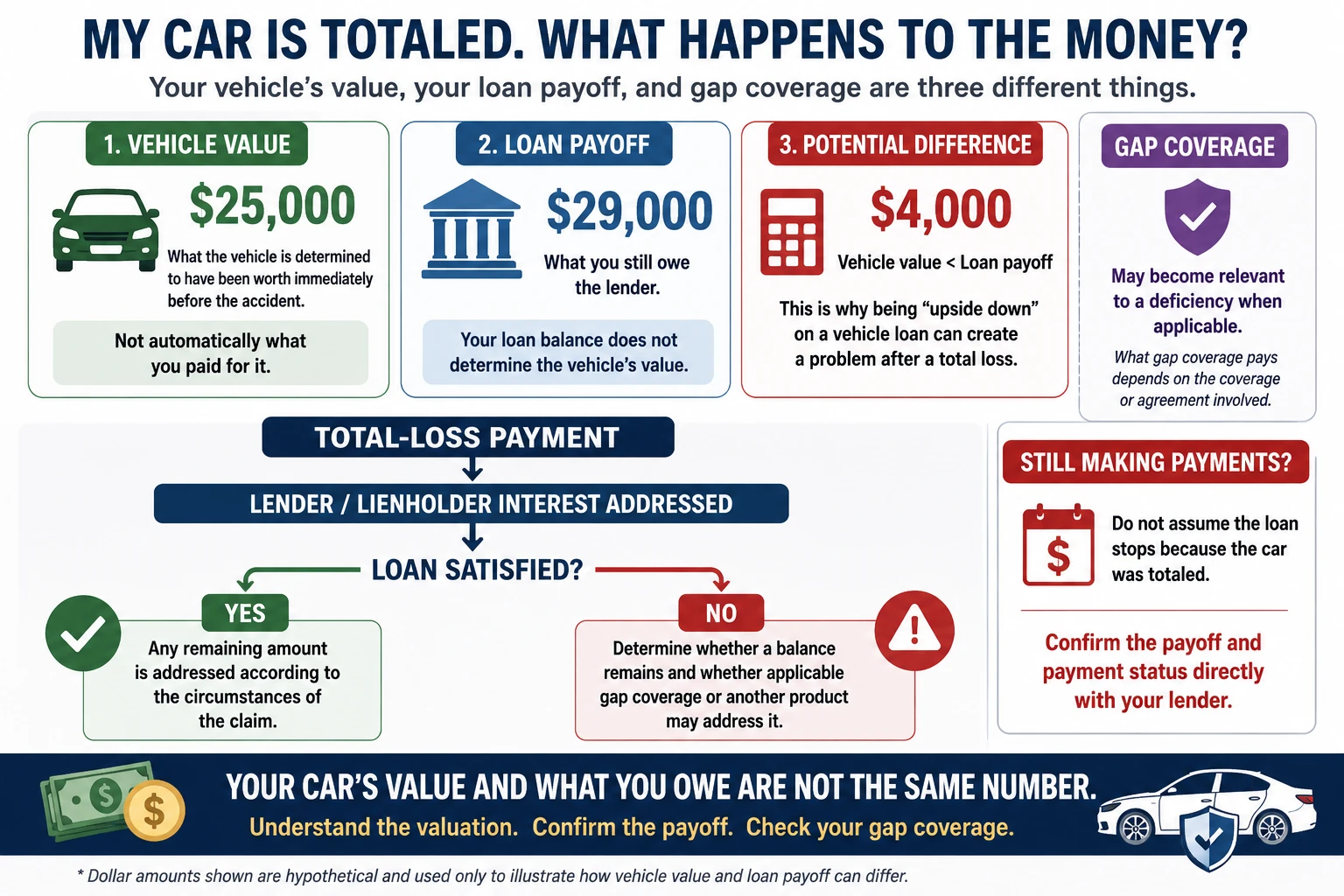
Your vehicle’s value, your loan payoff, and gap coverage are three different things.
Vehicle Value
This is the amount the vehicle was worth immediately before the accident under the valuation applicable to the property-damage claim.
It is not automatically the amount you originally paid for the vehicle.
Loan Payoff
This is the amount you still owe your lender.
Your loan balance is determined by your financing agreement, not by the current market value of the vehicle.
That means you can owe more than the vehicle is worth.
Gap Coverage
Gap coverage may become important when the amount owed on a financed vehicle exceeds the amount paid for the total loss.
Whether gap coverage applies, and exactly what it pays, depends on the coverage or agreement involved.
For example, imagine solely for illustration that:
Vehicle value: $25,000
Loan payoff: $29,000
Difference: $4,000
The fact that $29,000 remains on the loan does not automatically mean the property-damage insurer values the vehicle at $29,000. Applicable gap coverage may become relevant to the difference depending on its terms.
Before assuming you are personally responsible for a deficiency, or assuming gap coverage will pay all of it, review the applicable documents and determine exactly what coverage you purchased.
Who Gets the Insurance Check If I Still Have a Car Loan?
If you still owe money on a totaled vehicle, your lender has a financial interest in the vehicle that generally must be addressed as part of the total-loss process.
Depending on the circumstances, the insurance payment may involve the lender or lienholder rather than simply being paid entirely to you. The lender can provide a payoff amount showing what is required to satisfy the outstanding loan at that time.
If the total-loss payment is sufficient to satisfy the loan, the payoff process can be completed and any remaining amount can be addressed according to the circumstances of the claim.
If the vehicle’s value is less than the loan payoff, a deficiency may remain. That is when gap coverage or another applicable product may become particularly important.
Do not assume that receiving a total-loss offer means the loan has automatically been paid off. Confirm the payoff process with the lender and make sure you understand whether any balance will remain.
Can I Keep My Car After the Insurance Company Declares It a Total Loss?
In some circumstances, you may want to keep a vehicle even after it has been declared a total loss.
That decision can have financial and practical consequences. If you retain the vehicle, its salvage value may affect the amount paid on the property-damage claim, and title, repair, registration, safety, or insurance issues may also need to be considered depending on the circumstances.
Before deciding to keep the vehicle, ask:
- How much will retaining the vehicle reduce the total-loss payment?
- What is the vehicle's salvage value?
- What title requirements will apply?
- Can the vehicle legally and safely be repaired and returned to the road?
- Will obtaining future insurance be affected?
- Is there equipment or another legitimate reason that makes retaining the vehicle worthwhile?
Keeping a totaled vehicle is also different from simply wanting to retrieve personal belongings or potentially removable equipment.
Do not agree to retain the salvage vehicle until you understand what keeping it will cost you and what will be required afterward.
What Parts of a Total-Loss Valuation Should I Review Carefully?
When an insurance company sends you a total-loss valuation, do not review only the final dollar amount. Look at the information used to reach it.
Check:
Vehicle Information
Confirm the:
- Year
- Make
- Model
- Trim level
- Mileage
- Factory options
- Equipment
Pre-Accident Condition
Review how the report describes the vehicle’s condition before the collision.
If the report contains an inaccurate condition assessment, determine what documentation you have that may support a correction.
Comparable Vehicles
Look at the vehicles used for comparison.
Ask whether they are reasonably comparable in terms of:
- Model and trim
- Mileage
- Equipment
- Condition
- Location or market
Adjustments
If the valuation makes additions or deductions based on differences between your vehicle and the comparables, review those adjustments and ask questions about anything you do not understand.
Aftermarket Equipment
If your vehicle had documented custom equipment or modifications, determine whether and how those items were considered.
A valuation report is evidence supporting the insurer’s number. Reviewing the details allows you to determine whether the number is based on accurate information.
Can I Remove Aftermarket Equipment From a Totaled Car?
Maybe, but do not remove installed equipment without first determining how that equipment is being treated in the total-loss valuation and whether you are permitted to remove it.
There is an important difference between personal belongings inside the vehicle and equipment that has been installed as part of the vehicle.
Personal items such as clothing, child belongings, documents, or other possessions should generally be retrieved before the vehicle is released when you are permitted access.
Installed equipment can present a different issue. If custom wheels, stereo equipment, electronics, or other modifications have already been included in the insurer’s valuation of the vehicle, removing those items afterward could create a dispute.
Before removing installed equipment:
- Document it with photographs.
- Preserve receipts or other proof of purchase when available.
- Ask whether it was included in the valuation.
- Confirm whether you are permitted to remove it before doing so.
The key is to address these questions before the vehicle changes hands, not after it has already been transferred or sold as salvage.
Should I Photograph My Totaled Car Before It Is Taken Away?
Yes, when you can safely and reasonably do so. Once a totaled vehicle is transferred, moved to another facility, dismantled, repaired, or sold as salvage, you may no longer have the same opportunity to document its condition.
Useful photographs may include:
- All sides of the vehicle
- The primary impact area
- Close-ups of significant damage
- The interior
- Airbag deployment
- Damaged seats or interior components when relevant
- Aftermarket equipment
- Personal property damaged in the collision
- The odometer
- The VIN
- The overall pre-release condition of the vehicle
If you were injured, these photographs may have value beyond the property-damage claim. Vehicle photographs can become part of the broader evidence documenting the collision, the location and extent of vehicle damage, and what happened to the vehicle during the crash.
At the same time, vehicle damage by itself does not establish the nature or severity of a particular person’s injuries. Medical causation should be evaluated from the appropriate medical and other evidence.
Preserve the photographs even after the total-loss portion of the claim has been resolved.
What If I Still Owe More Than My Totaled Car Is Worth?
This is often called being “upside down” on the vehicle loan.
For example, your vehicle may have depreciated faster than you paid down the loan. If the car is then totaled, its pre-accident value may be less than the amount required to pay off the lender.
That can create a difficult situation:
Vehicle value < Loan payoff = Potential remaining loan balance
Being upside down does not necessarily mean the property-damage insurer must pay the entire loan balance. The property claim generally focuses on the vehicle’s value rather than simply replacing whatever debt remains on the financing agreement.
If this happens, determine whether you purchased gap coverage or another product that may apply to some or all of the deficiency.
If you were also injured in the collision, keep the two issues conceptually separate. Your bodily injury claim should be evaluated based on the injuries and legally recoverable damages arising from the accident, not simply as a way to make up the difference on an underwater vehicle loan.
What Happens to My Car Payment While the Total-Loss Claim Is Pending?
Do not assume that you can stop making payments simply because the vehicle has been totaled.
The accident and total-loss determination do not necessarily suspend your obligations under the loan agreement. Until the lender confirms that the loan has been satisfied or tells you otherwise, the financing agreement may remain in effect.
Contact the lender promptly and ask:
- What is the current payoff amount?
- Are payments still due while the insurance claim is pending?
- What information does the lender need from the insurance company?
- How will the insurance payment be applied?
- Will any balance remain after the insurance payment?
Keep documentation of your communications with both the lender and insurance company.
Do not rely on assumptions about the loan simply because you no longer have a usable vehicle. Confirm the status directly with the lender.
How Long Can I Keep a Rental Car After My Vehicle Is Declared a Total Loss?
Rental-car coverage after an accident can depend on which insurance policy is paying, the available coverage, and the status of the total-loss claim.
If another driver caused the collision, reasonable rental or loss-of-use issues may be addressed through the property-damage claim when applicable. If you have rental reimbursement coverage under your own auto policy, that coverage may also be relevant depending on its terms.
What is especially important in a total-loss case is that rental authorization may end before you have actually purchased another vehicle. An insurer may establish an end date after the total-loss valuation or settlement process reaches a particular point.
Ask the adjuster:
- Is my rental currently authorized?
- What is the last authorized rental date?
- What event causes rental coverage to end?
- Is there a daily or total limit?
- What happens if I dispute the vehicle valuation?
- Do I need written authorization for additional rental days?
Whenever possible, obtain the rental cutoff date in writing and preserve your receipts and communications.
Do not assume the rental will remain covered simply because you have not yet purchased a replacement vehicle, or because you are still disputing the total-loss valuation.
Do I Have to Pay a Deductible If My Car Is Totaled?
Whether a deductible applies can depend on which insurance coverage is handling the property-damage claim.
If you use collision coverage under your own auto policy, your policy may require a deductible. For example, if the covered vehicle value is determined and your collision coverage has a deductible, the deductible may be taken into account when your insurer calculates the payment under your policy.
If the property-damage claim is instead being paid directly through another driver’s liability coverage, the process is different because you are not making the same type of first-party collision claim under your own policy.
In some situations, your own insurer may later pursue reimbursement from a responsible party or insurer. Whether a deductible can ultimately be recovered depends on the circumstances.
Do not decide which coverage to use based solely on the deductible. Timing, liability disputes, available coverage, rental issues, and other circumstances can also matter.
Can I Resolve My Totaled-Car Claim Without Settling My Injury Claim?
Property damage and bodily injury are different components of an accident claim. Resolving what happens to your vehicle does not necessarily mean your injury claim must be resolved at the same time.
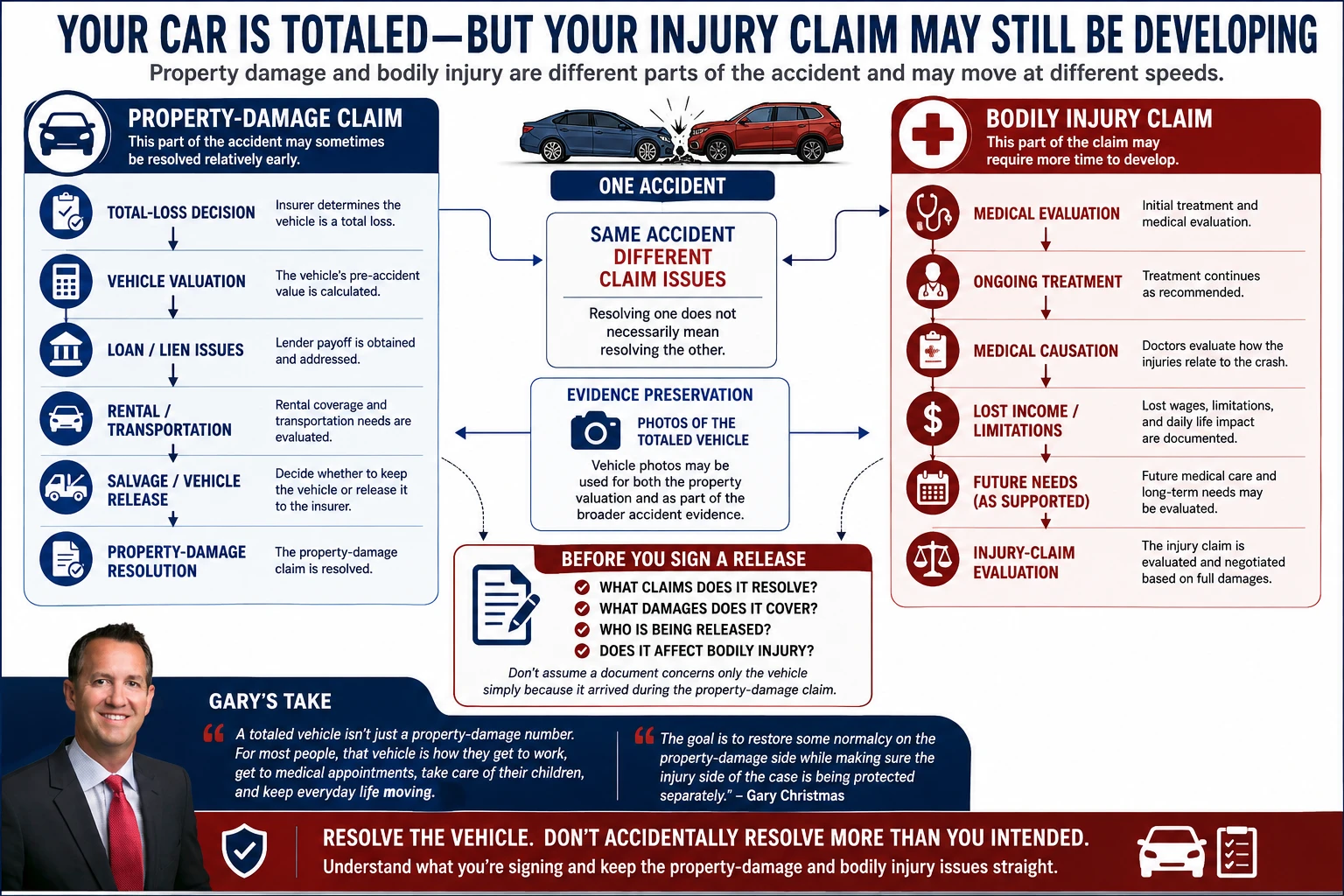
Property damage and bodily injury are different parts of the accident and may move at different speeds.
That distinction can be especially important because the two claims may develop at very different speeds.
The value of a totaled vehicle can often be evaluated relatively early. An injury claim may take longer because medical treatment, causation, future medical needs, lost income, ongoing limitations, and other damages may still be developing.
Before signing any release or settlement document, however, read it carefully and understand exactly what it is intended to resolve.
Ask:
- Does this document resolve only the property-damage claim?
- Does it contain language concerning bodily injury?
- Which parties are being released?
- Which claims or damages are being released?
- Is the release final?
Do not assume a document applies only to your vehicle simply because it arrived while the total-loss claim was being handled.
Getting the property-damage claim resolved can help you replace your transportation and move forward. Protecting the injury claim means making sure you do not unintentionally resolve something you were not ready to settle.
Can a Personal Injury Lawyer Help With Total-Loss Issues Too?
A personal injury lawyer’s primary role is handling the legal claim arising from your injuries, but property-damage issues can affect the broader accident case and the practical problems you are facing after the collision.
For example, the totaled vehicle may involve questions about:
- Preserving photographs and other vehicle evidence
- Insurance coverage
- Communications with adjusters
- The timing of the property-damage resolution
- Documents or releases you are being asked to sign
- Transportation while the injury claim continues
At Christmas Injury Lawyers, we want clients to understand how the different parts of the accident fit together. Resolving the vehicle can help restore transportation and stability, while the bodily injury claim may require a separate and more detailed evaluation.
Our role is not to make every property-damage issue unnecessarily adversarial. It is to help our clients understand the process, identify issues that may affect the broader case, and avoid unintentionally compromising the injury claim while trying to get the vehicle problem resolved.
Totaled Vehicle Checklist
- Photograph the vehicle before it is released or transferred when practical
- Remove personal belongings before surrendering the vehicle
- Obtain the complete written total-loss valuation
- Verify the year, make, model, trim level, mileage, options, and equipment
- Review how the vehicle's pre-accident condition was described
- Review the comparable vehicles and adjustments used in the valuation
- Document aftermarket equipment and significant modifications
- Preserve receipts, photographs, and other evidence supporting disputed value
- Determine your current loan payoff amount
- Check whether you purchased gap coverage
- Contact your lender about the payoff process and continuing payments
- Ask exactly when rental-car authorization ends
- Keep rental receipts and insurance communications
- Understand the financial and title consequences before deciding to keep the totaled vehicle
- Do not remove installed equipment until you determine whether it was included in the valuation and whether removal is permitted
- Preserve vehicle photographs and other evidence if you were injured
- Remember that property damage and bodily injury are separate components of the accident
- Read any release carefully before signing it
- Make sure you understand exactly which claims, damages, and parties a settlement document will resolve
Gary's Take: Why Can Losing a Vehicle Feel So Disruptive After an Accident?
“A totaled vehicle isn’t just a property-damage number. For most people, that vehicle is how they get to work, get to medical appointments, take care of their children, and keep everyday life moving.”
“When you’re already dealing with injuries, missed work, and everything else that follows a serious accident, suddenly losing your transportation creates another problem you didn’t ask for. That’s why I think it’s important to help clients understand what is happening with the vehicle and what decisions actually need to be made.”
“The goal is to restore some normalcy on the property-damage side while making sure the injury side of the case is being protected separately,” says Gary Christmas.
In Summary
If your vehicle is totaled after an accident, the property-damage claim generally focuses on the vehicle’s pre-accident value, not what you originally paid for the car or what you still owe on the loan. That is why the insurance valuation, loan payoff, and any gap coverage should be evaluated separately.
Before accepting a total-loss valuation, review the report carefully. Check the vehicle’s year, model, trim, mileage, options, condition, comparable vehicles, adjustments, and documented aftermarket equipment. If something is wrong, identify the specific issue and support your position with available evidence rather than focusing only on the final number.
You should also address the practical issues surrounding the vehicle: preserve photographs, retrieve personal property, understand how installed equipment is being treated, determine what happens to your loan, find out when rental authorization ends, and understand the consequences before deciding to keep the salvage vehicle.
Most importantly, if you were injured, remember that your property-damage claim and bodily injury claim are different components of the accident. Resolving the totaled vehicle can help restore transportation and normalcy without necessarily requiring you to resolve an injury claim that may still be developing. Read any release carefully so you understand exactly what claims, damages, and parties it affects.