


What Should I Do If the Other Driver Admitted Fault?
An admission can be useful, but do not treat it as a substitute for preserving the rest of the evidence.
| If This Happened | What to Do |
|---|---|
| Driver admitted fault at the scene | Document what happened and identify witnesses who heard the statement |
| Driver apologized or made a statement about the crash | Preserve the exact words as accurately as possible without exaggerating what was said |
| Admission was made by text or message | Save the original communication and preserve screenshots or copies |
| Admission may be captured on video or audio | Preserve the recording and its original source when available |
| Police responded to the collision | Obtain the collision report and preserve officer/witness information |
| Another person witnessed the crash | Preserve the witness's name and contact information |
| Nearby cameras may have recorded the collision | Act quickly to identify and preserve potentially relevant footage |
| The insurer disputes what happened | Preserve photographs, video, physical evidence, statements, and other available proof |
| You were injured | Seek appropriate medical evaluation and accurately report your symptoms |
| The claim is not being resolved | Consider obtaining legal advice about the evidence, coverage, damages, and applicable deadlines |
Is the Other Driver's Admission of Fault Legally Binding?
Not necessarily. A driver’s statement that an accident was “my fault” can be relevant evidence, but the legal effect of the statement depends on what was actually said and the circumstances in which it was made.
There is an important difference between a statement about facts and a person’s own conclusion about legal fault.
For example: “I was looking down at my phone and didn’t see the red light.” provides factual information about what the driver says happened.
By comparison: “I’m sorry. This was all my fault.” may still be important, but it is a broader conclusion made by the driver, sometimes in the immediate aftermath of a stressful collision.
The entire case should not be reduced to one sentence. Photographs, video, witness statements, vehicle damage, roadway evidence, traffic laws, electronic data when available, and other evidence may help establish how the crash actually occurred.
Preserve the admission, but evaluate it together with the rest of the evidence.
Does Saying "I'm Sorry" Mean the Other Driver Admitted Fault?
Not necessarily. An apology and an admission of specific facts are not always the same thing.
After a frightening collision, someone may say “I’m sorry” because another person is hurt, because the accident happened, or because they are upset about the situation. The meaning depends on the surrounding circumstances and what else was said.
A more specific statement may carry different evidentiary significance. For example: “I didn’t see the stop sign.” or: “I looked down and rear-ended you.” contains factual information about the driver’s conduct.
If the other driver made a statement after the accident, preserve the actual words as accurately as you can rather than turning an apology into a stronger admission than the person actually made.
Why Isn't the Insurance Company Paying If the Other Driver Admitted Fault?
Because fault for causing the collision is only one part of an injury claim.
Even if the insurer ultimately accepts that its insured caused the accident, it may still investigate or dispute other issues, including:
- Whether you contributed to causing the collision
- Whether the accident caused the injuries being claimed
- Whether particular symptoms are accident-related
- The nature and extent of the injuries
- The medical treatment received
- Whether future treatment is supported by the medical evidence
- Lost income or reduced earning ability
- Other claimed damages
- Available insurance coverage
For example, an insurer could accept that its driver rear-ended you but dispute whether a particular medical condition was caused by the collision. Or it could accept liability and still disagree about the amount of compensation supported by the evidence.
“Your driver caused the crash” and “here is the amount that should be paid” are two different conclusions.
That is why a strong injury claim requires evidence not only of how the collision happened, but also of what injuries and losses the collision caused.
Can the Insurance Company Dispute My Claim Even If Its Driver Admitted Fault?
Yes. A driver’s admission does not necessarily prevent the insurance company from conducting its own investigation or disputing part of the claim.
The insurer may review photographs, statements, the collision report, witness accounts, vehicle damage, applicable traffic rules, medical information, and other evidence before taking a position.
It may ultimately:
- Accept that its driver caused the collision
- Argue that both drivers share some responsibility
- Dispute what its insured actually admitted
- Dispute whether the accident caused particular injuries
- Dispute the nature or extent of the damages
- Raise an insurance-coverage issue
That does not mean the insurer’s position automatically controls the outcome.
The driver’s statement is evidence. The insurer’s position is a position. The ultimate strength of the claim depends on the facts, applicable law, and supporting evidence.
What Does an Admission of Fault Actually Prove?
An admission may help establish one or more facts about how the collision happened, depending on exactly what the driver said.
But it does not necessarily establish every element of an injury claim.

An admission can be important evidence, but it does not automatically answer every question in an injury claim.
Think of the case as several separate questions:
What happened? How did the collision occur, and what did each driver do?
Who was legally responsible? How did each person’s conduct contribute to causing the collision?
What injuries did the accident cause? Which medical conditions are supported as accident-related?
What losses resulted? What medical expenses, lost income, limitations, and other damages are supported by the evidence?
What insurance coverage applies? Which policies and coverage limits may be relevant?
A statement such as “I ran the red light” may be powerful evidence concerning the first questions. It does not, by itself, establish the nature of another person’s injuries or the monetary value of the resulting losses.
An admission can strengthen a case without answering every question the case requires.
Can an Insurance Company's Refusal to Settle Create Additional Legal Issues?
In some circumstances, yes, but this is a specialized area of South Carolina insurance law, and an ordinary disagreement or delay does not automatically create a separate claim against the insurance company.
South Carolina law recognizes duties that can become important when a liability insurer is handling a claim against its insured. One concept sometimes discussed in serious injury cases is commonly associated with the Tyger River doctrine.
The application of that law depends heavily on the facts, including the insurer’s obligations to its insured, the information available to the insurer, the opportunity presented, and how the claim was handled.
For an injured person, the practical point is simpler:
Preserve the evidence supporting liability and damages, document important communications, and do not assume that an insurer’s refusal to pay automatically establishes bad faith or some additional remedy.
When the circumstances raise a serious insurance-handling issue, a South Carolina attorney can evaluate whether additional legal considerations apply.
Why Might a Claim Remain Disputed Even When Liability Seems Clear?
Even when the evidence of fault appears strong, the parties may still disagree about other parts of the claim.
The insurer may be evaluating medical causation, prior injuries or conditions, the reasonableness and necessity of treatment, lost income, future medical needs, the extent of physical limitations, or other claimed damages.
There may also be insurance-coverage questions or disagreements about whether the injured person contributed to causing the collision.
That is why it helps to identify exactly what remains disputed.
Ask:
- Is liability still disputed?
- Has the insurer accepted that its driver caused the collision?
- Is medical causation disputed?
- Is the amount of medical treatment disputed?
- Is lost income disputed?
- Is there a coverage issue?
- Is the disagreement primarily about the amount of compensation?
A claim that feels like “they won’t pay” may actually involve one specific unresolved issue. Identifying that issue makes it easier to determine what evidence or legal step is needed next.
What Mistakes Should I Avoid After the Other Driver Admits Fault?
An admission can create a false sense that the case is already proven. Do not stop protecting the claim simply because the other driver said the accident was their fault.
Common mistakes include:
- Failing to preserve the admission. Save relevant texts, messages, recordings, or other communications when available.
- Failing to identify witnesses. Someone else may have heard the statement or seen the collision.
- Treating an apology as more specific than it really was. Preserve the actual words rather than exaggerating what the driver said.
- Assuming no other accident evidence is necessary. Photographs, video, witnesses, roadway evidence, and other proof may become extremely important if the story later changes.
- Making your own unnecessary statements about fault. Describe what you actually know without guessing about legal responsibility or assigning percentages.
- Assuming an admission proves your injuries. Medical causation and damages still require appropriate evidence.
- Delaying appropriate medical evaluation because you think liability is already settled. Your health and medical documentation are separate from the driver's admission.
- Assuming the insurer must accept its driver's statement. The insurance company may conduct its own investigation.
- Accepting a quick settlement before understanding your injuries and losses. Fault and claim value are different issues.
- Signing a release without understanding what it resolves. Determine which claims, damages, and parties the document affects.
- Waiting too long because you believe the admission guarantees payment. Legal deadlines can continue running while the insurance claim remains unresolved.
The admission may help your case. It should not replace the work of preserving the evidence and documenting the injuries and losses the accident actually caused.
What Other Evidence Can Support the Driver's Admission?
A driver’s admission can be important, but the strongest liability analysis usually considers the statement alongside the other available evidence.
Depending on the collision, that evidence may include:
- Photographs of the accident scene
- Vehicle damage and vehicle positions
- Dash-cam footage
- Surveillance or doorbell video
- Independent witness statements
- The collision report
- Traffic-signal or roadway evidence
- Skid marks or other physical roadway evidence
- Electronic vehicle data when available
- Commercial-driver or company records when relevant
- Expert accident reconstruction when appropriate
For example, if a driver says, “I ran the red light,” and independent video shows that driver’s vehicle entering the intersection after the light changed, the statement and the independent evidence may reinforce one another.
In commercial-vehicle cases, additional evidence may exist, including electronic data, driver records, dispatch information, or other company materials. Some of that evidence may not be preserved indefinitely.
Do not rely on the admission alone when independent evidence may be available to show what actually happened.
What If the Other Driver Admitted Fault at the Scene but Changes Their Story Later?
A later change in the driver’s account does not necessarily erase an earlier statement.
If the driver admitted specific facts at the scene and later gives a different version of events, both statements may become relevant when evaluating credibility and determining what actually happened.
That is one reason preservation matters.
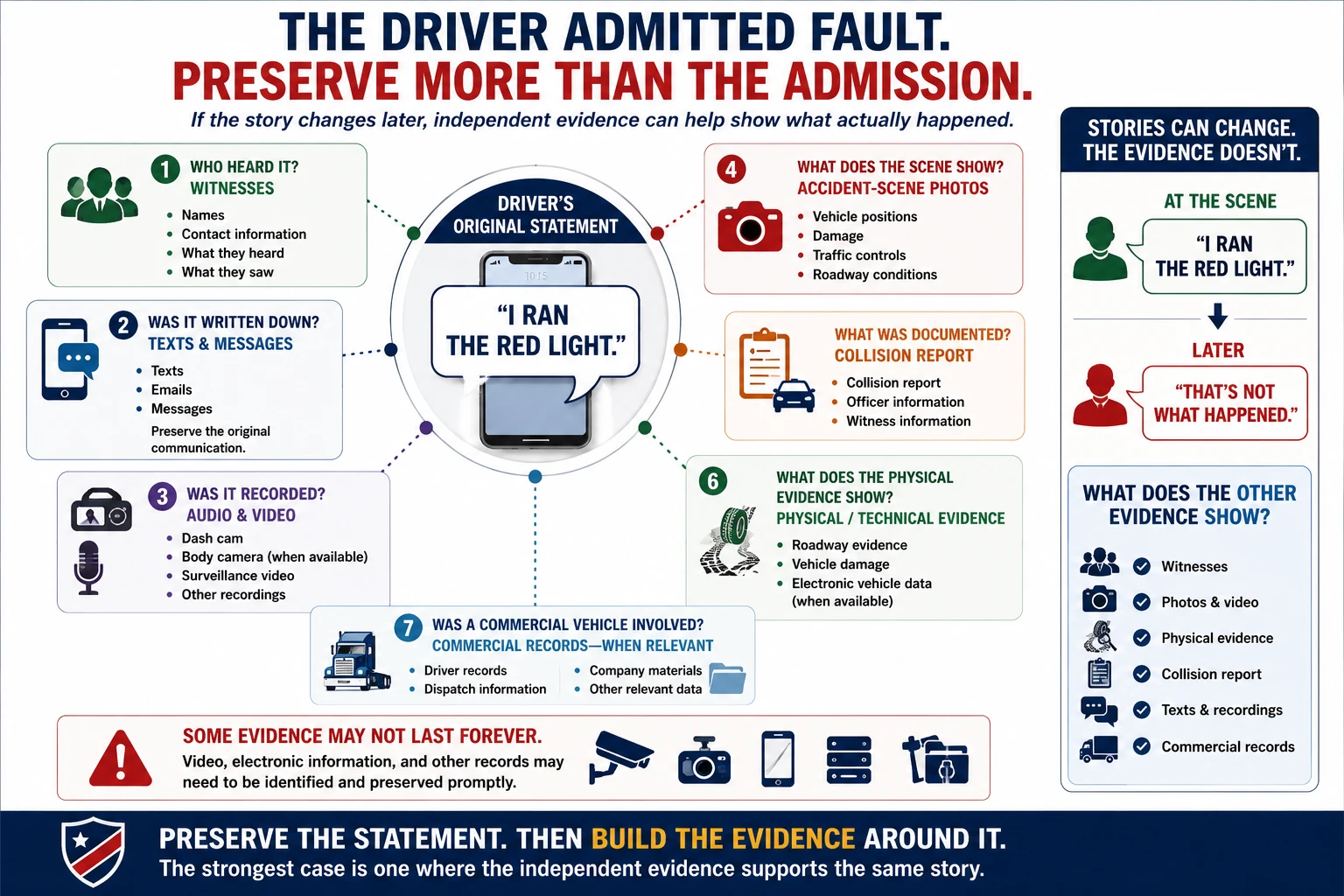
If the story changes later, independent evidence can help show what actually happened.
An earlier statement may be supported by:
- Witnesses who heard it
- Police body-camera or dash-camera footage when available
- Text messages
- Recorded communications
- Photographs or video
- The collision report
- Physical evidence from the scene
- Other statements made close in time to the accident
Do not embellish the earlier admission or try to recreate exact wording you do not remember.
Preserve what you actually have, identify who heard or recorded the statement, and let the complete evidence show whether the driver’s account changed.
What Should I Do If the Driver Admitted Fault but the Claim Still Is Not Moving?
If the other driver admitted fault but the claim remains unresolved, first determine what is actually preventing it from moving forward.
Ask whether:
- Liability is still being investigated
- The insurer disputes part of the accident
- Medical causation is disputed
- The insurer is waiting for medical records or other information
- There is a disagreement about damages
- There is an insurance-coverage issue
- A demand or other submission is still under review
Keep a record of communications and preserve the evidence supporting both liability and damages.
At the same time, continue appropriate medical care and keep documentation of treatment, expenses, lost income, and other accident-related losses.
If reasonable efforts to resolve the claim are not producing meaningful progress, an attorney can evaluate what remains disputed, communicate with the insurer, develop the supporting evidence, and determine whether litigation or another legal step is appropriate.
An admission can strengthen the evidence, but it does not eliminate the need to move the case through the appropriate process.
Does the Other Driver's Admission of Fault Extend My Filing Deadline?
No. You should not assume that an admission of fault, an open insurance claim, or ongoing settlement discussions extend the legal deadline for filing a lawsuit.
South Carolina limitation periods depend on the type of claim, the parties involved, and the circumstances. Many negligence claims are subject to a limitations period, but different rules or notice requirements can apply in particular situations, including some claims involving governmental entities.
The important point for this page is: a strong admission does not preserve a claim indefinitely.
You can have excellent evidence of fault and still create a serious legal problem by waiting beyond an applicable filing or notice deadline.
If the deadline is uncertain, have the specific claim evaluated rather than relying on the insurance company’s continued communication or the other driver’s admission.
How Can Christmas Injury Lawyers Help When the Other Driver Admitted Fault but the Claim Is Still Disputed?
At Christmas Injury Lawyers, we do not assume that an admission ends the liability investigation. We preserve it, test it against the other evidence, and build the case around what the facts can prove.
That may include identifying witnesses, preserving photographs and video, obtaining relevant records, evaluating applicable insurance coverage, reviewing medical evidence, documenting lost income and other damages, and determining what issues the insurance company is actually disputing.
We also prepare cases with litigation in mind from the beginning. That does not mean every case should go to trial. It means important evidence should be developed in a way that allows the claim to be presented effectively if informal negotiations do not produce a fair resolution.
Our goal is not to rely on one statement made at the accident scene. Our goal is to build the evidence necessary to prove what happened, what injuries the collision caused, and what losses are supported by the facts.
If a supported claim cannot be resolved through negotiation, we can evaluate the appropriate next step, including litigation when necessary.
Gary's Take: How Much Weight Should I Put on an Admission of Fault?
“If the other driver admits fault, I want to preserve that statement. But I don’t want to build the entire case around one sentence somebody said at the accident scene.”
“I want the photographs. I want the witnesses. I want the video if it exists. I want to know what the physical evidence shows. And on the injury side, I want the medical evidence to show what this collision actually caused.”
“An admission can be important evidence. The strongest case is the one where the rest of the evidence tells the same story,” says Gary Christmas.
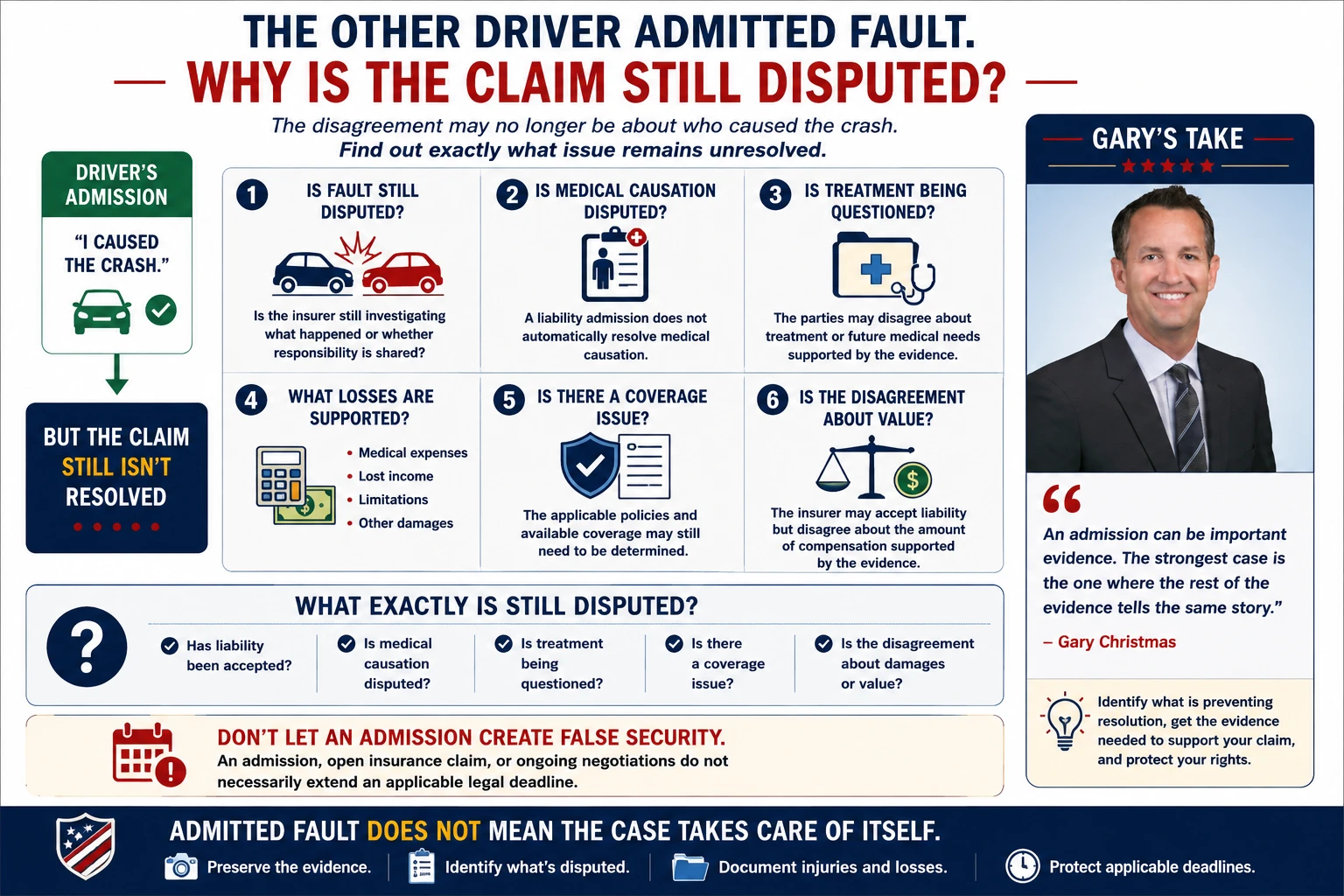
The disagreement may no longer be about who caused the crash. Find out exactly what issue remains unresolved.
Other Driver Admitted Fault Checklist
- Preserve the driver's actual statement as accurately as possible
- Save relevant texts, emails, messages, audio, or video
- Identify anyone who heard the admission
- Preserve accident-scene and vehicle photographs
- Look for dash-cam, surveillance, or other video evidence
- Obtain the collision report when available
- Preserve witness names and contact information
- Do not exaggerate an apology into a more specific admission
- Do not rely on the admission as your only liability evidence
- Do not guess about fault or assign yourself a percentage
- Seek appropriate medical evaluation for accident-related symptoms
- Accurately report injuries and symptoms to your medical providers
- Keep medical records, bills, and lost-income documentation
- Find out exactly what the insurance company is disputing
- Do not assume admitted fault establishes the value of the injury claim
- Do not accept a settlement simply because liability appears clear
- Understand any release before signing it
- Do not assume negotiations or an admission extend a legal deadline
- Consider legal advice if the claim remains disputed or stalled
In Summary
If the other driver admits fault after a South Carolina car accident, preserve the statement, but do not assume that one admission resolves the entire injury claim. What the driver actually said, the circumstances surrounding the statement, and the other available evidence all matter.
An admission may help establish how the collision happened, particularly when it contains specific facts such as “I ran the red light” or “I looked down and rear-ended you.” But an apology or statement that “it was my fault” does not necessarily establish every issue in the case. Liability, medical causation, the nature and extent of the injuries, damages, and available insurance coverage may still need to be investigated and supported by evidence.
That is why you should preserve more than the admission itself. Save relevant texts, messages, recordings, photographs, and video. Identify witnesses. Obtain the collision report when available. Preserve other evidence showing how the crash occurred, and keep accurate documentation of your medical treatment, expenses, lost income, and other accident-related losses. If the driver later changes their story, the earlier statement and the independent evidence surrounding it may become especially important.
If the insurance company still will not resolve the claim, find out exactly what remains disputed. The disagreement may concern liability, medical causation, treatment, damages, insurance coverage, or another specific issue. Identifying that issue can help determine what additional evidence or legal step may be necessary.
Most importantly, do not let an admission create a false sense that the case will take care of itself. Continue protecting the evidence, your medical documentation, your losses, and applicable legal deadlines. An admission can be important evidence, but the strongest claim is one in which the rest of the evidence supports the same story.