

What Questions Should I Ask Before Hiring a Car Accident Lawyer?
| Question | Why It Matters |
|---|---|
| Who will actually be my lawyer? | You should know who is responsible for legal decisions and case strategy |
| How much of your practice involves personal injury cases? | Helps you understand the lawyer's experience with injury claims |
| What experience do you have taking injury cases to trial? | Shows whether litigation is genuinely part of the lawyer's practice |
| When was the last injury case you tried? | Helps distinguish current courtroom experience from experience many years ago |
| How will you communicate with me? | Sets expectations for updates, calls, emails, and questions |
| Who do I contact if I need help? | Helps you understand the firm's day-to-day support structure |
| How do you investigate my case? | Shows how the firm approaches evidence, insurance, medical issues, and damages |
| How do you decide whether to recommend settlement or litigation? | Helps you understand the lawyer's decision-making process |
| What resources does your firm have? | Serious cases may require medical records, experts, investigation, technology, and litigation support |
| How does your contingency fee work? | You should understand how attorney fees are calculated |
| What case expenses may be involved? | Fees and litigation expenses are not necessarily the same thing |
| How many cases is my team handling? | Helps you evaluate whether the firm has the capacity to give the case appropriate attention |
| What will you need from me during the case? | Sets expectations for the attorney-client relationship |
A good consultation should help you understand not only the lawyer’s credentials, but also what working with that lawyer will actually feel like after you hire the firm.
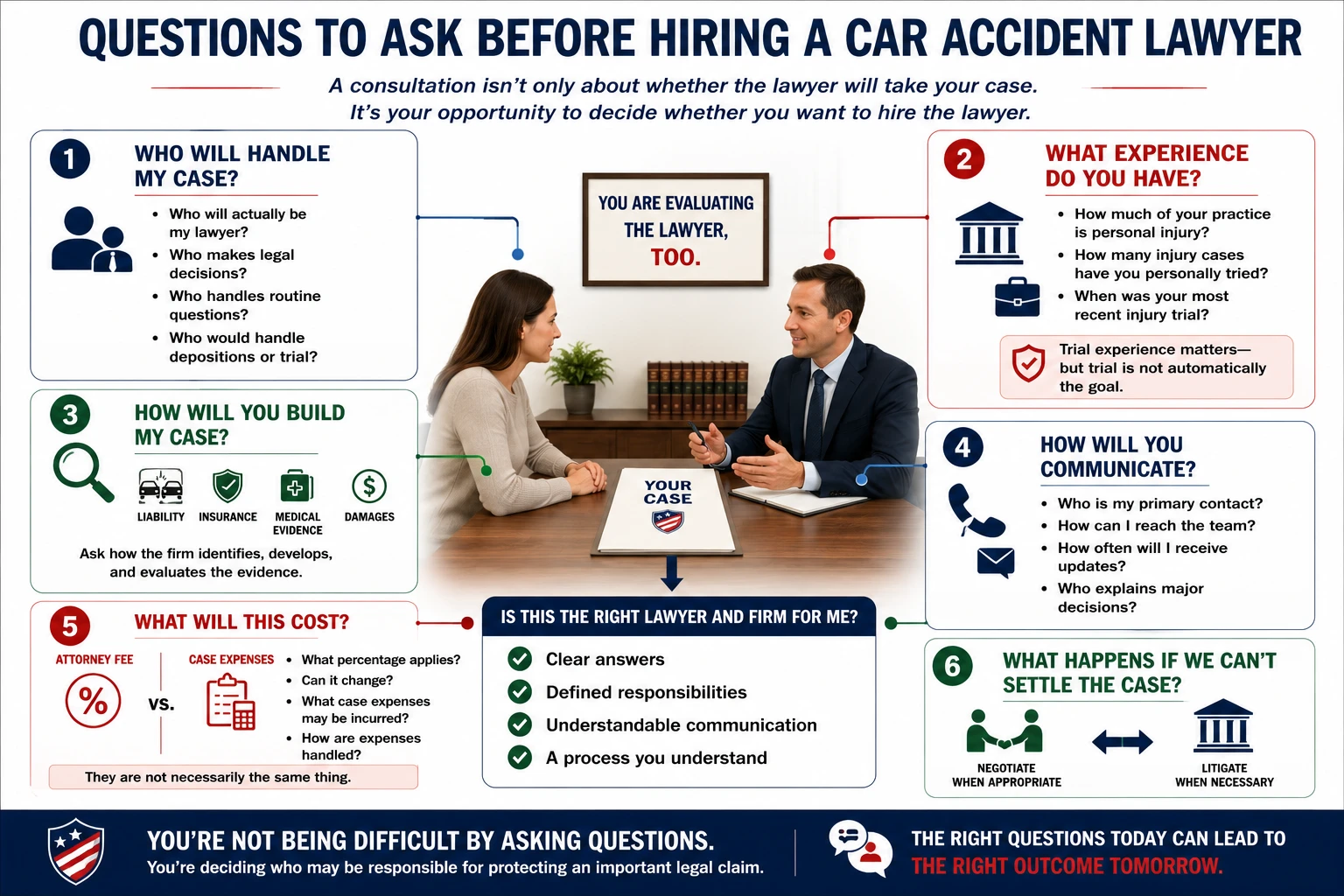
A consultation isn’t only about whether the lawyer will take your case. It’s your opportunity to decide whether you want to hire the lawyer.
What Mistakes Should I Avoid When Choosing a Car Accident Lawyer?
One common mistake is choosing a lawyer based primarily on advertising, slogans, or promises about results without learning how the lawyer actually handles cases.
Another is failing to ask who will be responsible for the case after the initial consultation. You may speak with one attorney at the beginning but work primarily with a different attorney or team afterward. That is not necessarily a problem, but you should understand the structure before hiring the firm.
It can also be a mistake to focus only on settlement history without asking whether the lawyer has meaningful litigation experience. Most injury cases do not go to trial, but if a fair resolution cannot be reached, you want to know whether the lawyer is prepared to move the case into litigation when appropriate.
Communication matters too. Ask how often the firm provides updates, who responds to questions, and what happens if you cannot reach someone.
Finally, do not hire a lawyer simply because they tell you what you want to hear during the first conversation. No responsible attorney can guarantee the outcome of a case before the evidence, medical issues, insurance coverage, and damages have been evaluated.
The better question is:
Does this lawyer explain the process clearly, answer difficult questions honestly, and have a system for actually handling the case?
Why Does Trial Experience Matter in a Car Accident Case?
Most car accident claims are resolved without a jury trial. Even so, trial experience can matter because litigation may become necessary when important issues cannot be resolved through negotiation.
A lawyer who handles litigation should understand how to:
- Develop admissible evidence
- Take and defend depositions
- Work with medical and other experts when appropriate
- Prepare witnesses
- Address motions and legal disputes
- Present liability and damages evidence
- Try the case before a judge or jury when necessary
That does not mean every case should be pushed toward trial.
The question is whether your lawyer has both options available: the ability to negotiate when a reasonable resolution is possible and the ability to litigate when it is not.
During the consultation, ask the lawyer about their actual litigation experience and how they decide when filing a lawsuit is appropriate.
How Do I Know Whether a Lawyer Is a Good Fit for My Case?
A lawyer may have impressive credentials and still not be the right fit for every client.
You should feel comfortable asking questions about your case and receiving understandable answers. You should know who is responsible for the legal strategy, how updates will be provided, and how quickly the team generally responds when you need help.
You should also understand the lawyer’s approach to important issues such as:
Liability: How will the firm investigate who caused the collision?
Insurance: How will potentially applicable coverage be identified?
Medical evidence: How will the firm obtain and evaluate medical records, bills, and causation issues?
Damages: How will lost income, limitations, future treatment, and other supported losses be documented?
Litigation: What happens if the case cannot be resolved through negotiation?
A good fit means more than liking the lawyer during the first meeting. It means understanding how the firm will protect, develop, and communicate about your case over time.
What Should I Expect When I First Contact a Car Accident Lawyer?
Most people who contact our office are dealing with some combination of shock, stress, pain, and uncertainty.
For many clients, the accident is one of the most difficult events they have ever experienced. They may be injured, unable to work, facing mounting medical bills, and unsure of what to do next.
Our goal is to relieve that burden. We tell our clients that their primary job is to focus on their medical treatment and recovery. Our job is to handle the legal issues, communicate with the insurance companies, and guide them through the process.
We also place a strong emphasis on communication. Through meetings, phone calls, emails, text messages, and other forms of communication, we work hard to ensure our clients feel heard, informed, and supported every step of the way.
What Questions Should I Ask a Car Accident Lawyer During the Consultation?
The consultation is your opportunity to evaluate the lawyer just as much as the lawyer is evaluating the case.
Ask direct questions.
You may want to ask:
- Who will actually be responsible for my case?
- How much of your practice involves personal injury cases?
- What experience do you have handling cases involving injuries like mine?
- How many injury cases have you personally tried?
- When was your most recent injury trial?
- How do you investigate disputed fault?
- How do you identify available insurance coverage?
- How do you handle medical records and medical causation issues?
- How do you document lost income and other damages?
- How often will I receive updates?
- Who will I call when I have a question?
- What happens if the insurance company will not make a reasonable offer?
- How do you decide whether to recommend settlement or litigation?
- How does your contingency fee work?
- What case expenses could be involved?
- What will you expect me to do while the case is pending?
The lawyer should be able to answer these questions in a way you understand.
You are not being difficult by asking detailed questions. You are deciding who will be responsible for protecting an important legal claim during a difficult period of your life.
What Red Flags Should I Watch for When Hiring a Car Accident Lawyer?
Be cautious if a lawyer makes promises about a specific settlement amount or guarantees the outcome before the case has been fully investigated.
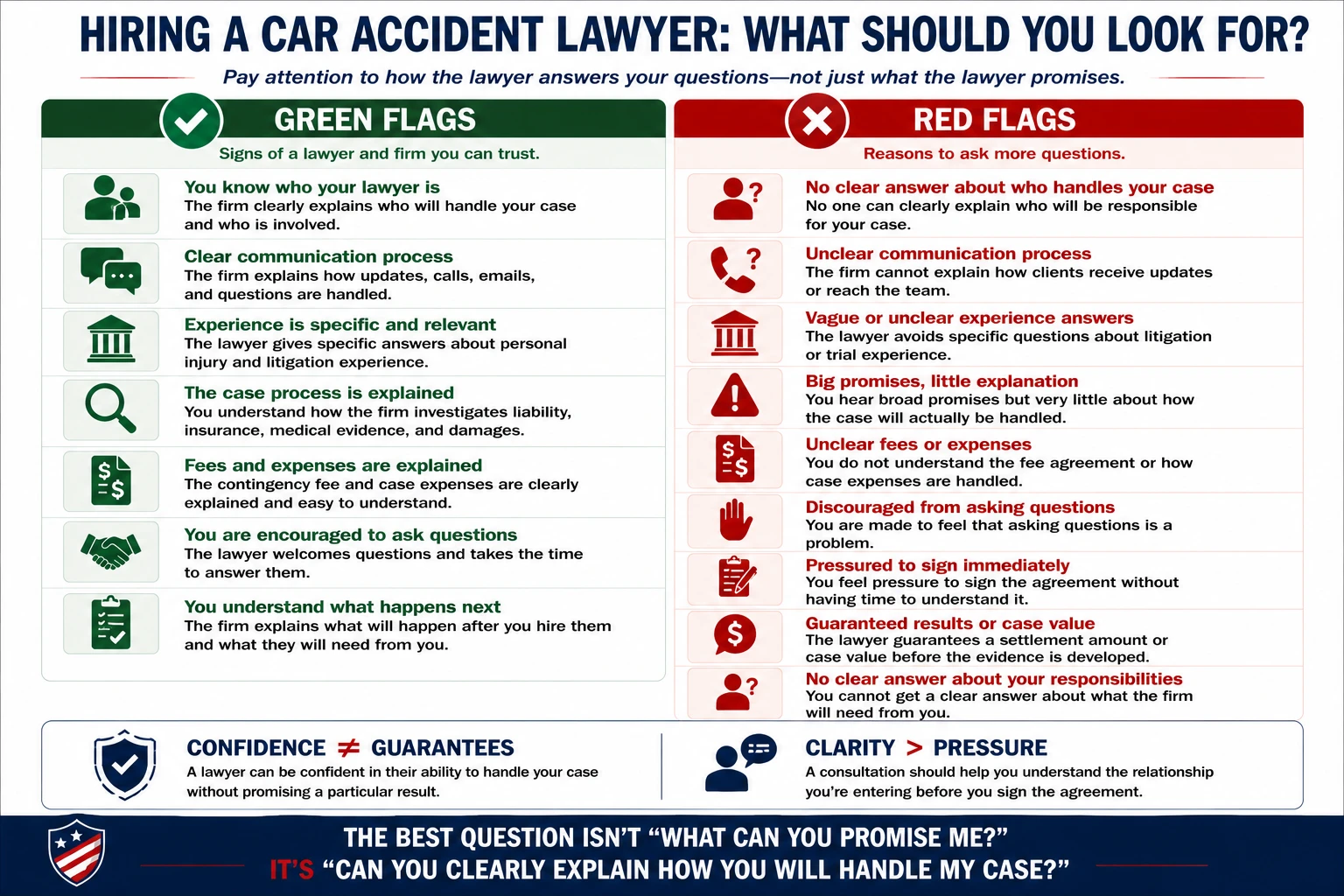
Pay attention to how the lawyer answers your questions, not just what the lawyer promises.
You should also ask more questions if:
- The lawyer cannot clearly explain who will handle your case.
- You do not understand how the fee agreement works.
- No one explains how case expenses are handled.
- The firm cannot tell you how clients receive updates.
- You are discouraged from asking questions.
- The lawyer avoids giving specific answers about litigation or trial experience.
- You receive broad promises but very little explanation of the actual case process.
- You feel pressured to sign immediately without understanding the agreement.
- You cannot get a clear answer about what the firm will need from you.
Confidence is important. Pressure is not. You should understand the relationship you are entering before you sign the representation agreement.
Should I Ask How Many Cases the Lawyer Has Actually Tried?
Yes, if trial experience matters to your hiring decision, ask specific questions rather than relying on general statements such as “we are trial lawyers.”
You can ask:
- How many injury cases have you personally tried?
- How many were jury trials?
- When was your most recent injury trial?
- What types of injury cases have you tried?
- Who in the firm would actually try my case if it reached that stage?
These questions help you understand whether trial work is a meaningful part of the lawyer’s current practice.
A lawyer does not need to promise that your case will go to trial. In fact, whether litigation is appropriate depends on the facts and how the claim develops.
The purpose of asking about trial experience is to understand the lawyer’s capabilities, not to assume that trial is automatically the best outcome.
How Do Contingency Fees Work in a Car Accident Case?
Personal injury lawyers often handle car accident cases on a contingency fee rather than charging the client an hourly attorney fee.
Under a contingency fee arrangement, the attorney’s fee is generally calculated as an agreed percentage of a recovery rather than being billed by the hour.
Before hiring a lawyer, ask:
- What percentage is the attorney fee?
- Does the percentage change if a lawsuit is filed or the case goes to trial?
- What case expenses may be incurred?
- How are expenses handled if there is a recovery?
- How are expenses handled if there is no recovery?
- Will I receive a written fee agreement explaining all of this?
Attorney fees and litigation expenses are not necessarily the same thing. Expenses may include items such as medical-record charges, filing fees, deposition costs, expert fees, investigation expenses, or other costs depending on the case.
Read the fee agreement before signing it and ask questions about anything you do not understand.
What Should Happen After I Hire a Car Accident Lawyer?
After you hire a lawyer, you should understand who is handling your case, what happens next, and how you will receive updates.
At Christmas Injury Lawyers, clients are assigned a legal team that typically includes an attorney, paralegal, and case manager.
Early work may include:
- Confirming the facts of the accident
- Preserving important evidence
- Identifying insurance coverage
- Obtaining collision documentation
- Tracking medical treatment
- Requesting medical records and bills
- Documenting lost income and other damages
- Communicating with insurance companies
- Identifying legal or factual issues that need further investigation
Your case will continue to develop as your medical condition and the evidence develop.
You should also know how to contact your team and what information the firm needs from you.
A good case-management system should make you feel more informed, not more confused about what is happening behind the scenes.
How Often Should a Car Accident Lawyer Update Me About My Case?
There is no single communication schedule that fits every case, but you should understand the firm’s communication process before you hire the lawyer.
Ask how the firm handles routine updates and what happens when an important event occurs.
For example, you should know:
- Who is my primary contact?
- How can I reach the team?
- How quickly are messages generally returned?
- Will I receive updates even when there has not been a major development?
- Who will explain settlement offers or major legal decisions to me?
- How will I know when something important happens in my case?
A personal injury case can last months or longer. You should not have to spend that time wondering whether anyone is working on it.
You should feel comfortable that your questions will be heard and that important developments will be explained clearly.
Should I Ask How Many Cases My Lawyer Is Handling?
Yes. A lawyer’s caseload can affect how a firm organizes work, communicates with clients, and allocates attorney and staff time.
A large caseload does not automatically mean poor representation, and a smaller caseload does not automatically mean better representation. Firms use different staffing models, technology, workflows, and team structures.
The more useful questions are:
- Who will be responsible for my case?
- How many matters does that team handle?
- How does the firm make sure deadlines and important tasks are completed?
- How are client calls and questions handled?
- How often are cases reviewed by an attorney?
The goal is not to find an arbitrary “perfect” caseload number. It is to understand whether the firm has a reliable system for giving your case appropriate attention.
What Will My Car Accident Lawyer Need From Me?
Hiring a lawyer does not mean you will never need to participate in the case.
Your legal team may ask you to:
- Provide accurate information about how the accident occurred.
- Identify medical providers.
- Keep the firm informed about significant changes in treatment or symptoms.
- Provide employment and wage-loss information when relevant.
- Forward insurance letters, bills, or other accident-related documents.
- Tell the firm about prior injuries or claims when relevant.
- Preserve photographs, videos, messages, or other evidence in your possession.
- Respond to reasonable requests from your legal team.
- Attend depositions, medical examinations, mediation, or court proceedings when required.
Most importantly, be accurate with your lawyer, even about facts you are worried may hurt the case.
Your lawyer cannot properly evaluate an issue they do not know exists.
Should a Lawyer Promise Me What My Case Is Worth During the First Consultation?
Be cautious about any lawyer who guarantees a particular settlement or case value before the evidence has been fully developed.
The value of an injury claim can depend on many factors, including:
- Liability
- Comparative fault
- Medical causation
- Nature and severity of the injuries
- Treatment
- Future medical needs when supported
- Lost income
- Long-term limitations
- Insurance coverage
- Evidence supporting each claimed loss
Early in the case, many of those issues may still be developing.
An experienced lawyer can explain what factors may affect value, but that is different from guaranteeing a result.
A thoughtful answer may contain uncertainty because the evidence is still developing. That can be a sign of careful analysis, not weakness.
Will I Work With the Lawyer or Mainly With Staff Members?
Personal injury cases are usually team efforts. Paralegals, case managers, medical-records staff, and other professionals can play important roles in keeping the case organized and moving forward.
But you should understand which decisions require attorney involvement and who is ultimately responsible for your legal representation.
Before hiring the firm, ask:
- Who is my attorney?
- Who handles routine questions?
- Who evaluates settlement offers?
- Who makes legal recommendations?
- Who would handle depositions or trial?
- How do I speak with my lawyer when I need legal advice?
At Christmas Injury Lawyers, clients are assigned a team that typically includes an attorney, paralegal, and case manager.
The important question is not whether staff members are involved. They should be. The important question is whether you know who is responsible for what and how to reach the people helping you.
Gary's Take: What Should I Look for When Hiring a Car Accident Lawyer?
“Trial experience matters to me, but I don’t think it’s the only question a client should ask.”
“You should know who your lawyer is. You should know who you’re going to call when you have a question. You should understand how the firm communicates, how it prepares cases, and what happens if the insurance company won’t resolve the claim fairly.”
“Most importantly, you should feel comfortable asking hard questions before you hire the firm. This is your case, and you deserve to understand who is going to be responsible for it,” says Gary Christmas.
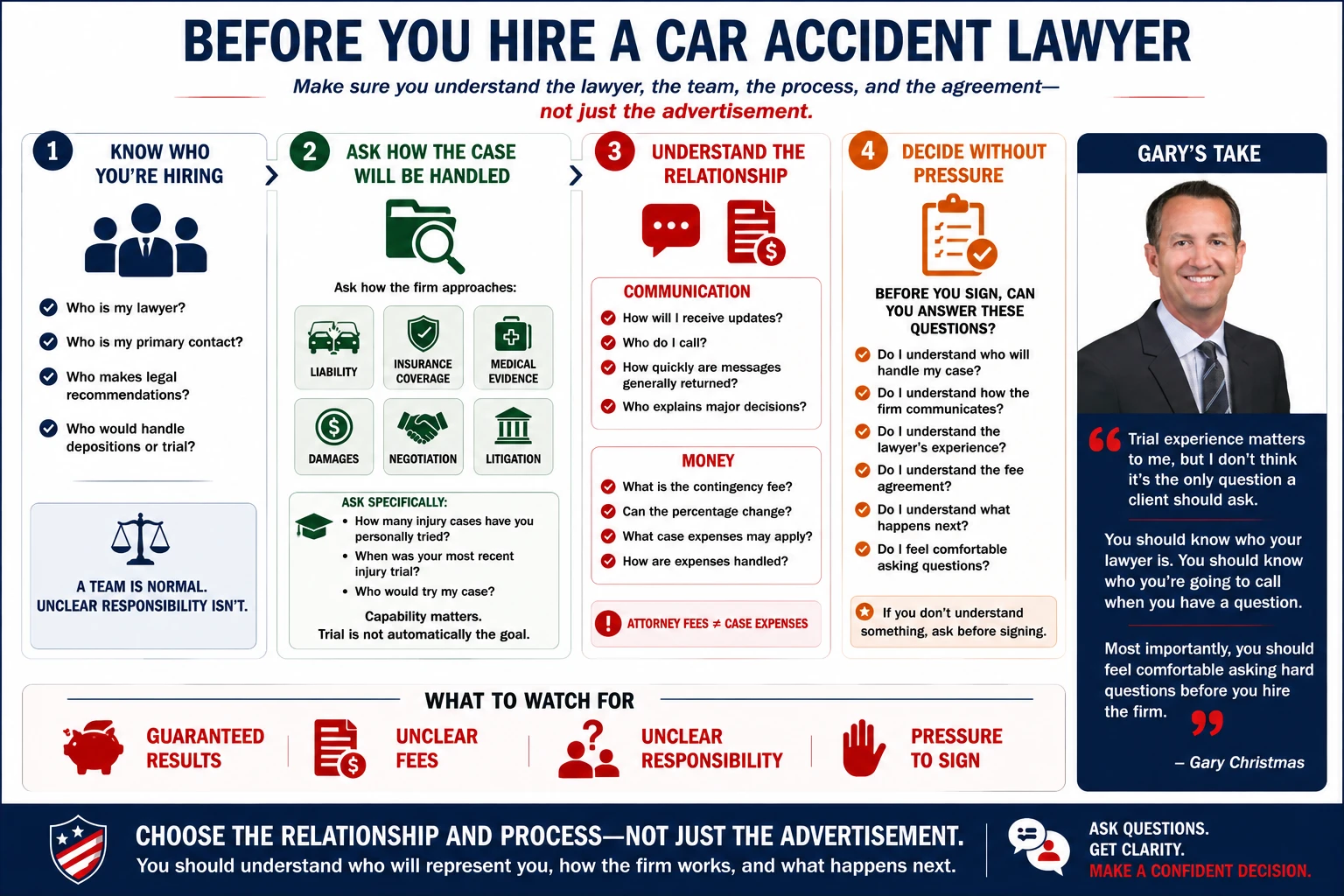
Make sure you understand the lawyer, the team, the process, and the agreement, not just the advertisement.
Car Accident Lawyer Hiring Checklist
- Ask who will actually be your lawyer
- Ask how much of the lawyer's practice involves personal injury cases
- Ask about actual litigation and trial experience
- Ask when the lawyer last tried an injury case
- Ask who would handle your case if it went to trial
- Ask how the firm investigates liability and insurance coverage
- Ask how medical evidence and damages are developed
- Ask how often clients receive updates
- Ask who you contact when you have questions
- Ask how quickly calls and messages are generally returned
- Ask how settlement decisions are discussed with clients
- Ask what happens if the case cannot be resolved through negotiation
- Ask how the contingency fee works
- Ask separately about case expenses
- Read the fee agreement before signing it
- Ask about the firm's staffing and case-management structure
- Ask what the lawyer will need from you
- Be cautious about guarantees or promises of a specific case value
- Make sure you feel comfortable asking questions
- Choose a lawyer based on the actual relationship and process, not just the advertisement
In Summary
Choosing a South Carolina car accident lawyer is about more than comparing advertisements, settlement claims, or impressive credentials. You are choosing the lawyer and legal team that may be responsible for investigating your accident, developing the evidence, communicating with insurance companies, advising you about important decisions, and litigating the case if a reasonable resolution cannot be reached.
Before hiring a lawyer, ask who will actually handle your case, how the firm communicates, how much of the lawyer’s practice involves personal injury cases, what litigation and trial experience the lawyer has, and how the firm investigates liability, insurance coverage, medical evidence, and damages. You should also understand how often you will receive updates, who you can contact with questions, and what the legal team will need from you while the case is pending.
Trial experience can be an important consideration, but it does not mean every car accident case should go to trial. The more important question is whether the lawyer has both options available: the ability to negotiate when a reasonable resolution is possible and the ability to litigate when important issues cannot be resolved through negotiation.
You should also understand the financial relationship before signing a representation agreement. Ask how the contingency fee is calculated, whether the percentage can change, what case expenses may be incurred, and how those expenses are handled. Attorney fees and case expenses are not necessarily the same thing, so read the written agreement and ask about anything you do not understand.
Finally, pay attention to how the lawyer answers your questions. Be cautious about guarantees, promises of a specific case value before the evidence has developed, pressure to sign immediately, or vague answers about who will handle the case and how you will receive updates. A good consultation should leave you with a clearer understanding of the lawyer, the firm, and the process, not more uncertainty.