


Property Damage Claim vs. Bodily Injury Claim: What's the Difference?
Both claims may begin with the same accident, but they address different types of loss.
| Property Damage Claim | Bodily Injury Claim |
|---|---|
| Damage to your vehicle | Physical injuries |
| Vehicle repair costs | Medical treatment |
| Total-loss valuation | Past medical expenses |
| Towing and storage expenses | Future medical needs when supported |
| Rental or loss-of-use issues | Lost income |
| Damaged personal property | Reduced earning ability when supported |
| Diminished value when applicable | Pain and suffering |
| Focuses primarily on property-related losses | Focuses on the physical, financial, and personal effects of the injury |
| May sometimes be evaluated relatively early | Often requires more time when the medical picture is still developing |
The key distinction is simple: property damage focuses on what happened to your property. A bodily injury claim focuses on what happened to you.
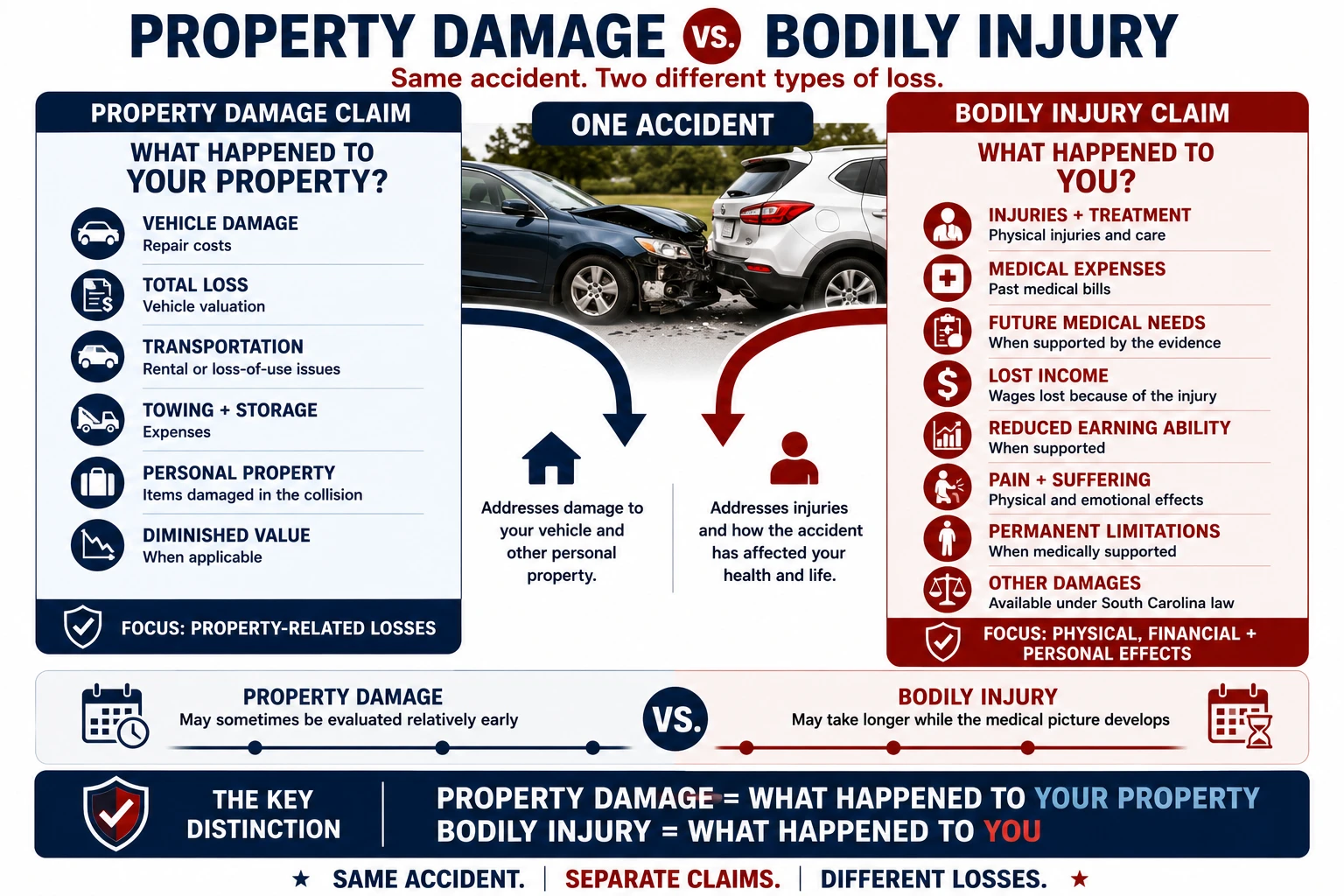
Same accident. Two different types of loss.
Can I Settle My Property Damage Claim While My Injury Claim Is Still Open?
A property damage claim and bodily injury claim may be handled on different timelines.
For example, you may need your vehicle repaired or replaced relatively quickly so you can return to work, attend medical appointments, take care of your family, and handle everyday responsibilities. At the same time, your medical treatment may still be ongoing and the full effects of your injuries may not yet be reasonably understood.
Resolving a property damage issue does not necessarily mean you must resolve your bodily injury claim at the same time.
The important distinction is not simply when the payment is made, but exactly which claims and rights the settlement agreement resolves.
However, settlement documents and releases matter.
Before signing anything, make sure you understand:
- Which claim is being resolved
- Which parties are being released
- Whether the document addresses property damage only
- Whether bodily injury claims are included
- Whether other rights or claims are being released
Do not assume a document applies only to your vehicle because the property damage claim is the issue being discussed. Read the document and understand what it resolves before you sign it.
Why Can a Property Damage Claim Be Resolved Before an Injury Claim?
Property damage can sometimes be evaluated earlier because much of the relevant information may become available relatively quickly.
For example, an insurer may be able to inspect the vehicle, review photographs, obtain repair estimates, evaluate whether the vehicle can be repaired, and determine its value if it is considered a total loss.
A bodily injury claim can be different because the medical picture may take time to develop.
After an accident:
- Symptoms may change
- Additional diagnoses may be made
- Treatment may continue for weeks or months
- Surgery or other procedures may be considered
- Work restrictions may continue
- Future medical needs may not yet be known
- Permanent limitations may not yet be reasonably understood
That does not mean every bodily injury claim must remain open for a particular amount of time. It means the information needed to evaluate the injury claim may develop on a different timeline from the information needed to evaluate the vehicle damage.
Your car may be ready to repair or replace before your doctors can reasonably evaluate what the accident has done to your health.
Why Should I Be Careful About Settling an Injury Claim Early?
An early settlement offer may arrive before all of the information needed to evaluate an injury claim is available.
If medical treatment is still ongoing, important questions may remain unanswered:
- What injuries have been diagnosed?
- Is additional testing needed?
- Will more treatment be recommended?
- Will surgery be necessary?
- How long are the symptoms expected to continue?
- Will you have permanent limitations?
- How much work will you miss?
- Could the injury affect your future ability to work?
- What other losses are supported by the evidence?
This does not mean you must wait until every symptom disappears before evaluating a settlement. The important question is whether there is enough medical and other evidence to reasonably understand the injuries, treatment, anticipated future needs, and other losses.
When an injury claim is settled and you sign a valid release resolving that claim, you generally cannot return later and seek additional compensation from the released parties for the same claim simply because the injury turned out to be more serious than you expected.
Before accepting an injury settlement, understand both what is known and what may still be medically unresolved.
Can Vehicle Damage Affect How an Injury Claim Is Evaluated?
Property damage and bodily injury are separate claims, but information about the collision may still become relevant when an injury claim is evaluated.
Photographs of the vehicles, repair records, accident-scene evidence, witness accounts, and other information may help establish how a collision occurred.
At the same time, the appearance of vehicle damage alone does not determine whether someone was injured or how serious an injury may be.
The injury claim should be evaluated using the relevant evidence, which may include:
- Medical records
- Diagnoses
- Treatment history
- Medical opinions when appropriate
- Accident photographs
- Vehicle damage
- Witness testimony
- Accident reports
- Other evidence concerning how the collision occurred and what injuries resulted
Two vehicles can sometimes show similar-looking damage while the people inside experience very different medical outcomes.
Evaluate the injury based on the medical and other evidence, not simply on whether the vehicle looks badly damaged in a photograph.
What Happens If My Vehicle Is Declared a Total Loss?
A vehicle may be considered a total loss when the applicable evaluation determines that repairing it is not economically practical under the circumstances.
If your vehicle is being treated as a total loss, pay attention to how its value is being calculated.
Information that may be relevant can include:
- Year, make, and model
- Mileage
- Vehicle condition before the accident
- Trim level
- Factory and optional equipment
- Comparable vehicles
- Prior damage
- Applicable taxes or fees
- Other information used in the valuation
Ask for the valuation information used to calculate the offer and review it for accuracy.
If information used in the valuation appears inaccurate, for example, the mileage, trim level, options, pre-accident condition, or comparable vehicles, identify the issue and preserve documentation that supports the correct information.
A total-loss settlement addresses the vehicle. It does not, by itself, establish the value of your bodily injury claim.
What Is a Diminished Value Claim?
Even after a damaged vehicle has been properly repaired, its accident history may affect what someone is willing to pay for it compared with a similar vehicle that has not been involved in the same type of collision.
That potential reduction in value is generally what people mean when they refer to diminished value.
Whether diminished value applies and how it should be evaluated depends on the facts, including the vehicle, the damage, the repairs, and the evidence of any reduction in value.
Potential evidence may include:
- Pre-accident vehicle information
- Repair records
- Photographs
- Vehicle-history information
- Comparable vehicle information
- Appraisals or other valuation evidence when appropriate
Repair cost and diminished value are not necessarily the same loss.
How Are Property Damage and Bodily Injury Claims Evaluated Differently?
The evidence used to evaluate the two claims overlaps in some areas, but the focus is different.
Property Damage Evaluation
A property damage claim may involve:
- Photographs of the vehicle
- Repair estimates
- Parts and labor costs
- Vehicle inspection
- Total-loss valuation
- Mileage and pre-accident condition
- Towing and storage records
- Rental or loss-of-use information
- Damaged personal property
- Diminished value when applicable
Bodily Injury Evaluation
A bodily injury claim may involve:
- Medical records
- Diagnoses
- Medical bills
- Treatment history
- Future medical recommendations
- Lost-income documentation
- Work restrictions
- Evidence of permanent impairment when applicable
- Pain and suffering
- Effects on ordinary activities and quality of life
- Liability and causation evidence
One claim asks what happened to your property. The other asks what the accident did to you and how those injuries affected your life.
What Evidence Should I Preserve for Each Claim?
Evidence can overlap, but different documents may become particularly important for each part of the case.
Property Damage Evidence
Keep:
- Accident-scene photographs
- Photographs of every side of the vehicle
- Close-up photographs of damage
- Repair estimates
- Repair invoices
- Towing bills
- Storage bills
- Rental-car or transportation records
- Total-loss valuation documents
- Receipts or photographs for damaged personal property
- Communications with insurers concerning the vehicle
Bodily Injury Evidence
Keep:
- Medical records
- Medical bills
- Prescription information
- Photographs of visible injuries
- Work restrictions
- Wage-loss documentation
- Receipts for accident-related expenses
- Insurance correspondence
- Information concerning future medical recommendations
- Other records showing how the injury affected your work or daily activities
Evidence That May Matter to Both
Some evidence can be relevant to both claims:
- Accident photographs
- Police or collision reports
- Witness information
- Video footage
- Vehicle photographs
- Information concerning how the collision occurred
Do not wait until a dispute develops to start preserving evidence. Some information can become harder to obtain as time passes.
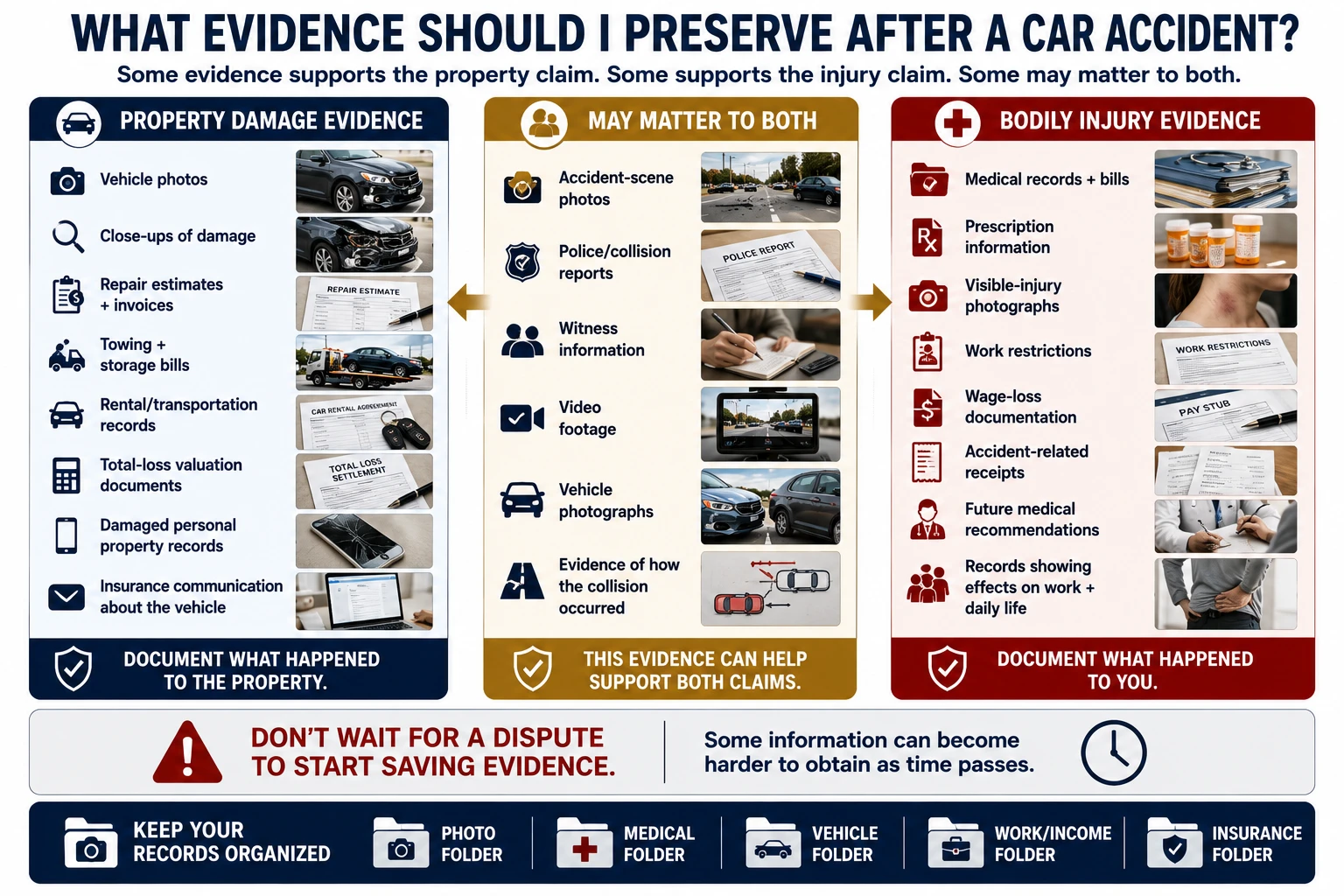
Some evidence supports the property claim. Some supports the injury claim. Some may matter to both.
Can I Handle My Vehicle Damage While I Am Still Receiving Medical Treatment?
Yes. You do not have to choose between addressing your transportation problem and taking care of your health.
After an accident, getting your vehicle repaired or replaced may feel urgent. You may need transportation to:
- Get to work
- Attend medical appointments
- Take children to school
- Buy groceries
- Care for family members
- Handle ordinary daily responsibilities
At the same time, do not let the urgency surrounding your vehicle cause you to overlook your medical needs.
Continue to:
- Attend appropriate medical appointments
- Describe your symptoms accurately
- Follow medical recommendations
- Report new or changing symptoms
- Preserve medical and work documentation
- Keep track of accident-related expenses
Your property damage claim and bodily injury claim can move forward at the same time, even if they are resolved on different timelines.
Does the At-Fault Driver's Insurance Company Pay My Medical Bills as I Receive Them?
Not necessarily.
A bodily injury liability claim generally does not function like a health insurance plan that simply pays each medical bill as treatment occurs.
Depending on the circumstances and the coverage or benefits available, medical expenses may initially be addressed through sources such as:
- Your health insurance
- Medical payments coverage if applicable
- Medicare or Medicaid when applicable
- Other available benefits or coverage
- Bills that remain outstanding while the injury claim is pending
Those medical expenses and other supported losses may later become part of the evaluation of the bodily injury claim.
Property damage can operate differently. Vehicle repairs, towing, rental issues, or total-loss payments may sometimes be addressed while the bodily injury claim remains unresolved.
This is another reason the two claims should not be treated as though they are one single insurance payment.
What Should I Check Before Signing a Property Damage Settlement or Release?
Before signing a settlement document, read it carefully and understand exactly what it covers.
Ask:
- Does the document resolve property damage only?
- Does it mention bodily injury?
- Which person or company is being released?
- Does it release all claims arising from the accident?
- Are towing, storage, rental, or other property-related losses included?
- Have all damaged items been identified?
- If the vehicle was repaired, has diminished value been considered when applicable?
- If the vehicle is a total loss, do I understand the valuation?
- Do I understand whether signing this document affects any claim other than the property damage claim I intend to resolve?
Do not rely only on the title of a document or a verbal explanation of what it supposedly covers. The actual language of the agreement matters.
Gary's Take: Don't Let the Car Distract You From the Injury
“After an accident, I understand why people become focused on their vehicle. You need transportation. You may need to get to work, take your children where they need to go, and make it to medical appointments. Getting the car repaired or replaced can feel like the most urgent problem in front of you.”
“But the vehicle and your health are two different issues. A car can often be repaired or replaced relatively quickly. Your injuries may take much longer to understand.”
“Over the years, I’ve seen injured people devote enormous attention to the property damage while assuming the injury side of the claim will somehow take care of itself. That is not an assumption I would make.”
“Take care of the transportation problem, but continue taking your medical care seriously. Keep your records. Document your losses. And before you sign a settlement or release, make sure you understand exactly what it resolves.”
“You can deal with the car and protect the injury claim at the same time. The important thing is not to let one cause you to overlook the other,” says Gary Christmas.
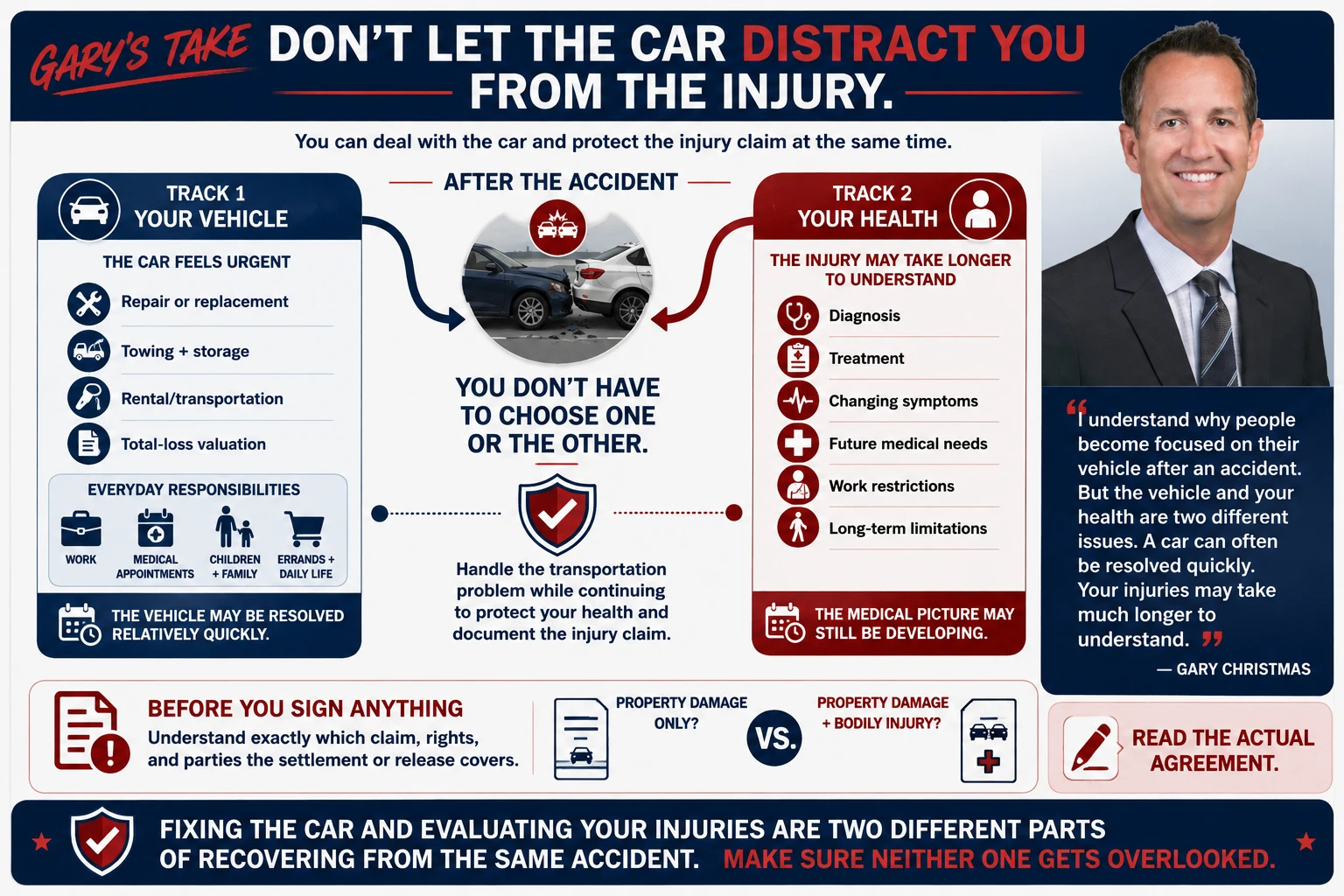
You can deal with the car and protect the injury claim at the same time.
What Is the Most Important Thing to Remember About Property Damage and Injury Claims?
Remember this distinction:
Your property damage claim is about what happened to your property.
Your bodily injury claim is about what happened to you.
The two claims may come from the same accident, involve the same insurance company, and rely on some of the same evidence. But they involve different losses and may develop on different timelines.
You may be able to repair or replace your vehicle while medical treatment continues. You may resolve certain property-related issues while the bodily injury claim remains under evaluation. And evidence concerning the collision may sometimes matter to both claims.
The important thing is to keep the two claims organized, preserve the evidence supporting each one, and understand exactly what you are resolving before signing a settlement or release.
If you are unsure whether a document affects only your property damage claim or also affects your bodily injury rights, consider getting legal advice before you sign it.
Fixing the car and evaluating your injuries are two different parts of recovering from the same accident. Make sure neither one gets overlooked.
Property Damage and Injury Claim Checklist
Property Damage
- Photograph the vehicle and accident scene
- Preserve repair estimates and invoices
- Keep towing and storage records
- Save rental or transportation expenses
- Review any total-loss valuation
- Preserve records for damaged personal property
- Consider diminished value when applicable
Bodily Injury
- Seek appropriate medical evaluation
- Report symptoms accurately
- Follow medical recommendations
- Preserve medical bills and records
- Document lost income and work restrictions
- Track accident-related expenses
- Evaluate future medical needs when supported
Before You Settle Either Claim
- Understand exactly which claim is being resolved
- Read the release carefully
- Identify which parties are being released
- Make sure all applicable losses have been considered
- Do not assume settling one claim automatically requires settling the other
- Get legal guidance if you do not understand the agreement
Summary
A property damage claim and a bodily injury claim can arise from the same South Carolina car accident, but they address different losses and may develop on different timelines.
Your property damage claim generally focuses on what happened to your vehicle and other personal property. It may involve vehicle repairs, a total-loss valuation, towing and storage expenses, rental or loss-of-use issues, damaged personal property, and diminished value when applicable.
Your bodily injury claim focuses on what happened to you. Depending on the facts and supporting evidence, it may involve your injuries, medical treatment, past medical expenses, future medical needs, lost income, reduced earning ability, pain and suffering, permanent limitations, and other damages available under South Carolina law.
Because vehicle damage can sometimes be evaluated relatively quickly, your property damage claim may be resolved while you are still receiving medical treatment. Resolving the vehicle portion of the claim does not necessarily mean the bodily injury claim must be resolved at the same time. The important question is exactly which claims, rights, and parties a settlement agreement or release covers.
Do not assume the appearance of your vehicle determines whether you were injured or how serious an injury may be. Vehicle photographs and repair information can be relevant evidence, but an injury claim should be evaluated using the medical and other evidence specific to the accident and your injuries.
Preserve documentation for both claims. Property damage evidence may include photographs, repair estimates, towing and storage bills, rental records, total-loss documents, and damaged-property records. Bodily injury evidence may include medical records and bills, photographs of visible injuries, work restrictions, wage-loss documentation, receipts, and information concerning future medical recommendations. Some evidence, including accident photographs, reports, witnesses, and video, may be relevant to both claims.
Most importantly, you do not have to choose between getting your transportation problem handled and taking care of your health. The two claims can move forward at the same time even when they are resolved on different schedules.
Before signing any settlement or release, read it carefully and understand exactly what it resolves.
Your property damage claim is about what happened to your property. Your bodily injury claim is about what happened to you. Protect and document both.