


Get The Flock Out of South Carolina
By Attorney Gary Christmas
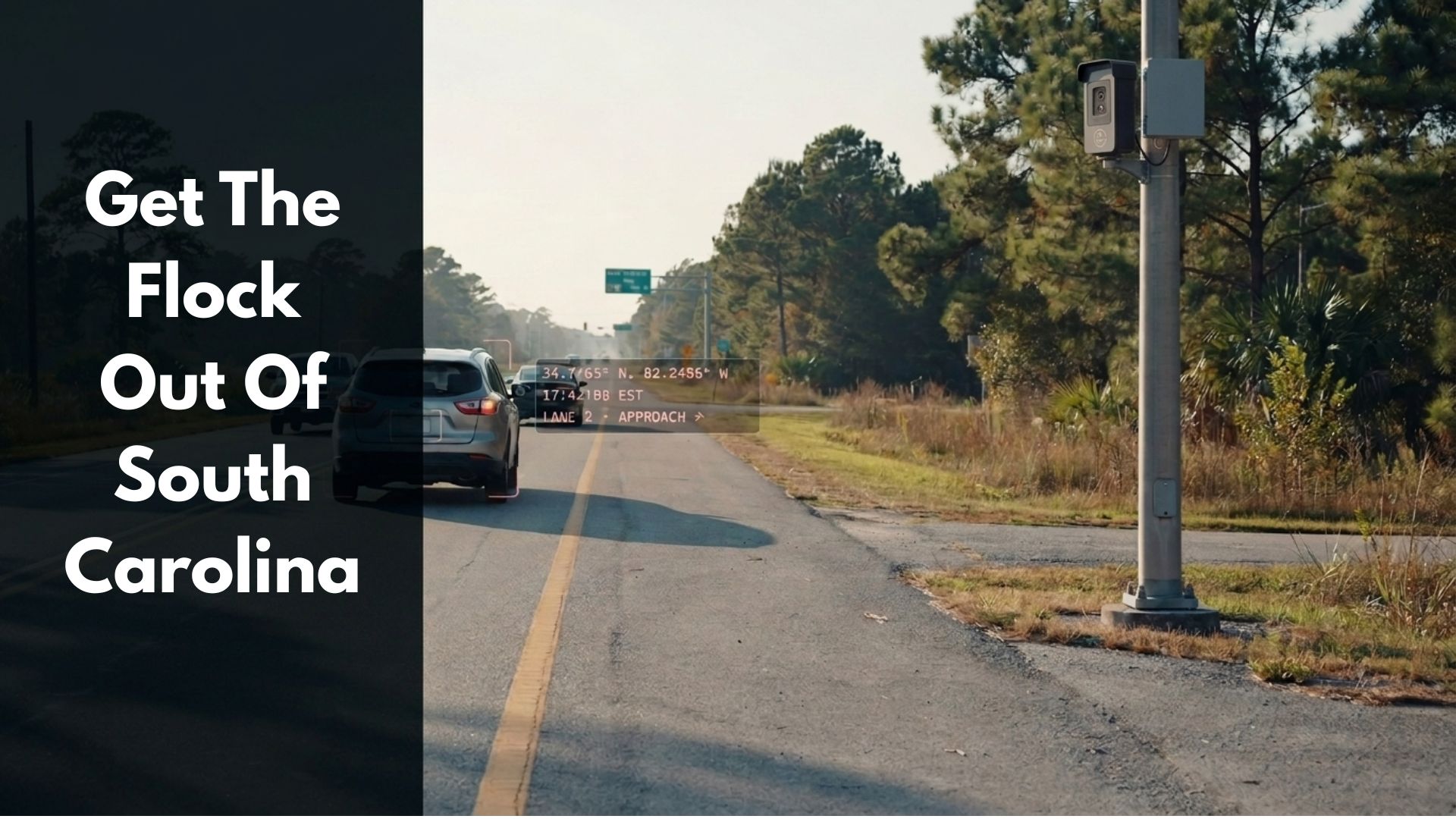
I am a trial lawyer. I believe in evidence.
When someone is seriously injured in a car accident, evidence can mean everything. A photograph, surveillance video, witness statement, vehicle record, cell phone record, or other piece of digital evidence can help us figure out what happened and who was responsible.
That is one reason I understand why law enforcement agencies across South Carolina have turned to automated license plate reader systems such as Flock Safety cameras.
These cameras can help solve crimes.
They can help identify vehicles.
They can potentially help locate a driver who leaves the scene of a serious accident.
We recently saw a compelling example of that in Florence.
But there is another side to this technology that every South Carolinian should understand.
These cameras don’t only photograph people suspected of committing crimes.
They photograph ordinary people driving down South Carolina roads.
You.
Me.
Our spouses.
Our children.
Our employees.
Our clients.
People going to church, going to work, visiting their doctors, seeing friends, meeting lawyers, shopping for groceries, or simply driving home.
That raises a much bigger question.
How much information about the movements of ordinary South Carolinians should be collected simply because the technology exists to collect it?
That question concerns me.
First, Let’s Be Fair About What Flock Cameras Can Do
I don’t believe you have an intelligent conversation about technology by pretending there aren’t legitimate reasons for using it.
Consider what happened recently in Florence.
Florence police responded to a pedestrian hit-and-run near Church Street and Palmetto Street and found a seriously injured person in the roadway. According to WMBF’s reporting, there were no witnesses.
Police obtained security footage, but that apparently wasn’t enough to identify the person they were looking for.
Investigators then turned to Flock cameras.
Police said the technology helped them identify a vehicle matching what they had seen and determine where it went. Additional investigative work followed, and police reported locating the vehicle and identifying the alleged driver within approximately an hour.
As an injury lawyer, I understand the significance of something like that.
Hit-and-run cases can be devastating.
You can have someone lying seriously injured in the road while the person who struck them is nowhere to be found. There may be no eyewitness who got a license plate. There may be grainy security footage that shows a vehicle without providing enough information to identify its owner.
In a situation like that, technology capable of identifying a vehicle can be extraordinarily useful.
So this isn’t an argument that Flock technology has never done anything good.
It clearly can be a powerful investigative tool.
The question is what happens when a powerful investigative tool becomes a system capable of collecting information about everybody else too.
You Don’t Have to Be Suspected of Anything
This is where I think the conversation changes.
An automated license plate reader doesn’t wait until somebody becomes a criminal suspect before photographing the vehicle.
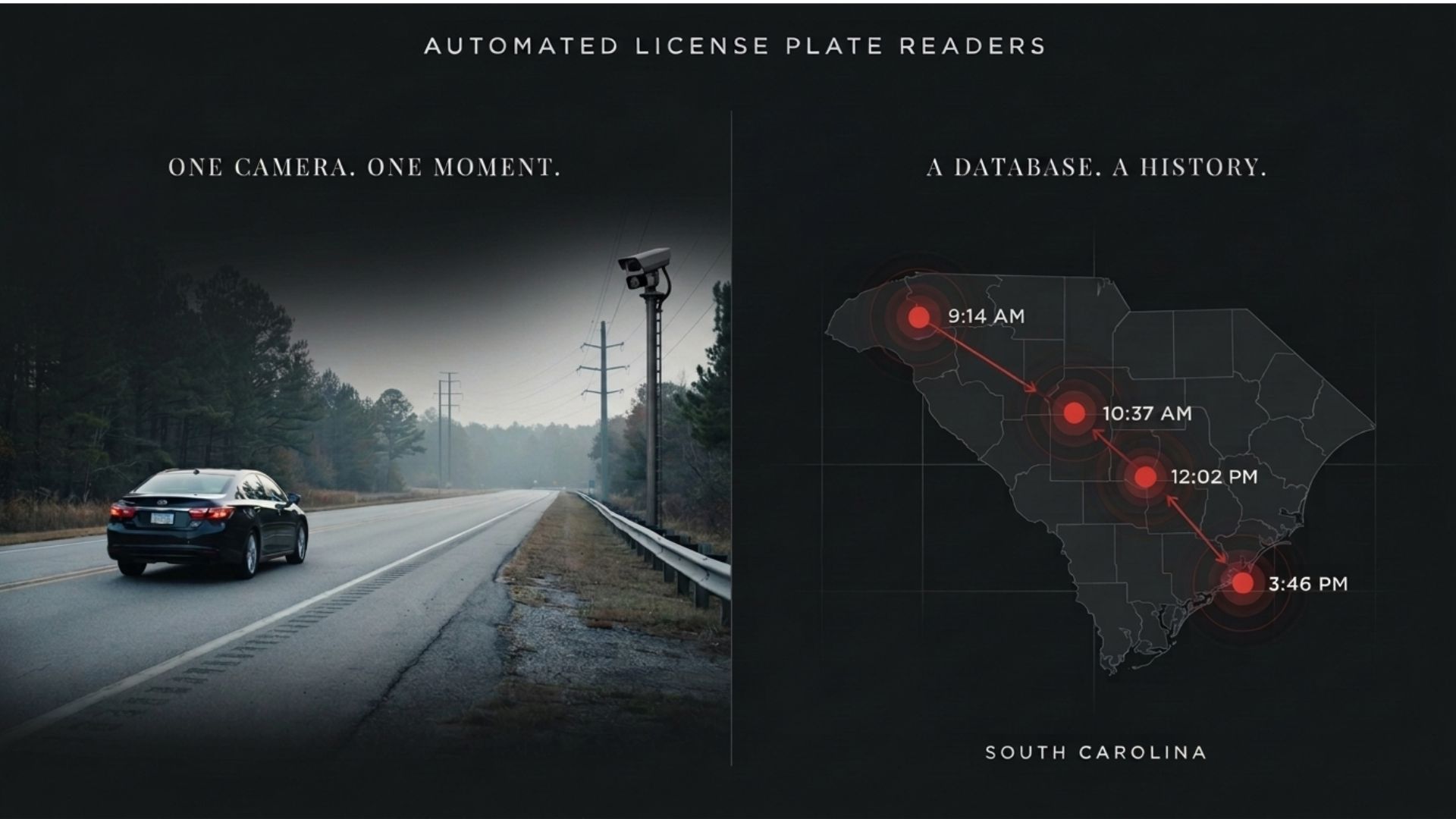
The system photographs vehicles passing its cameras and turns those observations into searchable information.
South Carolina’s pending S.447 gives us a useful description of what this technology can collect. The legislation defines license plate reader data to include GPS coordinates, date and time, a photograph, the license plate number, and vehicle characteristics.
Think about what those individual pieces of information can represent when accumulated across multiple locations.
Where was a vehicle?
When was it there?
What did it look like?
What was its license plate?
Now multiply that across cameras and across time.
That is where my concern begins.
There is an enormous difference between a police officer seeing your license plate while you drive down a public street and creating a searchable technological record of where vehicles have been observed.
One observation is fleeting.
A database can potentially be searched later.
South Carolina Has Already Seen Flock Misuse
If privacy concerns about this technology were purely hypothetical, we could have a different discussion.
They aren’t.
In 2026, South Carolina law-enforcement agencies dealt with a series of incidents involving alleged or internally determined misuse of Flock systems.
Greer terminated two officers after an audit. Documents reviewed by FOX Carolina reported searches involving personal relationships and searches in which stated reasons did not correspond with the actual purpose.
The Greenville County Sheriff’s Office terminated two employees after an internal audit determined they had misused the agency’s Flock system. Sheriff Hobart Lewis publicly said the misuse was a serious policy violation.
SLED subsequently confirmed active investigations involving allegations of Flock misuse associated with personnel from Greer, Greenville County, Mauldin, Sumter and Colleton County. Those investigations should not be confused with findings of criminal guilt.
Colleton County later reported another extraordinary internal finding. One lieutenant was fired after an audit reportedly found more than 2,700 unauthorized searches. Another lieutenant was subsequently terminated after the department reported finding 62 unauthorized searches involving vehicles associated with his spouse and other acquaintances. The sheriff requested SLED investigate potential criminal conduct.
Those aren’t theoretical privacy concerns.
They demonstrate something lawyers learn very early in their careers:
A safeguard is only as good as the people, rules, auditing and accountability surrounding it.
“Trust Us” Isn’t a Privacy Policy
I have tremendous respect for law enforcement.
I’ve worked around police officers, investigators, judges and other people in our justice system for decades.
The overwhelming majority of people working in law enforcement aren’t sitting around trying to figure out how to spy on their neighbors.
But that isn’t the point.
We don’t build constitutional protections around the assumption that every person entrusted with government power will always exercise that power correctly.
Good systems have safeguards precisely because human beings sometimes make bad decisions.
That’s why the recent South Carolina misuse cases deserve attention.
Greenville County provides an interesting example.
Following its misuse investigation, Sheriff Lewis described additional controls, including requiring searches to be tied to a reason and case number and adding quarterly audits. More than 300 employees nevertheless had some level of access to the system through mobile data terminals, according to his August presentation.
Those safeguards matter.
But so does the scale of access.
South Carolina’s Legislature Has Considered New Restrictions
South Carolina lawmakers have considered legislation specifically addressing automatic license plate readers.
S.447 received a favorable report from the Senate Judiciary Committee in April 2026, although the official legislative history I reviewed does not show it becoming law.
The proposed legislation itself tells us a great deal about the issues surrounding this technology.
Among other things, the proposal would require:
- A documented law-enforcement purpose for database searches
- Access logs providing an audit trail
- Publicly available agency policies
- Supervisory oversight
- Training requirements
- Rules governing access and data security
- Audit procedures
- Human verification of a plate before an officer makes a traffic stop based on an alert
- Restrictions on sharing data
- A general 90-day maximum retention period for law-enforcement data unless it becomes part of an ongoing investigation
The proposal would also make knowingly obtaining law-enforcement license plate data under false pretenses or for an unauthorized purpose a misdemeanor.
Whatever someone ultimately thinks the correct regulatory framework should be, the existence and substance of this legislation demonstrate that questions about access, retention and misuse aren’t imaginary.
They are issues South Carolina policymakers themselves have been considering.
What About the Constitution?
This question has already reached a South Carolina appellate court.
In July 2026, the South Carolina Court of Appeals decided State v. Faile.
Rock Hill police searched the Flock database and found two photographs of the defendant’s vehicle taken a day apart. One photograph showed the vehicle near Rock Hill. Another showed it the following day in Camden.
The defendant argued that searching the Flock database without a warrant violated the Fourth Amendment and South Carolina’s constitutional protections.
The Court of Appeals affirmed the trial court’s denial of his motion to suppress.
But there is an important qualification.
The opinion expressly says it has “no precedential value” except under the limited circumstances provided by South Carolina appellate rules.
The factual limitation is important too.
The court emphasized that police had obtained only two photographs taken a day apart. It distinguished those circumstances from the kind of comprehensive tracking history that could reveal much more about someone’s movements.
That distinction deserves attention.
Two photographs are one thing.
What happens when technology can potentially tell the government where a vehicle appeared again and again?
That is a much bigger privacy conversation.
The Database Concerns Me More Than the Camera
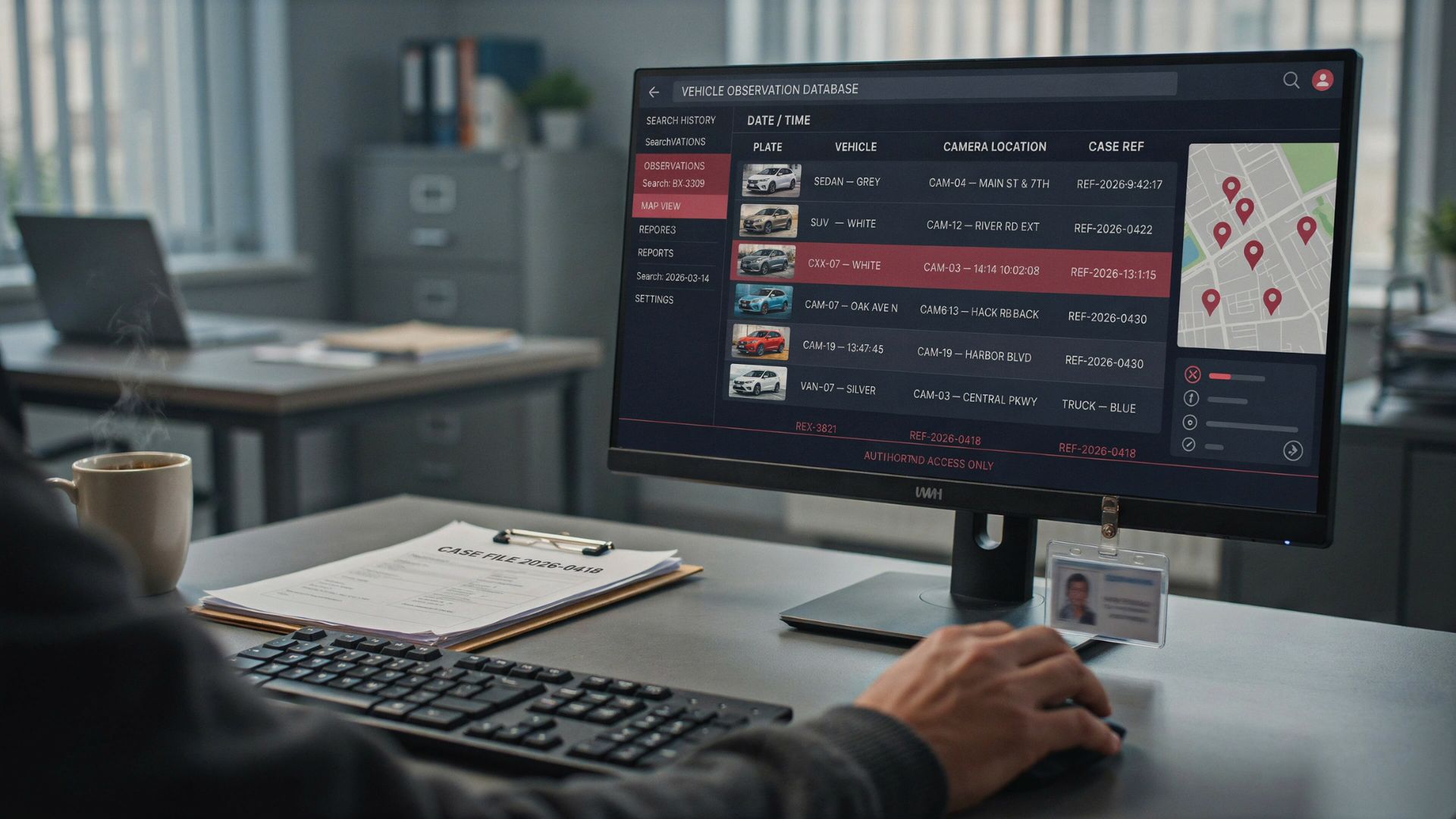
A camera by itself doesn’t bother me nearly as much as what happens after the camera takes the picture.
Who receives the information?
Who can search it?
How many people have access?
What justification must they provide?
Who verifies that justification?
Can another agency search it?
How long is the information retained?
Can searches reconstruct someone’s movements?
What happens when an employee searches for a spouse, former girlfriend, neighbor, political opponent, lawyer, journalist, business competitor, or anybody else for an improper personal reason?
And most importantly:
Who is watching the people doing the watching?
Those aren’t anti-police questions.
They’re accountability questions.
Even Flock Has Announced Additional Safeguards
The debate has become significant enough that Flock itself announced changes in August 2026.
According to FOX Carolina’s reporting on the announcement, Flock said its default storage period would be reduced from 30 days to seven days, although agencies could establish their own retention periods. The company also announced mandatory use of an audit-assistance feature intended to flag potential misuse and automatic suspension of users suspected by the system of improper searching until an administrator reviews their activity.
Those changes are relevant.
They also illustrate something important.
Privacy safeguards surrounding powerful technology aren’t a one-time question.
The technology changes.
Its capabilities change.
The number of cameras changes.
The number of participating agencies changes.
The databases change.
The safeguards have to keep up.
Oconee County Has Already Drawn Its Own Line
The debate has now moved beyond police departments and into local government.
In September 2026, Oconee County became the first South Carolina county reported to prohibit county resources from supporting these systems and to stop county funding for its Flock cameras.
The decision followed a public debate that included arguments about both privacy and public safety. The county-funded five cameras, while municipal departments within Oconee County aren’t controlled by the county prohibition.
I find the Oconee debate important because it forces South Carolinians to confront the real tradeoff.
This isn’t simply:
“Do you support law enforcement?”
Of course I support law enforcement.
And it isn’t simply:
“Can this technology solve crimes?”
We’ve already established that it can.
The harder question is how much surveillance infrastructure we are comfortable creating in exchange for those benefits.
Reasonable people can answer that question differently.
But South Carolinians ought to know the system exists before answering it.
What Does This Have to Do With Personal Injury Cases?
Potentially quite a bit.
Suppose you’re riding your motorcycle when a truck crosses the center line, hits you and leaves.
Suppose you’re a pedestrian struck at night and nobody gets the plate.
Suppose another driver causes a catastrophic collision and later disputes that his vehicle was anywhere near the scene.
Flock information could potentially become relevant evidence.
The Florence case shows the basic investigative possibility.
There is another important consideration.
Some Flock records may have relatively short retention periods. Testimony in Faile indicated that Rock Hill’s system retained images for 30 days at the time involved in that case. Greenville County’s sheriff likewise said in August that its county-level images were retained for 30 days unless saved as part of a formal investigation associated with a case number.
That means lawyers investigating serious automobile collisions should at least understand that this technology exists.
Evidence can disappear.
That is true of surveillance footage from a convenience store.
It is true of vehicle data.
It is true of physical evidence.
And it can be true of electronically stored information.
An experienced injury lawyer needs to think beyond the accident report.
So Why Call This “Get The Flock Out of South Carolina”?
Because I want people asking questions about this technology before mass vehicle surveillance simply becomes part of the scenery.
There are situations where Flock cameras have helped law enforcement. Florence appears to be one of them.
I can acknowledge that while remaining deeply concerned about a system capable of creating searchable records associated with the movements of people who aren’t suspected of doing anything wrong.
Those ideas aren’t contradictory.
Technology can be useful and intrusive at the same time.
Police can have legitimate investigative needs while citizens have legitimate privacy concerns.
And a tool designed for good purposes can still be abused.
South Carolina’s recent experience has already demonstrated that last point.
For me, that’s where the conversation should begin.
Before another camera goes up, South Carolinians deserve to know what information is being collected, who can access it, why they can access it, how long it remains available, who else can obtain it, what audits occur, and what consequences follow when somebody abuses that access.
Your license plate is visible when you drive down the road.
That doesn’t make every question about building a searchable database of your travels disappear.
There is a difference between being seen in public and having technology remember where you have been.
And that difference matters.
Injured in a South Carolina Hit-and-Run or Serious Car Accident?
If you were seriously injured in a hit-and-run or another motor vehicle accident, identifying and preserving evidence can be critical.
The police report may only be the beginning.
Depending on the circumstances, evidence could include nearby business cameras, residential security systems, dash cameras, witness statements, vehicle information, electronic records, and potentially license plate reader information.
At Christmas Injury Lawyers, injury cases are all we do. Our attorneys investigate serious accident cases and prepare cases with the understanding that sometimes the evidence ultimately has to be presented in court.
You concentrate on following your doctors’ instructions and recovering from your injuries.
We’ll concentrate on the legal case.
We work on a contingency fee basis. You don’t pay attorney’s fees unless we recover money for you.
If you or a loved one has been seriously injured in a South Carolina motor vehicle accident, call Christmas Injury Lawyers at (843) 258-5617 or use the Contact Us form on this page.