


What Are the Basic Steps in Filing a Third-Party Insurance Claim?
| Step | Purpose |
|---|---|
| Report the accident | Start the claim process |
| Obtain the FR-10 | Identify insurance information |
| Seek medical treatment | Document injuries |
| Preserve evidence | Protect the claim |
| Avoid recorded statements | Prevent unnecessary mistakes |
| Identify witnesses | Strengthen liability evidence |
| Get legal guidance if you are injured | Understand and protect your rights |
| Prepare for litigation if necessary | Be ready if the claim cannot be fairly resolved |
In a South Carolina car accident case, the FR-10 provided by the investigating officer can be an important starting point for identifying the drivers, vehicles, and insurance information associated with the collision. Keep that document with your accident records.
After nearly 30 years of handling injury cases, we have seen how decisions made in the first days after an accident can affect a claim months or even years later. What you tell the insurance company, when you seek medical treatment, what evidence you preserve, and how you document what happened can all matter. Our advice is to protect the claim from the beginning rather than trying to repair avoidable problems later.
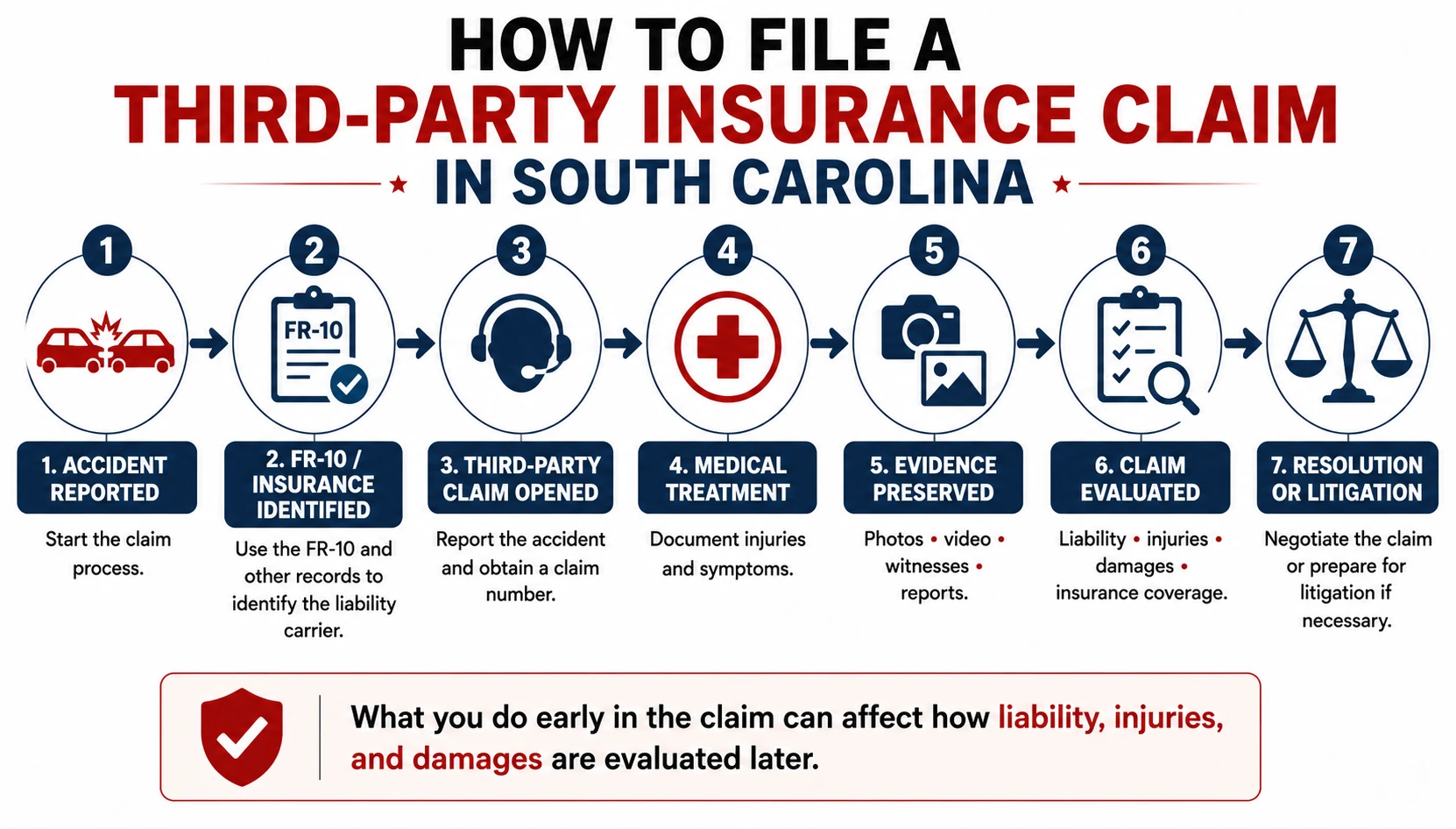
What you do early in the claim can affect how liability, injuries, and damages are evaluated later.
What Mistakes Should I Avoid When Filing an Insurance Claim?
One of the biggest mistakes we see is giving the at-fault driver’s insurance company more information than necessary before understanding how that information may affect the claim.
A recorded statement, a description of how the crash happened, or comments about your injuries can become important later. An innocent inconsistency can be used to question liability, credibility, or the seriousness of an injury.
You are a party to the case. Anything you say to the at-fault driver’s insurance company can potentially be used against you later. Whether it is a recorded statement, a casual conversation, or an innocent attempt to be helpful, insurance companies often use information gathered during those conversations to deny claims or reduce their value.
If you are represented, your lawyer can handle communications with the liability insurer while you focus on treatment and recovery. If you are not represented, be careful about giving a recorded statement or signing authorizations before you understand what is being requested and why.
Can I Trust the Insurance Adjuster?
One of the most common things adjusters do is make injured people feel as though they are on the same team.
They are often friendly, polite, and professional. They may sound concerned about your well-being and appear eager to help. However, it is important to remember who they work for. They work for the insurance company, and the insurance company’s financial interests are not the same as yours.
You are trying to recover for the losses the accident caused. The liability insurer is evaluating what it believes it is legally required to pay while protecting its own financial interests. That does not make the adjuster a bad person, but it does mean you should be very careful about trusting the insurance company to protect your interests.
Read: Should I Talk to the Other Driver’s Insurance Company?
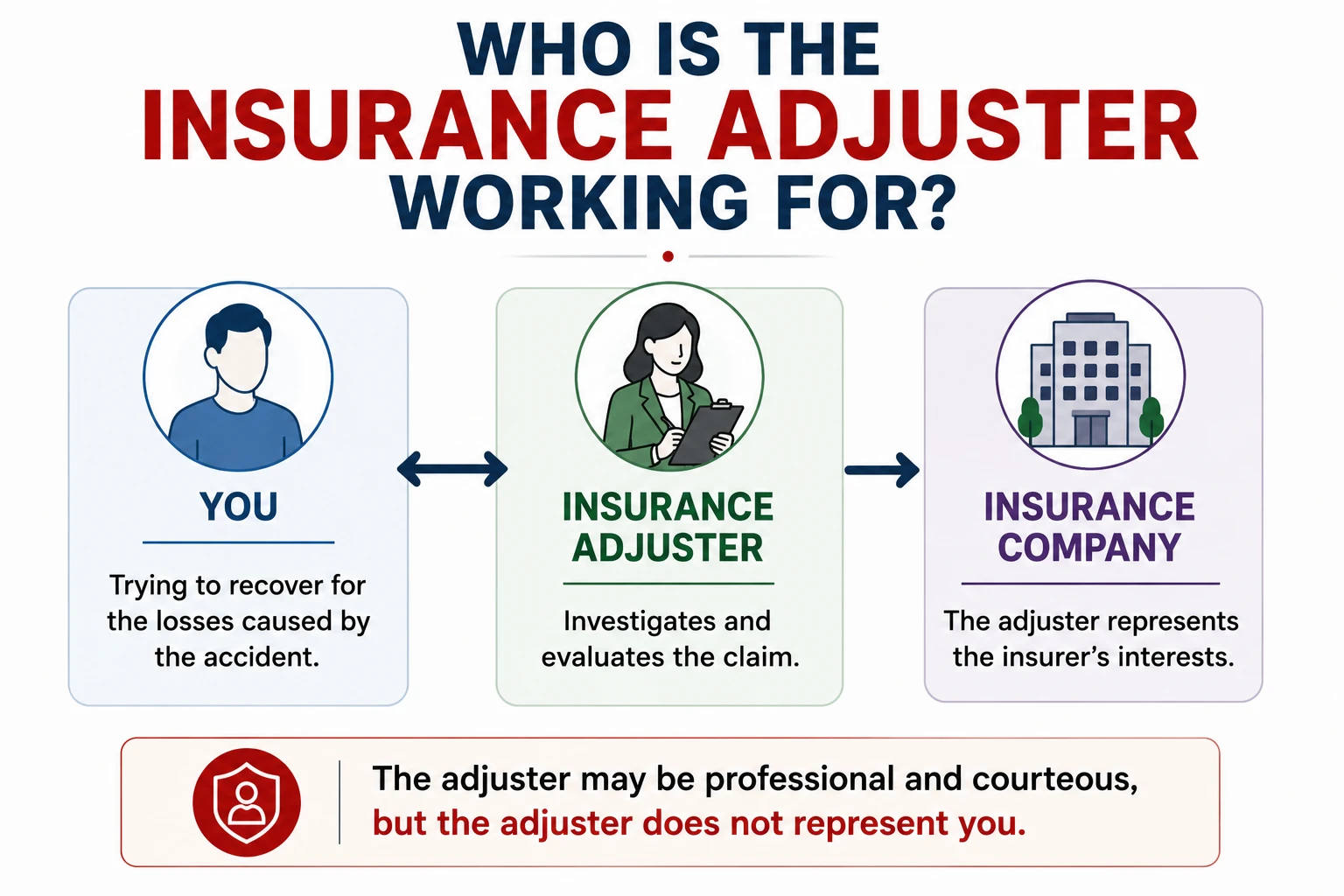
The adjuster may be professional and courteous, but the adjuster does not represent you.
Can Mistakes Early in the Process Hurt My Case?
We routinely hear from people weeks or months after an accident who initially attempted to handle the claim on their own.
By the time they contact us, they have often given recorded statements, failed to gather critical evidence, delayed medical treatment, or made other mistakes that allowed the insurance company to deny the claim or significantly reduce its value.
Sometimes we can correct those problems. Other times, the damage has already been done. That is why we would rather see an injured person protect the evidence, document the injuries, and understand the insurance process from the beginning instead of trying to fix preventable problems months later.
What Should I Do in the First 24-72 Hours After an Accident?
The first priority should always be your health and safety. Seek medical treatment immediately and make sure every injury and symptom is reported to your healthcare providers.
Next, gather and preserve as much evidence as possible. Take photographs of the vehicles, accident scene, injuries, road conditions, and anything else that may be relevant. Obtain witness information if it is available.
If you are injured, do not delay appropriate medical evaluation simply because you are unsure how the insurance claim will work. Your health comes first, and timely medical records can also help document the injuries and symptoms you experienced after the accident.
In our experience, the first 24 to 72 hours after an accident can be some of the most important hours in the life of an injury claim.
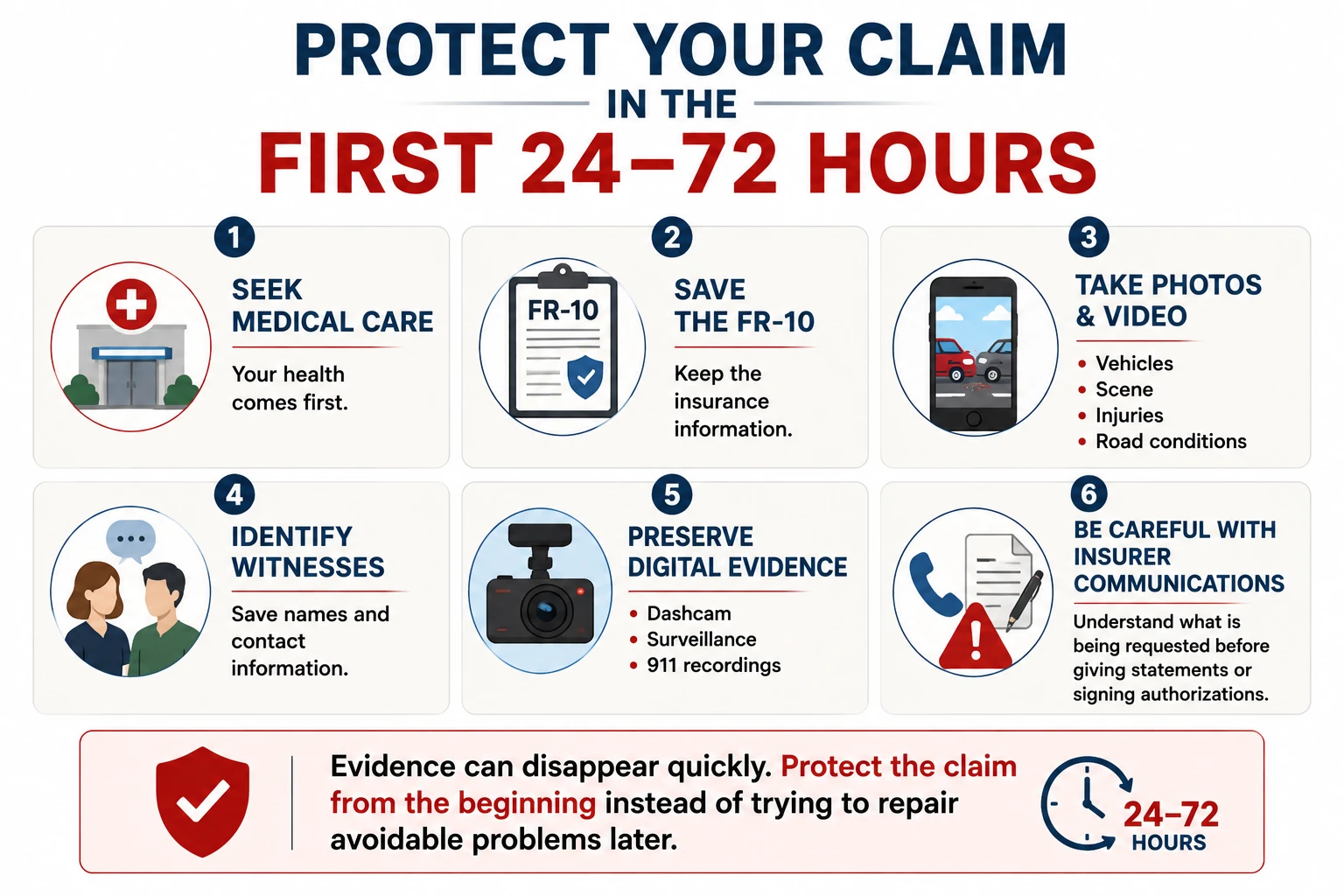
Evidence can disappear quickly. Protect the claim from the beginning instead of trying to repair avoidable problems later.
Should I Give a Recorded Statement to the At-Fault Driver's Insurance Company?
Generally, we would not recommend giving the at-fault driver’s insurance company a recorded statement before you understand your rights and the purpose of the statement.
Insurance companies often use recorded statements to search for inconsistencies, challenge credibility, dispute liability, or minimize injuries. Anything you say may later be used against you.
Our advice is straightforward: hire an experienced personal injury lawyer and let your lawyer communicate with the insurance company on your behalf.
Your obligations to your own insurance company may be different because your policy may require cooperation with your insurer. That is one reason it is important to understand which insurance company is asking for the statement and why.
What Evidence Makes a Third-Party Insurance Claim Stronger?
When it comes to third-party claims, evidence is everything.
Over the years, we have learned that you never know which piece of evidence will ultimately become the most important piece of evidence in a case. That is why we encourage clients to gather and preserve as much evidence as possible.
Examples include dashcam footage, surveillance video, photographs, witness information, 911 recordings, the collision report, black box data, medical records, and documentation of lost wages and other damages.
Our philosophy is simple: gather every piece of evidence available and prepare the case from day one as though it is ultimately going to be presented to a jury.
What Misunderstandings Do People Have About Insurance Claims?
One of the biggest misconceptions is that the insurance company is going to treat them fairly simply because they have a valid claim.
In our nearly 30 years of experience, we have found that insurance companies are focused on protecting their financial interests. Their interests are not the same as yours.
You, on the other hand, are trying to recover from an accident you did not cause, get your medical bills handled, replace lost income, and put your life back together.
That is why we strongly believe the best way to approach any injury claim is to prepare it as though it is going to trial from day one and to hire an experienced trial lawyer as early as possible.
What Is the FR-10 Form in South Carolina?
The FR-10 is a document that is typically provided by the investigating law enforcement officer after a South Carolina car accident. It generally contains important information about the drivers, vehicles, and insurance companies involved in the collision. The FR-10 is part of South Carolina’s process for documenting and verifying insurance information following a collision.
From a practical standpoint, the FR-10 is often one of the first documents we review when evaluating an accident case. It can be an important starting point for identifying insurance coverage and opening claims with the appropriate insurance companies. While the FR-10 does not determine who ultimately wins or loses a case, it often contains valuable information that can help move the claims process forward.
Why Does Your Firm Prepare Every Case for Trial?
Our law firm has firmly planted its flag as a litigation and trial law firm.
That means we do not simply gather cases and attempt to resolve them as quickly as possible. Instead, we prepare every case as though it may ultimately be presented before a judge and jury.
Our attorneys have received advanced trial advocacy training through organizations such as the National Institute for Trial Advocacy, the American Association for Justice, and other respected litigation programs. More importantly, we have spent decades putting those skills to work in courtrooms across South Carolina.
Our philosophy is simple: preparing every case for trial from day one puts us in a stronger position if the insurance company will not resolve the claim fairly.
Protecting Your Insurance Claim Checklist
- Seek medical treatment
- Report the accident
- Keep your FR-10
- Take photographs
- Preserve dashcam or surveillance footage
- Gather witness information
- Be cautious about giving the at-fault driver's insurer a recorded statement
- Get legal guidance if you are injured
- Keep copies of insurance correspondence
- Do not sign releases or broad medical authorizations without understanding them
In Summary
Filing a claim against someone else’s insurance company in South Carolina generally begins by identifying the appropriate liability insurer, reporting the accident, and opening a third-party claim. The FR-10 can provide useful insurance information after a South Carolina car accident. If you were injured, seek appropriate medical care, preserve evidence, identify witnesses, and be cautious about giving the at-fault driver’s insurer a recorded statement. Your own insurance policy may impose different cooperation requirements. The decisions you make early in the claim can affect how liability, injuries, and damages are evaluated later.