


Should You Talk to the Other Driver's Insurance Company?
| Situation | Recommended Approach |
|---|---|
| Property damage only | You may be able to communicate directly |
| Bodily injuries involved | Be cautious about discussing fault, injuries, or damages before getting legal guidance |
| Insurance company requests a recorded statement | Speak with a lawyer first |
| You are unsure who was at fault | Avoid discussing details |
| You are still receiving medical treatment | Avoid making definitive statements about injuries that are still being evaluated |
| You have already hired a lawyer | Refer all calls to your attorney |
Who Does the Other Driver's Insurance Adjuster Represent?
The other driver’s liability insurance adjuster works for the insurance company handling the claim against its insured. The adjuster does not represent you and is not your legal adviser.
That does not mean the adjuster is dishonest or that every conversation is hostile. It means you and the insurance company have different roles in the claim. You are seeking recovery for the injuries and damages you believe the other driver caused. The insurer is investigating liability, damages, coverage, and what it may be legally obligated to pay on behalf of its insured.
Understanding that relationship helps you decide how much information to provide and when getting legal guidance may be appropriate.
How Can What I Say to the Other Driver's Insurance Company Affect My Claim?
Statements made during an insurance investigation can become part of the claim file. Problems can arise when someone guesses about facts they do not know, minimizes an injury before its full extent is understood, gives an incomplete description of how the collision happened, or makes statements that later appear inconsistent with medical records, photographs, video, witness accounts, or later testimony.
For example, saying “I’m fine” shortly after a collision may simply mean you are relieved to be alive or do not yet understand what is hurting. But that statement could later become relevant if the nature or timing of your injuries is disputed.
The goal is not to hide information. It is to be accurate, avoid guessing, and understand the purpose of the conversation before providing a detailed statement.
Can a Recorded Statement Be Used Later in My Case?
Potentially, yes. A recorded statement creates a record of what you said about the collision, your injuries, your symptoms, and other issues at a particular point in time. If a lawsuit is later filed, prior statements may become relevant when your testimony is compared with what you said earlier.
One concept lawyers call “impeachment” involves using a prior statement to challenge the consistency or credibility of later testimony. That does not mean every difference is dishonest. Memories can be incomplete, injuries can develop, and additional facts can become known. But an unnecessary guess or inaccurate statement made early in the claim can create a dispute that did not need to exist.
That is why I tell people not to guess. If you do not know or do not remember something, say that rather than trying to provide an answer you are unsure about.
What Questions Might the Other Driver's Insurance Adjuster Ask Me?
After a car accident, the other driver’s insurance adjuster may contact you to gather information about the collision, your injuries, your medical treatment, and the damages you are claiming. The conversation may seem informal, but the questions are part of the insurance company’s investigation and evaluation of the claim.
Depending on the circumstances, an adjuster may ask questions such as:
- How did the collision happen?
- Where were you going when the accident occurred?
- How fast were you traveling?
- What did you see immediately before impact?
- Were you using or looking at a phone?
- Were you wearing a seat belt?
- What injuries are you claiming from the accident?
- When did your symptoms begin?
- Have you experienced similar injuries or symptoms before?
- Where have you received medical treatment?
- Have you returned to work since the accident?
- Are you still receiving medical treatment?
These questions are not necessarily improper. They are examples of the information an insurer may investigate when evaluating liability, medical causation, injuries, and damages. The important issue is that your answers can become part of the claim, so accuracy matters.
I tell people not to guess simply because an adjuster asks a question and seems to expect an immediate answer. If you do not know how fast you were traveling, do not estimate just to provide a number. If you do not remember something, say that you do not remember. And if your injuries are still being evaluated, be careful about making definitive statements about your medical condition before you actually know what that condition is.
The same principle applies to prior injuries and medical treatment. A previous medical condition does not automatically mean a new injury or aggravation was not caused by the accident. But inaccurate or incomplete answers about your medical history can create credibility and causation disputes later.
Remember, the other driver’s insurance adjuster is investigating the claim on behalf of the insurance company, not acting as your legal adviser. You can be polite and truthful without guessing, speculating, or feeling pressured to provide a detailed or recorded statement before you understand what is being requested.
The goal is not to hide information or manipulate the claim. The goal is to be accurate about what you know, honest about what you do not know, and careful not to turn uncertainty into a statement of fact simply because you were asked a question.

These questions are not necessarily improper. They are part of the information an insurer may investigate. Don’t guess, don’t speculate, be accurate.
When Might It Be Reasonable to Talk to the Other Driver's Insurance Company Myself?
The clearest situation where we believe it may be reasonable to communicate directly with the other driver’s insurer is when the claim involves property damage only and no bodily injury.
In that situation, communications about vehicle repairs, estimates, inspections, rental issues, or the value of a total-loss vehicle may be manageable without legal representation.
Once bodily injuries are involved, however, additional issues can arise involving medical causation, treatment, damages, prior medical history, liability, and insurance coverage. That is when I believe getting legal advice before giving a detailed or recorded statement becomes much more important.
Is the Other Driver's Insurance Adjuster Looking Out for Me?
The adjuster may be professional, courteous, and helpful with parts of the claims process, but the adjuster works for the insurance company, not for you. The adjuster’s job is to investigate and evaluate the claim under the applicable policy and facts.
That does not make the adjuster a bad person. It simply means you should understand the relationship. The adjuster is not your lawyer, does not represent your interests, and should not be treated as your legal adviser.
Does South Carolina Law Regulate How Insurance Companies Handle Third-Party Claims?
Yes. South Carolina law regulates certain insurance claim practices, including practices involving third-party liability claims. Among other things, state law addresses misrepresentations concerning coverage, reasonably prompt acknowledgment of claim communications, reasonable standards for investigating and settling claims, and good-faith efforts to reach prompt, fair, and equitable settlements when liability has become reasonably clear.
That does not mean the other driver’s insurance adjuster represents you or is responsible for giving you legal advice. The adjuster still works for the insurance company and is evaluating a claim against its insured.
The important distinction is this: the other driver’s insurer is subject to laws governing aspects of claim handling, but that does not make the adjuster your representative or advocate.
What Should I Say If the Other Driver's Insurance Company Calls Me?
You can be polite without discussing the details of the accident. If you have already hired a lawyer, provide the lawyer’s name and contact information and ask the adjuster to direct accident-related communications there.
If you have not hired a lawyer and are not comfortable giving a statement, you can tell the adjuster that you are not prepared to discuss the details of the accident or your injuries at that time and that you want to understand the request before responding.
You do not need to guess, speculate, or provide an immediate answer simply because you receive an unexpected phone call.
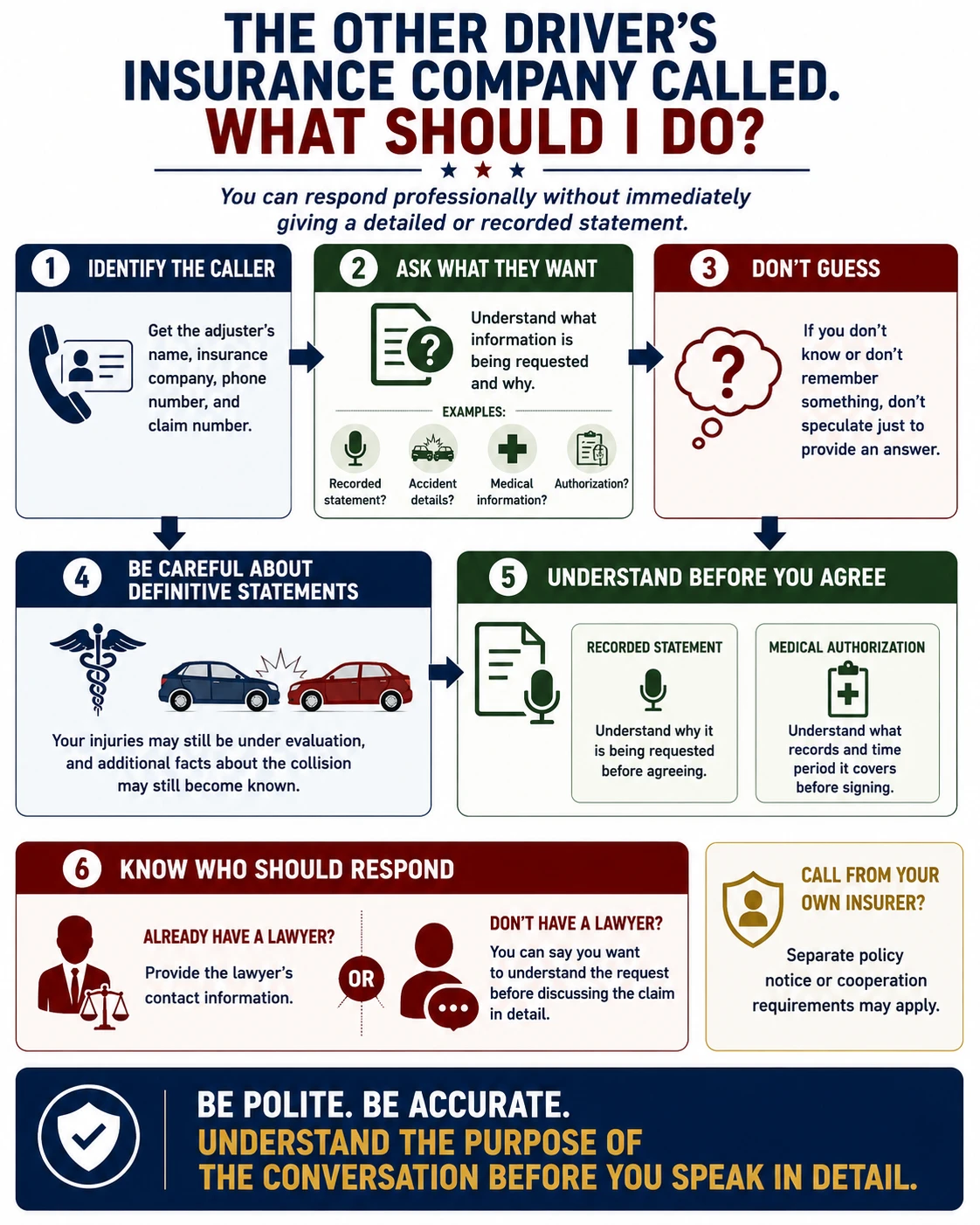
Be polite. Be accurate. Understand the purpose of the conversation before you speak in detail.
Is Talking to My Own Insurance Company Different?
Yes. Your own insurance company is different from the other driver’s liability insurer. Your auto policy may require you to provide timely notice of an accident, cooperate with the insurer’s investigation, provide information, or satisfy other policy requirements.
That does not mean you should guess or give inaccurate information. It means you should not apply a blanket “never talk to an insurance company” rule to your own insurer without first understanding your policy and the type of claim involved.
This distinction can become particularly important when uninsured motorist coverage, underinsured motorist coverage, Medical Payments coverage, collision coverage, or other first-party benefits may be involved.
The important question is not simply, “Is an insurance company calling me?” It is: “Which insurance company is calling? Whose interests does it represent? What is it asking for? What obligations apply?”
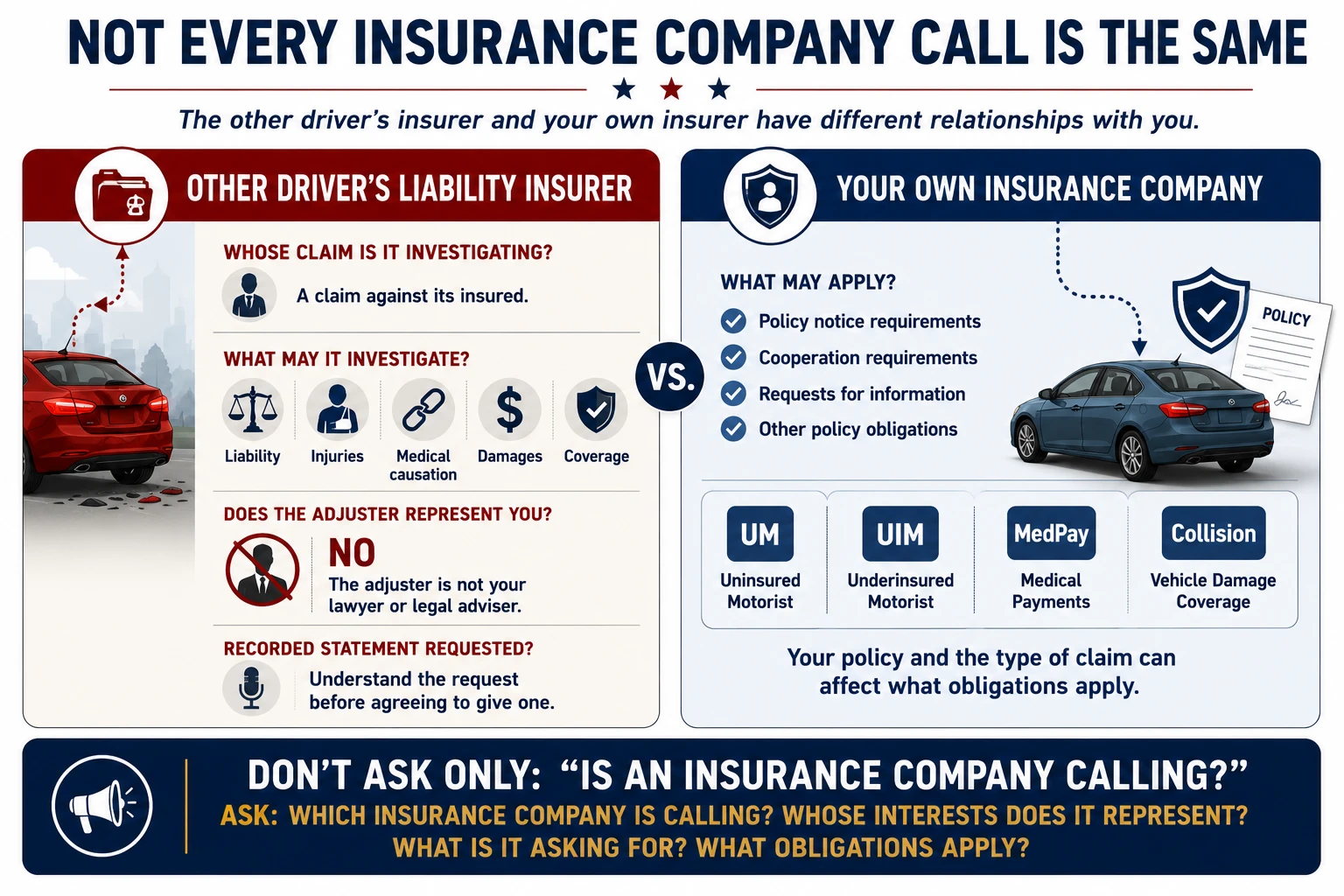
Your policy and the type of claim can affect what obligations apply. Ask which insurance company is calling, whose interests it represents, what it is asking for, and what obligations apply.
Should I Sign a Medical Authorization for the Other Driver's Insurance Company?
An insurance adjuster may ask you to sign an authorization allowing the insurer to obtain medical records. Before signing, understand exactly what records the authorization permits the insurer to obtain, how broad the authorization is, and what time period it covers.
Medical history can be relevant in an injury claim, particularly when questions arise about prior injuries, similar conditions, or medical causation. But that does not mean every authorization should be signed without first understanding its scope.
If you are unsure what an authorization allows the insurer to obtain, get legal guidance before signing it.
Why Is It So Easy to Make a Mistake After an Accident?
After a serious accident, many people are experiencing one of the most stressful events of their lives.
They may be in pain, dealing with shock, processing what happened, worrying about medical bills, and trying to figure out how they are going to move forward. Adrenaline is often still affecting them, and many people are simply not thinking as clearly as they normally would.
That is why I tell people not to feel pressured into answering detailed questions during an unexpected phone call. Take the time to understand who is calling, what they are asking for, and whether you are comfortable responding. An accurate answer given after you understand the question is better than a rushed answer based on stress, uncertainty, or incomplete information.
Why Does Careful Documentation Matter When Dealing With an Insurance Company?
Because we prepare cases with the possibility of trial in mind, we pay attention to statements and evidence from the beginning. Something said casually in the first few weeks of a claim can still matter months or years later.
Careful documentation can also help establish what actually happened. Medical records, photographs, video, witness information, accident reports, employment records, and written communications may each answer different questions about liability, injuries, medical causation, and damages.
I tell clients to think about the case from the beginning as though someone who was not there may eventually have to understand what happened. Good evidence helps tell that story accurately.
Can I Ignore the Insurance Company's Phone Calls?
You should not simply ignore important claim-related communications. But responding to a phone call does not mean you have to immediately give a detailed or recorded statement about the accident and your injuries.
If the other driver’s insurer contacts you, keep a record of the call, identify the adjuster and claim number, and understand what information is being requested. If you have a lawyer, direct the adjuster to your lawyer. If you do not, you can tell the adjuster you want to understand the request before discussing the details of the claim.
If the communication comes from your own insurer, remember that separate policy-based notice or cooperation requirements may apply.
What Is the One Thing Gary Wishes Every South Carolina Driver Understood Before Speaking With the Other Driver's Insurance Company?
The other driver’s insurance adjuster may be polite and professional, but the adjuster is not your representative. Before answering detailed questions, understand that the conversation is part of the insurer’s investigation of the claim.
You do not need to guess, speculate, or feel pressured into giving an immediate recorded statement simply because an adjuster calls. Know who is asking the questions, why the information is being requested, and how your answers may become part of the claim.
Simply put: be polite, be accurate, and understand the purpose of the conversation before you speak in detail.
Insurance Company Call Checklist
- Get the adjuster's name, company, phone number, and claim number
- Ask what information is being requested and why
- Do not guess about facts you do not know or remember
- Do not make definitive statements about injuries that are still being evaluated
- Do not admit or speculate about fault
- Do not agree to a recorded statement simply because one is requested
- Understand the scope of any medical authorization before signing it
- Keep records of calls, emails, letters, and other communications
- If you have a lawyer, provide the lawyer's contact information
- Remember that communications with your own insurer may involve different policy obligations
In Summary
If the other driver’s insurance company contacts you after a South Carolina car accident, do not assume you are required to immediately give a recorded statement or detailed account of the accident simply because an adjuster asks for one. The adjuster represents the insurance company handling the claim against its insured, not you, and statements about fault, injuries, medical treatment, or damages may become part of the claim.
Be polite and accurate, but do not guess, speculate, or make definitive statements about injuries that are still being evaluated. Before agreeing to a recorded statement or signing a medical authorization, understand what is being requested, why it is being requested, and what information you are authorizing the insurer to obtain.
Your own insurance company is different. Your policy may contain notice, cooperation, or other requirements that matter, particularly when uninsured motorist, underinsured motorist, MedPay, collision, or other first-party coverage is involved.
The practical rule is simple: know who is asking the questions, understand the purpose of the request, and make sure the information you provide is accurate.