


What Does a "$50,000 Injury Claim" Actually Mean?
The phrase “$50,000 injury claim” can mean several different things, and the distinction matters.
$50,000 in Medical Bills
If your medical expenses total $50,000, those bills may represent one category of damages. They do not automatically establish the total value of your claim.
Other damages may also need to be evaluated, depending on the evidence.
$50,000 in Total Damages
If you are using $50,000 to describe all of the damages you believe you sustained, the question becomes whether those damages are supported by the medical, financial, and other evidence in the case.
A $50,000 Insurance Policy Limit
A $50,000 liability limit generally describes the amount of liability insurance potentially available under a particular policy, subject to the policy terms and applicable law. It does not automatically establish what the injury claim itself is worth.
A claim could potentially be worth less than the available limit, or the supported damages could exceed that amount.
A $50,000 Settlement Offer
If an insurance company has offered you $50,000, the important question is not whether $50,000 sounds like a large amount of money.
The question is:
How does that offer compare with the value of the damages supported by the evidence and the amount that may actually be recoverable?
$50,000 in Property Damage
Property damage and bodily injury are different categories of loss. A $50,000 vehicle or property-damage claim should not be confused with a $50,000 bodily injury claim.
Before deciding whether any settlement is fair, make sure you understand exactly what the $50,000 represents.
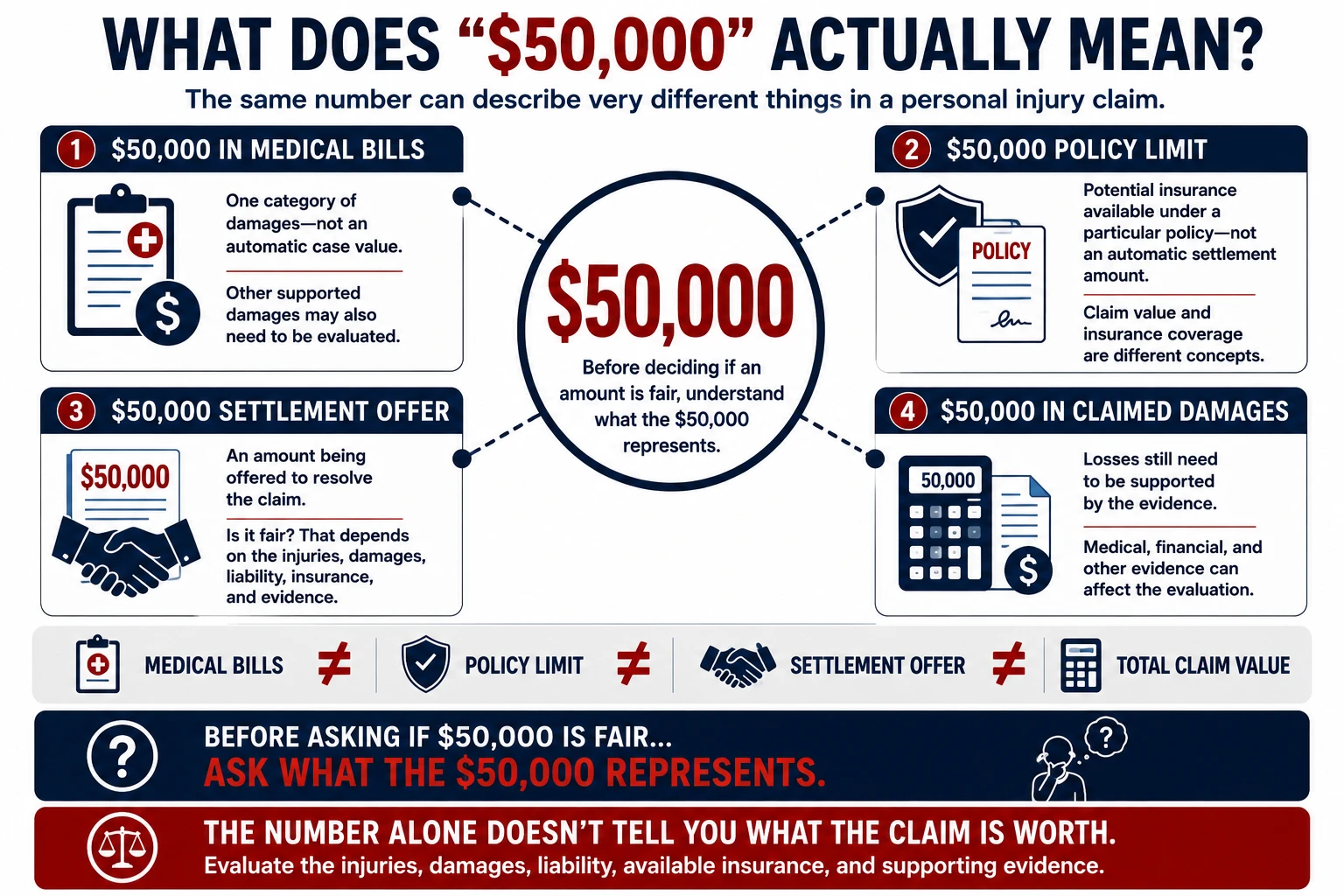
The same number can describe very different things in a personal injury claim.
What Factors Can Affect the Value of a South Carolina Injury Claim?
| Factor | Why It May Matter |
|---|---|
| Nature and Severity of Injuries | More serious injuries may involve greater medical needs, limitations, and other losses |
| Medical Treatment | Records can help document the injuries, symptoms, diagnoses, treatment, and recovery |
| Past Medical Expenses | May establish part of the economic loss associated with the injury |
| Future Medical Care | May affect damages when future treatment is reasonably supported by medical evidence |
| Lost Income | May document earnings lost because of the injury |
| Reduced Earning Ability | May matter when an injury affects the ability to earn income in the future and the loss can be supported |
| Pain and Suffering | May reflect the physical and personal effects of the injury |
| Permanent Impairment or Limitations | May affect value when supported by appropriate medical evidence |
| Effect on Daily Life | May help establish how the injury changed ordinary activities, independence, and quality of life |
| Liability | Disputed or shared fault can affect the amount that may be recovered |
| Available Insurance Coverage | Can affect the practical amount potentially available from applicable insurance |
| Other Sources of Recovery | Additional applicable coverage or legally responsible parties may affect potential recovery |
| Strength of the Evidence | Medical records, wage documentation, witnesses, photographs, and other evidence can support claimed losses |
| Punitive Damages | May become relevant in cases involving conduct that satisfies South Carolina's legal requirements |
What Is a Fair Settlement for a $50,000 Injury Claim?
A fair settlement is not determined simply by taking your medical bills and multiplying them by a particular number.
The starting point is identifying all legally recoverable damages supported by the evidence.
Depending on the case, those may include:
- Past medical expenses
- Future medical expenses supported by medical evidence
- Lost income
- Reduced earning ability when supported
- Pain and suffering
- Permanent impairment or limitations
- Loss of enjoyment of life
- Scarring or disfigurement
- Property-related losses when applicable
- Other damages recognized under South Carolina law
Liability must also be considered. If responsibility for the accident is disputed or you are alleged to share responsibility, that issue may affect what can ultimately be recovered.
Available insurance coverage matters as well. The value of the damages and the amount of insurance available to pay those damages are related issues, but they are not the same thing.
Finally, the evidence matters. A claimed loss generally becomes more meaningful when it can be supported through medical records, bills, employment records, photographs, witness testimony, expert opinions when appropriate, and other reliable evidence.
The question is not, “What formula applies to a $50,000 claim?” The better question is, “What damages can the evidence support, who is legally responsible for them, and what sources of recovery are available?”
Why Might an Injured Person Underestimate the Value of a Claim?
One reason is that the most obvious expenses are not necessarily the only damages that may need to be evaluated.
You may know exactly how much you have received in medical bills or how much income you have already lost. Other losses can be more difficult to identify or measure.
Depending on the facts and supporting evidence, a personal injury claim may involve questions about:
- Future medical treatment
- Future medical expenses
- Reduced ability to earn income
- Permanent physical limitations
- Pain and suffering
- Loss of enjoyment of life
- Scarring or disfigurement
- The effect of an injury on ordinary activities
- Other damages recognized under South Carolina law
There is another problem with evaluating a claim too early: you may not yet know the full medical consequences of the injury.
If treatment is ongoing, additional diagnoses are being evaluated, surgery is being considered, or doctors have not yet determined the likely long-term limitations, important information may still be missing.
Before evaluating a settlement, identify the damages that actually apply to your case and determine what evidence supports them.
What Kinds of Accidents Can Lead to a $50,000 or Greater Injury Claim?
There is no particular type of accident that automatically creates a $50,000 injury claim.
Depending on the injuries, damages, liability, insurance coverage, and evidence, claims of this size or greater may arise from:
- Car accidents
- Commercial truck accidents
- Motorcycle accidents
- Pedestrian accidents
- Bicycle accidents
- Rideshare accidents
- Workplace accidents involving third-party liability
- Other incidents in which someone's negligence or wrongful conduct causes injury
The amount of visible vehicle damage or the type of accident does not, by itself, determine the value of a bodily injury claim.
For example, two people involved in similar-looking collisions can experience very different injuries, treatment, recovery periods, work limitations, and long-term consequences.
Evaluate the person and the evidence, not simply the type of accident or the appearance of the vehicles.
Why Is It Important to Understand the Full Extent of Your Injuries Before Settling?
A settlement generally resolves the claims covered by the agreement. That makes it important to understand your injuries and reasonably anticipated future medical needs before deciding whether an offer adequately addresses your losses.
We represented an injured person who initially believed the accident had caused little more than a bruised hip. Further medical evaluation later identified a serious hip injury, and the client’s condition ultimately required a total hip replacement.
Before our involvement, the insurance company had made an offer of approximately $8,000. As additional medical evidence developed, it became clear that the client’s injuries and medical needs were substantially more serious than initially understood.
Every case is different. This example is not a representation or guarantee of what another case may be worth or how another claim will resolve. Its importance is much simpler: an early settlement evaluation can be incomplete when the medical picture is still developing.
Before settling an injury claim, consider whether:
- Your diagnoses are reasonably understood
- Recommended treatment has been evaluated
- Future medical needs can be reasonably assessed
- Work restrictions or lost income are known
- Permanent limitations have been evaluated when appropriate
- The other damages associated with the injury have been identified
This does not mean every injured person must wait until every symptom has disappeared before a claim can be evaluated. The important question is whether there is enough medical and other evidence to reasonably understand the injuries, treatment, future medical needs, and other losses that may affect the claim.
A settlement decision should be based on the medical and other evidence available in your case, not simply on how you felt during the first days or weeks after the accident.
What Factors Tend to Have the Biggest Impact on Settlement Value?
No single factor determines the value of every injury claim. In many cases, several issues become particularly important.
Severity and Duration of the Injury
An injury that resolves after limited treatment presents a different damages picture from an injury that causes continuing symptoms, surgery, permanent limitations, or long-term medical needs.
Medical Evidence
Medical records can help establish diagnoses, symptoms, treatment, restrictions, future medical recommendations, and the relationship between the accident and the injuries being claimed.
Effect on Work and Daily Life
An injury may affect your ability to work, care for your family, drive, exercise, sleep, perform household tasks, or participate in activities you previously enjoyed.
The significance depends on the evidence and the actual effect the injury has had on your life.
Liability
Even substantial damages do not eliminate the need to establish legal responsibility. Disputed or shared fault can affect potential recovery.
Available Insurance and Other Sources of Recovery
A case can involve significant damages while available insurance is limited. Conversely, the existence of substantial insurance coverage does not automatically make the claim worth the policy limits.
Quality of the Supporting Evidence
Medical records, wage documentation, photographs, witnesses, expert opinions when appropriate, and other evidence can affect the ability to establish claimed losses.
Settlement value comes from the interaction of these factors. That is why two people with similar medical bills can have very different claims.
What Mistakes Can Hurt the Evaluation of an Injury Claim?
A settlement evaluation depends heavily on the facts and supporting evidence. Problems can develop when important information is missing, inconsistent, or never preserved.
Common mistakes may include:
- Settling before the nature and extent of the injuries are reasonably understood
- Failing to report symptoms accurately to medical providers
- Ignoring new or changing symptoms
- Having significant unexplained gaps in medically recommended treatment
- Failing to preserve medical records, bills, receipts, and other documentation
- Failing to document lost income or work restrictions
- Overlooking reasonably anticipated future medical needs supported by the medical evidence
- Failing to identify all potentially applicable insurance coverage
- Assuming medical bills alone determine settlement value
- Exaggerating symptoms or limitations
- Minimizing real symptoms or limitations
- Posting accident, injury, or activity information publicly without considering how it may be interpreted
- Signing a settlement or release without understanding what claims or rights it resolves
- Assuming an insurance company's valuation is the only possible evaluation of the claim
Depending on the circumstances, there may also be damages or derivative claims that an injured person does not immediately recognize. For example, South Carolina law may permit a spouse to pursue a loss-of-consortium claim under appropriate circumstances.
The goal is not to make a claim appear larger than it is. The goal is to identify the losses that actually exist and support them with reliable evidence.
Is There a Formula for Calculating a Personal Injury Settlement?
There is no universal formula that determines what a South Carolina personal injury case is worth.
You may see websites suggesting that you multiply medical bills by a certain number or use an online “settlement calculator.” Those approaches cannot account for many of the issues that may affect an actual claim.
For example, two people could each have $50,000 in medical expenses but have very different:
- Injuries
- Diagnoses
- Treatment
- Recovery periods
- Future medical needs
- Work losses
- Permanent limitations
- Effects on daily life
- Liability issues
- Insurance coverage
- Supporting evidence
A person who fully recovers and returns to normal activities may present a different damages picture from someone with the same medical expenses who requires future surgery or has medically supported permanent limitations.
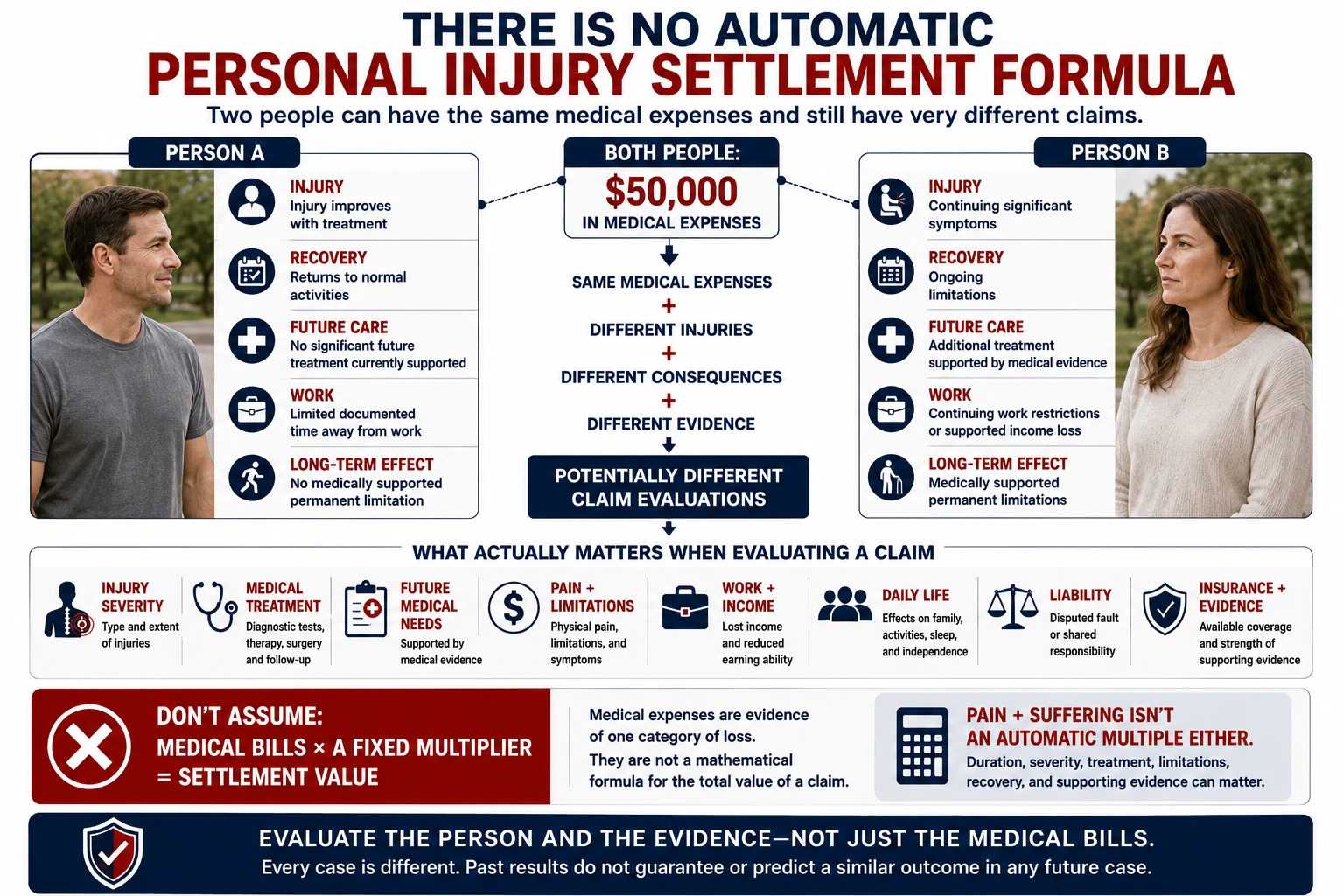
Two people can have the same medical expenses and still have very different claims.
Medical bills are evidence of one category of loss. They are not a mathematical formula for determining the total value of an injury claim.
How Does Pain and Suffering Affect the Value of an Injury Claim?
Medical expenses and lost income can sometimes be documented with bills, invoices, pay records, and other financial evidence. Pain and suffering is different because it concerns the physical and personal effects of the injury.
Depending on the circumstances, relevant considerations may include:
- The nature and severity of the injury
- How long symptoms continue
- The type and extent of medical treatment
- Physical pain and discomfort
- Limitations on ordinary activities
- Difficulty sleeping or performing daily tasks
- The effect of the injury on work, family responsibilities, hobbies, and independence
- Permanent impairment or limitations when medically supported
- The overall course of recovery
- Evidence supporting the claimed effects of the injury
There is no universal multiplier that automatically determines pain-and-suffering damages based on the amount of medical bills.
For example, $50,000 in medical expenses does not automatically mean pain and suffering is worth a particular multiple of $50,000. The significance of those expenses depends on the injuries, treatment, recovery, limitations, and other evidence in the individual case.
Medical records can be important, but they may not be the only evidence relevant to how an injury affected someone’s life. Depending on the case, testimony, photographs, employment records, and other evidence may also help document those effects.
Pain and suffering should be evaluated based on the actual effects of the injury and the evidence supporting them, not by applying an automatic formula to the medical bills.
Does a $50,000 Policy Limit Mean My Case Is Worth $50,000?
No. Claim value and available insurance coverage are different concepts.
A $50,000 bodily injury liability limit generally describes the maximum amount of liability coverage potentially available under that particular policy for a covered claim, subject to the policy terms and applicable law.
It does not automatically mean:
- Your claim is worth $50,000
- The insurer must offer $50,000
- $50,000 is the maximum amount that could potentially be recovered from every available source
- Your damages cannot exceed $50,000
Your supported damages could be less than the policy limit, approximately equal to it, or greater than it.
What If My Damages Are More Than the Available Liability Insurance?
If your damages may exceed the at-fault driver’s liability coverage, the next step is to determine whether other potentially applicable sources of recovery exist.
Depending on the facts, that analysis may include:
- Additional applicable liability policies
- Whether another person or business may also bear legal responsibility
- Applicable underinsured motorist coverage
- Other insurance issues specific to the accident
The existence and availability of additional coverage depend on the policies, facts, and South Carolina law.
Do not assume that a $50,000 liability limit automatically establishes either the value of your claim or every potential source of recovery.
It is also possible for the evidence to support damages greater than the amount that is practically recoverable from available insurance or other legally responsible sources. Claim value and the amount that can actually be recovered are related questions, but they are not always the same question.
Can Punitive Damages Increase the Value of an Injury Claim?
In some cases, South Carolina law may allow punitive damages when the defendant’s conduct satisfies the applicable legal requirements.
Punitive damages are different from damages intended to address an injured person’s medical expenses, lost income, pain and suffering, and other losses. Their purpose includes punishment and deterrence rather than simply reimbursing the injured person for a loss.
Punitive damages are not available in every personal injury case. Whether they may be pursued depends on the defendant’s conduct, the available evidence, and South Carolina law.
When appropriate, investigation and discovery may uncover evidence relevant to whether punitive damages should be considered.
Why Can Trial Experience Matter When Evaluating a Settlement?
A settlement offer is ultimately an alternative to continuing the legal process and, when necessary, asking a judge or jury to decide disputed issues.
That is one reason courtroom experience can be useful when evaluating a claim.
A lawyer evaluating a settlement may need to consider:
- What evidence would be admissible
- How liability could be disputed
- Which witnesses may be persuasive or vulnerable to challenge
- How medical evidence may be presented
- What damages can be supported
- What arguments the defense may make
- The risks and costs of continued litigation
- What issues could ultimately be presented to a judge or jury
Christmas Injury Lawyers is a litigation and trial law firm. Our attorneys have tried more than 500 cases before judges, commissioners, and juries. That experience informs how we evaluate evidence, liability, damages, and the risks involved in continuing a case rather than accepting a particular settlement.
Trial experience does not guarantee a particular result. It provides another perspective for evaluating whether a proposed settlement reasonably reflects the strengths, weaknesses, and evidence in a particular case.
What Should I Know Before Accepting a Settlement Offer?
A settlement decision can have lasting consequences. Before accepting an offer, make sure you understand what is being resolved and what information is available to evaluate the offer.
Ask:
- Do I reasonably understand the nature and extent of my injuries?
- Is important medical evaluation or treatment still pending?
- Are future medical needs supported by the medical evidence?
- Have my past medical expenses been identified?
- Have lost wages been calculated?
- Could the injury affect my future ability to earn income?
- Have pain, limitations, and the effect on my daily life been evaluated?
- Have all potentially applicable insurance policies been investigated?
- Is liability disputed?
- What evidence supports each claimed loss?
- Does the settlement resolve all claims against the parties covered by the agreement?
- Do I understand the release before signing it?
Insurance companies evaluate claims regularly. You may be dealing with this process for the first time while also managing medical treatment, missed work, pain, and uncertainty about what comes next.
You do not need to know everything about personal injury law to ask good questions. But you should understand the injuries, damages, evidence, insurance issues, and terms of the proposed settlement before deciding whether it is fair.
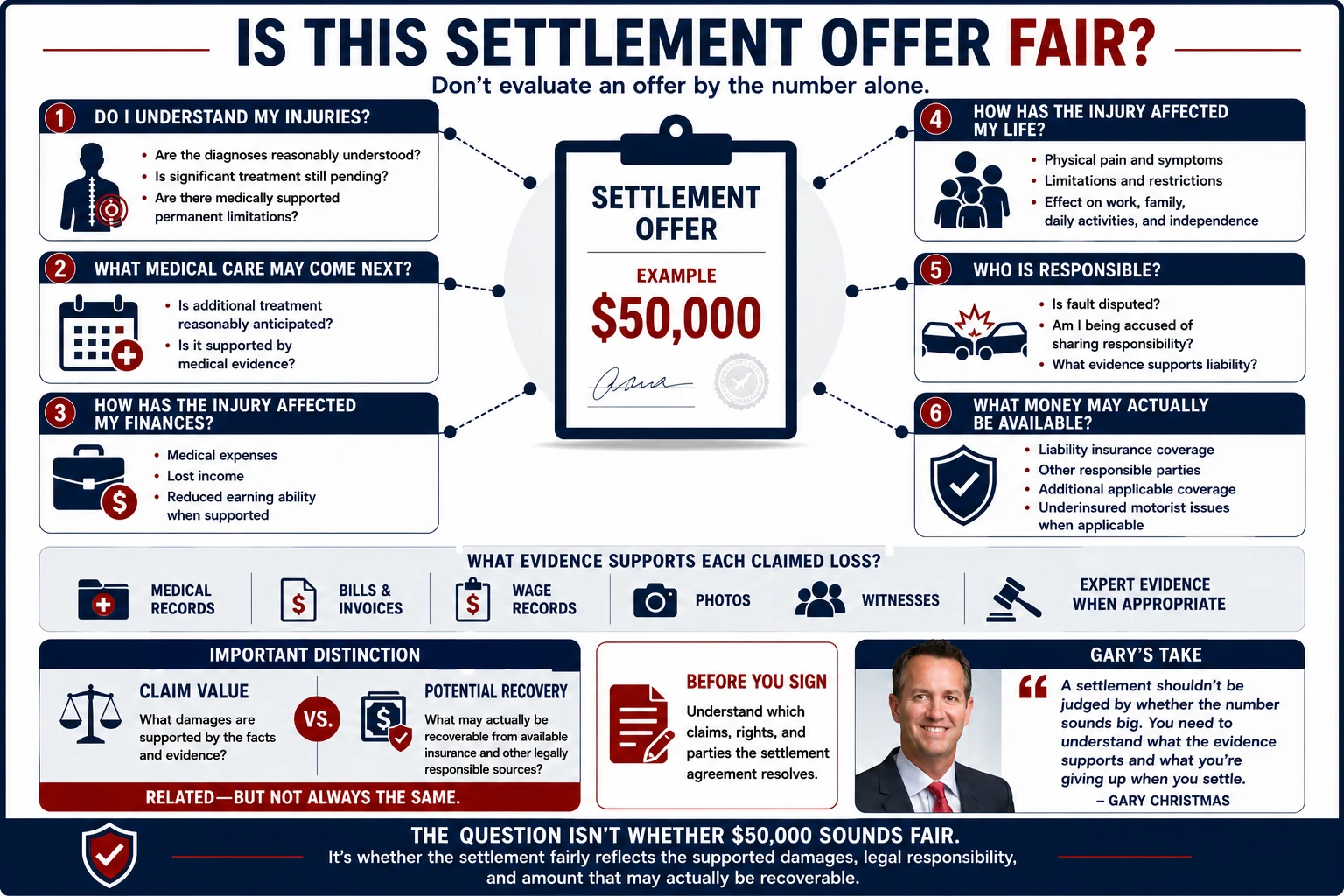
Don’t evaluate an offer by the number alone.
Before Accepting a Personal Injury Settlement
- Do I understand what the $50,000, or other settlement figure, actually represents?
- Do I reasonably understand the nature and extent of my injuries?
- Is significant medical evaluation or treatment still pending?
- Have future medical needs been evaluated when supported by the evidence?
- Have past medical expenses been identified?
- Have lost wages and work restrictions been documented?
- Has any supported reduction in future earning ability been evaluated?
- Have pain, physical limitations, and effects on daily life been considered?
- Have all potentially applicable insurance policies been identified?
- Do I understand whether liability is disputed?
- Is there evidence supporting each claimed loss?
- Do I understand what claims and parties the settlement release covers?
- Have I considered whether I need legal advice before accepting the offer?
A settlement should be evaluated using the facts and evidence in your case, not because a particular number sounds large or because someone says that is what a “$50,000 claim” is supposed to be worth.
Summary
There is no automatic fair settlement amount for a $50,000 injury claim in South Carolina. Before deciding whether $50,000 is fair, you first need to understand what that number represents. It could refer to medical expenses, total claimed damages, an insurance policy limit, or an actual settlement offer. Those are very different things.
A personal injury settlement should be evaluated based on the injuries, damages, liability, available insurance, and evidence in the individual case. Medical expenses are important, but they are only one part of the analysis. Lost income, reasonably anticipated future medical needs, reduced earning ability, pain and suffering, permanent limitations, effects on daily life, and other legally recoverable damages may also need to be considered when supported by the evidence.
Understanding the medical picture can be particularly important before accepting a settlement. If significant treatment or evaluation is still pending, the long-term effects of an injury may not yet be reasonably understood. That does not mean every person must wait until every symptom disappears before evaluating a claim. The important question is whether enough medical and other evidence exists to reasonably evaluate the injuries, treatment, anticipated future needs, and other losses.
Insurance coverage must be evaluated separately from damages. A $50,000 liability policy does not automatically make a claim worth $50,000, and a claim may involve supported damages above or below the available policy limit. Depending on the circumstances, additional liability coverage, underinsured motorist coverage, other responsible parties, or other potential sources of recovery may also need to be investigated.
Before accepting a settlement, make sure you understand the injuries and damages being evaluated, the evidence supporting them, whether liability is disputed, what insurance coverage may apply, and exactly what claims and parties the settlement agreement will resolve.
The question is not whether $50,000 sounds like a fair amount. The question is whether the proposed settlement fairly reflects the damages supported by the evidence, the legal responsibility for those damages, and the amount that may actually be recoverable.