

Is the Rear Driver Always at Fault in a South Carolina Rear-End Accident?
Not automatically. South Carolina law requires a driver to avoid following another vehicle more closely than is reasonable and prudent, considering factors such as vehicle speed, traffic, and roadway conditions. That rule is often important in rear-end collisions, but liability still depends on the particular facts and evidence.
For example, questions may arise about whether the front vehicle changed lanes immediately before impact, whether multiple vehicles were involved in a chain reaction, whether a vehicle was pushed into another vehicle, or whether some other event contributed to the collision.
The fact that one vehicle struck another from behind is important evidence. It does not mean every rear-end collision should be evaluated exactly the same way.
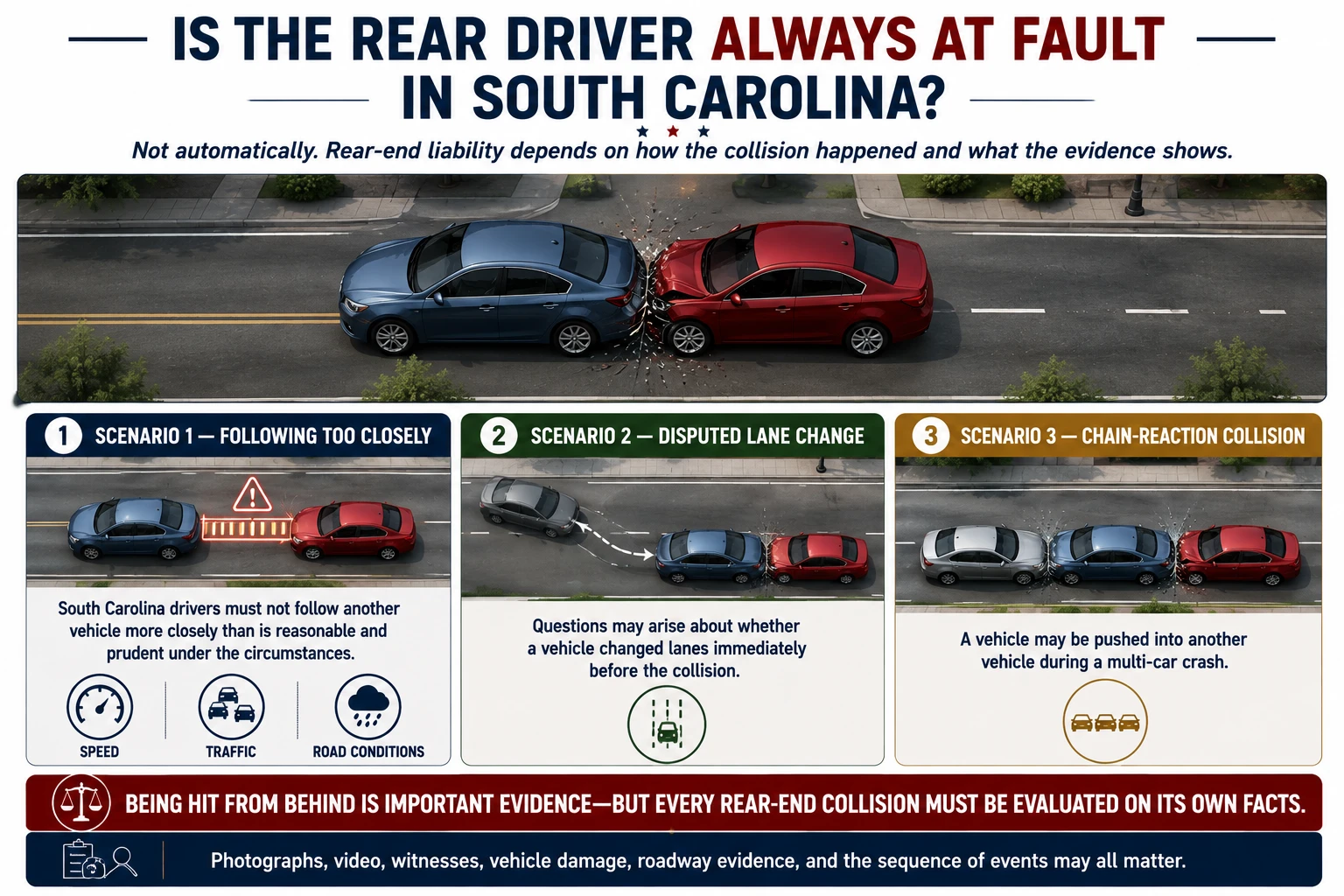
Being hit from behind is important evidence, but every rear-end collision must be evaluated on its own facts.
What If the Insurance Company Says I Was Partly at Fault for Being Rear-Ended?
South Carolina uses a modified comparative-negligence system. That means being assigned some fault does not necessarily prevent you from recovering damages. If your share of fault is 50% or less, a recovery may still be available, but it is reduced by your percentage of fault. If you are found more than 50% at fault, you cannot recover from the other party.
That is one reason evidence matters even in a rear-end collision. Photographs, video, witness accounts, vehicle damage, roadway evidence, and the sequence of events may become important if someone argues that you contributed to the crash.
When Should You Hire a Lawyer for a Rear-End Accident?
| Situation | Why a Lawyer May Help |
|---|---|
| You suffered bodily injuries | Medical and legal issues can become complicated |
| Multiple vehicles were involved | Fault may be disputed |
| Insurance company contacts you | Statements can be used against you |
| Your pain worsens over time | Injuries may be more serious than expected |
| Commercial vehicle was involved | Additional evidence, parties, insurance, or regulatory issues may need to be investigated |
| You are unsure what your claim is worth | Damages may be undervalued |
| Fault is being disputed | Evidence may need to be identified and preserved quickly |
What Mistakes Can Hurt a Rear-End Accident Claim?
Rear-end accidents often look straightforward. One vehicle hits another from behind, so the person who was struck may assume there cannot possibly be a dispute about what happened. That assumption can be a mistake. Questions can still arise about how the collision occurred, whether another vehicle was involved, whether the front vehicle changed lanes or stopped unexpectedly, what injuries were caused by the crash, and what the available evidence actually shows.
Here are some of the mistakes I would avoid after a rear-end collision:
Assuming fault cannot be disputed because you were hit from behind.
Being struck from behind is important evidence, but do not assume that ends every question about liability. The other driver or insurance company may argue that you changed lanes immediately before impact, that another vehicle caused a chain reaction, or that something else contributed to the collision. Preserve the evidence even when fault initially seems obvious.
Failing to photograph all of the vehicles and their positions.
Do not photograph only the damage to the back of your vehicle. If you are physically able and it is safe to do so, photograph the damage to all vehicles involved, their positions at the scene, license plates, debris, skid marks, traffic signals, lane markings, and the surrounding roadway. Those photographs may become important if the parties later disagree about how the collision happened.
Failing to identify witnesses.
An independent witness may have seen something neither driver noticed. Get names and contact information when reasonably possible. This can become particularly important in multi-vehicle crashes, disputed lane-change cases, and chain-reaction collisions.
Failing to look for dash cam or surveillance footage.
Video evidence can disappear quickly. Look beyond the vehicles involved in the collision. Nearby businesses, homes, doorbell cameras, parking lots, commercial vehicles, and other sources may have captured the crash. If potential footage exists, identifying it early can matter because some recording systems automatically overwrite older video.
Failing to report the symptoms you are actually experiencing.
After a collision, one injury may initially seem much more significant than another. That does not mean other symptoms should be ignored. Tell your medical providers about the symptoms you are actually experiencing and let them determine what requires evaluation. As I have seen over the years, an injury that initially appears less significant can sometimes become a much more important medical issue later.
Assuming limited vehicle damage means you could not have been meaningfully injured.
Vehicle damage and physical injury are different issues. Photographs and repair information can be relevant evidence, but the appearance of the vehicles does not, by itself, determine whether someone was injured or how significant an injury may be. Those questions depend on the individual facts and medical evidence.
Making unnecessary statements before the facts are clear.
Be accurate about what you know and what you do not know. Avoid guessing about speed, distance, fault, injuries, or other details simply because someone asks you for an immediate answer. What seems obvious in the hours after a collision may look different after photographs, video, witness accounts, medical evidence, and other information are reviewed.
Posting the accident, your injuries, or your activities publicly.
Social-media posts rarely provide the full context of someone’s medical condition or daily life. A photograph, video, comment, or activity post can nevertheless become part of a disputed injury claim. Be thoughtful about making accident- or injury-related information public while the claim is pending.
I tell people not to confuse an accident that looks simple with a claim that will necessarily stay simple. A rear-end collision may happen in seconds, but questions about liability, medical causation, injuries, damages, and insurance coverage can develop long afterward.
The best thing you can do early is preserve the evidence that exists, be accurate about what happened and what you are experiencing, and avoid making assumptions before all of the facts are known.
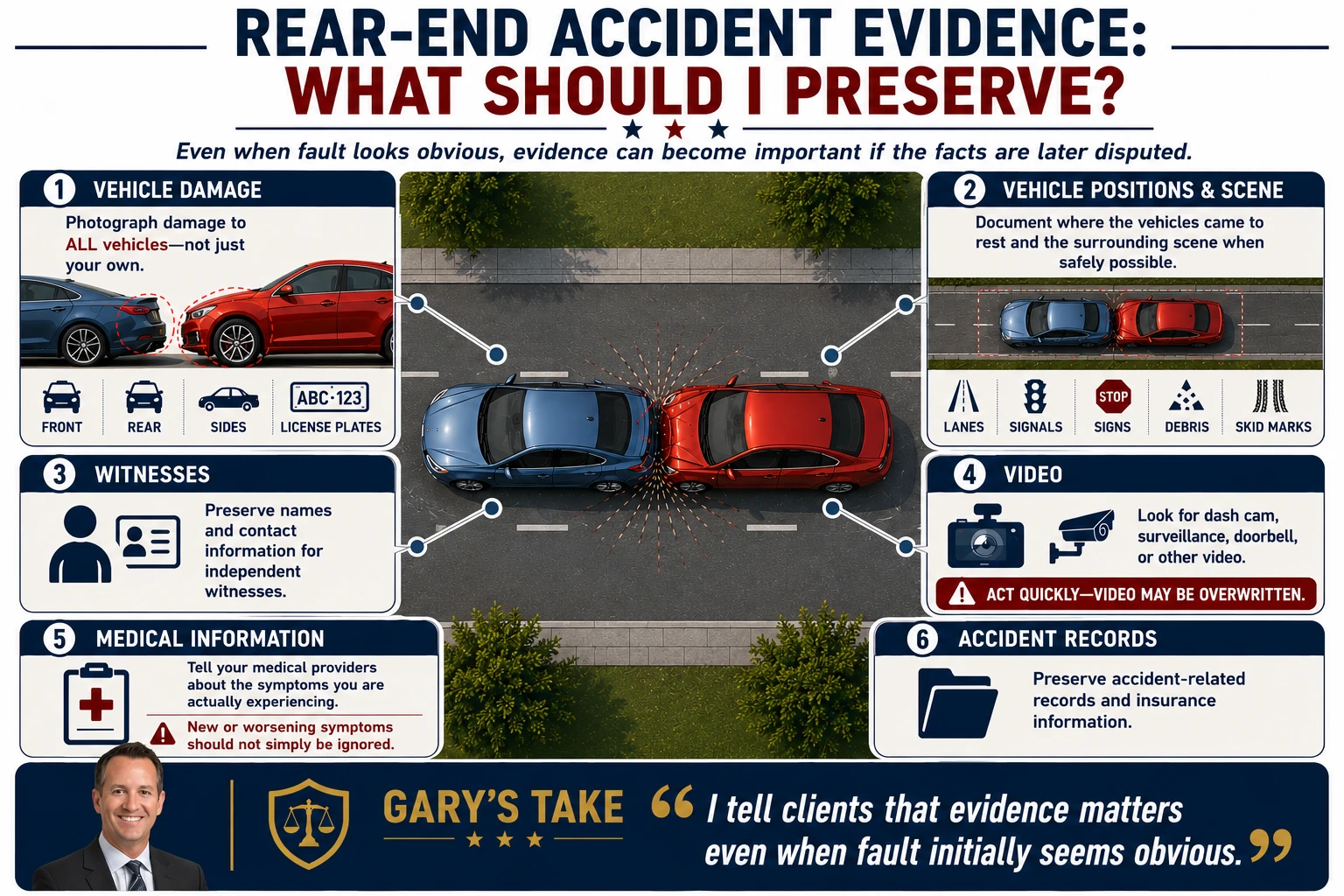
Even when fault looks obvious, evidence can become important if the facts are later disputed.
When Does a Rear-End Accident Claim Become Complicated?
While every case is different, some of the most complicated rear-end accident cases involve chain-reaction collisions and multi-vehicle pileups.
In these situations, there is often a dispute regarding which vehicles were stopped, which vehicles were moving, and which driver actually caused the sequence of collisions. Liability can become much more complicated than people initially assume.
At our firm, we prepare cases for the possibility of trial from the beginning. That means identifying and preserving evidence, analyzing how the collision occurred, determining which drivers or entities may bear responsibility, and understanding the strengths and weaknesses of the case.
What If My Pain Gets Worse After a Rear-End Accident?
Pain and other symptoms do not always remain the same after a rear-end collision. Some people know immediately that they are hurt. Others may notice symptoms later, or realize over time that something they initially thought was minor is not improving.
If your pain is getting worse, new symptoms develop, or something simply does not feel right, communicate those symptoms to an appropriate medical provider. Be accurate about what you are experiencing, when you first noticed it, and how it has changed. Your medical provider, not the insurance company, the other driver, or your lawyer, is the person who should evaluate what those symptoms may mean and whether additional medical care is appropriate.
I have seen cases where one injury initially received most of the attention because it hurt the most, while another symptom seemed less important at the time. As the days or weeks passed, that other problem became more significant. That is why I tell clients not to minimize a symptom simply because another injury seems worse. Tell your medical providers what you are actually experiencing and let them decide what needs further evaluation.
From a legal standpoint, accurate medical documentation can also become important if questions later arise about when symptoms developed, whether they changed over time, and whether the condition is related to the collision. That does not mean every new symptom was necessarily caused by the accident. Medical causation depends on the individual facts and medical evidence.
The important point is simple: do not assume that because an injury seemed minor immediately after the crash, you have to keep treating it as minor when your symptoms tell you otherwise. If something changes, report what you are actually experiencing to an appropriate medical provider.
Can Rear-End Accident Injuries Become Serious Later?
Over the past 30 years, I have seen many injuries that initially appeared minor but later became significant.
One case that comes to mind involved a client who suffered serious neck and back injuries, along with what appeared to be a relatively minor bruise on her hip. The bruise was documented in the emergency room, but the focus was naturally on the neck and back injuries.
While the neck and back eventually improved, the hip pain continued. Further evaluation revealed that beneath the bruise was a fracture. Unfortunately, the fracture later became necrotic and ultimately required a total hip replacement.
The lesson I took from that case is not to dismiss a symptom simply because something else hurts more. Tell your medical providers about the symptoms you are actually experiencing and let them decide what needs further evaluation.
What Will the Insurance Company Investigate After a Rear-End Accident?
Even when the collision appears straightforward, the liability insurer may investigate how the crash occurred, statements from the drivers and witnesses, vehicle damage, medical treatment, whether the collision caused the claimed injuries, the extent of the damages, and available coverage.
A rear-end impact does not necessarily eliminate those issues. What you say about the collision, your symptoms, prior injuries, or your medical treatment may become part of how the claim is evaluated.
That is why I tell clients to be accurate and careful about accident-related communications rather than assuming the claim has already been accepted simply because they were hit from behind.
Does Minor Vehicle Damage Mean I Cannot Have a Serious Injury?
Not necessarily. The amount of visible vehicle damage and the nature of a person’s injuries are different questions. Vehicle photographs and repair information can be important evidence, but medical causation should be evaluated based on the individual facts, symptoms, medical history, examination, testing, and medical evidence.
I would not assume that a claim is serious simply because a vehicle has major damage, and I would not assume someone cannot be injured simply because the visible vehicle damage appears limited. The medical evidence matters.
What Factors Affect the Value of a Rear-End Accident Claim?
No single factor determines what a rear-end accident claim is worth. The value depends on the particular facts, injuries, damages, evidence, and available insurance coverage.
Factors that may matter include:
- The nature and extent of the injuries
- Whether the collision caused or aggravated the medical conditions being claimed
- The medical treatment that was reasonably necessary
- Past and future medical expenses supported by the evidence
- Lost income or loss of earning capacity, when applicable
- Pain, physical limitations, and other effects of the injuries
- Whether liability or comparative fault is disputed
- The strength of the evidence supporting the claim
- The amount and types of insurance coverage available
Two rear-end accidents can look very similar in photographs and still involve very different claims. I tell clients that you have to understand the entire picture, the collision, the medical evidence, the damages, the liability evidence, and the available coverage, before you can meaningfully evaluate what a case may be worth.
One of the biggest factors is the amount of insurance coverage available.
South Carolina’s minimum automobile liability limits are currently $25,000 for bodily injury to one person, $50,000 for bodily injury to two or more people in one accident, and $25,000 for property damage.
Depending on the injuries involved, those limits may not be enough to cover all of the damages resulting from a serious collision. That is one reason identifying every potentially applicable source of insurance can matter.
The type of vehicle involved can also make a significant difference. If a commercial vehicle is involved, additional insurance policies or different coverage requirements may apply depending on the vehicle and how it was being used. The driver may also have been working for a business, which can create additional issues involving responsibility, records, and insurance coverage.
That is why our firm believes every case should be thoroughly investigated to identify all available insurance coverage. In our view, that is one of the most important steps in pursuing full justice and fair compensation.
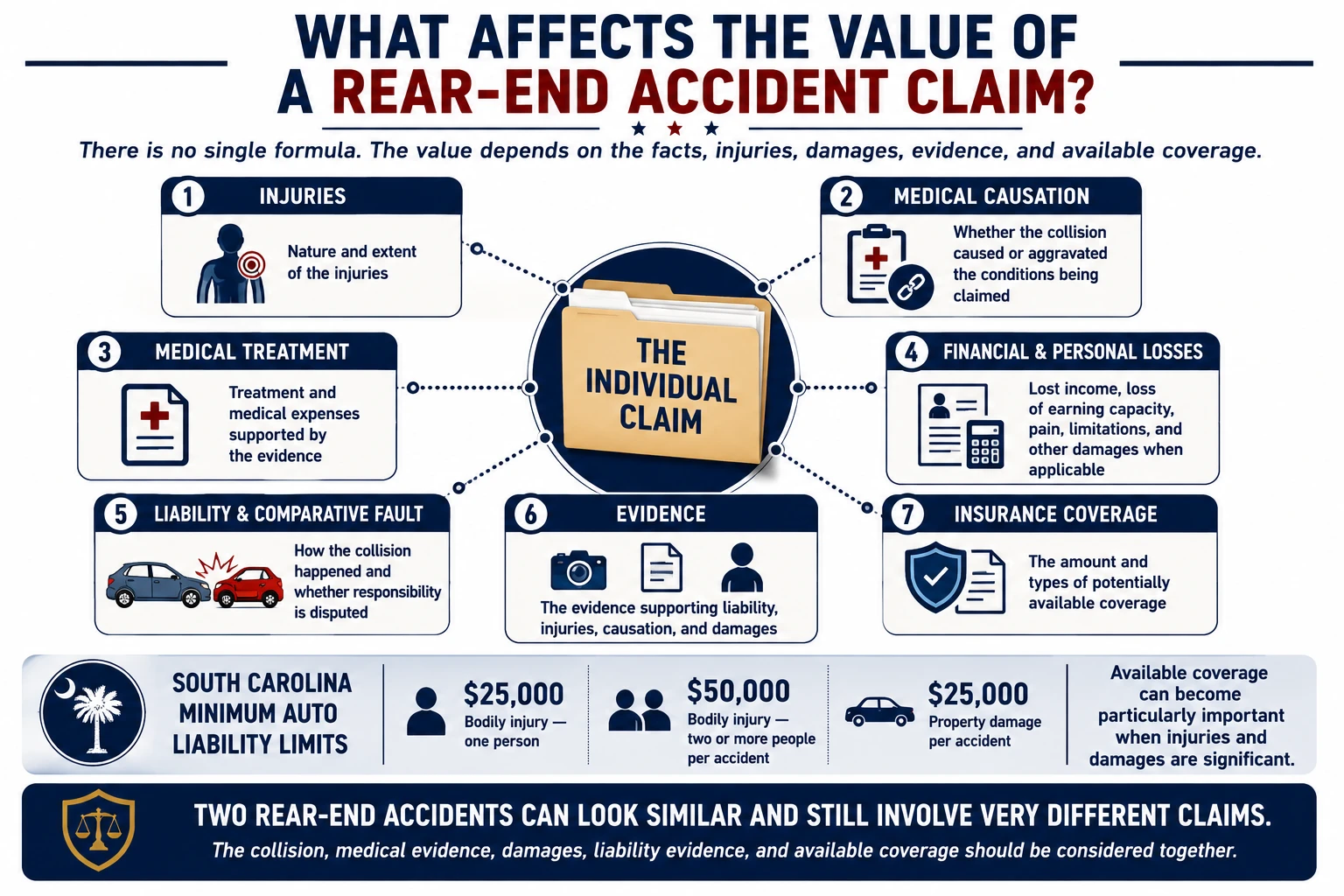
Two rear-end accidents can look similar and still involve very different claims. The collision, medical evidence, damages, liability evidence, and available coverage should be considered together.
When Might I Not Need a Lawyer After a Rear-End Accident?
In my opinion, the clearest example is when the claim involves property damage only and no bodily injury.
Property damage claims are often relatively straightforward. The vehicle is repaired, and the insurance company pays the repair bill. If the vehicle is a total loss, the insurance company generally uses recognized valuation methods to determine its fair market value.
While disagreements can occasionally arise, most property damage claims do not require legal representation. Once bodily injuries are involved, additional medical, legal, insurance, and evidentiary issues may arise, and getting legal advice can become more important.
Can Evidence Change the Outcome of a Rear-End Accident Case?
Over the years, we have handled rear-end collisions where the initial accounts of what happened were very different. In some cases, surveillance footage, residential video, dash cam recordings, vehicle damage, or independent witnesses provided information that was not apparent from the drivers’ statements alone.
I tell clients that evidence matters even when fault initially seems obvious. A rear-end collision may happen in seconds, but determining exactly what occurred can require looking at multiple pieces of evidence together.
That is why I believe evidence should be identified and preserved early, even in a rear-end collision that initially looks straightforward. Photographs, video, witness accounts, vehicle damage, roadway evidence, and medical records may each answer a different question. The important thing is to understand how those pieces fit together before conclusions are drawn about what happened or what the claim involves.
Should I Give the Other Driver's Insurance Company a Recorded Statement?
You generally should not assume that you are required to give the other driver’s liability insurance company a recorded statement simply because an adjuster asks for one. The other driver’s insurer is investigating the claim on behalf of its insured, and what you say about how the collision occurred, your injuries, your medical history, or your treatment may later become important to how the claim is evaluated.
That is different from communications with your own insurance company. Your own policy may contain notice, cooperation, or other requirements that can matter, so the two situations should not automatically be treated the same way.
I tell clients to understand who is asking for the statement, why it is being requested, and what obligations may apply before agreeing to a recorded interview. Be accurate about what you know, and do not guess about speed, distance, injuries, or other facts simply because someone wants an immediate answer.
If you are unsure whether you should give a recorded statement, getting legal advice before doing so can help you understand the request and your obligations.
Rear-End Accident Lawyer Checklist
- Photograph the vehicles and accident scene when safely possible
- Preserve witness information
- Look for dash cam or surveillance footage
- Report all actual symptoms to your medical providers
- Keep medical and accident-related records
- Determine whether more than one vehicle may be responsible
- Identify all potentially applicable insurance coverage
- Be careful about recorded statements concerning fault or injuries
- Avoid posting accident or injury-related content publicly
- Get legal guidance if you were injured, fault is disputed, multiple vehicles are involved, or significant medical or insurance issues arise
In Summary
A rear-end accident in South Carolina may look straightforward, but the legal and medical issues are not always simple. The rear driver is not automatically at fault in every case, and South Carolina’s comparative-negligence rules can affect recovery if more than one driver shares responsibility.
Evidence matters even when fault seems obvious. Photographs, witness statements, dash cam or surveillance video, vehicle damage, and roadway evidence can all help explain how the collision occurred. Injuries can also develop or become clearer over time, so worsening or new symptoms should be communicated to an appropriate medical provider.
The value of a rear-end accident claim depends on the full picture, including liability, medical causation, the nature and extent of the injuries, treatment, damages, available insurance coverage, and the strength of the supporting evidence.
The practical lesson is simple: do not assume a rear-end collision will stay simple just because it looked obvious at the scene.