

What Should I Do in the First Minutes, Hours, and Days After a Car Accident?
Not everything after a car accident needs to happen at once. Your priorities change as you move from the accident scene to medical care and then into the insurance and recovery process.
At the Accident Scene
If you are able to do so safely:
- Check yourself and others for injuries
- Call 911 when emergency assistance is needed
- Move out of immediate danger when appropriate
- Cooperate with responding law enforcement
- Obtain the other driver's identifying and insurance information
- Photograph vehicle positions, damage, roadway conditions, traffic signals, signs, debris, skid marks, and other relevant conditions
- Photograph visible injuries
- Get witness names and contact information
- Avoid arguing about fault
- Do not guess about details you do not know or remember
If you need emergency medical care, getting treatment is more important than collecting evidence yourself.
During the First 24 Hours
After leaving the scene:
- Obtain appropriate medical evaluation for injuries or concerning symptoms
- Tell healthcare providers how the accident occurred and describe your symptoms accurately
- Save photographs and videos in a secure location
- Write down what you remember about the collision while the events are still fresh
- Preserve the other driver's information and any documents provided by law enforcement
- Notify your insurance company as required by your policy
- Save towing, rental-car, medication, and other accident-related receipts
During the First Few Days
As the immediate situation settles:
- Follow your healthcare providers' recommendations
- Report new, worsening, or changing symptoms
- Keep track of medical providers and appointments
- Preserve work notes and documentation of missed income when applicable
- Avoid posting unnecessary accident, injury, or activity information publicly
- Be careful about detailed bodily injury discussions with the other driver's insurance adjuster
- Determine whether photographs, surveillance footage, vehicle data, or other time-sensitive evidence may need to be preserved
- Consider speaking with a South Carolina car accident lawyer if you have questions about fault, injuries, insurance coverage, evidence, or your rights
You do not have to solve the entire claim in the first few days. The immediate goal is to protect your health, preserve available evidence, and avoid preventable mistakes.
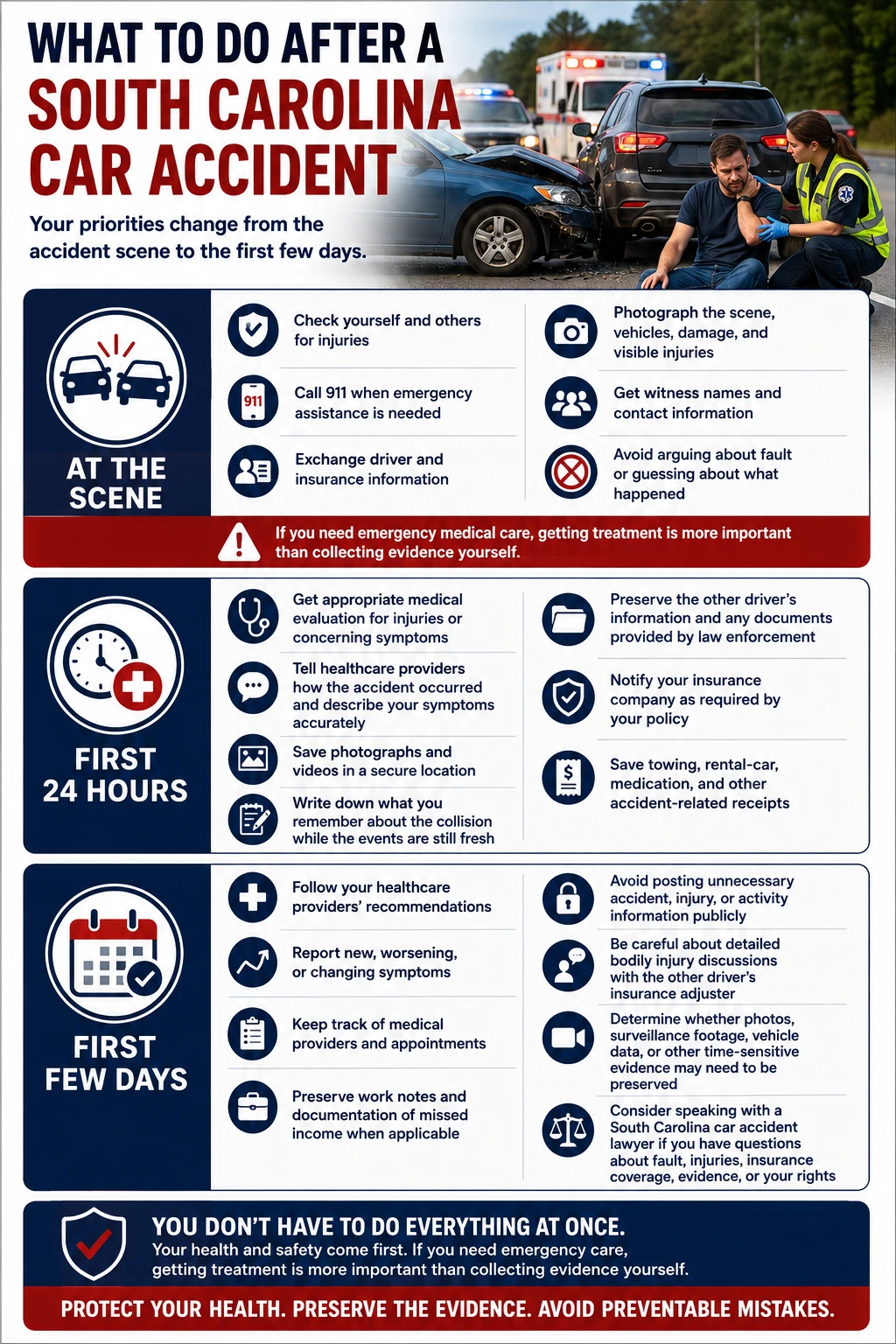
Your priorities change from the accident scene to the first few days.
Should I Call the Police After a Car Accident in South Carolina?
If a collision involves injuries, significant vehicle damage, a dangerous roadway condition, or another situation requiring emergency assistance, call 911 and follow the dispatcher’s instructions.
A responding law-enforcement officer may document information about the collision, identify the drivers and vehicles involved, obtain witness information, manage traffic hazards, and create an official record associated with the crash.
When officers arrive, cooperate with them and answer questions accurately. Do not guess about details you did not see or do not remember.
If law enforcement does not respond to the scene, that does not mean you should ignore the accident. Preserve the other driver’s information, photographs, witness information, and other available evidence, and determine what reporting requirements may apply to your particular collision.
A police report can be useful evidence, but it is not necessarily the only evidence that determines who was responsible for an accident.
What Should I Photograph After a Car Accident?
If you can safely take photographs after the collision, document more than just the damage to your own vehicle.
Useful photographs may include:
- All vehicles involved
- Damage to each vehicle
- The vehicles' positions when safe and possible
- License plates
- The overall accident scene
- Traffic lights and stop signs
- Lane markings
- Intersections and roadway layout
- Skid marks
- Debris
- Guardrails or other objects that were struck
- Road construction
- Weather or roadway conditions
- Visible injuries
- Damaged personal property
- Any other condition that may help explain what happened
Take both wide photographs that show the overall scene and closer photographs that capture specific details.
Video can also be useful when it helps document the scene, traffic pattern, visibility, roadway condition, or surrounding area.
Never put yourself in danger to take a photograph. If you are injured or the roadway is unsafe, prioritize medical care and personal safety.
What Should I Do If Someone Witnessed the Accident?
An independent witness may have seen something that the drivers involved did not.
If someone stops and says they witnessed the collision, try to obtain:
- Their full name
- Telephone number
- Email address, if available
- A brief indication of what they saw
Do not pressure a witness to agree with your version of events or tell them what you think happened. Preserve their contact information so they can be contacted later if necessary.
Witness information can become particularly important when drivers disagree about how the collision occurred.
Do not assume law enforcement obtained every witness’s information. If you are physically able to do so safely, preserving the information yourself can provide an additional safeguard.
What Information Should I Exchange With the Other Driver?
After a collision, obtain the information necessary to identify the other driver, vehicle, and available insurance.
Depending on the circumstances, useful information may include:
- Driver's name
- Contact information
- Driver's license information
- Vehicle make and model
- License plate number
- Registered owner's information when different from the driver
- Insurance company
- Policy information shown on the insurance card
If there are multiple vehicles, collect information for each involved driver and vehicle when you can safely do so.
Keep the interaction factual. You do not need to argue about responsibility, apologize for causing the collision, demand that the other driver admit fault, or debate what happened at the roadside.
Exchange the necessary information, preserve the evidence, and let the facts be investigated.
What If I Was Too Injured to Take Photographs or Gather Information?
If you left the scene in an ambulance, were unconscious, were in severe pain, or simply were not physically capable of gathering evidence, your first responsibility was getting the medical care you needed.
Do not assume that your claim is ruined because you did not take photographs or interview witnesses yourself.
Depending on the circumstances, evidence may still exist through:
- Law-enforcement records
- Witnesses
- Photographs taken by other people
- Vehicle damage
- Nearby businesses or residences
- Traffic or surveillance cameras
- Electronic vehicle information
- Medical records
- Other physical or digital evidence
Some evidence may only remain available for a limited period, which is one reason early investigation can matter.
You should not risk your health or safety to build an accident case at the scene.
What Mistakes Should I Avoid After a South Carolina Car Accident?
The hours and days after a crash can be confusing. Some mistakes occur simply because an injured person does not know what information may become important later.
Common mistakes include:
- Leaving an unsafe or emergency situation unaddressed instead of calling for help
- Failing to obtain appropriate medical evaluation for injuries or concerning symptoms
- Ignoring new or worsening symptoms
- Failing to photograph the vehicles or accident scene when you are safely able to do so
- Failing to preserve witness contact information
- Guessing or speculating about how the collision happened
- Arguing with another driver about fault
- Assuming a verbal promise from another driver eliminates the need to document the accident
- Losing photographs, receipts, insurance correspondence, medical documents, or other records
- Failing to follow medically recommended care without discussing the reason with your healthcare provider
- Posting unnecessary information about the accident, your injuries, or your activities publicly
- Giving detailed bodily injury statements to the other driver's insurer before understanding your rights
- Signing insurance documents or releases you do not understand
- Waiting so long to investigate that potentially useful evidence is no longer available
- Assuming that continuing medical treatment automatically extends a legal filing deadline
You do not need to handle everything perfectly in the confusing hours and days after an accident. Focus first on your health and safety, then preserve the information and evidence that remain available.
How Can Fault Affect a South Carolina Car Accident Claim?
South Carolina applies a modified comparative negligence rule. This means your own percentage of fault can affect whether you recover damages and how much you may recover.
If you are found partially responsible but are still legally permitted to recover, your recovery may be reduced based on your percentage of fault. If your share of responsibility exceeds the legal threshold for recovery, you may be barred from recovering damages from another responsible party.
That makes early evidence especially important when responsibility is disputed.
Evidence concerning fault may include:
- Accident-scene photographs
- Vehicle damage
- Witness statements
- Police records
- Video footage
- Traffic signals and signs
- Roadway evidence
- Electronic vehicle information
- Testimony from the drivers and witnesses
- Expert analysis when appropriate
Do not assume that an insurance company’s initial fault determination is necessarily the final word on legal responsibility.
Can General Online Accident Advice Apply to Every Car Accident?
No. Online information can help you understand general issues, but car accident claims are highly fact-specific.
The correct next step may depend on:
- Where and how the accident occurred
- Which drivers or entities may be responsible
- Whether you were injured
- Which insurance policies apply
- Whether you were working at the time
- Whether a commercial vehicle was involved
- Whether the responsible driver was uninsured
- Whether multiple vehicles were involved
- What evidence exists
- What medical treatment is necessary
- Which legal deadlines apply
Even accurate general information cannot evaluate evidence or determine how South Carolina law applies to every individual situation.
Use educational information to help you ask better questions, not as a substitute for advice about the specific facts of your case.
Does This Advice Apply If I Was Visiting South Carolina When the Accident Happened?
Yes. You do not have to live in South Carolina to be involved in a South Carolina car accident.
Crashes can involve:
- South Carolina residents
- Tourists
- Business travelers
- College students
- Military personnel
- Drivers visiting family or friends
- People passing through the state
- Drivers from neighboring North Carolina or Georgia
- Commercial drivers traveling interstate
If your collision occurred in South Carolina but you live somewhere else, questions can arise about South Carolina law, insurance coverage, medical treatment after you return home, evidence located in South Carolina, and where a lawsuit may need to be filed.
Do not assume that living outside South Carolina prevents you from pursuing a claim arising from a collision that occurred here.
Why Is It Important to Act Quickly After a Car Accident?
Some evidence can change or disappear surprisingly quickly after a collision.
Vehicles are repaired or sold. Debris is removed. Road conditions change. Witnesses become harder to locate. Businesses and residences may overwrite surveillance recordings. Electronic information may require timely preservation.
We have handled cases where nearby video could potentially help establish how a collision occurred. The longer an investigation is delayed, the greater the risk that potentially useful footage or other evidence will no longer be available.
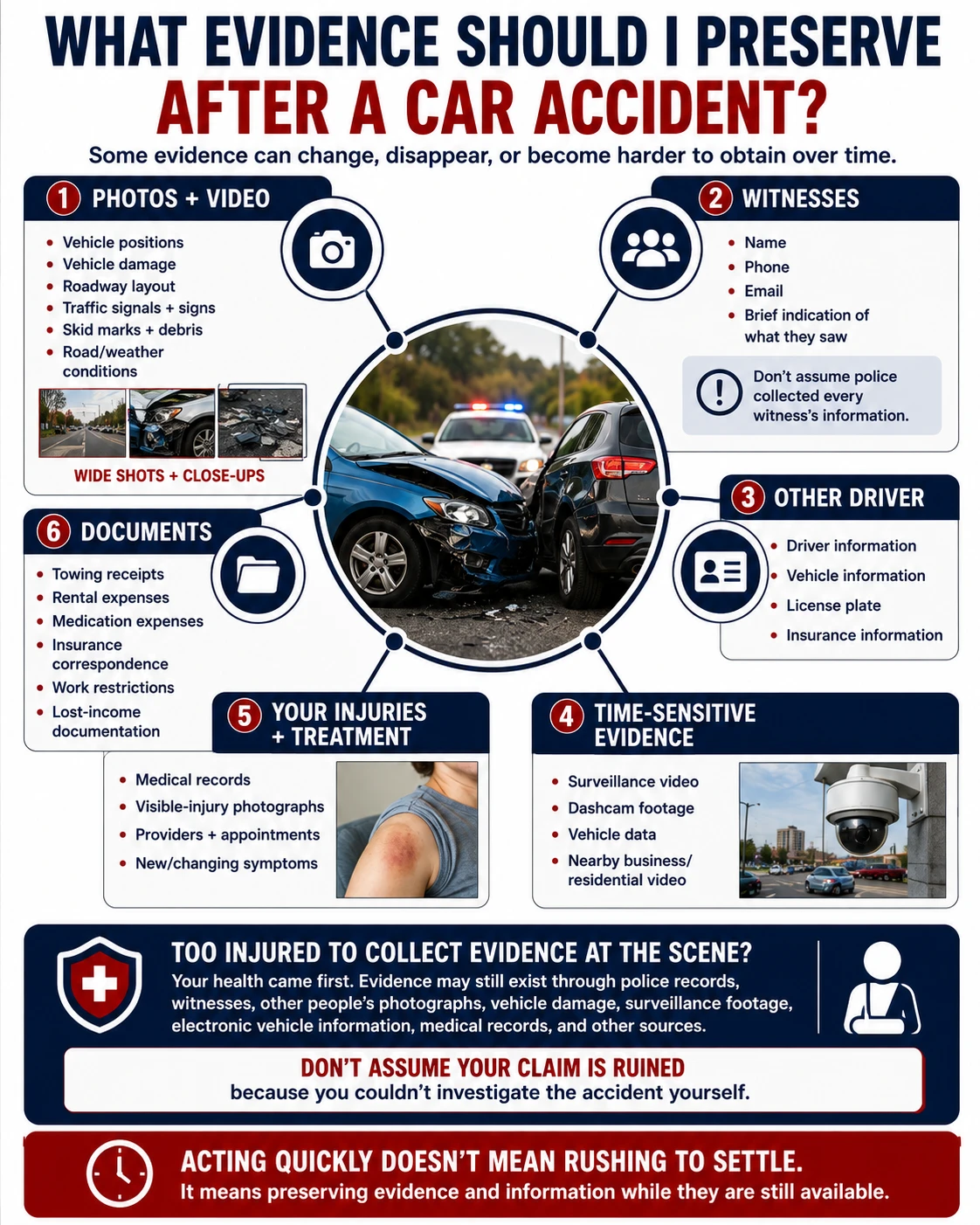
Some evidence can change, disappear, or become harder to obtain over time.
Other time-sensitive evidence may include:
- Surveillance video
- Dash-camera footage
- Vehicle data
- Photographs of vehicle damage
- Physical evidence from the roadway
- Witness recollections
- Commercial-driver records when applicable
- Vehicle inspection evidence
Acting quickly does not mean you should rush to settle your claim. It means preserving evidence and information while they are still available.
What Types of Injuries Can Occur in a South Carolina Car Accident?
Car accidents can cause injuries ranging from temporary soft-tissue symptoms to injuries requiring surgery, rehabilitation, or long-term medical care.
Depending on the forces involved and the circumstances of the collision, injuries may include:
- Neck and back injuries
- Herniated or bulging discs
- Shoulder injuries
- Knee injuries
- Fractures
- Head injuries and traumatic brain injuries
- Concussions
- Spinal cord injuries
- Nerve injuries
- Lacerations and scarring
- Internal injuries
- Psychological symptoms associated with the accident
Not every injury is immediately obvious at the accident scene. Pain, stiffness, headaches, numbness, weakness, or other symptoms may develop or become more noticeable later.
That is why appropriate medical evaluation and accurate communication with your healthcare providers are important after an accident.
Tell your providers about your symptoms and how they change. Your doctors, not the insurance company or your lawyer, are the appropriate professionals to diagnose your injuries and recommend medical treatment.
What If I Feel Okay Immediately After the Accident but Start Hurting Later?
Not every accident-related symptom is obvious at the scene.
After a collision, you may initially be focused on the shock of what happened, getting out of danger, checking on passengers, speaking with law enforcement, or dealing with your damaged vehicle. Some symptoms may become noticeable later.
If you develop new, worsening, or concerning symptoms after leaving the scene, do not ignore them simply because you did not report significant pain immediately after the collision.
Seek appropriate medical attention and accurately explain:
- When the accident occurred
- How the collision happened
- When you first noticed symptoms
- Which symptoms you are experiencing
- Whether the symptoms are changing
- Any relevant prior injuries or medical conditions
Do not diagnose yourself or assume a symptom is minor. Let qualified healthcare professionals determine whether evaluation or treatment is necessary.
Gary's Take: An Injury Can Affect Much More Than Your Body
“I’ve lived with a significant low-back injury since I was 29 years old. I’m 54 now. I wasn’t happy to receive that injury, but living with it has helped me understand what many injured clients experience.”
“The difficult part isn’t always just the physical pain. You start thinking about work. You think about supporting your family. You wonder whether you’ll be able to do the things you used to enjoy or whether the bills are going to keep piling up.”
“That’s why I tell injured people to take their medical care seriously. Don’t minimize what you’re experiencing, and don’t assume that the only effect of an injury is the pain you feel today,” says Gary Christmas.
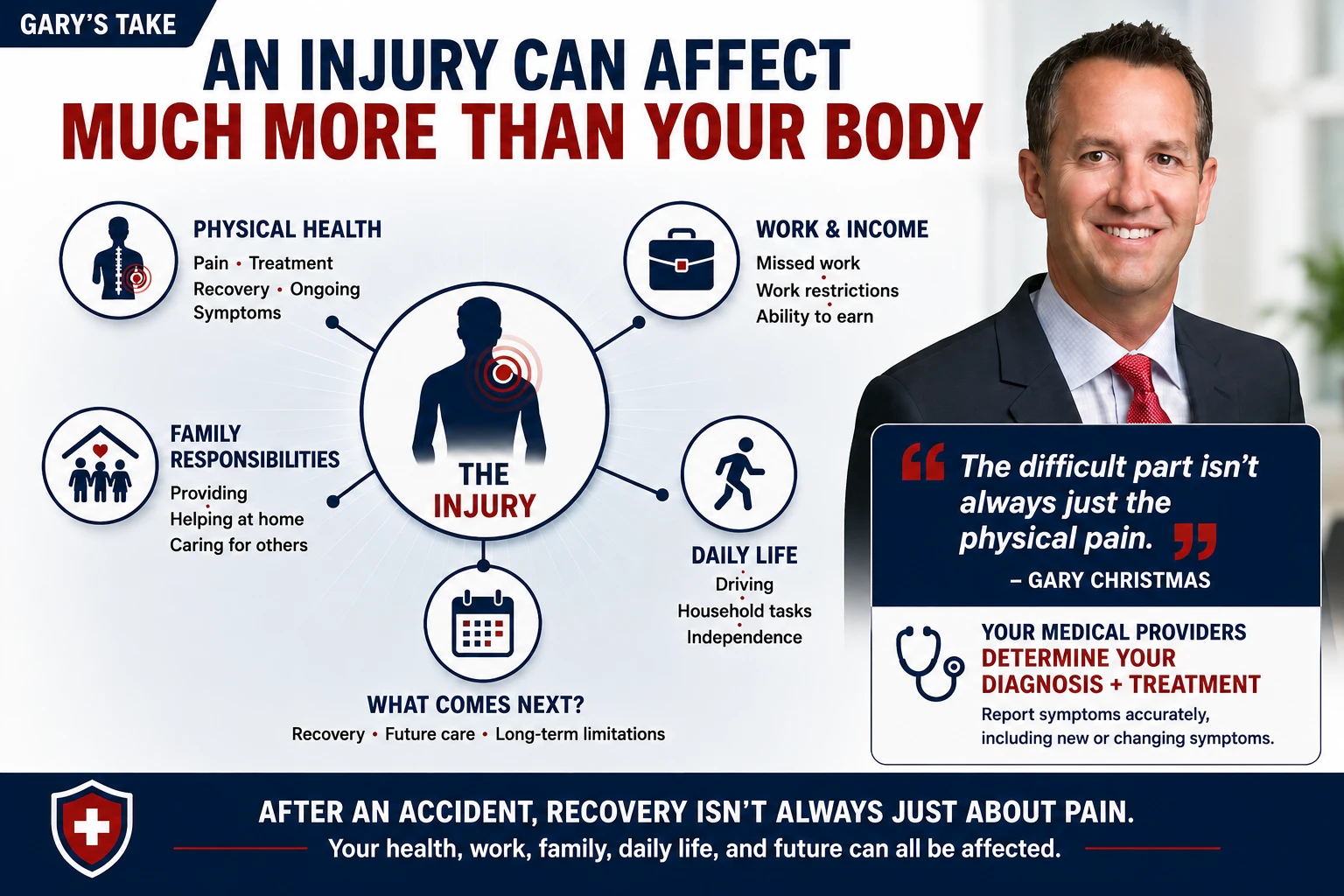
After an accident, recovery isn’t always just about pain. Your health, work, family, daily life, and future can all be affected.
When Should I Contact a Lawyer After a Car Accident?
You do not necessarily need to wait until an insurance company denies your claim or a serious problem develops before asking for legal guidance.
Consider speaking with a South Carolina car accident lawyer early if:
- You suffered an injury
- Someone disputes who caused the collision
- You are being blamed for part or all of the accident
- Multiple vehicles were involved
- A commercial vehicle was involved
- The at-fault driver may be uninsured or underinsured
- An insurance adjuster is asking you for a recorded statement
- You are being asked to sign a release or authorization
- Surveillance video, vehicle data, or other time-sensitive evidence may exist
- You are missing work because of your injuries
- Your injuries may require significant or continuing medical treatment
- You are unsure which insurance coverage applies
- You have questions about what you should or should not say to an insurance company
- You simply do not understand what you should do next
Early legal involvement may allow an attorney to investigate the collision, identify potential insurance coverage, preserve available evidence, and explain the claim process before important decisions are made.
You do not have to wait for something to go wrong before asking for legal guidance.
Read: When Should I Hire a Car Accident Lawyer in South Carolina?
What Happens After I Contact Christmas Injury Lawyers?
When you contact Christmas Injury Lawyers after a serious car accident, our first job is to listen and understand what happened.
We want to know how the collision occurred, what injuries you suffered, what medical care you have received, how the accident has affected your work and daily life, and what has happened with the insurance companies so far.
If we are able to represent you, our team can begin evaluating issues such as:
- How the collision occurred
- Which parties may be responsible
- What evidence needs to be preserved
- Which insurance coverage may apply
- Your injuries and medical treatment
- Lost income or work restrictions
- Communications with insurance companies
- Other damages and losses supported by the evidence
Depending on the case, that may involve obtaining records, investigating the collision, preserving available evidence, communicating with insurance companies, documenting injuries and financial losses, and evaluating legal and insurance issues as they develop.
Your legal team may include attorneys, paralegals, case managers, and other professionals working on different parts of the case.
There may also be times when we need information or participation from you. When that happens, our job is to explain what is needed, why it matters, and what comes next.
We want you focused on your medical care and recovery while our team handles the legal work that comes with your claim.
What Makes Christmas Injury Lawyers Different?
At Christmas Injury Lawyers, our core values are not simply words we put on a wall. They are intended to guide how we treat our clients, how we prepare cases, and how we make decisions.
Our first core value is God and family first. When we represent someone who has been injured, we understand that the accident rarely affects just one person. Injuries, medical appointments, missed work, financial pressure, and uncertainty can affect an entire family. We want our clients to feel that they have a legal team that knows them, listens to them, and understands what they are going through.
We also believe in always doing the right thing. That means giving clients straightforward advice, explaining the issues that may affect their case, and helping them make informed decisions rather than telling them only what they want to hear.
Another core value is that we will not be outworked. Serious injury cases can require careful investigation, medical evidence, insurance analysis, witness testimony, expert evaluation, depositions, and litigation. We believe the details matter, and we are willing to put in the work necessary to develop those details.
We are also committed to continuous learning and improvement. The law changes. Technology changes. The ways evidence can be identified, preserved, and presented continue to evolve. We want to keep learning so that we can continue improving how we investigate cases, communicate with clients, and advocate for injured people.
Finally, we believe in preparing cases with litigation in mind when appropriate. That does not mean every case should go to trial. Many cases can and should be resolved without one. But when important issues cannot be reasonably resolved through negotiation, we want to be prepared to litigate the case rather than discover too late that the necessary work was never done.
For our clients, those values should translate into something practical: clear communication, careful preparation, personal attention, and a legal team committed to doing the work their case requires.
South Carolina Car Accident Checklist
At the Scene
- Check for injuries and immediate danger
- Call 911 when appropriate
- Cooperate with responding law enforcement
- Get appropriate emergency medical care
- Photograph all involved vehicles when safely possible
- Photograph the overall accident scene
- Photograph traffic controls, roadway conditions, debris, and other relevant evidence
- Photograph visible injuries
- Get witness names and contact information
- Exchange identifying and insurance information with the other driver
- Do not argue about fault
- Do not guess about facts you do not know or remember
After You Leave the Scene
- Obtain appropriate medical evaluation
- Report new or changing symptoms
- Follow medical recommendations
- Save photographs and videos
- Write down what you remember about the accident
- Notify your insurance company as required
- Save medical, towing, rental, medication, and other accident-related records and receipts
- Preserve work restrictions and lost-income documentation when applicable
- Avoid unnecessary public posts about the accident, injuries, or your activities
- Be careful when discussing bodily injuries with the other driver's insurer
- Do not sign documents you do not understand
- Consider whether video or other time-sensitive evidence needs to be preserved
- Get legal guidance if you have questions about your rights or what to do next
Summary
The first minutes, hours, and days after a South Carolina car accident can affect your health and the evidence available if an injury claim develops. Your first priority should always be your safety and medical needs. If you are seriously injured, getting emergency medical care is more important than taking photographs, gathering witness information, or trying to investigate the accident yourself.
If you are physically able to do so safely, contact law enforcement when appropriate, exchange identifying and insurance information with the other driver, photograph the vehicles and accident scene, and obtain contact information from witnesses. Take both wide photographs of the overall scene and closer photographs of vehicle damage, roadway evidence, traffic controls, visible injuries, and other details that may help explain what happened.
After leaving the scene, obtain appropriate medical evaluation for injuries or concerning symptoms and accurately report new, worsening, or changing symptoms to your healthcare providers. Not every injury is immediately obvious after a collision, and qualified medical professionals, not an insurance company or lawyer, should determine your diagnosis and treatment.
Preserve photographs, videos, medical information, receipts, insurance correspondence, work restrictions, and documentation of missed income when applicable. Some evidence can disappear with time, including surveillance footage, vehicle data, roadway evidence, and witness recollections. Acting quickly does not mean rushing to settle your claim. It means preserving potentially important evidence while it is still available.
Be accurate when discussing the collision. Do not guess about facts you do not remember, argue with another driver about fault, or assume an insurance company’s initial liability determination necessarily decides legal responsibility. Be careful when discussing bodily injuries with the other driver’s insurance adjuster, and understand insurance documents, releases, and authorizations before signing them.
If you were too injured to gather evidence at the scene, do not assume your claim is ruined. Evidence may still be available through law-enforcement records, witnesses, photographs taken by others, vehicle damage, surveillance footage, electronic vehicle information, medical records, and other sources.
You also do not have to wait until an insurance dispute develops before asking for legal guidance. If you were injured, fault is disputed, important evidence may disappear, significant medical treatment may be required, you are missing work, or you simply do not understand what to do next, consider speaking with a South Carolina car accident lawyer about your specific circumstances.
You do not have to solve the entire claim immediately after the accident. Protect your health, preserve the evidence that remains available, avoid preventable mistakes, and get guidance when you need it.