

Why Can the Timing of Hiring a Car Accident Lawyer Matter?
The days and weeks after a serious car accident can be important because several parts of a potential injury claim may begin developing at the same time.
You may be:
- Receiving medical treatment
- Learning whether additional treatment will be necessary
- Missing work
- Dealing with vehicle damage
- Communicating with insurance companies
- Trying to understand which coverage applies
- Identifying witnesses
- Preserving photographs, video, and other evidence
Some information may remain available later. Other evidence can become more difficult to obtain as time passes.
For example, surveillance or dashcam footage may not be retained indefinitely. Witnesses may become harder to locate. Vehicles may be repaired or disposed of. Roadway conditions may change. Memories can fade.
At the same time, you may not yet understand the full medical effects of the collision.
That is why the timing question is not simply:
“How quickly can I hire a lawyer?”
A more useful question is:
“Are important decisions being made or evidence developing that could affect my claim?”
If the answer is yes, getting legal advice early may help you understand what needs attention and what should be preserved.
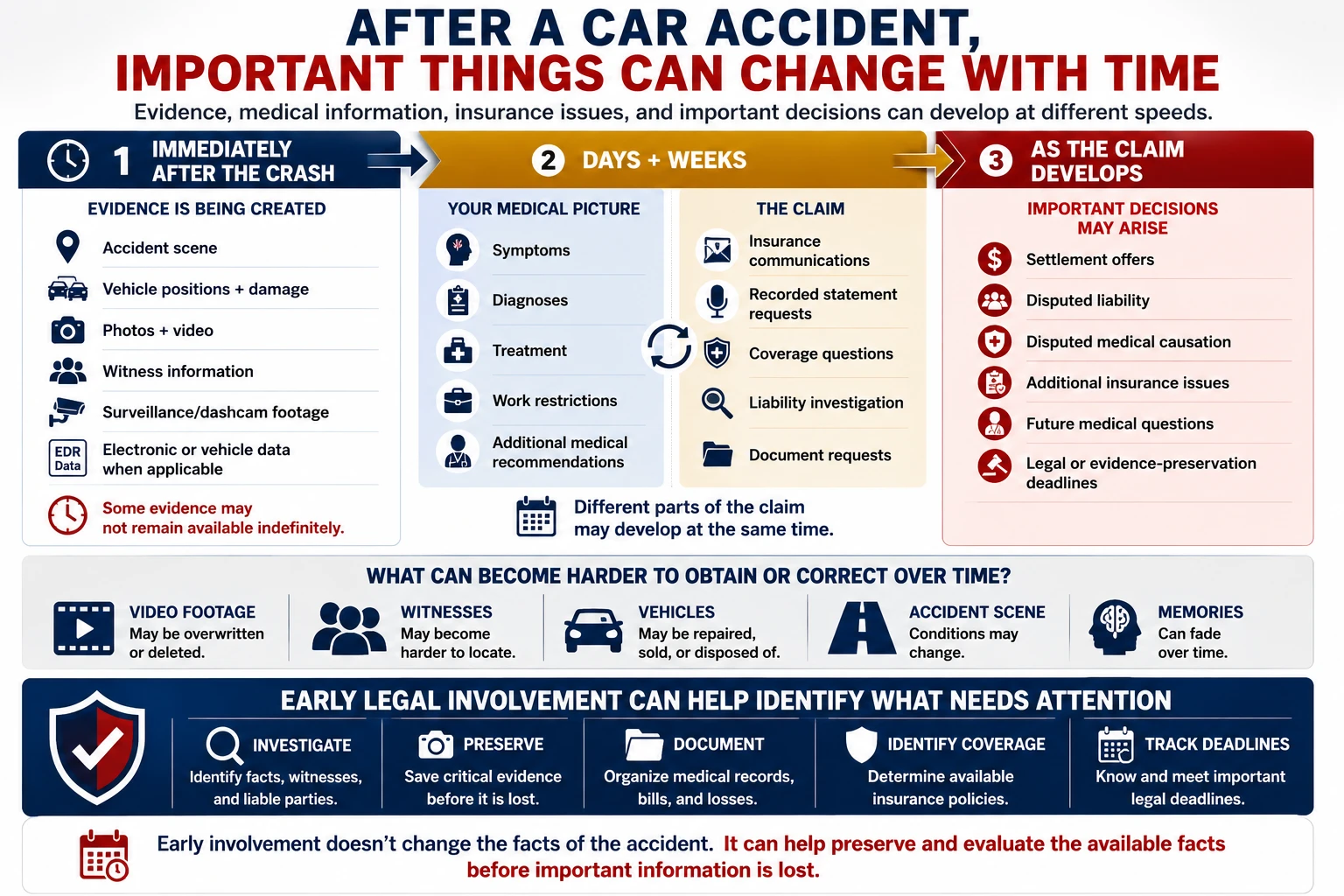
Evidence, medical information, insurance issues, and important decisions can develop at different speeds.
When Is It Especially Important to Speak With a Car Accident Lawyer?
Not every collision presents the same legal or medical issues. However, certain circumstances can make early legal guidance particularly useful.
Consider speaking with a lawyer promptly when:
You Were Injured
If you need medical treatment after the accident, the claim may involve medical expenses, causation, future treatment, lost income, pain and suffering, and other damages supported by the evidence.
Fault Is Disputed
If another driver, witness, police report, or insurer gives a different account of what happened, evidence concerning liability may need to be identified and preserved.
You Are Accused of Sharing Fault
South Carolina’s rules concerning comparative fault can make allegations about your own conduct important to the claim.
Important Evidence May Disappear
Video footage, electronic vehicle information, photographs, physical evidence, and witness information may become harder to obtain later.
Multiple Parties or Insurance Policies May Be Involved
Commercial vehicles, multi-vehicle collisions, rideshare accidents, employer-owned vehicles, uninsured or underinsured drivers, and other situations may raise additional insurance or liability questions.
The Insurance Company Wants a Recorded Statement or Authorization
Before providing information or signing documents, understand what is being requested, why it is being requested, and what obligations may apply.
You Receive an Early Settlement Offer
An offer may arrive while treatment is ongoing and before future medical needs, work losses, or long-term limitations can reasonably be evaluated.
Your Claim Has Been Denied or Disputed
A dispute over liability, insurance coverage, medical causation, treatment, or damages is a strong reason to understand your legal options.
You do not have to wait for several of these issues to occur at once. One significant legal, medical, insurance, or evidence issue may be enough to justify getting advice.
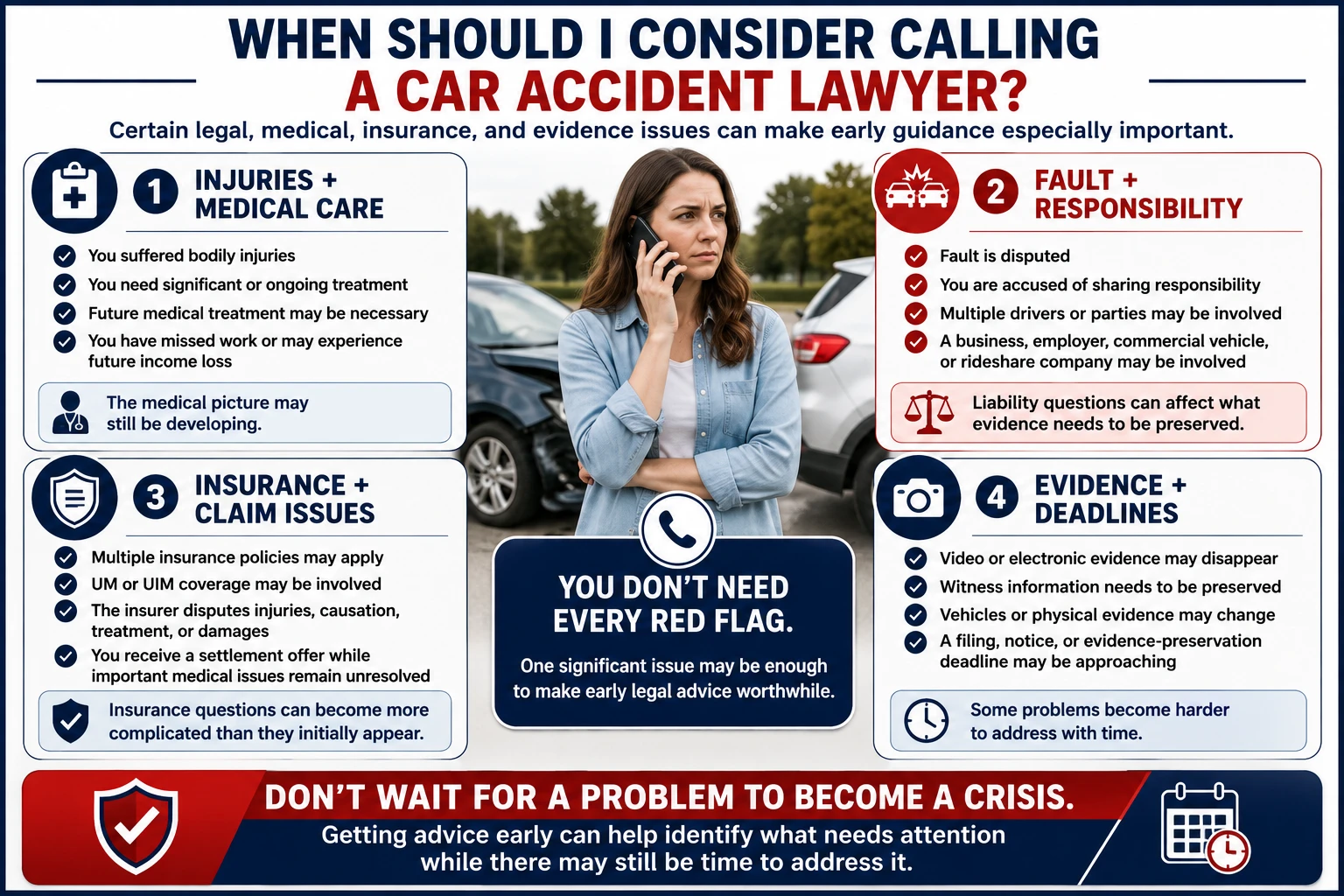
Certain legal, medical, insurance, and evidence issues can make early guidance especially important.
What Problems Can Develop If I Wait Too Long to Get Legal Help?
Waiting does not automatically destroy a car accident claim. But certain problems can become more difficult, or sometimes impossible, to correct as time passes.
Potential problems include:
- Video footage is overwritten or deleted
- Witnesses become difficult to locate
- Vehicles are repaired, sold, or disposed of before important evidence is preserved
- Accident-scene conditions change
- Electronic or digital evidence is not preserved
- Important insurance coverage is overlooked
- A recorded statement creates disputes about what happened or how you were injured
- A broad authorization provides access to information beyond what you expected
- Medical symptoms are not accurately documented
- Lost income or work restrictions are not properly preserved
- A settlement is accepted before the medical picture is reasonably understood
- A filing or notice deadline is missed
The point of getting legal advice early is not to create unnecessary urgency. It is to identify the issues that actually matter in your case while there may still be time to address them.
What Are the Red Flags That I May Need a Lawyer Quickly?
Some situations can make getting legal advice particularly time-sensitive.
Watch for these red flags:
- Important video, electronic data, vehicle evidence, or other evidence may disappear
- The insurance company disputes fault or blames you for the collision
- You suffered serious injuries or a doctor is discussing significant future treatment
- A commercial vehicle, employer, rideshare company, or other business may be involved
- The at-fault driver is uninsured or may not have enough insurance
- You are being asked for a recorded statement or broad medical authorization that you do not understand
- You receive a settlement offer while significant medical issues are still unresolved
- The insurer denies the claim or disputes whether the collision caused your injuries
- A filing, notice, or evidence-preservation deadline may be approaching
You do not need every red flag on this list before getting legal advice. One significant issue may be enough to make early guidance worthwhile.
What Can a Car Accident Lawyer Do Early in the Case?
The value of early legal involvement is not simply having someone talk to the insurance company. A lawyer can begin identifying the legal, insurance, medical-documentation, and evidentiary issues that may affect the claim.
Depending on the case, early work may include:
- Investigating how the collision occurred
- Identifying drivers, vehicle owners, employers, businesses, or other potentially responsible parties
- Locating and interviewing witnesses
- Preserving accident-scene photographs and video
- Seeking available surveillance or dashcam footage
- Preserving vehicle or electronic evidence when appropriate
- Reviewing police and collision reports
- Identifying potentially applicable insurance policies
- Evaluating liability and comparative-fault issues
- Organizing medical records and bills
- Documenting lost income and work restrictions
- Tracking accident-related expenses
- Communicating with insurers about the claim
- Identifying legal deadlines
- Determining whether expert assistance may be appropriate
As medical treatment develops, the lawyer can also evaluate how the medical evidence relates to the claimed injuries and damages.
Early involvement does not change the facts of the accident. It can help make sure the available facts and evidence are identified, preserved, and evaluated before important information is lost.
What May the Insurance Company Do After a Car Accident?
Once an accident is reported, an insurance company may begin gathering information relatively quickly.
Depending on the claim, that may include:
- Contacting drivers and witnesses
- Obtaining recorded statements
- Reviewing the police report
- Inspecting vehicle damage
- Reviewing photographs or video
- Evaluating liability
- Requesting medical information
- Reviewing claimed injuries and treatment
- Investigating insurance coverage
- Evaluating claimed damages
The insurance company is evaluating the claim from the perspective of its policy and its insured’s interests. The adjuster is not your personal legal adviser and generally does not represent your interests.
That does not mean every interaction with an adjuster is improper or adversarial. It means you should understand who the adjuster represents, why information is being requested, and how your response may affect the claim.
While the insurer is gathering information, you should be preserving information too.
Should I Talk to the Insurance Adjuster Before Hiring a Lawyer?
You may need to communicate with an insurance company after an accident, but who is asking the questions matters.
An adjuster for another driver’s insurance company represents the insurer’s interests, not yours.
Before providing a recorded statement or signing an authorization, consider asking:
- Which insurance company do you represent?
- Which driver or party do you insure?
- Is this conversation being recorded?
- Why are you requesting a recorded statement?
- What information are you asking me to authorize?
- How broad is the authorization?
- Which claim or coverage are you investigating?
- Am I required to provide this information?
- Could I review the request in writing first?
Your obligations may differ depending on whether you are dealing with another driver’s insurer or your own insurance company under your policy.
For example, your own insurance policy may contain cooperation requirements that do not apply in the same way when you are dealing with another driver’s liability insurer.
If you do not understand what is being requested or what obligations apply, consider getting legal advice before providing a recorded statement or signing an authorization.
Read: Should I Talk to the Other Driver’s Insurance Company?
What Should I Be Careful About Saying or Signing After a Car Accident?
After a collision, avoid making important decisions simply because someone tells you they are routine.
Be particularly careful with:
- Recorded statements you do not understand
- Broad medical authorizations
- Settlement agreements or releases
- Documents that appear to resolve "all claims" arising from the accident
- Statements guessing about speed, distance, fault, or other facts you do not actually know
- Statements minimizing symptoms because you hope they will disappear
- Statements exaggerating injuries or limitations
- Social-media posts about the accident, injuries, treatment, or physical activities
When discussing your injuries with medical providers, be accurate. Report what you are actually experiencing without exaggerating or minimizing it.
When dealing with insurance paperwork, understand:
- Who is requesting the information
- Why they want it
- What the document authorizes
- Which claims it affects
- Which parties it releases
- Whether signing it could affect rights you intend to preserve
Accuracy and understanding are more important than trying to say the “right” thing.
Why Might I Not Understand the Full Extent of My Injuries Right Away?
The hours immediately after a collision can be confusing. You may be focused on the damaged vehicle, getting home, contacting family, speaking with police, or figuring out how you will get to work.
Some symptoms may be obvious immediately. Others may become more noticeable or be diagnosed as medical evaluation continues.
Depending on the circumstances, symptoms or conditions identified after a collision may include:
- Headaches or other symptoms associated with a possible head injury
- Neck or back pain
- Shoulder, knee, hip, or other joint pain
- Numbness, tingling, or weakness
- Soft-tissue injuries
- Fractures
- Sleep problems
- Anxiety or other psychological symptoms
This list does not mean every symptom was caused by the accident or that every person will develop these conditions. Medical professionals should evaluate medical causation and appropriate treatment.
Your role is to describe your symptoms accurately and report meaningful changes.
Do not exaggerate what you are experiencing, but do not minimize real symptoms because you do not want to complain.
Is It Ever Too Late to Hire a Car Accident Lawyer?
Waiting to contact a lawyer does not necessarily mean you have lost your ability to pursue a car accident claim.
However, the longer you wait, the more important it may become to determine what evidence is still available, which legal deadlines apply, and whether decisions already made have affected the claim.
If some time has passed since the accident, a lawyer can evaluate issues such as:
- Whether important evidence can still be obtained
- Whether witnesses can still be located
- What medical documentation exists
- Whether insurance claims have already been opened or resolved
- Whether you have provided statements or signed documents
- Whether settlement offers have been made
- Which insurance coverage may still be available
- Which South Carolina deadlines apply
Some problems may still be addressable. Others may become more difficult as time passes.
Do not assume that because you did not hire a lawyer immediately, there is no point in speaking with one now. If you are still dealing with injuries, insurance issues, or uncertainty about your claim, getting legal advice can help you understand where things stand and what options may remain.
Read: Is It Ever Too Late to Hire a Lawyer for an Old Accident?
Why Do Some Injured People Wait to Speak With a Lawyer?
There are understandable reasons someone may hesitate to contact an attorney after a car accident.
"I Don't Want to Sue Anyone."
Speaking with a lawyer does not automatically mean a lawsuit will be filed.
A consultation can help you understand the claim, the available insurance, potential legal issues, and your options. Whether litigation becomes necessary depends on how the particular case develops.
"I Think I Can Handle the Insurance Claim Myself."
Some claims are relatively straightforward. Others involve disputed liability, multiple policies, significant injuries, future medical needs, lost income, medical liens, or other issues that are difficult to recognize at the beginning.
The question is not whether you are capable of making phone calls or completing paperwork.
The question is whether you know which legal, insurance, medical, and evidentiary issues need to be addressed.
Read: What Can a Car Accident Lawyer Do That I Can’t Do Myself?
"I'm Worried a Lawyer Will Be Too Expensive."
Christmas Injury Lawyers handles qualifying personal injury cases on a contingency-fee basis. For qualifying personal injury matters accepted on a contingency-fee basis, the attorney’s fee is generally calculated as an agreed percentage of the recovery rather than billed as an hourly attorney’s fee.
Before hiring any lawyer, read the written fee agreement and make sure you understand:
- The contingency-fee percentage
- How case costs and expenses are handled
- Whether the percentage can change if litigation or an appeal becomes necessary
- What happens to costs and expenses if there is no recovery
"My Injuries Don't Seem Serious Enough Yet."
Early symptoms do not always tell you everything about the eventual medical picture. If you are injured or receiving treatment, you can ask a lawyer whether representation makes sense based on your actual circumstances.
Speaking with a lawyer is a way to get information. It does not require you to make assumptions about how serious your case is or where it will ultimately lead.
What Happens After I Hire Christmas Injury Lawyers?
Hiring a lawyer should give you more clarity about what happens next, not create another source of uncertainty.
At Christmas Injury Lawyers, the process generally begins with getting your case organized and identifying the issues that need immediate attention.
1. We Learn What Happened
Our intake and legal teams gather information about:
- The collision
- Your injuries
- Medical treatment
- The vehicles and people involved
- Available insurance information
- Witnesses
- Work losses
- Important documents and evidence already in your possession
2. Your Legal Team Gets to Work
You are introduced to the team assigned to your case, which typically includes an attorney, paralegal, and case manager.
The team can begin identifying and preserving relevant evidence, investigating liability and insurance issues, and organizing the information needed to evaluate the claim.
3. We Follow the Medical and Legal Issues as They Develop
As your medical treatment progresses, the legal team can gather records, bills, work documentation, and other evidence relevant to the injuries and damages being claimed.
At the same time, we continue evaluating legal issues, insurance coverage, liability, and the evidence necessary to prepare the case.
4. We Prepare for What Comes Next
Not every case goes to trial. But Christmas Injury Lawyers is a litigation law firm, and our approach is to prepare cases with the possibility of litigation in mind.
That means evaluating the evidence, anticipating disputed issues, and preparing the case so informed decisions can be made as it develops.
You focus on your medical care and your life. Our job is to help manage the legal process, keep you informed, and make sure you understand what comes next.
Gary's Take: The Best Time to Address a Problem Is Before It Becomes One
“One of the hardest conversations I have with an injured person is explaining that a piece of evidence we would have wanted is no longer available or that a decision made months earlier has created a problem we now have to work around.”
“That is why I believe there is real value in getting legal advice early after a serious accident. It is not because every case needs a lawsuit filed immediately. It is because the early stages of a case are when evidence is being created, medical treatment is beginning, insurance companies are asking questions, and important decisions are being made.”
“A good lawyer should help you identify what actually matters in your case and what does not.”
“You should be able to focus on your medical care, your family, and getting your life back on track while your legal team focuses on preserving evidence, investigating the claim, and helping you understand what comes next,” says Gary Christmas.
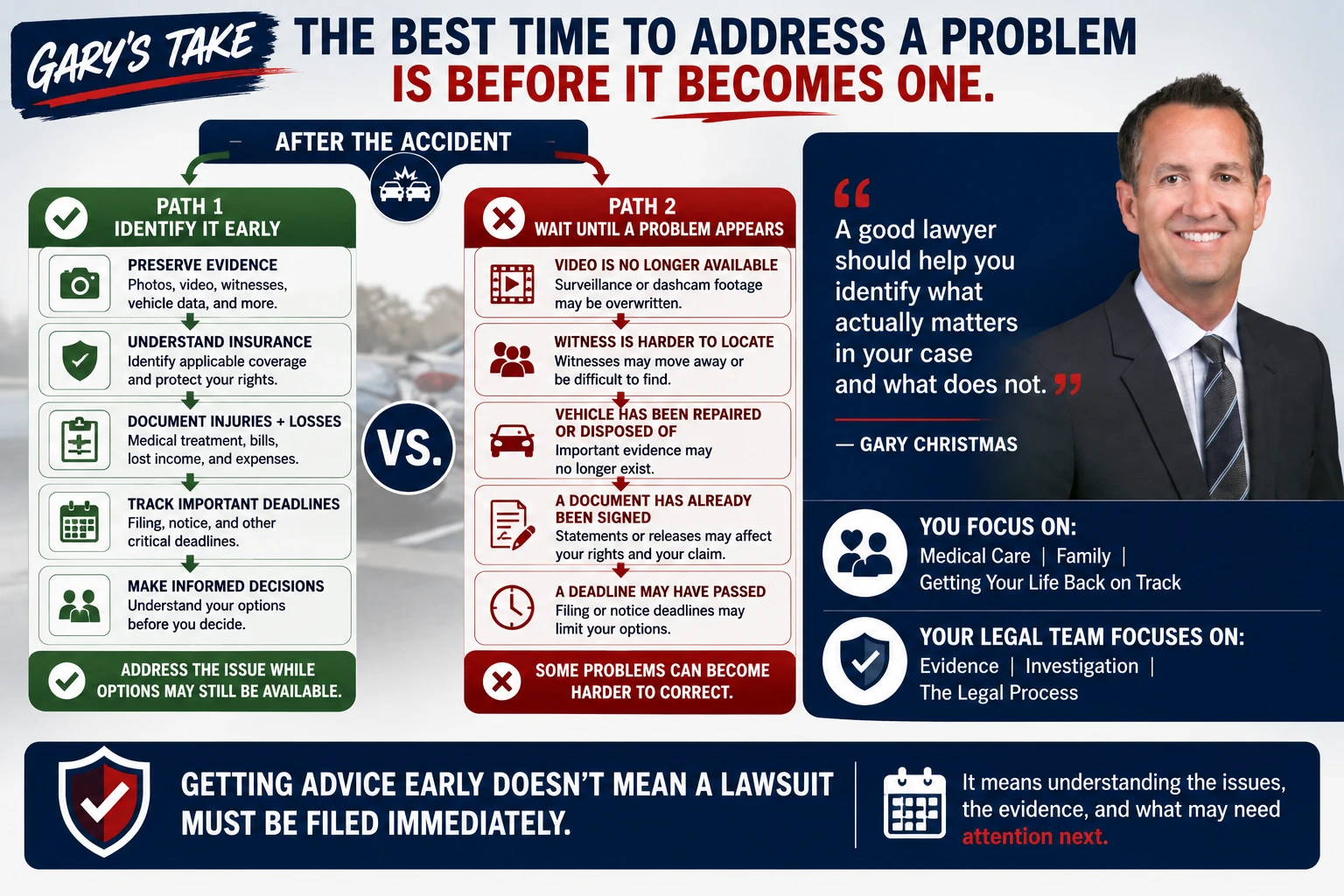
Getting advice early doesn’t mean a lawsuit must be filed immediately.
What Should I Ask Before Hiring a South Carolina Car Accident Lawyer?
Once you decide it may be time to hire a lawyer, the next question is whether the lawyer and law firm are the right fit for your case.
Consider asking:
- Who will actually handle my case?
- Will I have a specific attorney, paralegal, or case manager?
- How will I receive updates?
- Who should I contact when I have a question?
- How does the contingency fee work?
- How are case costs and expenses handled?
- What experience does the lawyer have handling South Carolina car accident cases?
- Has the lawyer tried cases before judges or juries?
- When did the lawyer last try a case?
- How does the firm prepare cases that may require litigation?
- What will the firm need from me?
- What happens after I sign the representation agreement?
Be cautious about promises of a specific settlement amount or guaranteed outcome before the facts, injuries, insurance coverage, and evidence have been properly evaluated.
You should leave the conversation understanding who will handle your case, how communication works, how the fee arrangement works, and what happens next.
When Should I Consider Calling a Car Accident Lawyer?
Consider getting legal advice promptly if:
- You suffered injuries requiring medical treatment
- You have missed work or may experience future income loss
- Fault is disputed or you are accused of sharing responsibility
- Multiple vehicles, businesses, or responsible parties may be involved
- Multiple insurance policies, UM, or UIM coverage may apply
- You are being asked for a recorded statement or medical authorization you do not understand
- Important photographs, video, vehicle data, witness information, or other evidence needs to be preserved
- The insurer disputes your injuries, treatment, causation, or damages
- You receive a settlement offer while important medical issues remain unresolved
- A filing, notice, or evidence-preservation deadline may be approaching
- You are unsure what your rights or obligations are
You do not have to diagnose every legal problem before speaking with a lawyer. If you are injured and something about the claim feels uncertain, getting advice early can help you understand what needs attention before important evidence or options are lost.
Summary
There is no single moment when every injured person must hire a car accident lawyer. However, getting legal advice early can be particularly important when injuries, disputed fault, insurance questions, disappearing evidence, significant medical treatment, lost income, or other complications are developing after a South Carolina car accident.
The days and weeks after a collision can matter because several parts of a potential injury claim may develop at the same time. Medical treatment may be beginning, witnesses and video may need to be identified, vehicles may be repaired or disposed of, insurance companies may be gathering information, and important decisions may need to be made before the full medical picture is reasonably understood.
Early legal involvement does not change the facts of an accident. It can help identify the issues that matter, preserve available evidence, investigate liability and insurance coverage, organize medical and financial documentation, identify applicable deadlines, and help an injured person understand what is being requested by insurance companies.
You should be particularly careful when fault is disputed, you are accused of sharing responsibility, multiple parties or insurance policies may be involved, important evidence could disappear, an insurer requests a recorded statement or broad authorization, or you receive a settlement offer while significant medical issues remain unresolved.
You should also understand who you are communicating with. An adjuster for another driver’s insurance company represents the insurer’s interests, not yours. Your obligations may be different when dealing with your own insurer under your policy. Before giving a recorded statement, signing a medical authorization, or accepting a settlement, understand what is being requested and what rights or claims may be affected.
Waiting to contact a lawyer does not necessarily mean you have lost your ability to pursue a claim. If time has already passed, legal advice can still help determine what evidence remains available, what insurance issues exist, what decisions have already been made, which deadlines apply, and what options may remain.
The goal of getting legal advice early is not to create unnecessary urgency. It is to identify potential problems while there may still be time to address them and help you make informed decisions as the claim develops.