

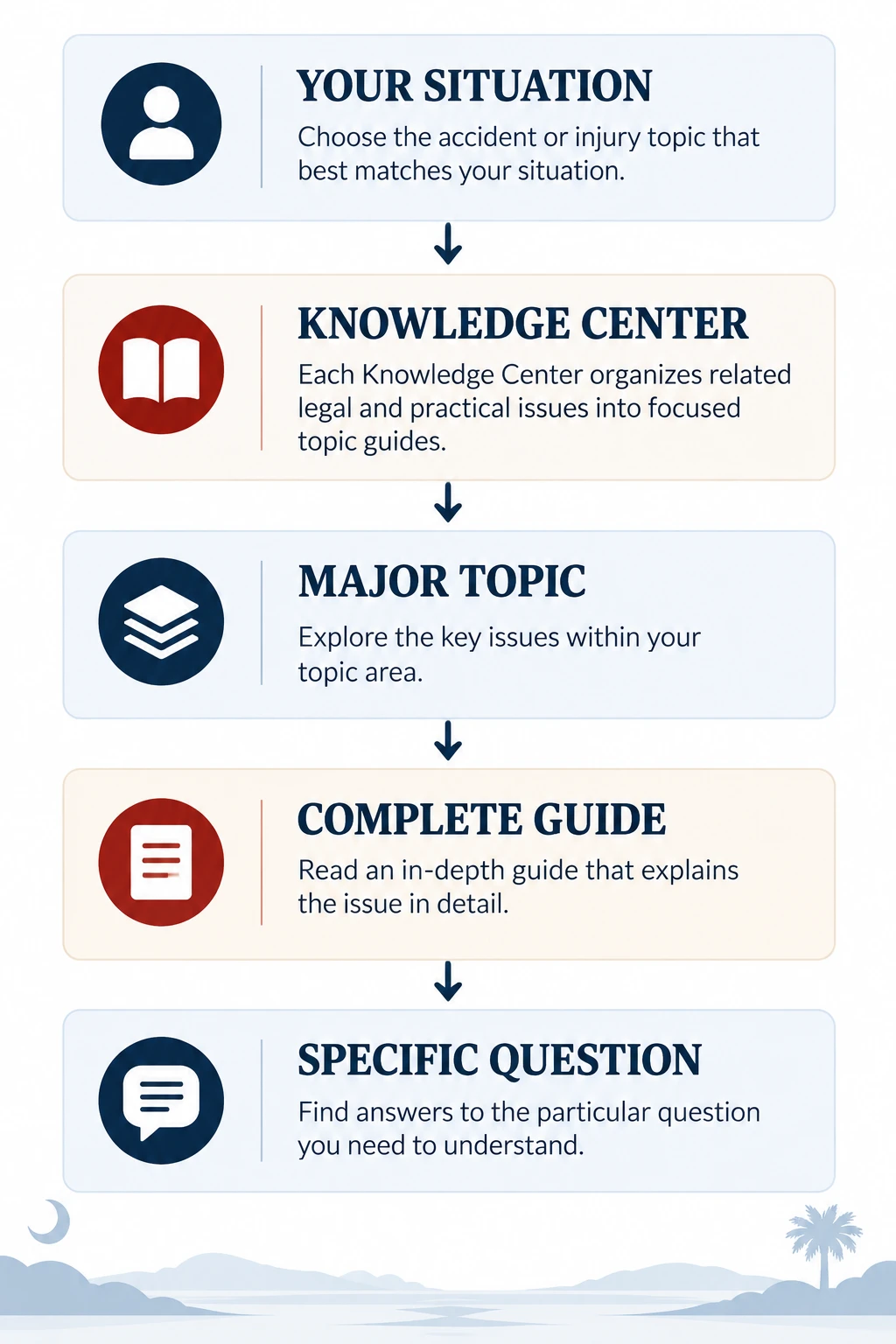
South Carolina Car Accident Law Knowledge Center
South Carolina Car Accident & Injury Resource Library
Christmas Injury Lawyers · Knowledge Center
South Carolina Car Accident Law Knowledge Center
A car accident can create questions about insurance, medical treatment, fault, evidence, financial recovery, lawsuits, and whether legal representation may be useful.
The South Carolina Car Accident Law Knowledge Center organizes those issues into six major topics so you can understand how the pieces fit together and find detailed guidance for the questions relevant to your situation.
Whether you are trying to understand an insurance request, make sense of your medical treatment, determine what evidence matters, evaluate a settlement issue, learn what happens in a lawsuit, or decide whether you need a lawyer, start with the topic that matches the problem you are facing.
Quick Overview
South Carolina car accident claims can involve six interconnected areas: insurance and claims, medical treatment and recovery, evidence and liability, settlement value and financial recovery, lawsuits and litigation, and legal representation and strategy.
You do not need to understand all six areas at once.
Use the topic guides below to learn how each part of a car accident claim works, or move directly to the question you need answered.
Explore the Six Major Car Accident Topics
1
Insurance & Claims
Insurance questions often begin soon after a collision.
You may need to understand which insurance applies, what an adjuster is asking for, how the claims process works, what happens if the other driver is uninsured, or why an insurance company is delaying or disputing the claim.
This section explains insurance coverage, claims handling, adjuster communications, property-damage issues, uninsured and underinsured motorist coverage, settlement-related questions, and other insurance problems that may arise after a South Carolina car accident.
2
Medical Treatment, Injuries & Recovery
The medical side of a car accident can develop over time.
Symptoms may appear immediately or later. Treatment may involve different providers. A diagnosis, course of treatment, recovery, prognosis, medical records, and future limitations may all become important depending on the injuries involved.
This section helps you understand medical treatment, injury documentation, delayed symptoms, continuing problems, medical records, treatment gaps, emotional effects, and recovery after a collision.
3
Evidence, Liability & Case Strength
Knowing what happened and being able to prove what happened are not always the same thing.
Photographs, video, witness information, police documentation, vehicle damage, medical evidence, and other records may help address questions about fault, causation, shared responsibility, and damages.
This section explains how evidence can affect liability, how disputed fault may be evaluated, what happens when the police report is wrong or incomplete, how comparative fault can matter, and what may make a claim stronger or weaker.
4
Settlement Value & Financial Recovery
A car accident claim can involve several different kinds of losses, and no single number automatically determines what a claim is worth.
Medical expenses, lost income, future treatment, limitations, pain and suffering, liability, causation, available insurance, and the supporting evidence may all affect how a claim is evaluated.
This section explains damages, settlement offers, claim value, policy limits, pain and suffering, financial obligations, and the difference between a gross settlement and the amount ultimately received.
5
Lawsuits & Litigation
Not every car accident claim becomes a lawsuit, and not every lawsuit reaches trial.
When important issues cannot be resolved through the insurance-claim process, formal litigation may involve pleadings, discovery, depositions, motions, mediation, additional settlement discussions, trial preparation, and potentially trial.
This section explains what can happen after a lawsuit is filed, how discovery works, what to expect from a deposition, how long litigation may take, and why settlement can remain possible while a lawsuit is pending.
6
Hiring a Lawyer & Legal Strategy
Not every car accident necessarily requires an attorney.
The need for legal representation can depend on the injuries, evidence, disputed issues, insurance complexity, financial stakes, settlement decisions, deadlines, and whether litigation may become necessary.
This section explains when legal representation may be useful, what a car accident lawyer can do, what to ask before hiring an attorney, how fees and costs work, and how legal strategy can change as a claim develops.
How the Pieces of a Car Accident Claim Fit Together
The six topics in the Knowledge Center are organized separately so they are easier to understand, but the issues themselves can overlap.
Insurance coverage can affect the sources available for recovery. Medical treatment can help establish the nature, extent, and development of injuries. Evidence can affect fault, medical causation, and the strength of disputed claims. Liability, damages, available insurance, and evidence can all influence settlement decisions. If important disputes cannot be resolved, the claim may move into litigation. And the seriousness or complexity of those issues can affect whether legal representation is useful.
A simplified way to think about the system is:
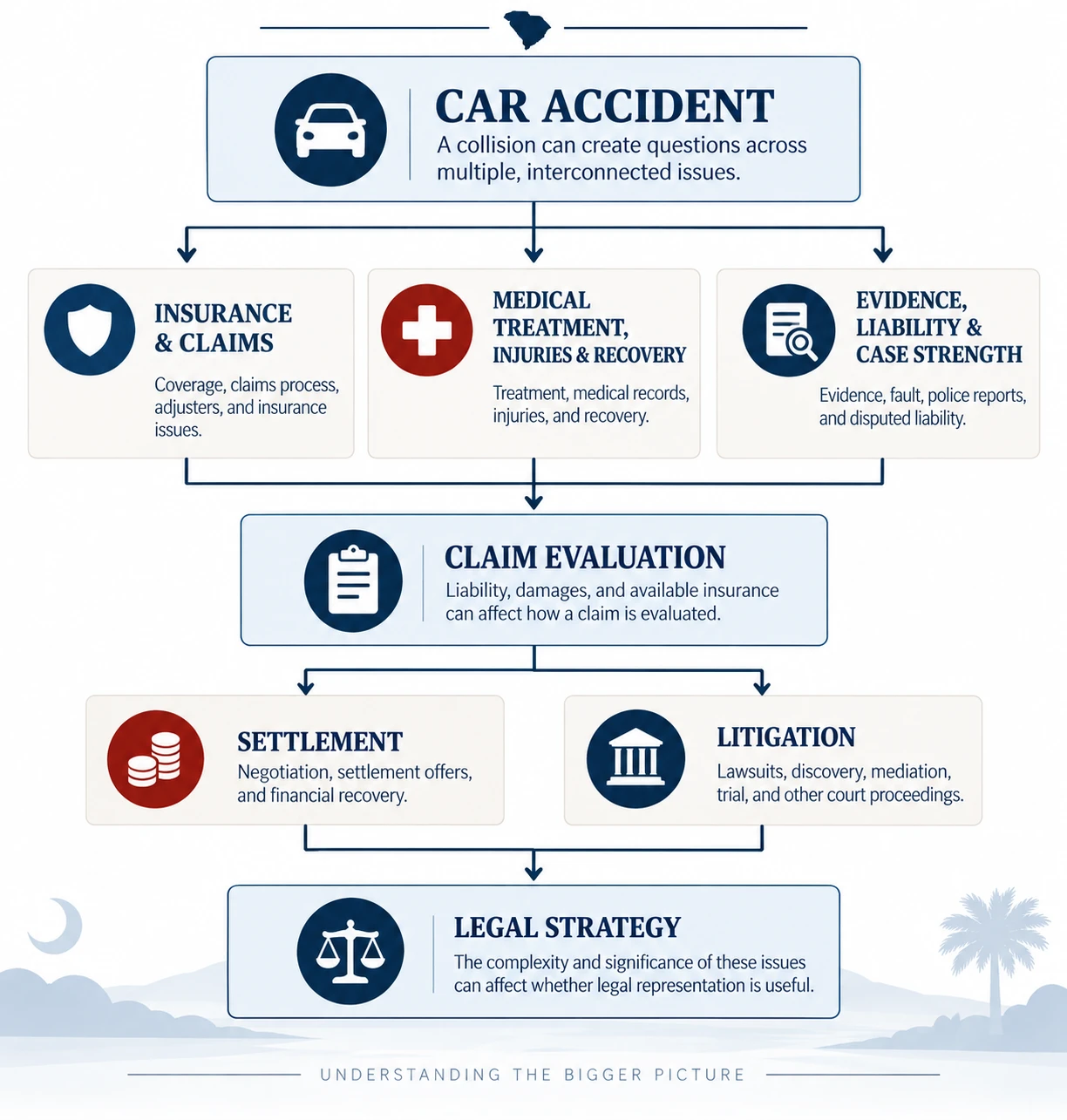
This is not a rigid timeline. Different issues can develop at the same time, and every accident does not involve every issue.
The purpose of the Knowledge Center is to help you identify the problem you are dealing with and move directly to the information that can help you understand it.
Start With Your Car Accident Question
If you already know what you are trying to figure out, start with one of these common questions.
Insurance & Claims
What If the Other Driver Doesn't Have Insurance?
Learn what uninsured motorist coverage and other insurance issues may need to be evaluated when the at-fault driver does not have liability insurance.
What Should I Avoid Saying to an Insurance Adjuster?
Learn why it matters who the adjuster represents, what information is being requested, and whether the request involves your own insurer or another driver’s insurance company.
What If the Insurance Company Won't Return My Calls?
Learn what a lack of response may mean, how to document communications, and what issues may need attention while the claim remains unresolved.
Medical Treatment, Injuries & Recovery
What If My Symptoms Appear Days After the Accident?
Learn why symptoms, diagnosis, medical evaluation, treatment, and causation are related but separate issues.
What If I'm Still Injured Months After the Accident?
Learn how continuing symptoms, additional treatment, restrictions, future medical recommendations, and prognosis may affect the medical picture.
What Medical Records Can Matter for My Claim?
Learn the difference between medical records and medical bills and how records may document symptoms, diagnosis, treatment, restrictions, and recovery.
Evidence, Liability & Case Strength
Should I Get the Dash Cam Video Before Filing a Claim?
Learn when dash cam footage can matter, why preserving it early may be important, and how it can fit with other evidence used to evaluate fault after a South Carolina car accident.
What Should I Do Immediately After a Car Accident?
Learn what steps you can take after a car accident to protect your safety, document what happened, preserve important evidence, and prepare for the insurance claim that may follow.
Can I Recover if I Was Partly at Fault?
Learn why shared responsibility does not automatically mean there is no claim and why the allocation of fault matters under South Carolina law.
Settlement Value & Financial Recovery
How Much Might My Car Accident Claim Be Worth?
Learn why there is no universal settlement calculator and how injuries, evidence, liability, causation, damages, and available insurance may affect valuation.
Should I Accept the Insurance Company's First Offer?
Learn what to consider before resolving a claim and signing a release.
Can I Recover for Pain and Suffering?
Learn how physical pain, emotional effects, inconvenience, and limitations on everyday life may become part of an injury claim.
Lawsuits & Litigation
How Long Can a Car Accident Lawsuit Take?
Learn why there is no single litigation timeline and what factors can affect how a lawsuit develops.
What Happens During a Deposition?
Learn what a deposition is, why testimony is taken before trial, and how it fits into the discovery process.
What's the Difference Between a Property Damage and Injury Claim?
Learn how property damage and bodily injury claims address different losses after a car accident, why they may be handled separately, and what resolving one claim may mean for the other.
Hiring a Lawyer & Legal Strategy
Do I Need a Lawyer After a Car Accident?
Learn when a relatively straightforward claim may be manageable without representation and what circumstances can make legal help more important.
When Should I Hire a Car Accident Lawyer?
Learn how evidence, insurance communications, injuries, settlement decisions, legal deadlines, and claim complexity can affect timing.
What Does a Car Accident Lawyer Actually Do?
Learn how representation may involve investigation, evidence, insurance communications, claim development, negotiation, litigation, and trial preparation.
Not Sure Where to Start?
You do not need to know the legal terminology for your problem. Start with what is happening to you right now.
| If You're Trying to Understand… | Start Here |
|---|---|
| The insurance claim, adjuster, or coverage | Insurance & Claims → |
| Your injuries, symptoms, or medical treatment | Medical Treatment, Injuries & Recovery → |
| Who was at fault or what evidence matters | Evidence, Liability & Case Strength → |
| What losses may be recoverable or how settlement works | Settlement Value & Financial Recovery → |
| What happens if the dispute goes to court | Lawsuits & Litigation → |
| Whether, when, or how to hire an attorney | Hiring a Lawyer & Legal Strategy → |
You can enter the Knowledge Center from any of these six topics and move between related resources as your questions change.
That approach is especially consistent with the needs CIL has identified among injured clients who frequently arrive feeling overwhelmed and unsure what they should do next. Clear explanations and obvious next steps help the reader regain a sense of control.
Gary's Take: Understand How the Pieces Fit Together
“After a serious car accident, it’s natural to focus on whatever problem is right in front of you. Maybe your car is damaged. Maybe an insurance adjuster is calling. Maybe you’re worried about a medical bill or an injury that isn’t getting better.
But those issues don’t always exist separately. Insurance, medical treatment, evidence, fault, damages, and legal deadlines can affect one another.
One of the most useful things you can do is understand what issue you’re dealing with, how it connects to the rest of the claim, and what question needs to be answered next. You don’t have to learn everything about injury law. You need enough information to make informed decisions as your situation develops.”
— Gary Christmas
Understanding South Carolina Car Accident Law
Car accident claims can involve several different sources of South Carolina law and legal authority.
Depending on the issue, those sources can include:
- South Carolina statutes
- South Carolina appellate decisions
- South Carolina court rules
- Automobile-insurance requirements
- Insurance-policy language
- Procedural rules governing lawsuits
- Other state and federal requirements that may apply to a particular claim
The individual Knowledge Center guides identify and explain relevant legal rules where appropriate.
When primary authority is useful, resources may also direct readers to sources such as the South Carolina Legislature, South Carolina Judicial Branch, and South Carolina Department of Insurance.
The purpose is not to turn the Knowledge Center into a law library. It is to help you distinguish general information from the legal rules that may matter to a particular question.
About the South Carolina Car Accident Law Knowledge Center
The South Carolina Car Accident Law Knowledge Center was developed by Christmas Injury Lawyers to help injured people understand the issues that can arise after a collision.
The Center organizes car accident information into six connected areas:
- Insurance & Claims
- Medical Treatment, Injuries & Recovery
- Evidence, Liability & Case Strength
- Settlement Value & Financial Recovery
- Lawsuits & Litigation
- Hiring a Lawyer & Legal Strategy
Within those topics, you will find comprehensive guides and focused resources addressing individual questions.
The content is designed to explain complicated subjects in practical language, help readers identify what they need to understand next, and connect related issues rather than treating each question in isolation. That approach aligns with CIL’s broader emphasis on clear explanations, guidance, and helping injured people feel informed rather than left guessing.
Have Questions About a South Carolina Car Accident?
The Knowledge Center can help you understand common insurance, medical, evidence, financial, litigation, and legal-representation issues.
But an individual accident can involve facts, policies, injuries, evidence, deadlines, or disputed issues that general information cannot fully evaluate.
If you were injured in a South Carolina car accident and want help understanding the issues affecting your situation, you can contact Christmas Injury Lawyers to discuss your questions and whether legal representation makes sense.
Contact Christmas Injury Lawyers
Injured in a South Carolina car accident? Let’s talk about your options.
Christmas Injury Lawyers, LLC. 1495 Remount Road, North Charleston, South Carolina.
Responsible Attorney: Gary Christmas, Christmas Injury Lawyers, LLC
Office Address: 1495 Remount Road, North Charleston, South Carolina
Attorney Advertising Disclaimer: The information provided in the South Carolina Car Accident Law Knowledge Center is for general informational purposes only and is not legal advice for any individual case or situation. Laws, court rules, and legal procedures can change, and how the law applies depends on the particular facts and circumstances. Viewing these resources or contacting Christmas Injury Lawyers does not, by itself, create an attorney-client relationship. Every case is different, and prior results do not guarantee or predict a similar result in another matter.